

There is no universal number for how many cords can you wear at graduation, because your school, district, or university sets the limit, and it can range from one approved cord to several depending on the ceremony level. That answer surprises families who expect a simple number, especially after a student earns honors, joins a society, and completes a special program in the same year.
A student can earn three real distinctions and still be told to choose one item for the stage. Another student at a different school can wear several approved items at once. The difference isn't effort or achievement. It's written ceremony policy, and you need to read yours before you buy anything that might be removed at check-in.
The Short Answer and Who Sets Your Limit
Your school sets the cord limit, and there is no universal number that applies to every graduation. Local rules also determine which honors qualify and whether stoles, medals, or pins count toward the same limit as cords. Treat the ceremony policy as the rulebook for what may be worn.
Why No Single Number Exists
The University of South Carolina Aiken history of academic regalia explains that many basic forms of academic dress remained substantially unchanged from the sixteenth century onward. United States universities later adopted the Intercollegiate Code of Academic Costume on March 16, 1895, which offered common guidance on gowns, materials, degree colors, and academic presentation.
Honor cords and stoles are handled separately from degree colors. Institutions decide whether to use them and which achievements or memberships they recognize. One school may permit several approved cords; another may limit them or allow none.
A cord works like a label for an honor the school recognizes at that ceremony. Buying a cord in the right color does not, by itself, make it permitted.
Cord Rules by Ceremony Level
| Ceremony level | Who sets the rule | Typical cord situation | Where to verify |
|---|---|---|---|
| High school | School district or principal | Often limited to district-approved honors; outside organization cords may need approval | Commencement handbook or counseling office |
| Bachelor's (college) | University | Honor cords may follow GPA tiers; additional cords depend on local policy | Commencement regalia policy |
| Master's | Graduate school | The hood is central to degree regalia; undergraduate cord rules may not apply | Graduate ceremony rules |
| Doctoral | Graduate school | Degree regalia centers on the hood and other formal attire; extra cords require approval | Graduate ceremony rules |
At high schools, district rules may standardize what graduates wear. A cord from an outside club, community program, or national organization may represent a genuine achievement and still need approval for the ceremony.
At bachelor's ceremonies, a university may provide a cord for academic honors and permit other approved cords. Eligibility for one distinction does not automatically establish permission to wear every organization's cord, or to wear multiple cords for a double major.
Approval is the key. The ceremony policy, not the product description, determines whether an accessory may be worn.
For master's and doctoral ceremonies, the hood carries formal information about the degree and field of study. Extra cords may be restricted, and undergraduate permissions do not necessarily carry over to graduate commencement.
Three Questions to Find in Your Policy
Before ordering, look for clear answers to these three questions:
- What is the maximum count? Does the limit apply only to cords, or to all accessories such as stoles, sashes, and medallions?
- Which items does the school provide? Does the policy explain whether school-issued cords count toward the limit?
- What needs advance approval? Does an organization cord require permission, and who grants it?
If the handbook leaves any answer unclear, ask the counseling office, registrar, or commencement office for written confirmation. A written reply gives you a reliable reference if the policy is questioned at the ceremony.
Treat silence as a reason to check, not as permission. If your item is absent from a list of approved regalia, ask before wearing it.
Honor Cord Eligibility by GPA and Institution
Honor-cord rules are set by each institution, so a GPA that qualifies at one school may not qualify at another. The table shows how selected policies differ. Confirm the current requirements with your institution before relying on a tier or color.
| Institution | Honor tier | Eligibility | Cord or color |
|---|---|---|---|
| University of Memphis | Distinction | GPA 3.25 to 4.0 | White |
| University of Memphis | High distinction | Within the 3.25 to 4.0 distinction range | Red or crimson |
| University of Memphis | Highest distinction | Top tier within the 3.25 to 4.0 distinction range | Gold |
| UMBC | Cum laude | GPA 3.50 to 3.7499, with 60 graded credits | Color confirmed by the registrar |
| UMBC | Magna cum laude | GPA 3.75 to 3.9499 | Color confirmed by the registrar |
| UMBC | Summa cum laude | GPA 3.95 to 4.0 | Color confirmed by the registrar |
| Georgia Tech | Honors | GPA 3.15, with 60 credit hours in residence | Color confirmed by the registrar |
| Georgia Tech | High honors | GPA 3.35 | Color confirmed by the registrar |
| Georgia Tech | Highest honors | GPA 3.55 | Color confirmed by the registrar |
| Penn State Brandywine | Cum laude | Set by campus Latin honors policy | White |
| Penn State Brandywine | Magna cum laude | Set by campus Latin honors policy | Blue |
| Penn State Brandywine | Summa cum laude | Set by campus Latin honors policy | Blue and white |
| LSU | Magna cum laude | Set by university Latin honors policy | Two gold cords |
How to Read the Differences
The University of Memphis cord and stole policy sets undergraduate distinction within GPA ranges from 3.25 to 4.0: white for distinction, red or crimson for high distinction, and gold for highest distinction. It also limits recognized cords to academic university-recognized honor societies and military service.
UMBC requires at least 60 graded credits completed at UMBC and sets 3.50 to 3.7499 for cum laude, 3.75 to 3.9499 for magna cum laude, and 3.95 to 4.0 for summa cum laude, according to its undergraduate honors policy. A transfer student may have a strong GPA but still fall short of the credit requirement.
Georgia Tech sets its thresholds at 3.15 for honors, 3.35 for high honors, and 3.55 for highest honors, with at least 60 credit hours earned in residence, as described in its undergraduate honors policy. Double majors receive one cord based on overall GPA, so having two majors does not mean earning two honor cords. For a general explanation of how GPA can affect eligibility, see this guide to what GPA you need for honor cords.
The listed colors also depend on the institution. Penn State Brandywine assigns white to cum laude, blue to magna cum laude, and blue and white to summa cum laude under its Latin honors policy. LSU specifies two gold cords for magna cum laude in its commencement honors information.
A GPA tier determines academic eligibility; it does not automatically settle which cord to wear. Check the institution's policy for both the cutoff and the approved color before choosing regalia.
Which Cords and Stoles Can Be Worn Together
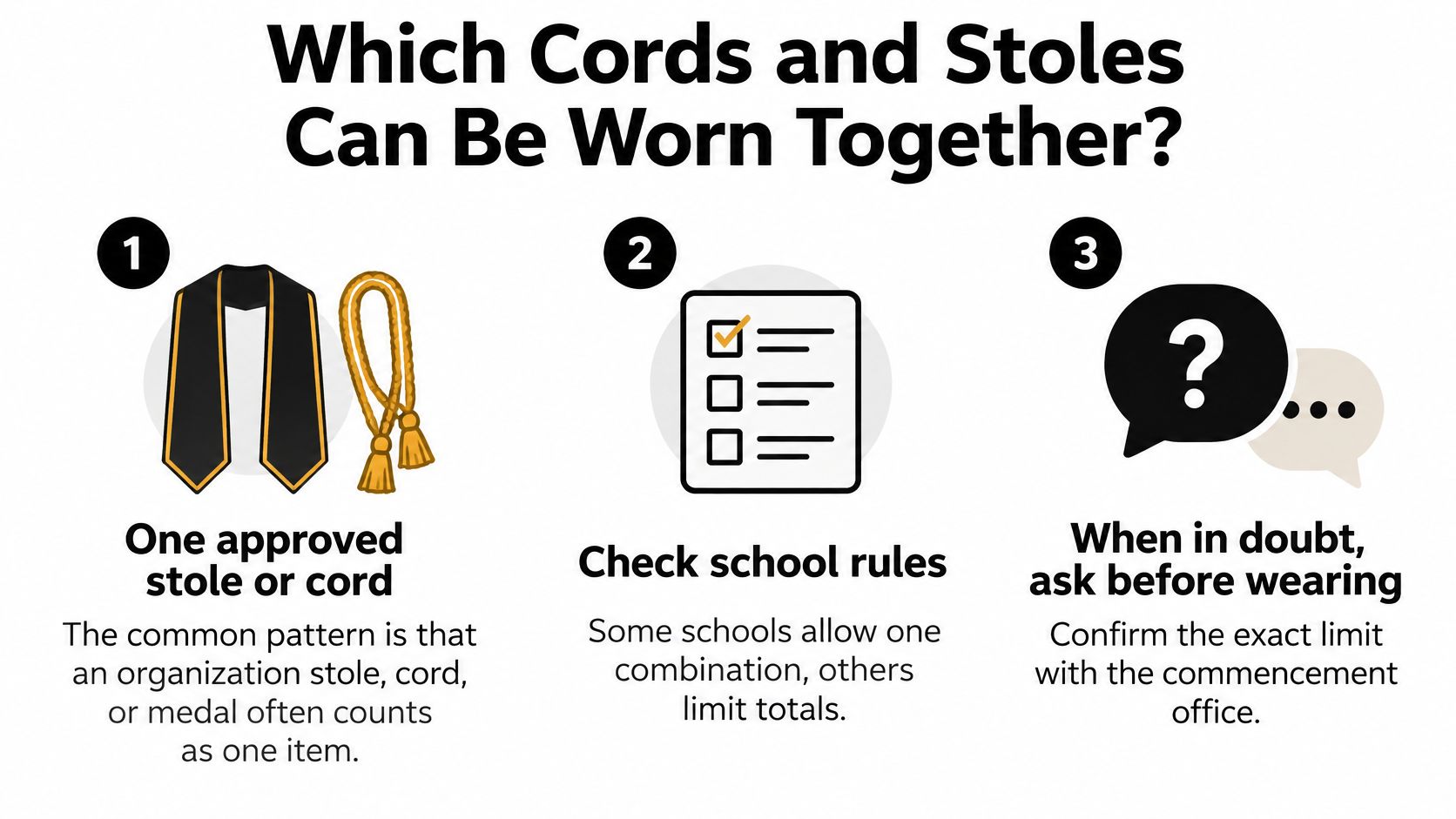
Stacking rules decide whether cords, stoles, medals, and sashes can share the same gown. Some schools count each item separately, while others cap the total number of adornments.
| Policy example | Stated rule | What it means for stacking |
|---|---|---|
| University of Southern Indiana | One approved stole or cord of the student's choice, plus university-provided items | One self-chosen item can be added to institution-issued ones |
| Kansas State University | Organizations choose a single adornment, not several types | An organization stole and a cord cannot be stacked |
| Capital University | More than one cord may traditionally be worn at once | Stacking is accepted by tradition, so still confirm locally |
| Policy with a three-item cap | Up to three academic accoutrements total, including cords, stoles, sashes and medallions | Two honor cords plus a stole can exceed the cap |
What the Named Policies Actually Allow
The University of Southern Indiana regalia, stoles and cords policy allows only one approved stole or cord of the student's choosing in addition to university-provided stoles and cords. It provides separate items for the Honors Program, commencement honors, and active or veteran military students, and it restricts stole width to 5 inches or less while allowing length to vary.
Kansas State takes a different approach for organizations. Recognized organizations should request a single stole, cord, or medallion rather than multiple adornment types, so one group doesn't take up your whole gown. Capital University, by contrast, states that wearing more than one cord is traditionally acceptable.
A three-item cap creates the easiest mistake. Two honor cords plus a stole sounds modest, but that's already three items, and a medallion would put you over. Always ask whether the limit counts cords alone or all academic accoutrements together. Our guide on how to wear graduation honor cords covers placement once your items are approved.
Placement and the Stacking Test
Placement rules are local too. Kansas State specifies that its honor cords are worn on the left shoulder. Penn State describes honor cords as double ropes knotted at the back of the neck and worn over the robe, while another university describes them as braided cords with tassels at both ends.
Use one test for every item you plan to wear. Can you point to the approved distinction behind it and the written rule that allows it at this ceremony? If an item fails either part, leave it off, even if it looks good with the gown.
Special Cases for High School and Graduate Ceremonies
Ceremony rules can change with the degree level. A high school district may limit cords to district-approved recognitions, while a university or graduate school may set different rules for its own graduates.

High School and Bachelor's Rules
High school districts may restrict cords to approved recognitions. If you earned an honor through an outside organization, ask whether its cord, pin, or medal is permitted. Families choosing high school caps and gowns can check the district's accessory rules before ordering extras.
At the bachelor's level, cords may be tied to GPA tiers or approved honor societies. Some universities also recognize military service with a separate stole or cord. Kansas State limits its honor cords to bachelor's candidates, so check the policy for your own degree level.
The Graduate School Conflict
Graduate schools differ on whether students may wear cords earned during an undergraduate degree. The University of Memphis permits graduate students to wear cords from their undergraduate careers; other graduate schools prohibit undergraduate ornaments with graduate regalia. Check the rules for the ceremony you are attending, and ask the graduate school which policy applies if its guidance is unclear.
For master's and doctoral ceremonies, confirm hood requirements and cord permissions separately. The hood has its own color and placement rules, and a cord may not be allowed. Gradshop offers master's graduation packages and doctoral graduation regalia, but the ceremony's policy determines which accessories you can wear.
Three Worked Examples of Cord Decisions
A student's honors do not determine the number of cords they can wear. The school's ceremony rules do. These examples show how GPA recognition, organization insignia, and degree level can lead to different choices.
Maya and the One-Cord District
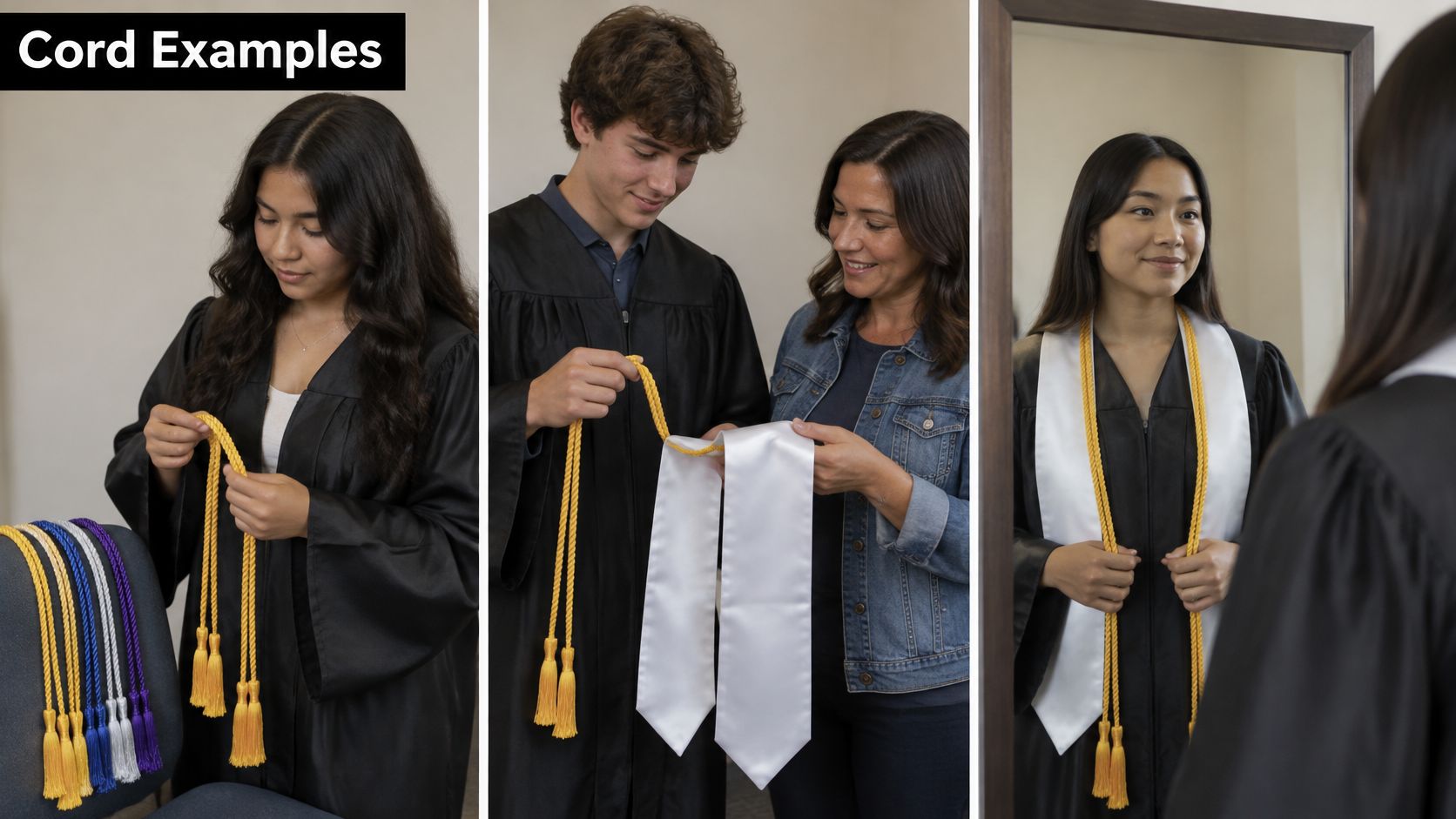
Maya is a high school senior with a 3.9 GPA, National Honor Society membership, and AP recognition. Her district permits one approved honor cord. Her counselor explains that the NHS pin identifies her organization, but it does not replace the district's cord limit. Maya wears the district-issued cord at graduation and saves the pin and any additional regalia for photos, if the district allows them outside the ceremony.
Jordan and the Multi-Cord University
Jordan graduates with a bachelor's degree, earns cum laude recognition, and qualifies for a veteran stole. The university allows multiple approved items, so Jordan's decision turns on how they can be worn together. The registrar confirms that the school-issued cum laude cord and veteran stole are both permitted. Jordan wears both at commencement.
Priya and the Graduate Hood
Priya earned a cum laude cord as an undergraduate and hopes to wear it at her master's ceremony. Her graduate school's policy does not allow undergraduate ornaments with graduate regalia. She follows the rule for her current degree and wears her hood and program regalia without the cord. Her undergraduate honor remains part of her academic record, even though it is not part of this ceremony's outfit.
Confirm Your Cord Limit Before You Buy
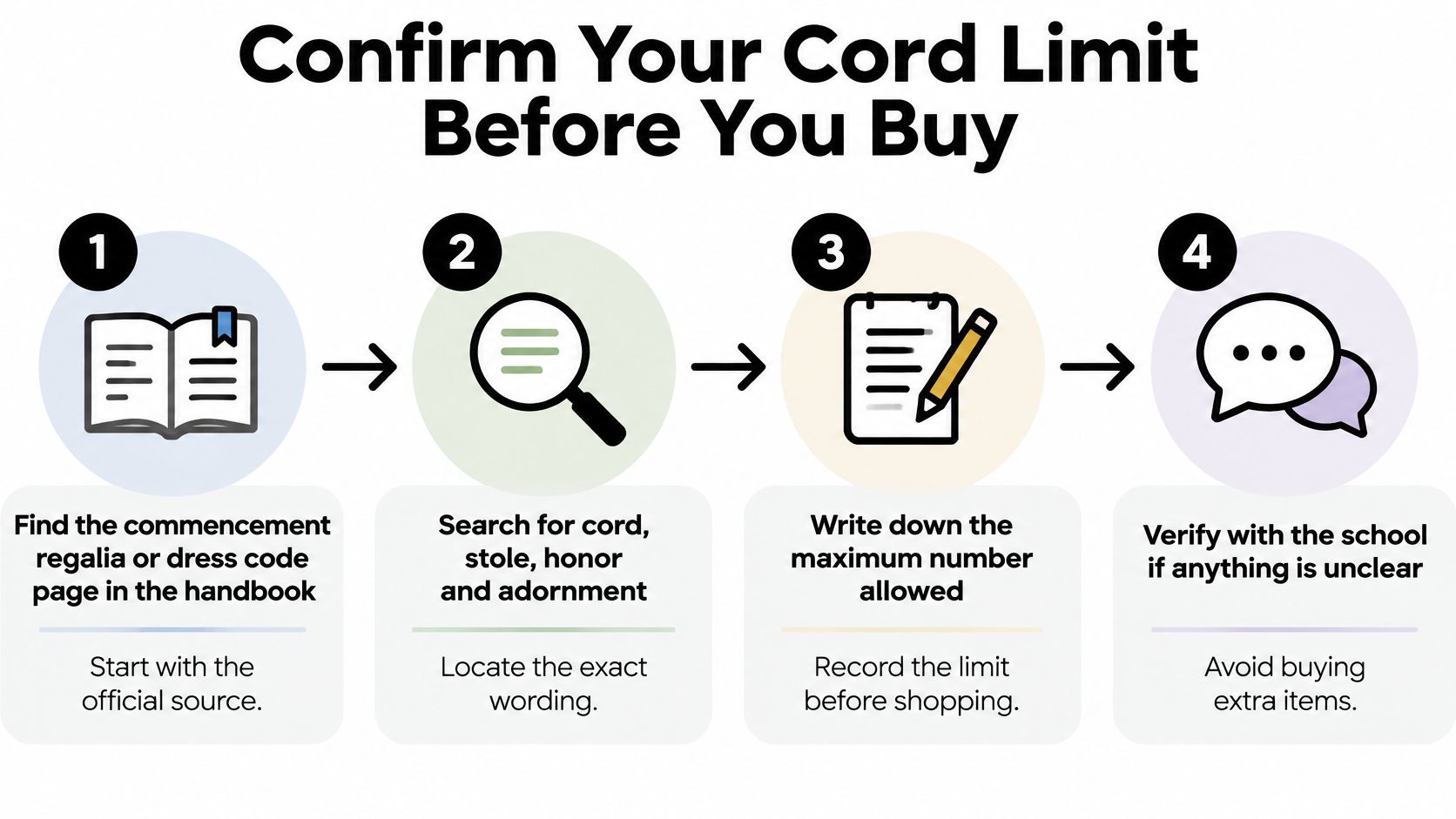
Your school's written ceremony rules determine which cords you can wear. Check them before buying, then follow a clear verification process.
- Find the official page: Check your student handbook or school website for commencement regalia and dress-code rules.
- Search the exact words: Look for “cord,” “stole,” “honor” and “adornment.” A rule may set a total limit across different items.
- Record the limit: Note the maximum number of items and whether stoles or medallions count.
- Ask about organization cords: Contact the registrar or counseling office to learn whether each organization's cord needs advance approval.
- Check size and placement: Confirm the permitted stole width, cord placement and any rules against altering regalia.
- Get written confirmation: Email the school if any policy is unclear. A written answer is easier to refer to than a conversation.
- Order approved items: Once you have confirmation, choose only regalia that meets the ceremony rules. Use this guide to find graduation honor cords near you when comparing ordering options.
The cap and gown form the required base outfit; cords and stoles depend on your school's rules. For high school ordering guidance, see Gradshop's High School Graduation Guide. Graduates shopping for a master's ceremony can compare Master's Degree Academic Cap, Gown, Tassel and Hood Packs, while students seeking a personalized design can explore custom graduation stoles.
Once your choices are approved, shop for high school caps and gowns, stoles, honor cords, and master's and doctoral regalia. Gradshop offers graduation apparel and accessories for graduates at different academic levels.