

So, you've earned your honor cords. Congratulations! Now, let's make sure you wear them correctly to showcase your achievements on the big day.
The basic placement is simple. You just drape the cord around the back of your neck, letting the two ends hang down evenly on the front of your graduation gown. Think of it like a necklace, but one that sits on your shoulders.
Crucially, your honor cords should be the very last thing you put on. They go on top of any stoles or academic hoods, making them the outermost layer of your regalia. This isn't just for looks; it ensures your honors are visible and properly displayed, not hidden underneath other items.
Quick Honor Cord Placement Guide
Here’s a quick-glance table to help you get it right on graduation day.
| Step | Instruction | Key Tip |
|---|---|---|
| 1. Gown First | Put on your cap and gown first. This is the base layer for all your regalia. | Ensure your gown is zipped up completely before adding anything else. |
| 2. Add Stoles/Hoods | If you have an honor stole or an academic hood, place it over your gown next. | The stole should lie flat on your shoulders, and a hood should be draped down your back. |
| 3. Drape the Cord | Find the center of your honor cord (usually a small knot) and place it on the back of your neck. | Let the tassels hang down evenly in the front, one on each side. |
| 4. Final Adjustments | Make sure the cords are lying neatly on top of everything and aren't tangled or twisted. | If you have multiple cords, you can pin them together at the back of your neck to keep them secure. |
This simple sequence ensures every piece of your academic attire is worn with the respect it deserves.
What Your Graduation Honor Cords Really Mean
Before we get into the nitty-gritty of wearing them, it's worth taking a moment to appreciate what these cords represent. They aren't just a colorful accessory for your high school cap and gown; they're a visual testament to your hard work, leadership, and unique accomplishments.
This tradition of wearing distinct academic regalia is centuries old, connecting you to a long lineage of scholars. While the practice has deep historical roots, it was formalized in the early 20th century as universities and honor societies began assigning specific colors to different achievements. Today, it’s a staple of graduation ceremonies, with some estimates suggesting that up to 85% of American graduates receive honor cords for their accomplishments. If you're curious about the deeper history, you can find great info by exploring guides on graduation cord symbolism.
The Story Behind Each Cord
Every cord you wear tells a piece of your academic story. They're symbols of specific achievements, and understanding them adds meaning to your graduation day.
-
Academic Excellence: This is the most common reason for a cord. Graduating with Latin honors like cum laude, magna cum laude, or summa cum laude is often signified by a gold or silver cord.
-
Honor Society Membership: Groups like the National Honor Society or specialized academic fraternities award cords to their members as a mark of distinction.
-
Field of Study: At the college level, it's common for institutions to use different colored cords to represent a graduate's major, much like the colors used on masters and doctoral hoods.
-
Leadership & Service: You might also earn a cord for your role in student government, significant volunteer contributions, or other exceptional service to your school community.
Wearing your honor cords correctly is a sign of respect—for yourself, for the institution that awarded them, and for the hard work they symbolize. It's the final touch that proudly completes your academic regalia.
Positioning Your Cords for a Polished Look
After you've got your cap and gown on, it's time for the finishing touches—your honors. It might seem like a minor detail, but getting your cords to hang perfectly makes a world of difference for your photos and your walk across the stage. You're aiming for a clean, symmetrical look that displays your accomplishments with pride.
First, find the center of your honor cord. Most cords have a small knot right in the middle, which makes this easy. Just place that knot at the back of your neck and let the two sides drape evenly over your shoulders, hanging down the front of your gown.
Give them a quick adjustment to make sure the tassels at the end are hanging at the same height. They should run parallel to the zipper on your gown, creating a nice, balanced frame.
This infographic lays out the basic steps visually.
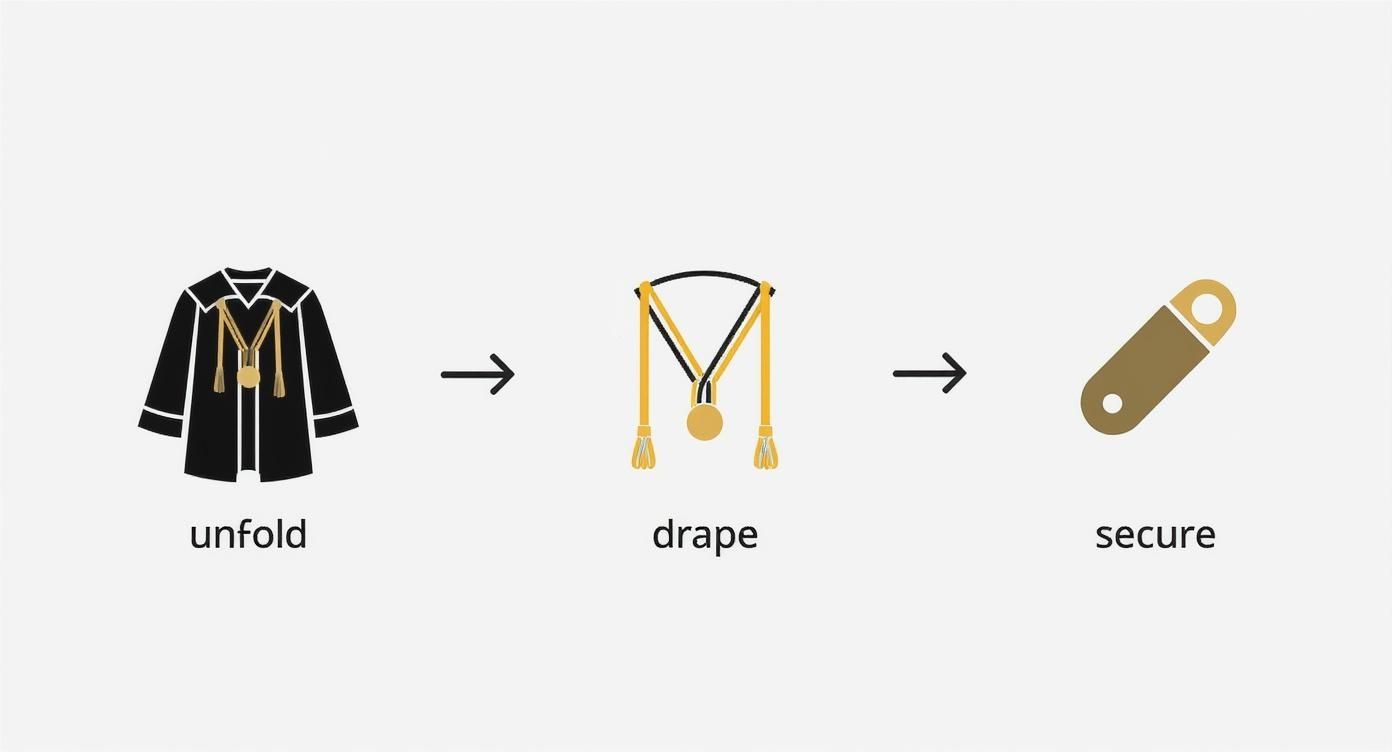
As you can see, it's a simple process: get your gown on, drape the cords, and you're almost ready to go.
Arranging Multiple Cords
So, you've earned more than one honor? That’s fantastic! When you're working with multiple cords, the trick is to arrange them so they lie flat and don't end up looking like a jumbled mess.
Drape the first cord just as you would a single one. Then, place the next cord either slightly inside or outside the first, repeating for any others. The real secret is consistency.
- Fan them out slightly. You want each color to be visible, so gently separate them.
- Keep them flat. Don't let them twist around each other. Imagine them as flat ribbons lying side-by-side.
- Pin for security. A small, well-placed safety pin at the back of your neck (tucked under the gown's collar) is a lifesaver. It’ll keep everything in place, especially if you have a lot of cords.
The Correct Layering Order
There’s a definite order to putting on your academic regalia, and getting it right is key to looking the part. The honor cords should always be the very last thing you put on. They sit on top of everything else, representing the culmination of your specific achievements.
Regalia Order of Operations: The proper sequence is always gown first, then your stole or hood, and finally, your honor cords on top. This layering ensures your hard-earned honors are front and center.
Following this order makes your cords the most prominent part of your regalia, letting them hang freely without being obscured. For those receiving advanced degrees, this means your cords will drape elegantly over the more elaborate masters or doctoral hoods, creating that classic, distinguished look.
Proper layering also keeps the cords from getting tangled up with your tassel or lost underneath a stole. Speaking of tassels, it's always good to have a quick reminder of the rules—you can get a full rundown in our guide on what side your tassel should be on. Taking a minute to get every detail right will make all the difference when it's your turn to walk.
What Do All the Different Honor Cord Colors Mean?
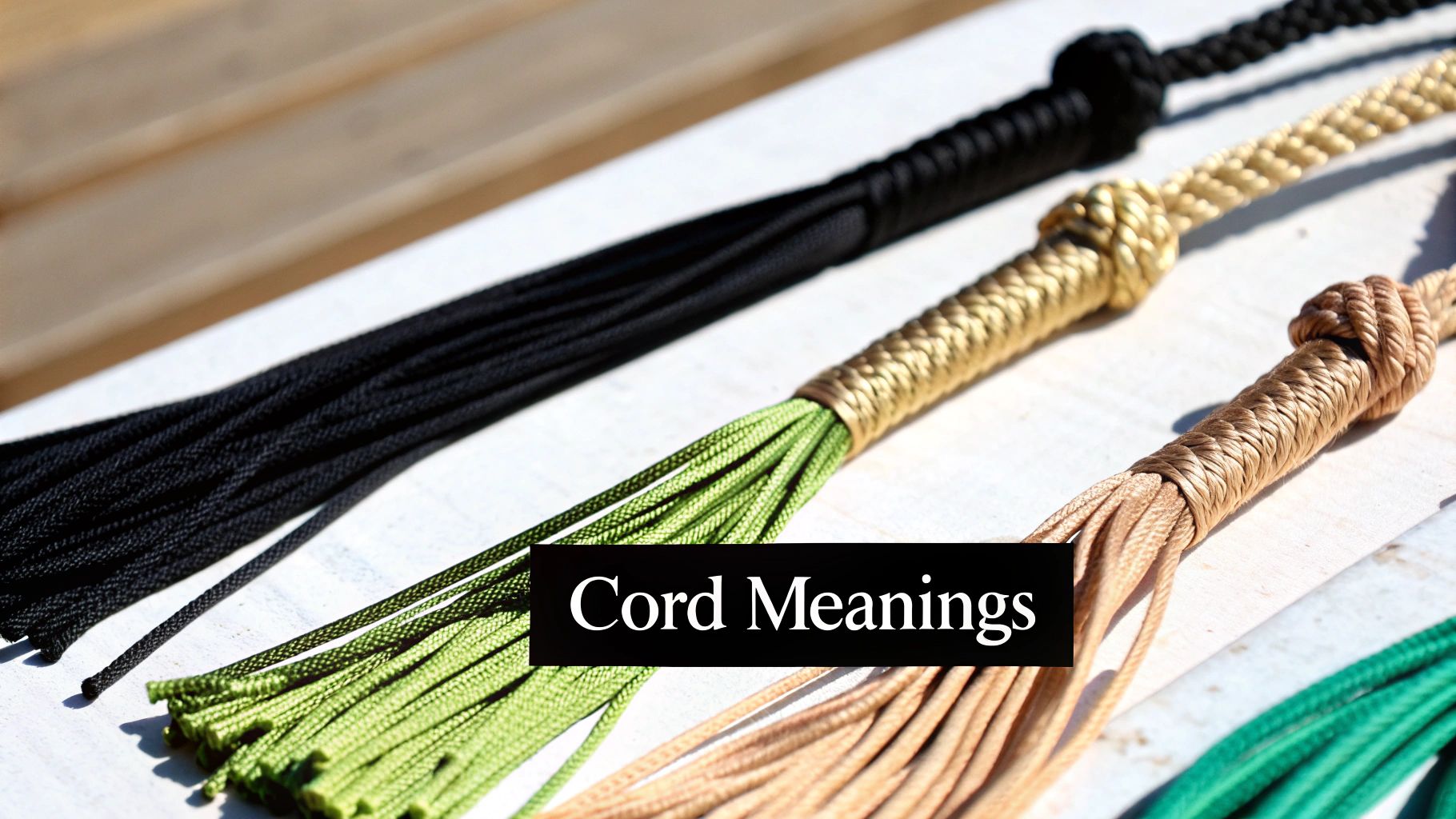
Those vibrant honor cords draped over a graduate's shoulders are so much more than just a colorful accessory. They're a visual language, telling the story of your unique academic journey at a single glance. Each color, and every combination, points to a specific achievement—from your major to your membership in a prestigious honor society.
Understanding this symbolism connects your personal success to a deep-rooted history of academic tradition.
The one color nearly everyone recognizes is gold. A gold cord is the classic symbol for the highest levels of academic achievement. It’s typically awarded to students graduating with Latin honors like summa cum laude, magna cum laude, and cum laude. Seeing a graduate with a gold cord is a clear signal of their dedication and outstanding GPA.
But the story doesn't stop there. Specific colors are also tied directly to a graduate's field of study, adding another layer of meaning to their regalia.
A Rainbow of Academic Disciplines
Many schools follow a standardized color code to represent different fields of study. It’s a tradition that helps faculty, family, and friends identify graduates by their academic discipline during the ceremony. While there can be slight variations between institutions, many color associations have become widely accepted over time.
For instance, a science major often wears a bright green cord, a nod to growth and the natural world. On the other hand, an arts or humanities graduate might wear white, representing a blank canvas for creativity and new ideas.
You’ll see other common pairings, too:
- Engineering graduates are frequently set apart by orange cords.
- Nursing and medicine are often represented by apricot or emerald green.
- Education majors typically wear light blue cords.
- Law students are traditionally honored with purple cords.
This system creates a beautiful and meaningful tapestry of color on graduation day, showcasing the incredible diversity of the academic community. To dive deeper, you can check out our comprehensive guide on stole and cord color meanings.
Honor Societies and Special Recognitions
Beyond departmental honors, many cords signify membership in specific honor societies. These organizations often have their own signature colors, sometimes in multi-colored, braided cords. A classic example is the royal blue and gold cord for the National Honor Society, a familiar sight at high school graduations.
The tradition of assigning specific hues is both diverse and carefully managed by schools and societies worldwide. With over 50 different cord colors in regular use in the United States alone, the system is remarkably detailed.
The table below breaks down some of the most common honor cord colors and what they typically represent.
Common Graduation Honor Cord Color Meanings
| Color | Commonly Represents (Field of Study) | Associated Honors/Societies |
|---|---|---|
| Gold | General Academic Excellence | Summa Cum Laude, Magna Cum Laude, Cum Laude, General Honors |
| Silver | Oratory, Public Speaking, Vet Science | Lambda Pi Eta |
| White | Arts, Letters, Humanities, Sociology | Phi Kappa Phi, Sigma Tau Delta (English) |
| Light Blue | Education | Kappa Delta Pi |
| Royal Blue | Philosophy, Political Science | Phi Beta Kappa (often with gold), Pi Sigma Alpha |
| Purple | Law, Dentistry, Architecture | Phi Alpha Delta, Jurisprudence honors |
| Green | Medicine, Pharmacy, Physical Ed. | Phi Sigma Pi |
| Orange | Engineering | Tau Beta Pi |
| Red/Crimson | Journalism, Communications, Theology | Sigma Delta Chi |
| Yellow/Lemon | Library Science | |
| Brown | Fine Arts, Drama, Business | Delta Mu Delta |
| Pink | Music | Mu Phi Epsilon |
This is just a starting point, as many societies use braided cords combining multiple colors to represent their unique identity.
Key Takeaway: Every cord tells a piece of your story. From the gold one celebrating your GPA to the specific hue representing your major, these colors are a proud declaration of the path you've taken and the knowledge you've earned.
Ultimately, knowing how to wear graduation honor cords properly starts with understanding what they symbolize. This knowledge adds real depth to your celebration, turning a simple accessory into a powerful testament to your academic journey.
Navigating Cord Rules for Different Graduations
How you wear your honor cords isn’t just about getting them to hang straight. The rules and traditions shift quite a bit depending on whether you're at a high school, college, or postgraduate ceremony. Getting these nuances right is key to showing up looking polished and respectful of your institution's traditions.For most people, high school is the first time they encounter honor cords. The regalia is usually pretty straightforward at this stage, which really makes the cords stand out as a primary symbol of achievement.
High School Graduation Cords
At a high school commencement, cords are all about recognizing your hard work. They usually signify membership in big-name honor societies, academic excellence, or even significant volunteer hours. The one you'll see most often is the gold cord from the National Honor Society, which represents a commitment to scholarship, service, leadership, and character.
You'll also spot cords for specific subjects, like green and purple for the Science National Honor Society or red for the Spanish National Honor Society. Since high school graduates don’t wear academic hoods, the cords are draped right over the gown. They're often paired with an honor stole, creating a clean, distinguished look.
Undergraduate College Ceremonies
Once you get to college, things get a little more complex. Undergraduates often have a whole collection of accomplishments to show off, which means you'll see a much wider variety of cords on display.
- GPA-Based Honors: Graduating cum laude, magna cum laude, or summa cum laude is almost always recognized with a gold or silver cord. It's the classic sign of academic distinction.
- Departmental Honors: Did you write a thesis or graduate at the top of your program? Many departments give out cords for that. Think orange for engineering or light blue for education.
- Greek Life and Clubs: Fraternities, sororities, and other major student organizations also have their own cords to recognize dedicated members and leaders.
It's not uncommon to see an undergraduate wearing several sets of cords along with a stole, showcasing a rich and busy four years.
A key difference at the university level is the formal regulation of cords. Institutions often have specific rules about which cords are officially sanctioned for the ceremony, so always check your school’s commencement guide.
Master and Doctoral Degree Nuances
When you reach the master's or doctoral level, the star of the show becomes the academic hood. This is the most important piece of regalia for postgraduates. These elaborate garments use specific colors to represent both your university and your field of study, making them the main symbol of your advanced degree.
Graduate students definitely still wear honor cords—often for being inducted into a graduate-level honor society like Alpha Epsilon Lambda—but they have to be layered correctly. The rule is simple: cords always go on top of the hood. This ensures the hood drapes properly down your back and the cords are still visible from the front. The combination of the gown, the colorful hood, and the neatly placed cords creates that formal, distinguished look you've earned.
For a complete rundown of the full ensemble, check out our guide on the proper way of wearing academic regalia.
Keeping Your Cords in Perfect Condition

Your honor cords are more than just a piece of graduation regalia; they're a symbol of everything you've worked for. They deserve to look their best on the big day and be preserved as a keepsake for years to come. With a little care before and after the ceremony, you can ensure they stay in perfect shape.
The trip to your graduation ceremony is the first hurdle. The easiest way to ruin a perfectly good cord is to just shove it into a bag, where it's destined to become a tangled, wrinkled mess. A simple pro-level move? Just loop the cords over the hanger holding your graduation gown. This keeps them straight and ensures you won’t accidentally leave them behind.
Pre-Ceremony Prep for a Flawless Look
Even with careful handling, cords can sometimes have creases right out of the packaging. Getting them perfectly smooth is easy, but you have to be gentle.
Whatever you do, never use a hot iron directly on the cords. Most are made from synthetic fibers that will melt or scorch in an instant, permanently ruining them. Trust me, it's a mistake you only make once.
The safest and most effective method is steam. Hang your cords in the bathroom while you take a hot shower—the ambient steam works wonders on minor wrinkles. For tougher creases, a handheld garment steamer on its lowest heat setting is your best friend. Keep it a few inches away and make a few slow passes. They’ll be perfectly straight in no time.
Pro Tip: No steamer? No problem. Hang the cords and give them a very light spritz with a water bottle. As they air dry, the weight of the tassels will help pull out the wrinkles. Just be sure to test a tiny, hidden spot first to make sure the color doesn't run.
Storing Your Honor Cords After Graduation
Once the cap has been thrown and all the pictures have been taken, it's time to think about preserving your cords. You don't want to just toss them in a drawer. Storing them properly protects them from fading, dust, and damage, keeping the memory of your achievement vivid.
Here are a few great ways to store and display them:
- Create a Shadow Box: This is my personal favorite. A shadow box lets you create a beautiful display with your cords, tassel, and maybe even a photo from the day.
- Use an Acid-Free Box: If you prefer to store them away safely, an archival, acid-free box is the way to go. It prevents the fabric from yellowing and the vibrant colors from dulling over time.
- Drape Over Your Diploma: For a simple and elegant look, you can drape your cords right over the corner of your framed diploma on the wall.
No matter which option you choose, the key is to keep them out of direct sunlight, which is the fastest way to fade those bright colors. A little bit of care goes a long way in making sure your honor cords remain a pristine reminder of all your hard work.
Common Questions About Graduation Cords
As commencement gets closer, those little last-minute questions about your regalia always seem to pop up. When you're trying to figure out exactly how to wear your graduation honor cords, some of the details can feel a bit fuzzy. Let's clear up the most common questions so you can walk across that stage feeling confident and looking sharp.
How Many Honor Cords Can I Wear at Graduation?
This is easily the question I hear most often, and the answer really comes down to your school. In most cases, there isn't a hard-and-fast limit on the number of cords you can wear, as long as you've legitimately earned each one. After all, your school wants you to be proud of your accomplishments.
That said, the goal is to look distinguished, not cluttered. Wearing between one and three sets of cords is pretty standard and keeps everything looking neat. If you've earned more than that—which is a fantastic achievement—you might consider choosing the ones that mean the most to you.
The key is to showcase your honors, not bury them in a tangle. A little time spent arranging them so they lie flat and separate makes a world of difference.
Pro Tip: Your institution’s commencement guide is your best friend here. Always double-check the official guidelines. Some universities are very specific about which cords are permitted and how many you can wear.
Do Cords Go Over or Under an Academic Hood?
This one is especially important for anyone getting a master's or doctoral degree, but the rule is simple and applies to everyone: honor cords are always worn on top of everything else.
Think of your regalia as layers. You put it on in this order:
- Your Gown: This is the base layer for your whole outfit.
- Your Academic Hood or Stole: The hood drapes down your back, while a stole lays over your shoulders.
- Your Honor Cords: These are the final touch, draped around your neck to sit on top of your hood or stole.
Putting them on last ensures every one of your hard-earned honors is perfectly visible. If you tucked them under a hood, they'd be hidden, and it would throw off the way the hood is supposed to hang. For that polished, seamless look, get your academic hood situated just right, then add your cords.
Can I Buy My Own Honor Cords Online?
The short answer is a firm "it depends." You can absolutely find honor cords for sale online, but whether you can actually wear them at your ceremony is determined by your school's policy. To maintain authenticity, many honor societies and academic departments give cords directly to the students who earned them.
If you think you're eligible for an honor but never received a cord, the first thing you should do is reach out to your program advisor or the registrar's office. They can confirm if you qualify and tell you what to do next. Some schools have very strict rules to make sure every cord at commencement represents an officially sanctioned achievement. If your school gives you the green light to buy your own, then finding a trusted supplier is a great way to go.
What Is the Difference Between an Honor Cord and a Stole?
Both of them signify an achievement, but an honor cord and a stole are two very different pieces of regalia.
An honor cord is that classic twisted rope with tassels on each end. It usually points to a specific academic milestone, like graduating with a high GPA (cum laude, magna cum laude) or being a member of a national honor society.
An honor stole, on the other hand, is the wider, flat sash worn over your shoulders, kind of like a scarf. Stoles are often used to signify leadership or deep involvement in a campus organization—think student government, a fraternity or sorority, or a cultural club. They can also represent participation in a special program, like studying abroad.
It's actually very common to see graduates wearing both cords and stoles to celebrate the full range of their academic and extracurricular accomplishments.
At Gradshop, we have everything you need to celebrate your academic journey in style. From high school caps and gowns to specialized master's and doctoral regalia, our collection ensures you look your best. Explore our full range of caps, gowns, honor cords, and stoles to find the perfect pieces for your big day.