

Getting your high school cap and gown should be an exciting milestone, not another thing to stress about. Think of it as the official uniform for your final academic victory lap—a symbol of all your hard work and the shared experience with your classmates. Let’s walk through how to get it right, starting with a simple checklist to make the whole process a breeze.

Your High School Cap and Gown Graduation Checklist
With all the moving parts of graduation, it’s easy to feel overwhelmed. The key is to break it down into small, manageable steps. Our goal here is to make sure you have everything you need way before the ceremony, so you can actually enjoy the celebration.
This rite of passage is a huge deal, and it's also a surprisingly large industry. Projections show the global graduation attire market hitting about $1.9 billion in 2025 and growing to around $3.3 billion by 2032. This isn't just because more students are graduating, but also because people want more personalized items to mark the occasion.
Graduation Regalia Quick-Start Checklist
Getting your graduation gear is straightforward if you follow a few simple steps. This checklist breaks down exactly what you need to do and when, so nothing gets missed.
| Step | Action Required | Key Tip |
|---|---|---|
| 1. Confirm School Rules | Check the school's graduation packet or website for rules on color, fabric (matte/shiny), and required accessories. | Don't assume anything. Schools often have exclusive vendors or strict color codes. |
| 2. Take Your Measurements | Have someone measure your height from head to toe. This is the primary measurement for your gown size. | Stand up straight! A slouch can throw off the measurement and lead to a poor fit. |
| 3. Place Your Order | Buy your cap, gown, and tassel as a set. Order any honor cords or stoles at the same time. | Ordering early is your best friend. It saves you from rush fees and last-minute panic. |
| 4. Inspect Your Package | As soon as it arrives, open the box. Check that the size, color, and all items are correct. | Hang the gown up immediately. This will help the wrinkles from shipping fall out naturally. |
With these steps handled, you'll be in great shape. The most important thing is to stay ahead of deadlines to avoid any issues.
Timing is everything. Ordering early gives you a buffer to fix any problems, whether it's the wrong size gown or a missing tassel. Don't wait until the last minute!
As you pull your plans together, think about capturing the memories in a unique way. Creating a graduation celebration video is a fantastic way to document your achievement and share it with friends and family who couldn't be there in person.
And for a full rundown, be sure to check out our complete guide on the 15 things you need to remember on your graduation day to stay organized and stress-free.
The Story Behind Your Graduation Attire
Ever stopped to think about why you wear that specific robe and flat-topped hat for graduation? The high school cap and gown isn't just a recent trend. It’s a tradition with a surprisingly long history, stretching back nearly a thousand years to the very first universities in Europe.
Picture the massive, drafty halls of Oxford and Bologna back in the 12th and 13th centuries. The scholars—who were often clergymen—wore long, heavy robes and hoods for a very simple, practical reason: to keep from freezing. Those garments were essential for staying warm during countless hours spent studying in unheated stone buildings.
What started as a necessity soon became the standard uniform, a visual symbol of a person’s commitment to learning. As these universities grew, the attire transitioned from practical clothing into a formal academic costume that set students and faculty apart from everyone else. The look was function-first, but it quickly became a powerful badge of academic identity.
From Medieval Halls to Modern Ceremonies
So, how did this ancient European custom jump the pond and land in high school auditoriums all over America? It was all part of a conscious effort to bring a sense of unity and formality to academic celebrations. For a long time, American colleges had a mishmash of styles, often just copying what they saw in Europe without any real standard.
That all changed toward the end of the 19th century when academic leaders decided it was time to create a distinctly American system. The turning point was in 1894, when an intercollegiate commission laid down a formal academic costume code. This code made the black robe and the familiar mortarboard-style cap the standard for degree ceremonies, establishing the classic look we know today. You can dive deeper into the history of graduation attire and see how that 1894 decision shaped modern regalia.
High schools started to pick up on this standardized look in the 20th century. They saw it as a way to lend more weight and prestige to their own graduation ceremonies, borrowing the powerful symbolism of higher education to celebrate their students' accomplishments.
The Symbolism in Your Regalia
Today, that cap and gown you’ll wear is loaded with meaning. It tells a story of your own hard work and the shared journey you’ve taken with your classmates, connecting you to generations of graduates who have walked this path before.
The cap and gown is the great equalizer. On graduation day, students from every walk of life wear the exact same thing. It creates a powerful visual of unity and shared success, temporarily setting aside social and economic differences to focus on the incredible goal you’ve all achieved together.
This evolution from practical garment to powerful symbol is what it's all about. The simple robe that kept a medieval scholar warm now represents your completion of years of dedication and effort.
- The Gown: This symbolizes democracy and unity. For one day, it puts every graduate on equal footing, celebrating a collective achievement.
- The Cap (Mortarboard): The square top is often said to represent a book or the mortarboard used by a master craftsman, symbolizing scholarship and skill.
- The Tassel: The "turning of the tassel" from right to left is a modern rite of passage, a simple action that marks the official moment you go from candidate to graduate.
What started as functional clothing has been transformed into the ultimate symbol of academic success, worn with pride by millions of students every single year.
How to Find Your Perfect Cap and Gown Fit
One of the biggest worries students have when ordering graduation gear is getting the sizing wrong. But I have some good news for you: it's way easier than you think. Unlike a prom dress or a suit that needs a bunch of different measurements, graduation gowns are designed to fit based on just one thing: your height.
This whole system is built for simplicity, making it a breeze for schools to order for hundreds or even thousands of students at once. The goal isn't a custom-tailored outfit, but a comfortable, dignified robe that looks great and uniform on everyone.
Let’s walk through the simple steps to nail your measurements so you can order with total confidence.
Measuring for Your Gown
The only measurement you really need for your gown is your height, from the top of your head to the floor. Being accurate is important, but you definitely don't need a professional tailor for this.
Here’s how to get it right at home:
- Take Off Your Shoes: Make sure you're measuring your true height, so do this in socks or bare feet.
- Stand Tall and Straight: Stand with your back against a wall. Your heels, back, and head should all be touching the surface. Keep your chin up and look straight ahead.
- Mark the Spot: Ask a friend or family member to place a flat, hard object (a hardcover book is perfect) on top of your head, keeping it level against the wall. Then, have them make a small pencil mark on the wall right where the bottom of the book is.
- Measure Up: Now, just use a tape measure to get the distance from the floor to that pencil mark. That's it! This is the height you'll use for sizing.
Once you have that number, you're all set to find your size on the chart from your school or the graduation supplier.
Keep in mind, these gowns are designed to be roomy and flowy by nature. They aren't supposed to be form-fitting at all. Each size is cut to comfortably fit a variety of body shapes within a specific height range, so you don't need to stress about chest or waist measurements.
Understanding Sizing Charts
Most graduation companies use a sizing chart that connects a height range to a specific gown size code. You won't see familiar sizes like "small" or "large"—just numbers that correspond to your height.
To get a really good look at how these charts work, you can check out this detailed guide on how to measure for your cap and gown.
For now, here’s a quick example of what a typical high school sizing chart looks like.
Example High School Gown Sizing Chart
This chart gives you a clear idea of how suppliers match your height to the right gown size.
| Student Height (Feet & Inches) | Recommended Gown Size Code |
|---|---|
| 4'9" – 4'11" | 41 |
| 5'0" – 5'2" | 44 |
| 5'3" – 5'5" | 47 |
| 5'6" – 5'8" | 50 |
| 5'9" – 5'11" | 53 |
| 6'0" – 6'2" | 56 |
See how straightforward that is? Just find where your height falls in the left column, and the number on the right is your gown size code.
The Perfect Cap Fit
Okay, so what about the cap? The mortarboard cap is even simpler. It’s designed as a one-size-fits-most item.
Almost every high school cap has a hidden elastic band inside. This lets it stretch to fit a huge range of head sizes comfortably and securely, so there's no need to measure your head at all.
The elastic ensures your cap stays put without feeling too tight, freeing you up to enjoy the ceremony. For the classic look, it should sit flat on your head, parallel to the ground—not tilted back. This universal design takes all the guesswork out of the equation.
Decoding Graduation Cords, Stoles, and Tassels
Your high school cap and gown is the classic uniform for the big day, but the accessories are what really tell your story. Those colorful cords, sashes, and tassels aren't just for show; they're a visual language that speaks volumes about a student's achievements, memberships, and personal identity.
Think of the gown as a blank canvas. Every cord and stole added to it paints a picture of four years of hard work, late-night study sessions, and dedicated leadership. When you know what to look for, you can see an incredible depth of accomplishment walking across that stage.
The Meaning Behind Tassel and Gown Colors
While many schools stick with a traditional black or white gown for a timeless, uniform look, it's just as common to see them embrace their official school colors. A sea of blue and gold or red and white gowns creates an instant sense of school pride and unity. It’s a powerful visual.
The tassel is another key part of that identity. Most often, it will match the gown or feature the school's primary colors. Some schools even use a specific tassel color to signify an academic program, though that’s a bit more common at the college level.
This flowchart shows the simple, step-by-step process suppliers use to make sure every student gets a comfortable gown that fits just right.
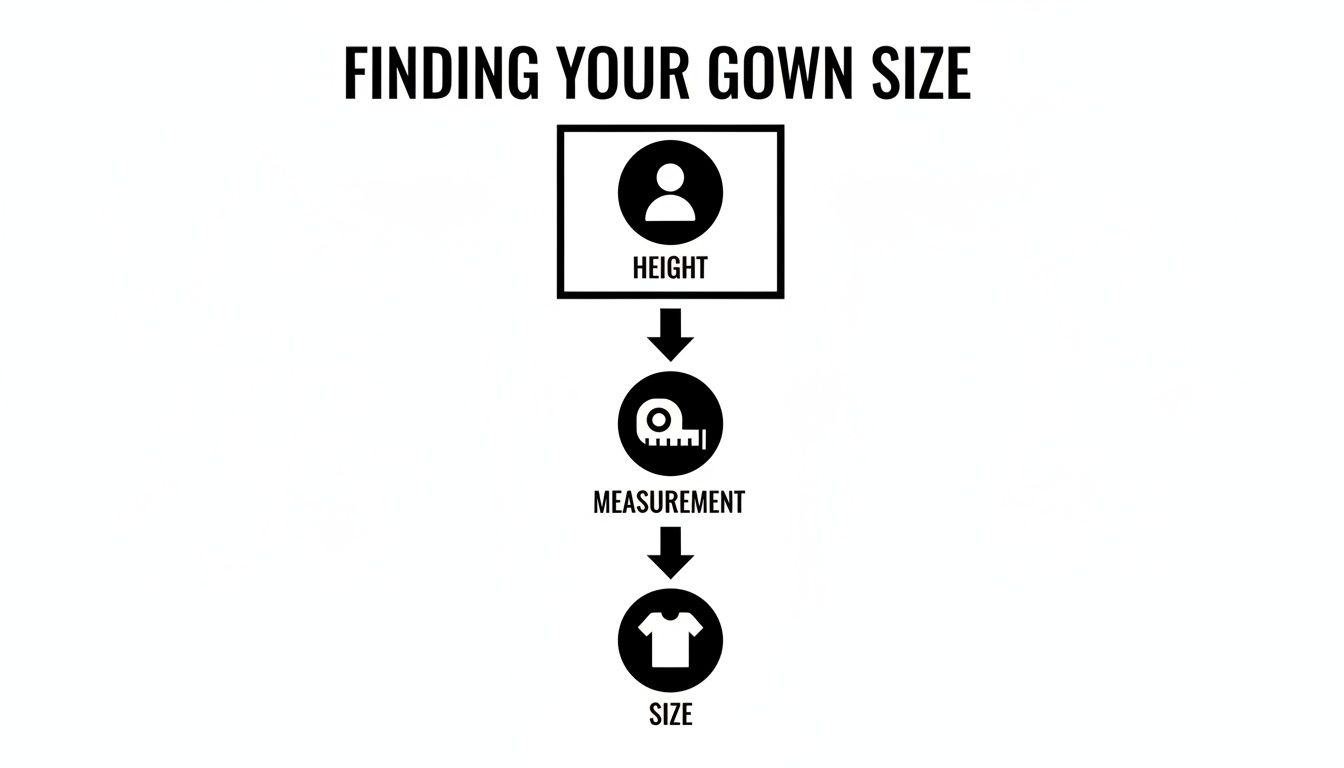
As you can see, it all starts with the student's height. From there, it's easy to find the correct measurement and its corresponding size code.
Understanding Honor Cords
Honor cords are probably the most recognizable graduation accessory. These braided ropes are draped around the neck and awarded to students for specific academic achievements or for dedicated participation in clubs and organizations. Each color, or combination of colors, represents something different.
The exact meanings can shift a bit from school to school, but there are some widely accepted standards you'll see almost everywhere:
- Gold Cords: This is the universal signifier for high academic honors. It's famously linked to the National Honor Society (NHS), but it also often represents graduating Summa Cum Laude, Magna Cum Laude, or simply maintaining a very high GPA.
- Silver Cords: You’ll often see silver used to recognize excellence in specific areas like technology, outstanding community service, or technical arts programs.
- Red, White, and Blue Cords: This patriotic combination is a common way to honor students who are enlisting in the U.S. military after graduation or those who have demonstrated exemplary leadership in civic engagement.
- Other Colors: Schools use a whole spectrum of colors to represent involvement in everything from the school band (maybe pink or a cord with a lyre emblem) to the science club (often green) or the debate team (typically maroon).
Think of graduation cords like merit badges for your entire academic career. Each one tells a story—a challenge met, a skill learned, or a commitment honored. They turn a simple high school cap and gown into a personalized record of achievement.
The Significance of Graduation Stoles
Stoles, which you might also hear called sashes, are the wider strips of fabric worn over the shoulders. They make a much bigger statement than cords and usually represent broader affiliations or major leadership roles.
It helps to know the different kinds of stoles you might see at a high school graduation. For a much deeper look into what all these different accessories mean, our guide on graduation cords and stoles breaks it all down.
- Honor Stoles: Just like gold cords, these are typically given out for high academic standing. They might be embroidered with a simple word like "Honor" or the official name of an honor society.
- Student Government Stoles: Students who served in key leadership roles, like on the student council or as a class president, often wear a stole to represent their term of service to the school.
- Cultural Stoles: These beautiful sashes are a way for students to celebrate their heritage. Kente stoles, with their vibrant patterns full of meaning, are a powerful way for students of African descent to honor their ancestry. You'll also see stoles with international flags or other cultural designs connecting graduates to their roots.
- Greek and Organizational Stoles: While you see these more in college, some high school service clubs or academic fraternities provide stoles for their graduating members.
For anyone curious about the nitty-gritty of how regalia is made, it can be interesting to see the tools involved. For example, creating personalized designs on caps requires things like specialized cap embroidery frames. All these different pieces come together to transform the standard high school cap and gown into a unique and deeply meaningful tribute.
How to Wear and Care For Your Graduation Regalia
On the big day, you want to feel confident and look sharp, not fussing with a wrinkled gown or a wobbly cap. Getting your high school cap and gown ready is pretty straightforward, but a few pro tips can make a huge difference.

Your regalia is almost guaranteed to arrive folded up and full of wrinkles. The easiest and safest way to smooth it out is with steam. A handheld steamer is your best friend here, but if you don't have one, just hang the gown in the bathroom while you take a hot, steamy shower. It works like a charm.
Crucial Tip: Whatever you do, never put a hot iron directly on your gown. Most are made from polyester, which will melt in an instant and ruin your regalia. If you absolutely have to use an iron, set it to the lowest heat setting and place a towel between the iron and the fabric as a buffer.
The Right Way to Wear Your Cap and Gown
Once your gown is wrinkle-free, it’s time to get everything on. Nailing the fit and placement is what separates a polished look from a sloppy one, especially for all the photos you'll be taking.
Here’s a quick rundown to get it right:
- Gown First: Slip on the gown and zip it up all the way. The neckline should lie flat and feel comfortable.
- Cap Position: The mortarboard cap should sit level on your head, parallel to the floor—not tilted back or to the side. The point should be centered on your forehead. Don't be shy with bobby pins; they are essential for keeping the cap secure, especially if you have smoother hair.
- Tassel Placement: Before the ceremony starts, the tassel always hangs on the right side of your cap. This is the universal starting point for every graduate.
The cap is usually a one-size-fits-most deal with a handy elastic band. But a few bobby pins will provide that extra security so you can walk across the stage without worrying about it slipping.
The Tassel Turn Tradition
The "turning of the tassel" is probably the most iconic moment of the whole ceremony. It’s a simple, symbolic gesture that signifies your official shift from student to graduate.
The tradition is simple. When instructed—usually after everyone has received their diploma and the principal gives the cue—you and your entire class will move the tassel from the right side of your cap to the left side. It’s a small movement with a huge meaning, a rite of passage that connects you with generations of graduates.
After the Ceremony: Care and Keepsakes
Your high school graduation is a huge milestone, and your cap and gown can be a fantastic memento. A little care goes a long way if you want to preserve it.
- Cleaning: Check the care tag inside the gown. Some can handle a delicate cycle in the washing machine, but dry cleaning is typically the safest option to keep the fabric and color looking pristine.
- Storage: After it's clean, store the gown in a garment bag to protect it from dust and light. Sunlight can fade the color over time, so a cool, dry closet is the perfect spot.
- Creative Keepsakes: Don't just shove it in a box! Think about creating a shadow box with your cap, tassel, an honor cord, and a favorite photo from graduation day. It's a wonderful way to put your accomplishment on display.
Answering Your Top Questions About High School Graduation Gear
Getting your cap and gown sorted out can bring up a lot of last-minute questions. From making your regalia your own to fixing a sizing mistake, getting the facts straight early on is the best way to make sure graduation day is all celebration and no stress. Let's walk through some of the most common things students and parents ask.
Can I Decorate My Graduation Cap?
This is probably the number one question we hear every single spring. The short answer? It completely depends on your school.
Many high schools love the tradition of decorated caps, seeing it as a great way for students to show off their personality, give a shout-out to their future college, or thank their family. Others, however, have strict rules against it to keep the ceremony looking uniform and traditional.
Before you break out the hot glue gun, always check your school's official graduation handbook or talk to the person in charge of the ceremony. If you get the green light, just be mindful of your design—make sure it's respectful and won't block the view of the person sitting behind you.
What Happens If My Gown Doesn't Fit?
First off, don't panic. This happens more often than you'd think, and it's almost always an easy fix. Most fit issues come from a simple mistake in the height measurement, and the companies that make these gowns are ready for it.
Here’s what to do:
- Call the Vendor Immediately: Look for a customer service number or email on your order confirmation. Let them know what's wrong and ask about their exchange process. They move fast during grad season.
- Check In With Your School: Your school's graduation coordinator is your best friend here. They often order a handful of extra gowns in different sizes just for these kinds of emergencies and might be able to do a quick swap for you.
Do I Really Have to Buy From the School's Official Supplier?
For the most part, yes. Schools usually sign an exclusive contract with one company, like Gradshop, for a very good reason. It guarantees that every single student's cap and gown is the exact same color, has the same fabric finish (shiny or matte), and is made to the same quality standard. That sea of identical gowns is what makes the ceremony look so polished and powerful.
Trying to buy from somewhere else is a gamble. You might save a few bucks, but you could easily end up with a gown that's a slightly different shade of blue or a material that looks cheap next to everyone else's. It's almost always smarter and safer to just stick with the official vendor.
Using the designated school vendor guarantees uniformity. It eliminates guesswork and ensures your regalia perfectly matches your classmates', preserving the visual integrity of the ceremony.
How Does This Cap and Gown Compare to a College One?
Think of your high school regalia as the classic, foundational piece of academic wear. It’s elegant and simple, marking a huge achievement. As you continue your education, the regalia gets more detailed to reflect higher levels of learning.
The most noticeable difference comes at the graduate level with the academic hood. If you go on to earn a master's or doctoral degree, you'll wear a colorful, draped hood over your gown. The silk lining shows off your university's colors, while the velvet trim signifies your specific field of study—light blue for education, for example, or dark blue for a Ph.D. The gowns get an upgrade, too, with doctoral robes often featuring velvet panels down the front and plush, bell-shaped sleeves.
At Gradshop, we're proud to offer high-quality regalia for every step of your academic journey. Whether you're searching for the perfect high school cap and gown, custom stoles to mark your achievements, or sophisticated doctoral regalia, we have everything you need to celebrate your milestone in style.