

So, you’ve got the cap and gown ready to go. But what about all those colorful ropes and sashes you see students wearing? Those are cords and stoles, and they’re what turn a standard graduation gown into a personal story of your time in school.
Think of them like the military medals of your academic career. They’re much more than just decorative accessories; they're wearable symbols that showcase your unique accomplishments, affiliations, and even your heritage.
Understanding Your Graduation Regalia
Picture a sea of graduates in identical gowns. It’s the cords and stoles that add the color and character, making each person’s achievements visible at a glance. They transform the graduating class from a uniform crowd into a vibrant tapestry of individual journeys.
Without these, every graduate’s story looks the same. With them, your hard work in a specific honor society, your leadership role in a student club, or your cultural pride is put on full display for everyone to see and celebrate with you.
What’s the Point of Cords and Stoles, Anyway?
In short, cords and stoles do the talking for you. They’re a visual language understood by everyone at the ceremony, instantly communicating what you’ve accomplished beyond just earning your diploma.
Their purpose is to honor achievements that deserve special recognition. Here’s a quick rundown of what they typically represent:
- Academic Excellence: This is the most common reason you'll see them. They signify top-tier academic performance, like Latin honors (cum laude, magna cum laude, summa cum laude) or membership in a prestigious group like the National Honor Society.
- Leadership and Service: Many institutions award special cords for things like serving in student government, dedicating hours to community service, or being an active member of a specific department club.
- Cultural Identity: Stoles are a beautiful and powerful way to celebrate your heritage. You’ll often see graduates wearing Kente stoles, stoles with international flags, or designs representing specific cultural communities.
- Group Affiliation: From Greek life fraternities and sororities to athletic teams and military service, these pieces of regalia proudly show where you belonged and the communities you helped build.
This isn't just a new trend; it's a deeply rooted academic tradition. In fact, it's estimated that over 70% of U.S. colleges and universities use cords and stoles to recognize student achievements during commencement. If you're interested in the data, market reports like those from Data Insights Market Research often highlight these trends.
A graduation gown signifies completion. The cords and stoles signify distinction. They represent the late-night study sessions, the passion projects, and the communities that truly defined your time as a student.
Long after the ceremony is over, these become cherished keepsakes. They’re tangible reminders of everything you worked for, perfect for framing or storing as a proud memento of your graduation day.
Decoding the Colors of Cords and Stoles
When you look out at a graduating class, the sea of black gowns is instantly brought to life by the vibrant splashes of color from cords and stoles. But these colors aren't just for decoration. They’re part of a rich academic tradition—a visual language that tells a story about each graduate's unique journey, their field of study, and their biggest accomplishments.
Think of it this way: each color is a chapter in that graduate's story. A brilliant gold cord often shouts "academic excellence," perhaps for being in a top honor society. A stole in a specific shade of blue might tell you that person is about to become a teacher, having earned a degree from the College of Education. Together, these traditions weave a silent but powerful narrative across the entire graduating class.
This concept map breaks down how the gown, cord, and stole come together to showcase a graduate's achievements.
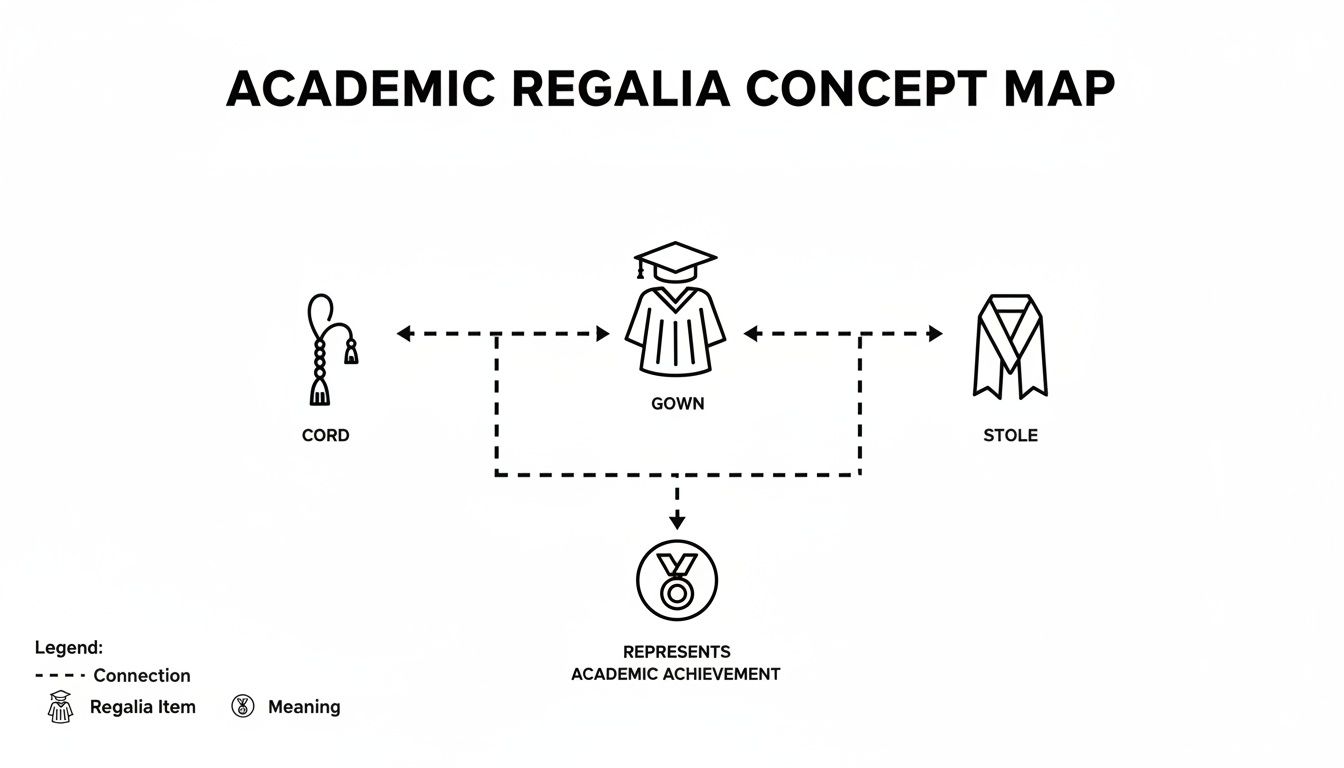
As you can see, both cords and stoles are distinct accessories that build upon the foundational gown, each symbolizing a different type of academic honor or affiliation.
The Language of Academic Honors
Some of the most recognizable colors you'll see are those representing Latin honors. These are reserved for students who maintained an exceptionally high GPA throughout their college years. While the exact GPA requirements can differ from one school to another, the color scheme is usually pretty consistent.
- Summa Cum Laude (With Highest Honor): This is the pinnacle of academic achievement. It’s almost always represented by a double-braided gold cord and is awarded to graduates with a near-perfect GPA, placing them at the very top of their class.
- Magna Cum Laude (With Great Honor): Typically symbolized by a silver cord, this honor recognizes students with outstanding academic records who are just a fraction below the top tier.
- Cum Laude (With Honor): Often represented by a white or bronze cord, this is the first level of distinction awarded to graduates who have demonstrated a strong and consistent academic performance.
Spotting one of these cords is an immediate sign of a student's incredible dedication. If you want to get into the nitty-gritty of what each color means, our complete graduation honor cords color meaning guide is a great resource.
Colors Representing Fields of Study
Beyond overall academic excellence, many colors are used to identify a graduate’s specific field of study. This system, largely standardized by the American Council on Education (ACE), helps you spot future nurses, engineers, and artists in the crowd.
It’s a bit like a sports team wearing its colors. In this case, the "team" is an academic discipline. A graduate wearing a green cord probably studied medicine or a related science, while someone with a light blue stole is likely heading into the world of education.
This color system creates a visual connection between graduates and their chosen profession, highlighting the diverse expertise that makes up the graduating class. It’s a celebration not just of completion, but of specialized knowledge.
Here’s a look at some of the most common colors and the academic fields they represent.
Common Academic Colors and Their Meanings
The table below breaks down some of the standard colors you'll see at commencement and what they signify.
| Color | Associated Field or Honor | Where You'll See It |
|---|---|---|
| Gold | Science, Latin Honors | Worn by graduates in STEM fields or those achieving Summa Cum Laude. |
| White | Arts, Letters, Humanities | Common for degrees in English, History, Sociology, and Fine Arts. |
| Light Blue | Education | Represents the commitment to teaching and shaping future generations. |
| Drab (Tan) | Business, Commerce, Accounting | Worn by graduates from the business school, including finance majors. |
| Sage Green | Physical Education | Symbolizes degrees related to kinesiology, sports science, and health. |
| Royal Blue | Philosophy | A distinct shade often reserved for Doctor of Philosophy (Ph.D.) degrees. |
| Purple | Law | Associated with Juris Doctor (J.D.) degrees and the legal profession. |
This is just a small sample, but it gives you an idea of how much information is communicated through color alone on graduation day.
Interpreting Multiple Cords and Stoles
It’s pretty common to see a graduate wearing a whole collection of cords and stoles. This isn't just for flash—it signifies a student who has earned multiple, distinct honors. They might be wearing a cord for their high GPA, another for being in an honor society, and a stole for their leadership role in student government.
Each piece tells a different part of their college story. For instance, a single graduate might have:
- A Gold Cord: For achieving Summa Cum Laude honors.
- A Royal Blue and White Cord: For membership in an honor society like Phi Alpha Theta (History).
- A Custom Stole: Featuring their university’s crest to signify their role as a student ambassador.
When layered correctly, these items turn a simple gown into a detailed resume of a student’s hard work, leadership, and diverse achievements. They are a cumulative, wearable record of an incredible academic career.
How to Wear Your Cords and Stoles Correctly
Graduation day is all about the details. After all that hard work, the last thing you want to worry about is whether your regalia looks right for the photos and the walk across the stage. Getting your cords and stoles to sit perfectly is a small but important part of looking polished and respecting the achievements they represent.
Think of it like getting ready for any big, formal event. There's a proper way to wear everything, and doing it right helps you feel confident and ready. Let’s walk through the simple steps to make sure your regalia is perfectly placed, so you can focus on your big moment without any wardrobe distractions.

Step-by-Step Guide to Wearing Honor Cords
Putting on honor cords is pretty straightforward. The main goal is just to make sure they're secure and hanging evenly.
- Find the Middle: Hold the cord up and find its center point—this is usually a small, decorative knot that holds the strands together. Place that knot right at the back of your neck.
- Drape Over Shoulders: Let the two ends of the cord fall forward over your shoulders. They should now be hanging down the front of your gown, one tassel on each side.
- Even Them Up: Take a quick look in a mirror. You want both tassels hanging at the same height. Just slide the cord a little at the back of your neck until they line up perfectly.
If you're looking for more tips and tricks, our detailed guide on how to wear graduation honor cords has you covered.
How to Position Your Graduation Stole
A stole (or sash) needs a little more finessing to make sure it lays flat and doesn't get twisted during the ceremony.
- Center the Stole: Most stoles are designed with a V-shaped seam at the back. This is your guide—it's meant to sit right at the nape of your neck.
- Drape and Smooth: Place the stole around your neck and let the two long panels hang down your front. Run your hands over them to smooth out any wrinkles so they lie flat against your shoulders and chest.
- Check for Evenness: Just like with cords, you want the ends of the stole to be roughly even. The panels should hang straight down, running parallel to your gown's zipper.
Pro Tip: Stoles can be a bit slippery. To keep yours from shifting around, use a small safety pin or a bit of double-sided fabric tape to discreetly fasten it to your gown at the back of your neck.
Layering Multiple Cords and Stoles
It's common for graduates to have more than one honor to display. If you're wearing multiple cords or a mix of cords and stoles, the key is to keep things looking organized, not cluttered.
- Wearing Multiple Cords: If you have several cords, just drape them around your neck one by one. Let them hang next to each other, and make sure all the tassels are untangled and hanging at an even length. There's no strict rule, but some people like to put their most prestigious honor cord on top.
- Combining Cords and a Stole: Always put the stole on first. Think of it as the base layer. Once it's sitting flat, drape your honor cords over it. The cords should rest neatly on top of the stole, framing it.
Following this order ensures every single one of your achievements is visible. With these simple steps, you can wear your honors with the pride and poise they deserve on your graduation day.
Celebrating Identity with Cultural and Custom Stoles
While honor cords are fantastic for celebrating what you've achieved in the classroom, stoles offer a beautiful way to tell the rest of your story. Think of them as more than just an accessory; a custom or cultural stole turns your graduation gown into a canvas for your personal identity, heritage, and the unique experiences that got you here. It's a powerful statement about the entire journey.
Your gown is the uniform, but the stole is your personal crest. It's your chance to fly the flag for the communities you belong to, the heritage you cherish, and the affiliations that shaped you. From vibrant Kente cloth that honors your roots to a flag representing a life-changing study abroad trip, these stoles make sure your individuality shines through on the big day.

This desire to personalize such a huge life event is part of a bigger trend. The global market for ceremonial items, which includes culturally significant cords and stoles, is a massive USD 5.5 billion industry. The demand is particularly strong in North America, where graduates are increasingly looking for ways to honor both their faith and heritage during academic ceremonies.
Honoring Heritage with Kente Stoles
When you think of a cultural stole, the Kente stole is probably the first one that comes to mind. With roots in the Ashanti people of Ghana, Kente cloth is a stunning, handwoven fabric where every single color and pattern tells a story—about history, values, and even cultural proverbs.
Wearing a Kente stole is a powerful way to connect with African heritage. It’s a celebration of the perseverance and excellence of the African diaspora and a visual declaration of pride in the ancestors and communities who paved the way.
Showcasing Global Experiences
For any student who spent time studying abroad, an international flag stole is the perfect way to commemorate that journey. It represents so much more than a semester in another country; it symbolizes the personal growth, new perspectives, and cross-cultural understanding you gained.
These stoles act as a colorful badge of honor, visually weaving that life-changing experience right into your graduation celebration.
A custom stole is more than fabric; it’s a narrative. It tells a story of where you come from, what you believe in, and the communities that have lifted you up. It turns your academic achievement into a celebration of your whole self.
Representing Greek Life and Military Service
Beyond cultural heritage, custom stoles are a popular way to represent specific organizations that were central to your college experience.
- Greek Life: Members of fraternities and sororities often wear stoles that proudly feature their organization's Greek letters, colors, and crest. It's a clear symbol of the brotherhood or sisterhood and the lifelong bonds they built.
- Military Service: Graduates who are veterans, on active duty, or from military families may wear a stole representing their branch of the armed forces. This is a deeply respectful way to honor their commitment, sacrifice, and service to their country.
These stoles acknowledge that a student’s identity is often forged in commitments outside the classroom, highlighting dedication and leadership in all its forms. If you're curious about other cultural traditions, you can dive deeper in our guide on Hispanic graduation stoles.
Choosing Your Perfect Custom Stole
When it’s time to pick out your own stole, focus on quality and authenticity. You’ll want high-quality satin or woven materials that will lie flat against your gown and look great in photos. Make sure any embroidery or printing is crisp and clear, so it perfectly represents the symbols that mean so much to you.
Your stole is a keepsake you'll look back on for years to come. It’s worth choosing one that truly captures the pride you feel on graduation day—it’s the final, personal touch that makes the whole celebration uniquely yours.
A Guide for Schools and Administrators
Making sure commencement runs smoothly is a huge behind-the-scenes effort, and managing the regalia is a big piece of that puzzle. For administrators, faculty, and student group leaders, planning for cords and stoles is more than just buying things—it takes careful foresight and a solid distribution plan. When you get it right, students feel properly recognized and the ceremony looks dignified and polished.
The very first thing to do is set up clear policies. You need to decide which honor societies, departments, and campus organizations are approved to award cords or stoles. This simple step cuts down on confusion later and makes sure every piece of regalia worn at the ceremony meets your school's standards.
Streamlining the Ordering Process
Honestly, placing one big bulk order for all the approved cords and stoles is almost always the best way to go. The benefits go way beyond just getting a better price.
- Color Consistency: When you order from a single supplier like Gradshop, you know the "royal blue" for your honor society will be the exact same shade for every single student. It creates a much more professional, uniform look.
- Quality Control: Using one trusted source means all the regalia will be made to the same standard. You won't have to worry about some stoles looking cheap while others are high-quality.
- Simplified Logistics: It's so much easier to manage one large order than to try and coordinate dozens of different orders from individual student groups. It just saves a ton of administrative headaches.
This centralized approach is becoming more critical as the demand for these items grows. The market for ceremonial products, which includes academic cords and stoles, is expected to hit USD 9.4 billion by 2035. That growth just underscores how important it is for schools to have a reliable supplier they can count on for quality and consistency.
By centralizing the procurement process, institutions can uphold visual standards, reduce administrative burdens, and often secure better pricing, ensuring every graduate's honor is represented with dignity and uniformity.
Establishing Clear Institutional Guidelines
After you’ve locked in a supplier, your next move is to communicate your guidelines clearly across the entire campus. Create a formal policy that spells out exactly which honors, clubs, and affiliations are officially recognized with regalia at commencement.
This keeps the ceremony from feeling cluttered with random, unapproved items and protects the meaning behind the honors being awarded. A well-defined policy lets students celebrate their identities while making sure the ceremony itself keeps its traditional and respectful feel.
For those involved in planning academic ceremonies, gathering more tips can be a huge help. You can find some great information in these general university event planning resources.
Creating an Efficient Distribution System
Finally, you need a stress-free distribution process. The last thing anyone wants is chaos right before graduation day. Plan to hand everything out well in advance, maybe at a "Grad Fest" or a similar event a few days before the ceremony.
Distribution Checklist:
- Prepare an Official List: Have a master spreadsheet of every eligible student and the specific regalia they've earned.
- Organize by Last Name: Pre-package the cords and stoles for each student and sort them alphabetically. This makes pickup incredibly fast.
- Provide Clear Instructions: Slip a small card into each package with simple instructions on how to wear the items correctly.
- Have a Help Desk: Make sure there's someone on hand to answer questions or sort out any issues right away.
A well-oiled distribution system means every graduate gets their honors without any drama, letting them focus on what matters most: celebrating their incredible achievement.
Common Questions About Cords and Stoles
As the big day gets closer, the questions about graduation gear start to pop up. It's completely normal. You've worked hard for those honors, and you want to make sure you're wearing them correctly and respecting the tradition of it all.
To help clear up any confusion, let’s tackle some of the most frequent questions we hear from graduates and their families about cords and stoles. Think of this as your quick-and-easy guide to regalia etiquette, so you can walk across that stage feeling nothing but pride.
Can I Wear Multiple Honor Cords?
Yes, you absolutely can—and you should! Wearing multiple honor cords is incredibly common. Each cord represents a unique achievement, so wearing all of them together is the best way to show the full picture of your accomplishments.
It's not unusual to see a graduate with a cord for Latin honors (like Cum Laude), another for their membership in an academic honor society, and maybe even a third for a leadership program. The trick is just to wear them neatly. Drape each one around your neck so they hang side-by-side, making sure the tassels at the bottom are even and not tangled up.
What Is the Difference Between a Stole and a Sash?
You’ll often hear these terms used interchangeably, but in the formal world of academic regalia, there’s a small distinction. A stole is what you typically see at graduation: a long, V-shaped piece of fabric worn over the shoulders, with two panels hanging down the front of the gown. They're usually made of quality satin and decorated with embroidered logos, crests, or lettering.
A sash, on the other hand, tends to be a simpler, narrower strip of cloth, sometimes worn over just one shoulder or even around the waist. For commencement, what you'll almost always be wearing is a stole. If someone says "sash," it’s a safe bet they’re talking about a graduation stole.
Think of it this way: The stole is the main event—the formal accessory for displaying your honors, affiliations, or heritage. While sashes are a thing, stoles are the undisputed standard for graduation ceremonies.
Do I Get to Keep My Cords and Stoles?
You sure do. Unlike the gown and cap, which are sometimes rented, your cords and stoles are considered personal keepsakes. They belong to you, serving as a tangible reminder of your hard work and the communities you were a part of.
After the ceremony, many graduates find creative ways to display their regalia.
- Shadow Boxes: A really popular option is to create a shadow box with your cords, stole, tassel, and maybe a favorite graduation photo.
- Diploma Framing: Some professional framers can incorporate your tassel or a medallion right into the frame with your diploma.
- Keepsake Storage: Even if you don't put them on display, keeping them in a protected box will preserve them for years to come.
These aren't just pieces of fabric; they symbolize years of dedication, making them some of the most meaningful mementos you'll take away from your academic journey.
How Do I Find Out Which Regalia I Earned?
Figuring out which cords and stoles you're eligible for takes a little initiative. Your school won't just mail them to you automatically; you usually need to connect with the right department or organization to get them.
Your first stop should be your academic advisor or the registrar's office. They are the official source for academic honors like Summa, Magna, and Cum Laude. They can confirm if you've qualified and point you in the right direction to get the right cord or stole. Many schools even hold a "Grad Fest" or similar event where you can pick everything up at once.
For your other affiliations, you’ll need to reach out directly.
- Honor Societies: Get in touch with the faculty advisor for your specific chapter (like Phi Beta Kappa or Tau Beta Pi). They handle the distribution of their society's official regalia.
- Student Organizations: If you were a leader in student government or another major club, ask the advisor if they offer a recognition stole.
- Cultural or Departmental Groups: For custom stoles celebrating your heritage, like a Kente cloth or an international flag, you’ll likely need to purchase them from the group that sponsors them or from an approved vendor.
Ultimately, it’s up to you to follow up and gather your regalia. Don't leave it to the last minute! Start asking around a couple of months before graduation to make sure you have everything you've earned.
Are There Rules for Wearing Cords and Stoles?
While the specifics can differ a bit from school to school, there are some widely accepted standards for wearing your regalia. The number one rule is simply to wear them with respect—after all, they represent some major accomplishments.
The proper layering order is pretty straightforward: your stole goes on first, lying flat over your gown and shoulders with the panels hanging evenly down your chest. Once the stole is in place, you can drape your honor cords over it. This method ensures that every piece of your hard-earned regalia is visible.
Always give your school's commencement guide a quick read, just in case they have any unique instructions for their ceremony. Following these simple steps will give you a polished, dignified look as you celebrate your big day.
Ready to find the perfect cords and stoles to celebrate your achievements? At Gradshop, we offer a wide selection of high-quality regalia for every honor, discipline, and cultural identity. From classic honor cords to custom-designed stoles, we provide everything you need to look your best on graduation day. Explore our full collection and order your keepsakes today at https://www.gradshop.com.