

So, what GPA do you really need to get those coveted honor cords for graduation? While every school sets its own standards, a GPA of 3.5 or higher is the most common target for earning academic honors. Think of it as the threshold where your hard work and dedication get a visible nod on the big day.
Your Guide to Graduation Honor Cords
Earning honor cords is a pretty big deal. It's the moment your standard-issue graduation regalia transforms from a simple uniform into a personalized story of your success. Those decorative ropes draped over your gown are more than just accessories—they're badges of honor that represent all those late-night study sessions, challenging projects, and consistent academic drive.
The GPA you need usually lines up with the traditional Latin honors system, which most colleges and many high schools use to recognize their top students. Getting familiar with this system is the best way to know what you should be aiming for.
- Cum Laude ("with praise"): This is the first level of academic distinction. Typically, you'll need a GPA somewhere in the 3.5 to 3.69 range to earn this honor.
- Magna Cum Laude ("with great praise"): The next step up, this is usually reserved for students who have earned a GPA between 3.7 and 3.89.
- Summa Cum Laude ("with highest praise"): This is the pinnacle of academic achievement, often requiring a stellar GPA of 3.9 or higher.
Keep in mind, while these ranges are a great rule of thumb, your school has the final say. Some institutions use a fixed GPA cutoff, but others award honors to a top percentage of the graduating class (like the top 10%), which means the exact GPA needed can change from year to year. For a deeper dive, you can learn about the graduation honors cords and what they all mean in our more detailed guide.
This article will break down everything you need to know, from understanding the different types of honors to confirming your own eligibility. And once you've officially earned your distinction, Gradshop is here to help you find high-quality honor cords and complete cap and gown packages to celebrate your accomplishment in style.
Decoding the Three Tiers of Latin Honors
When you earn graduation honors, you're not just hitting a certain GPA—you're stepping into a tradition of academic excellence that's been around for centuries. The most common way schools recognize this is through the Latin honors system, which sorts high-achievers into three prestigious tiers. Figuring out where you stand is the first step toward knowing which honor cords you'll get to wear.
You've probably heard the terms: cum laude, magna cum laude, and summa cum laude. They translate to "with praise," "with great praise," and "with highest praise." It helps to think of them as the bronze, silver, and gold medals of your academic journey. Each one represents a serious level of commitment, but the exact GPA needed to earn them can feel like a moving target from one school to another.
Fixed GPA vs. Percentile Systems
So, why would a 3.8 GPA get you one level of honors at one college but a completely different one somewhere else? It all boils down to how the school does its math. Generally, they use one of two methods:
- Fixed GPA Cutoffs: This is the most straightforward way. The university decides on a static GPA for each honor. For example, a 3.5 might be the magic number for cum laude, year in and year out. It’s a clear, predictable target.
- Percentile-Based Systems: This approach is far more competitive. Instead of a fixed number, honors are given to a top percentage of the graduating class—say, the top 2% get summa cum laude. This means the required GPA can shift every single year, depending on how that particular class performed.
Because of these different approaches, there's no universal GPA for a specific honor cord. This visual helps lay out the typical progression.
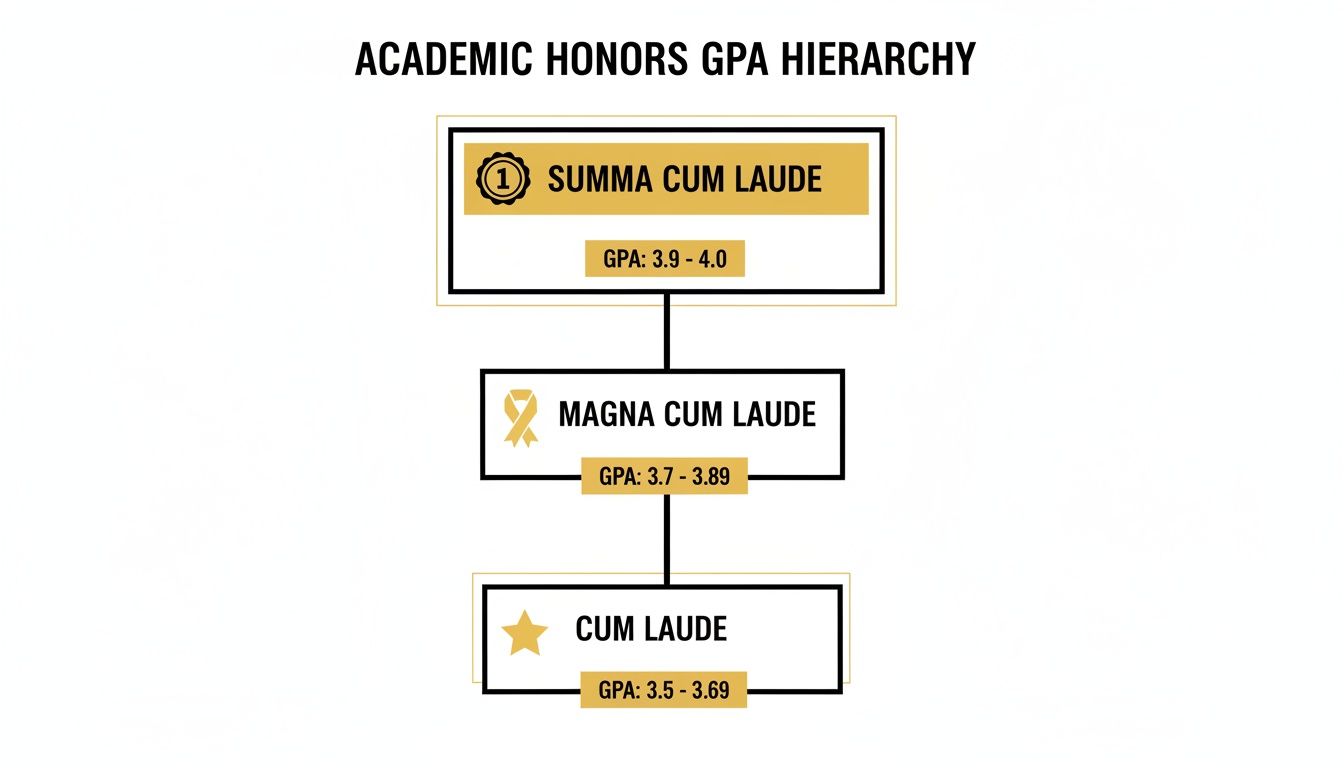
As you can see, the journey from cum laude to summa cum laude is a steep climb, with each tier becoming more and more exclusive.
Real-World GPA Examples
Looking at colleges across the U.S., you'll see these standards vary quite a bit, but some patterns emerge. At the University of Minnesota, for instance, you need a minimum cumulative GPA of 3.500 for cum laude, 3.666 for magna cum laude, and 3.750 for summa cum laude. Then you have a place like UCLA, where the bar is set much higher. For its 2025-26 class, the School of Arts and Architecture requires a stunning 3.956 GPA just for cum laude. You can discover more about these university honor policies and see how they compare.
Here's the key takeaway: Your school's specific policies are the only thing that matters. What one institution considers "with highest praise" might just be "with praise" at another, more academically competitive one.
Once you get that official confirmation of your hard-earned honors, it's time to celebrate with the right regalia. Gradshop has a fantastic collection of honor cords in just about every color and combination imaginable. You'll be able to find the perfect one to signify your achievement and wear it with pride on the big day.
High School vs. College: A Whole New Ballgame for Honors
When it comes to earning those coveted honor cords, the jump from high school to college is a big one. Think of it like this: high school honors are often a straightforward sprint to a finish line, while college honors are more like a multi-stage race with different events. Both celebrate incredible achievement, but the way you qualify changes dramatically.
In most high schools, the path is pretty clear-cut. The school or district sets a specific GPA, and if you hit it, you're in. A common benchmark you’ll see is a 3.5 GPA or higher. Many schools also recognize involvement in groups like the National Honor Society, which comes with its own academic standards and its own specific cord. It's a system designed for clarity and broad recognition of hard work.
For high school grads hitting that mark, getting the right gear is part of the celebration. Nailing the look with a sharp high school cap and gown set and the right honor cords really makes the achievement feel real.
Unpacking the Layers of College Honors
Once you step onto a university campus, things get a lot more intricate. A single GPA number rarely tells the whole story. Colleges have a much more nuanced system for recognizing academic success, and it's not just about one simple benchmark.
Why the complexity? Because universities recognize different kinds of achievement all at once. You could find yourself qualifying for honors in a few different ways:
- University-Wide Honors: This is where you'll see the classic Latin honors—cum laude, magna cum laude, and summa cum laude. These are awarded by the university as a whole and are typically tied directly to your final cumulative GPA.
- Departmental or Major-Specific Honors: Your individual department, like the Biology Department or the School of Business, often has its own honors program. These usually have tougher requirements, like a higher GPA just in your major classes, completing a senior thesis, or contributing to a faculty research project.
- Minimum Credit Requirements: You can't just transfer in at the last minute and expect to get honors. Most universities, like Montclair State University for example, require you to have earned a certain number of credits at their institution to be eligible. This ensures the honor is for work actually done at their school.
The biggest takeaway here is that college honors separate general academic performance from deep, specialized excellence in your chosen field. This is exactly why you'll see graduates wearing multiple cords—one for their overall GPA and another for acing their major.
For university graduates, this milestone deserves regalia that matches the accomplishment. Many scholars add custom honor stoles to showcase their specific program, and for those continuing their academic journey, high-quality masters and doctoral regalia is the perfect way to commemorate years of intense dedication.
How Weighted and Unweighted GPAs Affect Your Honors
So, is a 4.0 always a 4.0? Not quite. When you're trying to figure out the GPA needed for honor cords, one of the biggest hang-ups is the difference between weighted and unweighted GPAs. Getting this straight is the key to knowing where you really stand.
An unweighted GPA is the classic, straightforward calculation. It’s based on a standard 4.0 scale: an A is worth 4 points, a B is 3, a C is 2, and so on. In this system, every single class carries the same weight, whether it’s Intro to Pottery or AP Physics.
A weighted GPA, on the other hand, gives you an academic pat on the back for taking on tougher classes. It’s like getting bonus points for choosing the hard-mode version of your education. By taking Advanced Placement (AP), International Baccalaureate (IB), or honors courses, the grades you earn get extra "weight," which can push your GPA well above a 4.0.

Unweighted vs. Weighted: A Deeper Look
Let's see how this actually works. Picture two students: Alex gets straight A's in a schedule of standard-level classes, while Bailey earns the exact same A's but in a schedule full of AP courses.
- On an unweighted scale, both Alex and Bailey have a perfect 4.0 GPA.
- But on a weighted scale, Bailey’s GPA might be a 4.5 or even higher, reflecting the difficulty of their classes.
This distinction is a big deal. Many high schools and colleges use weighted GPAs to find their top students—think valedictorians and salutatorians. It’s their way of recognizing and rewarding the students who really pushed themselves with the most challenging curriculum available.
It's worth noting, though, that many universities will recalculate all their applicants' GPAs on their own standardized scale. They do this to level the playing field, making sure they can compare students fairly even if they come from high schools with wildly different grading policies.
How This Connects to Your Honor Cords
At the end of the day, what truly matters is which GPA your school uses to decide who gets honors. You need to find out if your institution is looking at your weighted GPA, your unweighted one, or if they have their own special formula. Understanding your school's system is critical, which is why so many students look for strategies for improving essay grades to keep every part of their academic record as strong as possible.
Once you’ve confirmed you've earned those honors, the final step is celebrating that achievement with the right regalia. A high-quality, custom-embroidered honor stole from Gradshop is the perfect complement to your cords, making that high GPA feel even more special on graduation day.
Confirming Your Eligibility and Getting Your Regalia
You've put in the work, and your final GPA is looking solid. So, what’s next? How do you go from a promising GPA to actually holding that honor cord on graduation day? A few proactive steps can clear up any confusion and get you ready to celebrate.
Think of your school's official documents as your rulebook. The best place to start is the student handbook or the registrar's page on the university website. These resources almost always detail the exact GPA cutoffs for cum laude, magna cum laude, and summa cum laude.
Next, it's always a good idea to connect with your academic advisor. They're your personal guide in this process and can confirm where you stand, double-check your GPA, and shed light on any department-specific honors you might qualify for. They can also tell you if your school uses a fixed GPA system or a more competitive percentile model.
Watch for Official Notifications
Keep a close eye on your student email as graduation gets closer. The registrar or commencement office will send out official notices to every student who qualifies for academic honors. This email is your green light—it’s the definitive confirmation and will typically tell you exactly how to get your honor cords.
Securing honor cords is more than just hitting a number; it’s a statistical badge of elite performance. At UCI, for example, honors are awarded by class percentile, with the top 2% earning summa cum laude for Fall 2025-Summer 2026. Similarly, Duke's Spring 2025 data shows seniors in Trinity College needed a 3.936 GPA for top 5% honors. You can discover more insights about how different universities determine these honors.
Secure Your Graduation Regalia
Once you get that official confirmation, the fun part starts: getting your regalia. Gradshop makes this step simple. Our online store is easy to browse, so you can find the exact honor cords you earned, sorted by color and style.
You can also complete your look with our high-quality honor stoles and full cap and gown packages. We’ve got you covered with a lowest-price promise and fast shipping to make sure you look your best, even if you're on a tight deadline.
For more helpful advice, check out our guide with tips for graduation regalia ordering.
Choosing the Right Honor Cords and Stoles
Your graduation outfit isn't just a rental—it's a canvas that tells the story of your hard work, late nights, and proudest moments. Picking out the right honor cords and stoles is the final, satisfying touch before you walk across that stage. Let’s make sure you select the pieces that truly celebrate everything you’ve accomplished.

The first question is always about GPA. Most schools tie their Latin honors to specific thresholds that represent real academic distinction. Generally, you can expect cum laude to start around a 3.5 GPA, magna cum laude near a 3.7, and the prestigious summa cum laude at a 3.9 or higher. This top-tier honor is usually reserved for the absolute top 1-5% of a graduating class.
The Symbolism Behind Cord Colors
Every honor cord draped around your neck has a meaning. Think of them as a visual language for your achievements. While some colors have a nearly universal meaning, others are tied to specific honor societies or your field of study. Knowing the difference helps you tell your story accurately.
- Gold: The classic. This is the go-to color for general academic excellence, often representing the cum laude, magna cum laude, and summa cum laude distinctions.
- Royal Blue and Gold: A familiar sight at high school graduations, this combination is the signature of the National Honor Society (NHS).
- Specialty Colors: From there, it gets wonderfully specific. You might see light blue for education majors, lilac for dentistry, or dozens of other shades representing different departments and honor societies.
Getting the color right is key. At Gradshop, our huge selection of single, double, and triple-braided honor cords has every shade you need to perfectly match your specific honors. And if you're curious about what each one means, our guide on graduation honor cord color meaning breaks it all down.
Completing Your Look with Stoles and Gowns
Cords are just one piece of the puzzle. Academic stoles, those beautiful sashes worn over your shoulders, add another layer of personalization. They can signify your major, your status as valedictorian, or membership in a specific organization, perfectly complementing your honor cords for a truly distinguished look.
Of course, the whole ensemble starts with the cap and gown. It's the foundation of your graduation day look. Gradshop is your one-stop shop for celebrating in style, offering everything from complete high school cap and gown sets to the premium masters and doctoral regalia required for advanced degrees. We’re all about quality materials and dependable service, so you can build the perfect outfit to mark your big day with pride.
Got Questions About Graduation Honors? We’ve Got Answers.
As your big day gets closer, you're probably swimming in questions about graduation rules and regalia. It's totally normal. Let's clear up some of the most common things students wonder about when it comes to their honors.
Can I Wear More Than One Honor Cord?
Absolutely! In fact, most students who’ve earned them do. Think of your graduation gown as a canvas for your accomplishments—each cord represents a different success story.
It’s perfectly fine to wear cords for your GPA, your honor society membership, and that special departmental award all at the same time. While schools love to see you celebrate your hard work, it's always a good idea to quickly double-check their official regalia guidelines just in case. If you've earned multiple distinctions, Gradshop has a huge selection of honor cords to match every single achievement.
Does the School Give Me My Cords, or Do I Have to Buy Them?
This really comes down to how your school handles things. Some institutions will hand you your honor cords right along with your cap and gown, all included in their honors package. Others will simply notify you that you've qualified and leave it up to you to purchase them.
And don't forget about honor societies like the National Honor Society—they almost always require members to buy their own official cords. The best way to know for sure? Just ask your registrar or faculty advisor. If you do need to buy your own, Gradshop’s fast shipping will make sure you have everything you need well before graduation day.
What's the Difference Between an Honor Cord and an Honor Stole?
It's a great question. The easiest way to think about it is that a cord is like a specific badge of honor, while a stole is more like a banner proclaiming a major achievement.
An honor cord is that classic twisted rope you see, and it usually signifies a very specific accomplishment—like your GPA or membership in an honor society. On the other hand, an honor stole is the wider, sash-like garment that drapes over your shoulders, often used for broader recognitions like being valedictorian or completing a unique academic program.
And yes, you can definitely wear both! There’s no reason not to show off the full range of what you’ve accomplished. At Gradshop, you can find a complete collection of high-quality cords and customizable honor stoles to perfectly complete your look.
Here at Gradshop, we know that every single achievement is worth celebrating in style. Whether you’re looking for high school caps and gowns or distinguished masters and doctoral regalia, we have everything you need to make your graduation day feel as special as it is.