

The ceremony date is circled, the photos are booked, and the cap still will not stay put. You sized it by grade, the square board tips forward the moment your child turns, and the school just emailed that decorated caps are not allowed. A children's graduation cap has to pass two checks before it belongs on a head: a real measurement, and the school's written rules.
Parents and purchasing officers often treat age or grade as a size. That shortcut fails when two fourth graders have different head circumferences, or when a high school policy bans the extra stole a family already paid for. I would start with the written policy, then measure, then order.
Whether you are buying for one child or a whole grade, the sequence is the same. Confirm what the school requires, measure the head, test the fit while the child walks, and only then place the order.
Graduation Cap Sizes for Each School Level
A preschool cap may look right on the shelf and still slip during the ceremony. Start with the school level, then use the school's sizing guidance to choose the cap. Gradshop sells caps and tassels for kindergarten and preschool, elementary, junior high and middle school, and high school.
| School level | Cap style and board | Sizing approach | Gradshop catalog reference |
|---|---|---|---|
| Kindergarten or preschool | Mortarboard | Check the available size and fit guidance for the selected cap | Kindergarten and preschool caps and tassels |
| Elementary | Mortarboard | Check the available size and fit guidance for the selected cap | Elementary caps and tassels |
| Junior high or middle school | Mortarboard | Check the available size and fit guidance for the selected cap | Junior high and middle school caps and tassels |
| High school | Mortarboard | Check the available size and fit guidance for the selected cap | High school caps and gowns in 16 colors |
For older students, the school's requirements may determine the cap color or whether the cap must match a gown. Gradshop offers high school caps and gowns in 16 colors, so confirm the approved color before choosing a set.
The square mortarboard is associated with academic dress. The Boston Globe's account of commencement mortarboards traces the term to a comparison with a mason's mortar board.
For broader sizing guidance, see the guide to standard graduation cap sizes. Use it alongside the cap's product details and the school's requirements. A general size reference cannot replace the fit guidance for the specific cap being ordered.
How to Measure a Child's Head and Test the Fit
A children's graduation cap should be a properly fitted mortarboard, not a cap chosen by age. The Yale academic regalia guide describes the working parts: a crown, a flat square board, a central button, and a tassel at that button. For elementary and high school, a lightweight fabric cap with an adjustable or elasticized headband is the practical spec, because head sizes differ a lot inside one grade.
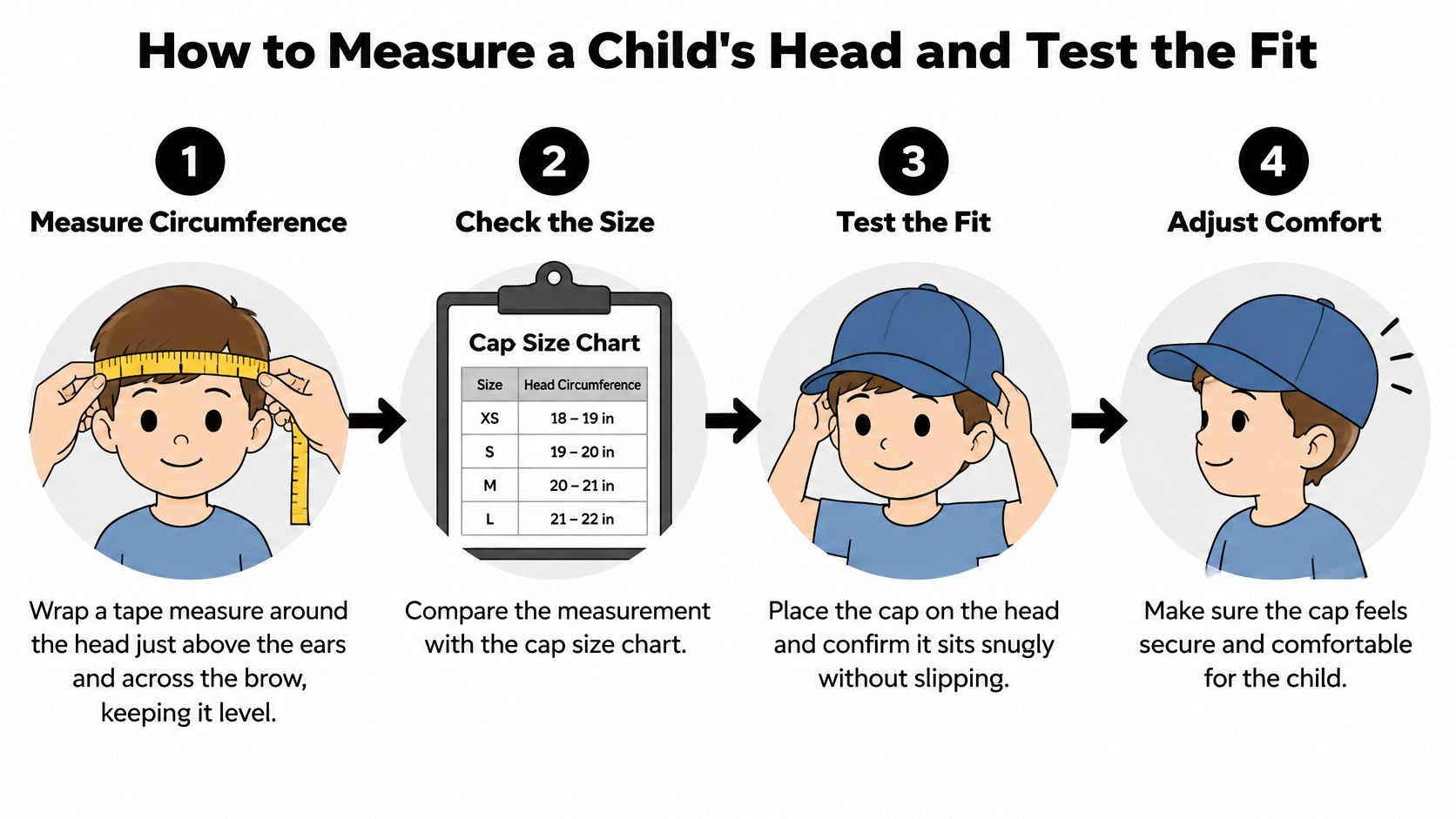
- Wrap a soft tape around the head just above the ears and across the brow, and keep the tape level. A tilted tape reads short on one side and long on the other, so the band you order will not match the head you measured.
- Compare that number with the supplier's size chart and pick the size that matches the measurement, not the grade or age. Two children in the same class can need different bands, and the chart is the only place those differences show up before the box arrives.
- Seat the crown on the head and check that the square board sits level, not tipped forward or back. A level board keeps a processional line looking even and stops the front edge from dropping into the child's eyes.
- Have the child walk, turn, and sit for a few minutes. A cap that looks fine at the mirror often slides once the head moves, which is exactly when photos and the procession happen.
- Adjust the elasticized or adjustable band until it holds snugly without leaving a mark on the forehead. Too loose and the cap creeps forward. Too tight and the child pulls it off before the names are called.
- Attach the tassel at the central button and hang it on the side the school requires. Many American institutions use the left side for graduates, but the school's written instructions take precedence over that habit.
- Before any bulk order, repeat the test on two or three students, not just the child who happens to be in the office. A sample that stays level while walking and turning cuts last-minute replacements.
The common slip is measuring over a high ponytail, or skipping the tape and ordering by grade. Hair adds circumference the chart never intended, and a grade label hides the outliers in the class.
A good fit after the test looks quiet. The crown sits secure, the board stays level through a turn, the band leaves no red line, and the child is not reaching up to reset the cap.
Fabric, Board Stiffness and Comfort for Young Wearers
A cap that looks neat on the table can feel heavy or flimsy once a child wears it. Check the fabric under a bright light, and judge the board by whether it keeps its shape without putting unnecessary pressure on the forehead. For more context, see this guide to materials used for academic wear.
What to check in your hands
- Flex: Press the board gently. It should spring back toward its square shape rather than crease.
- Crown support: Check for a firm crown and secure stitching so the cap holds its shape after unpacking.
- Fabric: Hold it under a bright light. If the material looks too sheer for the ceremony setting, choose another option.
- Added weight: Charms, thick glue, and stacked trim can pull the front edge down. Check school rules before adding decoration.
Board size and stiffness affect comfort as much as fabric does. A large, rigid square can feel awkward on a small head, while a board that bends out of shape may look uneven in ceremony photos. Choose a cap that balances structure with a manageable weight, and follow the school's written requirements if they specify a style or material.
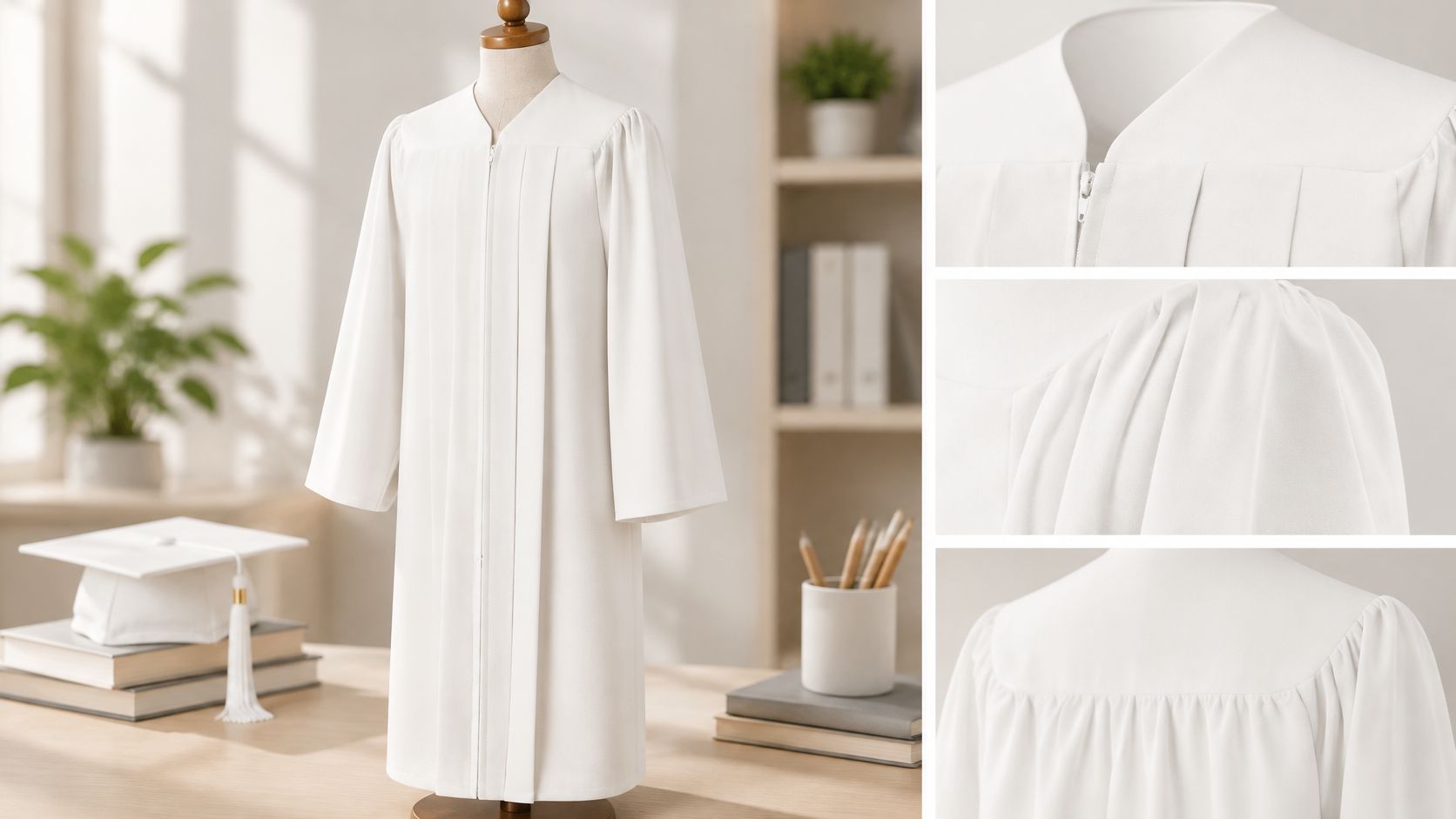
Use the fit checks from the measuring section to assess comfort and stability. For a school order, try the selected cap on a few students with different head measurements before placing the full order.
Why Kids' Caps Differ From University Regalia
A school-wide order can include kindergarten caps, high school sets, and university regalia, but those items serve different purposes. Sort the order by school level and follow each institution's written rules before choosing products.
Academic caps, gowns, stoles, and hoods signal different levels of attainment. Virginia Tech's guidance on selecting the proper hood color explains the degree-specific conventions behind university regalia. Most American bachelor's and master's graduates wear a black mortarboard. Some doctoral candidates wear a velvet tam, and doctoral regalia may include a gold tassel; black is common at other degree levels.
University hoods also differ in length and trim. Yale's regalia guide specifies a 3.5-foot master's hood with a 3-inch velvet border and a 4-foot doctoral hood with a 5-inch border. Those dimensions are for degree regalia, not children's graduation apparel. For younger students, choose only the accessories their school permits.
Split the order by level
Children's and high school packages should match the student's school level, with stoles included only when approved by the school.
Bachelor's and master's packages should follow the institution's regalia requirements. A bachelor's package includes a gown, cap, tassel, and hood. The Deluxe Masters Graduation Package includes a matte black gown, cap, tassel, and hood.
Doctoral packages should follow the university's specifications for the hood, tam, and tassel. Faculty regalia also varies by degree, with bachelor's, master's, and doctorate caps, gowns, hoods, and tams. Gradshop sells university and college graduation products for associate's, bachelor's, master's, and doctorate degrees, including tams and beefeaters.
Keep degree levels on separate order lines, then check each school's written protocol before placing the order. That reduces the chance of ordering the wrong hood or tassel color.
Decorations, Cords and Stoles Under School Rules
Families ask three questions first. Can the cap be decorated? Which stoles and cords are allowed? Can a cultural or religious item be worn? The answers are local, and they override taste.
Policies do not line up from one campus to the next. The Wiregrass Ranch High School graduation gown page is one example of a school that limits what may be added to the official set. Some schools allow only officially approved cords and stoles and forbid anything extra. Others ban decorated caps outright. A meaningful accessory can still break the ceremony rules, so the policy comes before the glue gun.
A sound principle, used by some districts, is that recognized cultural or religious items may be worn with the designated cap and gown, not instead of it. Regalia colors should not be assigned based on protected characteristics. Personalization is not automatically inclusive if the venue will ask the student to remove it at the door.
Honor cords are not a universal code
Cord colors belong to the school or the honor society, not to a national chart you can shop from memory. The University of Memphis undergraduate honors page is a clear college example: a gold cord for a 3.80–4.00 GPA (summa cum laude), a crimson cord for 3.50–3.79 (magna cum laude), and a white cord for 3.25–3.49 (cum laude). Those cords are single ropes worn over the robe, handed out at distribution. Another school can assign the same colors to service, an organization, or military affiliation. Our guide on how to wear graduation honor cords is useful after the school has named the approved cord, not before.

Take this list to the school, in writing if you can:
- Cap decoration: Is anything allowed on the board, or is the cap to stay plain?
- Cords and stoles: Which ones are approved, and who confirms eligibility?
- Cultural or religious items: May they be worn with the cap and gown?
- Access: How does a student who uses a wheelchair, a communication device, or who cannot tolerate headwear request another arrangement?
- Who decides: Which office handles the request, and by what date?
We can design custom graduation stoles online for groups that have approval. Custom stoles are $29.00. Approval still has to come from the school before anyone wears one.
Common Fit Problems and How to Fix Them
A cap can fit securely and still sit crooked. Hair gathered under the crown often lifts one side, while a tassel placed on the wrong side can distract or block a child's view. Check these details before changing the cap size.
| Symptom | Likely cause | Fix |
|---|---|---|
| Cap slides forward | Band too loose or head under-measured | Tighten the elastic, or measure again and choose the correct size |
| Board tilts when walking | Hair lifting the crown or board not seated evenly | Smooth the hair beneath the crown, reseat the cap, and check the angle |
| Forehead pressure | Heavy board or band set too tight | Loosen the band or choose a lighter cap for long ceremonies |
| Tassel blocks vision | Tassel hangs too low or is on the wrong side | Adjust its length and place it on the side the school specifies |
| Cap falls off in photos | Insufficient securing | Check school rules before using pins or clips |
Fixes you can try at home
For a tilted board, lift the cap and smooth the hair flat at the crown. Seat the cap evenly, then have the child look down and walk a short line. If the tilt returns, the board may be too heavy for the child's head. Choose a lighter cap rather than tightening the band, which can create pressure without correcting the angle.
A tassel that swings into the child's eyes needs a placement adjustment. Set it on the side specified by the school and shorten its hang if the tassel allows. A cap that falls off may need a more secure hold, but pins and clips can mark the cap or gown and may be prohibited. Follow the school's rules before using them.
Forehead pressure tends to become more noticeable over a long ceremony. Loosen the band or choose a lighter cap; a red mark that remains after removal suggests the fit was too tight. If the cap still needs a different size, arrange an exchange before ceremony day.
Confirm the School Rules Before You Order
The school's written policy comes first. A child may prefer a decorated cap or a particular color, but school requirements decide which cap and gown to buy and whether accessories are allowed.
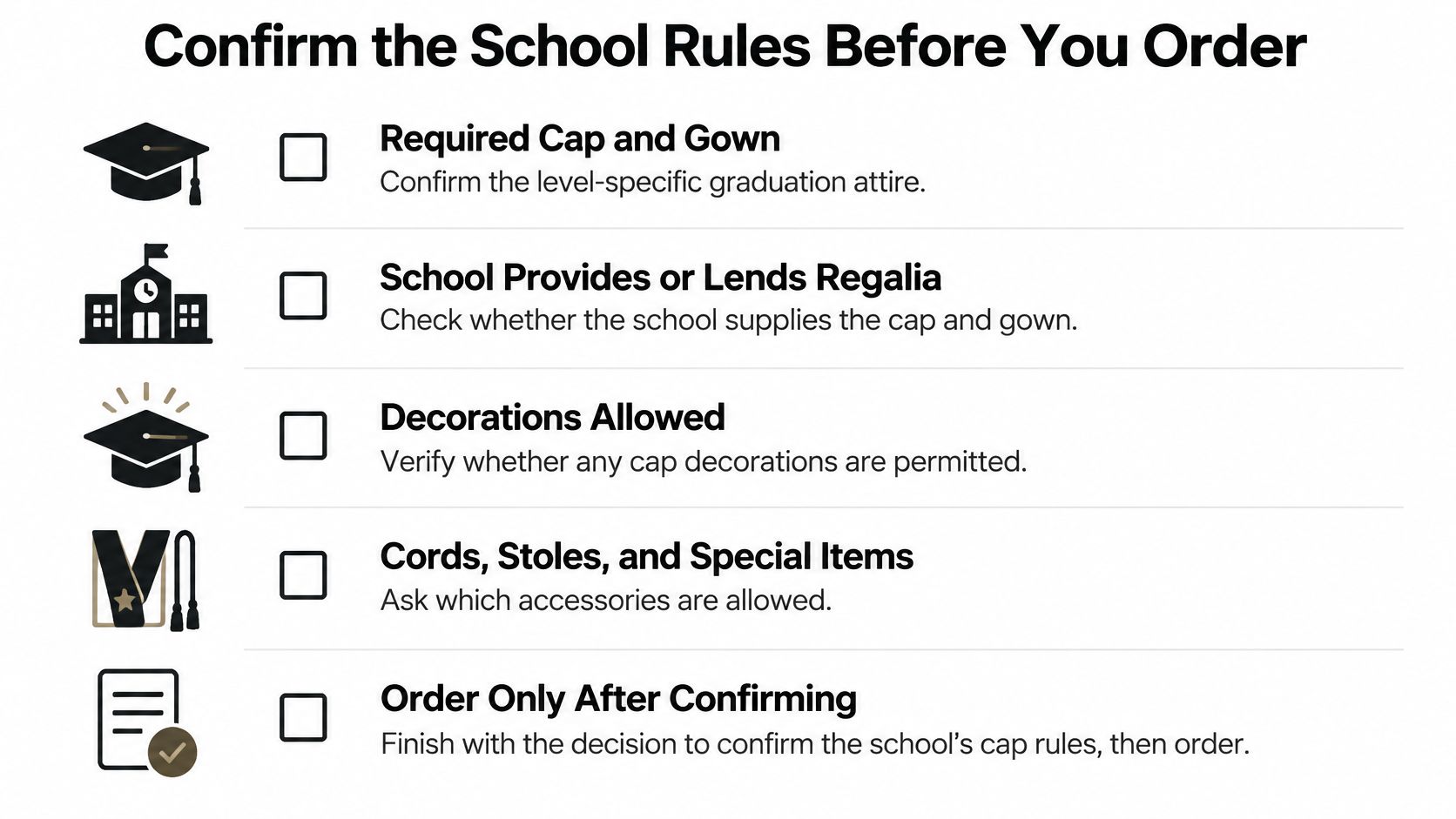
Before ordering, get clear answers to these questions:
- Required cap and gown: Which set and color does the school require?
- School-provided regalia: Must families buy, borrow, or return a gown?
- Decorations, cords, and stoles: Are they allowed? Get the answer in writing.
- Sizing method: Does the school use a one-size kindergarten cap or require a head measurement?
- Delivery and bulk orders: When must the items arrive, and who receives a school order?
Gradshop offers caps and tassels for high school, junior high, elementary, and kindergarten or preschool, along with gowns and accessories for these levels. Kindergarten and preschool apparel includes caps, gowns, tassels, honor cords, stoles, diploma covers, diplomas, medals, and collars. High school tassels are available in 16 colors, so confirm the school's color before choosing. The Shiny Maroon Kindergarten/Preschool Cap is a one-size-fits-most option. For high school, Gradshop offers caps and gowns in 16 colors; a Matte White High School Gown is one available choice. White mortarboard caps and tassels can complete the outfit. Gradshop can personalize graduation products for a school's ceremony. For guidance on how the pieces are worn, see how to wear academic regalia after the school confirms its requirements.
Send the school a short email:
Please confirm the required cap and gown color, whether families should buy or borrow the gown, and whether decorations, cords, or stoles are permitted. Please also tell us how caps should be sized, when orders must arrive, and who receives a school order.
Use the school's reply to choose the regalia and set the order deadline. Gradshop offers children's graduation apparel from kindergarten through high school, as well as bachelor's, master's, and doctoral regalia. Browse Gradshop's graduation products once the school's requirements are clear.