

Putting on your cap and gown isn't just about getting dressed for the big day. It’s about correctly assembling the gown, cap, tassel, and any honors like stoles or cords to present a polished look that respects centuries of academic tradition.
Your Guide to Graduation Day Attire
Graduation day is a huge milestone, and looking the part is a big piece of the experience. This guide will walk you through exactly how to wear your academic regalia, step by step. We'll break down each component, giving you a clear roadmap to putting everything on with confidence.
While making sure your own attire is perfect, you might also be thinking about how to celebrate the graduates in your life. You can explore thoughtful graduation gifts to find a meaningful way to mark their achievement. Honoring this moment is a blend of personal celebration and following long-standing academic customs.
Understanding the Symbolism
Every piece of your regalia is packed with history and meaning, turning it from a simple outfit into a symbolic uniform. When you put it on, you're connecting with a tradition that goes back centuries, adding real weight and significance to your accomplishment.
The practice of wearing academic regalia started back in the 12th and 13th centuries with the first European universities. Without central heating, scholars wore long robes and hoods simply to stay warm in drafty buildings. These early garments were modeled after clerical dress, which made sense given the close ties between academia and the church at the time.
Today, every element carries a specific meaning. The gown’s cut tells everyone your academic level, the hood's vibrant colors represent your field of study and university, and even the tassel's placement signals your new status as a graduate.
Before we dive into the how-to, let's get a quick overview of each piece you'll be wearing. This at-a-glance checklist will help you identify every component and its purpose.
Academic Regalia Checklist At-a-Glance
| Regalia Component | Academic Level | Key Placement Detail |
|---|---|---|
| Gown | All Levels | The main robe; style varies by degree (e.g., sleeve shape). |
| Cap (Mortarboard) | All Levels | Worn flat on the head, parallel to the ground. |
| Tassel | All Levels | Starts on the right side, moved to the left after conferral. |
| Stole | Varies | Draped around the neck, lying flat on the chest. |
| Honor Cords | Varies | Looped over the neck, hanging down the front. |
| Hood | Master's & Doctoral | Draped over the shoulders, displaying colors down the back. |
Understanding these basics makes the entire process of getting ready much smoother and less stressful on an already exciting day.
Your Regalia Checklist
To properly wear your academic attire, it helps to know what each piece is for and where it goes. Here’s a quick rundown of what you'll be handling on the big day:
-
The Gown: This is the foundation of your entire look. It goes on over your clothes and should be zipped all the way up. The style of the gown itself signifies your degree—bachelor’s gowns have pointed sleeves, master’s have long, oblong sleeves, and doctoral gowns feature full bell sleeves with velvet chevrons.
-
The Cap (Mortarboard): This needs to sit flat on your head, with the board parallel to the ground. It’s not a hat, so resist the urge to tilt it back. A couple of bobby pins are your best friend here, especially if you have long or smooth hair that might let it slip.
-
The Tassel: This is the most symbolic moving part of your outfit. Before your degree is officially conferred, the tassel hangs on the right side of your cap. During the ceremony, you’ll get the signal to move it to the left side, a small but powerful gesture that marks your transition from candidate to graduate.
-
Honors (Stoles, Cords, Medallions): These items are all about celebrating your specific achievements. Stoles are draped evenly over the neck so they lie flat against your gown. Honor cords are looped around your neck, with the tassels hanging neatly down the front.
Getting the Cap and Gown Just Right
Your cap and gown are the centerpiece of your graduation look. Getting the fit right is the difference between looking sharp and feeling sloppy, so let's make sure you look and feel your best on the big day.
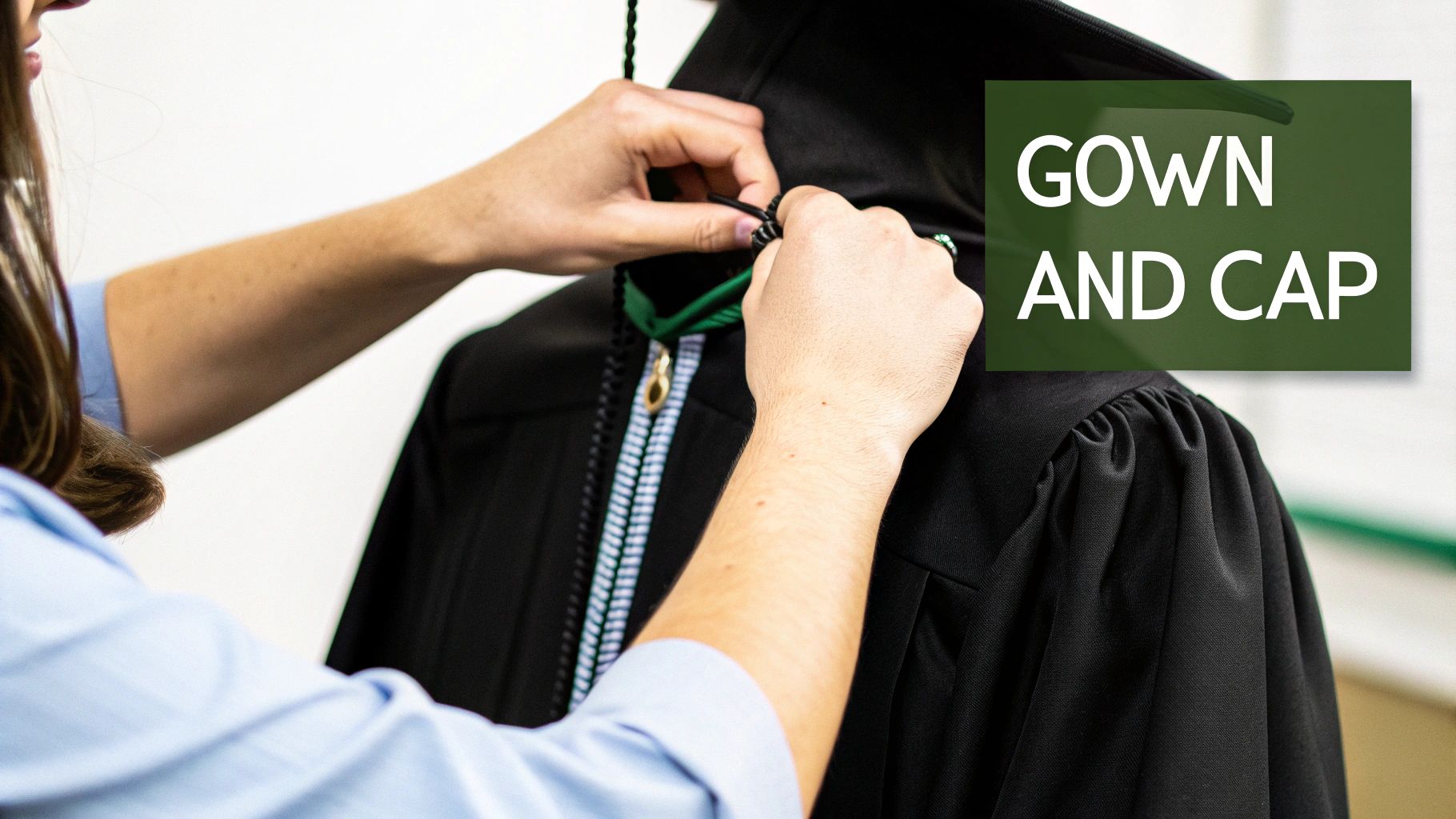
First things first: get those wrinkles out. Your gown has probably been folded up in a package, so give it a light steaming a day or two before the ceremony. Whatever you do, don't use a hot iron—the synthetic fabric can melt in an instant. When it's time to get dressed, zip the gown all the way up for a clean, formal line. A quick test of the zipper beforehand can save you from a last-minute panic.
Nailing the Perfect Gown Fit
The length of your gown is a big deal for both style and safety. You want it to fall somewhere between your knee and your ankle. This sweet spot makes you look distinguished without creating a trip hazard as you walk across the stage.
The perfect length allows the bottom of your pants or dress and your shoes to show. It’s a small detail that creates a polished, intentional look. If you're wrestling with which size to order, our guide on measuring for the right graduate cap and gown has all the details you need.
A Quick Tip from Experience: What you wear underneath really matters. Opt for business casual or professional attire. A crisp collar or a nice pair of dress shoes peeking out from under your gown elevates your whole appearance and honors the formality of the day.
Gown sleeves are another detail that signals your academic level. Bachelor's gowns have simple, pointed sleeves. Master's and doctoral gowns get a bit more elaborate. For example, back in 1959, the American Council on Education updated the standards, giving master's gowns long, closed sleeves with an opening at the wrist. That update also gave master's and doctoral candidates the option to wear their gowns open or closed.
How to Wear Your Cap (Mortarboard) Correctly
The mortarboard can feel a little strange at first, but it's easy to get right. The number one rule is to wear it flat on your head, so the square top is parallel to the ground. A lot of people tilt it back like a hat, but that’s the most common mistake.
To figure out the front from the back, look for the slightly pointed end of the headpiece—that part goes to the back. The front should sit about one inch above your eyebrows.
If you have a hairstyle that makes the cap feel wobbly, bobby pins will be your savior. Here's a trick I've seen work for countless graduates:
- Make an "X": Cross two bobby pins over each other to form an 'X'.
- Anchor it: Slide the 'X' through the inner fabric edge of the cap and into your hair.
- Double Up: Place one 'X' on each side of your head, just above your ears. This creates a surprisingly secure hold that will survive pictures, hugs, and all the excitement of the ceremony.
Regalia Styles for Every Academic Level
While the basics are the same, the regalia evolves as you move up the academic ladder.
High school graduates typically wear a classic gown and mortarboard, usually in their school colors. There's a huge selection of styles to browse in Gradshop's High School Caps & Gowns collection.
The details become more distinct at higher levels:
- Bachelor's Gown: Known for its simple design and pointed sleeves.
- Master's Gown: Features unique oblong sleeves that are closed at the end with a slit for your arm.
- Doctoral Gown: This is the most ornate of the bunch. Look for the plush velvet panels running down the front and three velvet bars (called "chevrons") on each of the full, bell-shaped sleeves.
By taking a few minutes to master these basics, you're not just putting on a uniform—you're stepping into a tradition and showing the world the dignity of your achievement.
The Tassel Turn and Its Significance
It might just look like a small tassel hanging from your cap, but its journey from one side to the other is the symbolic grand finale of your academic career. Honestly, getting this simple gesture right is a huge part of wearing your regalia correctly and feeling confident on the big day.

Before the ceremony kicks off, there's one golden rule: your tassel hangs on the right side of your cap. This placement shows that you're still a candidate for graduation, poised to receive your degree. It’s a position of anticipation, representing all the late-night study sessions and hard work that got you here.
The Pre-Ceremony Placement
Think of the right side as your "before" status. Placing your tassel there ensures you’re in formation with every other graduate, ready for that pivotal moment.
Even if you’re a master's or doctoral candidate who has graduated before, the rule still applies for this ceremony. Your tassel starts on the right to honor the specific degree you’re about to receive now.
For a deeper dive into the history of this tradition, our guide on what side the tassel goes on has some great background information. It’s a small detail, but it connects you to generations of scholars.
Executing the Perfect Tassel Turn
The "turning of the tassel" is the moment it all becomes real. This is the physical act that marks your official transition from student to graduate. It’s a genuine rite of passage, and you’ll want it to go smoothly.
Typically, this happens all at once after a university leader officially confers the degrees on your graduating class.
You'll hear a clear instruction from the stage, something like, "Graduates, you may now move your tassels from the right to the left." Seeing everyone do this together is a powerful visual of a shared accomplishment.
Here’s how to nail it when your moment comes:
- Wait for the cue. Don't jump the gun! It’s a common mistake in all the excitement. Wait for the official announcement.
- Use your right hand to reach up and get a good grip on your tassel.
- Move it smoothly. In one clean motion, bring the tassel over the button in the center of your mortarboard and guide it to the left side.
- Let it settle. Let the tassel hang freely on the left. It now represents your new status as an alum.
With that simple move, your academic transformation is complete. The tassel’s new home on the left side is a badge of honor you’ll carry for the rest of the day—and a memory you’ll keep for a lifetime.
Wearing Your Stoles, Cords, and Medallions with Pride
Your honors—the stoles, cords, and medallions you’ve earned—are more than just accessories. They’re the visual representation of your late-night study sessions, your dedication to your field, and your unique achievements. Wearing them correctly ensures your story is told with the respect it deserves.
These pieces personalize your regalia, showcasing everything from your academic standing and society memberships to your cultural heritage or military service. Let's walk through how to arrange everything so you look distinguished, not disorganized, on your big day.
How to Properly Wear a Graduation Stole
The graduation stole, or sash, is often the most eye-catching piece of your regalia. It drapes over your shoulders and hangs down the front of your gown. The goal here is simple: balance and symmetry.
Make sure the stole lies flat against your shoulders and chest, with the center seam sitting right at the back of your neck. Both sides should hang evenly. You don't want it bunched up behind your head or hanging lopsided—it's a small detail that makes a big difference in photos.
What if you've earned multiple stoles? Wear them! The best approach is to layer them neatly, one on top of the other. The first stole goes directly on your gown, and the second one lies smoothly over it. You can even stagger them slightly so the emblems on both are visible. For a look at different styles and how they're meant to be worn, check out this beautiful collection of Graduation Stoles.
Pro Tip: Stoles can be slippery. To keep yours perfectly in place throughout the ceremony, use a small safety pin or a bit of double-sided fabric tape on each shoulder. Attach it from underneath your gown so it's completely invisible. No more fidgeting while you wait for your name to be called.
Arranging Your Honor Cords
Honor cords are the twisted ropes with tassels that signify specific distinctions, like graduating cum laude or your membership in an academic society.
To wear them, just drape the cord over the back of your neck so the tassels hang evenly down the front. If you have more than one cord, group them together and drape them as a single bunch. This keeps them from looking messy or getting tangled.
The cords should always hang underneath your stole. Think of it as creating a clean, layered look where each honor is clearly visible. The stole acts as a frame for the cords, creating a nice visual hierarchy of your accomplishments. For a closer look at the etiquette, our guide on how to properly wear graduation honor cords has all the details.
Understanding Cord Colors and Meanings
Those cord colors aren't just for show—they carry specific meanings. While the exact system can vary between institutions, many colors follow a traditional academic code.
Here are a few common associations you might see:
- Gold or Gold/White: Almost universally represents high academic honors (like Summa Cum Laude) or membership in a national honor society.
- Light Blue: The traditional color for the field of Education.
- Red: Often signifies achievements in areas like Journalism, Public Service, or Theology.
- Silver: Frequently used for service cords to recognize significant contributions through volunteer work.
It's always a good idea to double-check with your university or the specific honor society to confirm what your colors represent. After all, you earned them—you should know the story they tell
Decoding and Draping the Academic Hood
The academic hood, reserved for master's and doctoral graduates, is easily the most impressive and symbolic part of your regalia. It’s also the one piece that can feel a bit baffling to put on correctly. But don’t worry—with a couple of simple tricks, you’ll be draping it like a seasoned pro in no time.
Your hood goes over your gown, draping down your back to showcase the colors of your university and your field of study. It’s a powerful symbol of your advanced degree, so let's get it right so you can wear it with pride.
Understanding the Parts of Your Hood
Before you even try to put it on, it helps to know what you’re working with. An academic hood has three key parts, and each one means something:
- Shell: This is the main body of the hood, usually made of black fabric to match your gown.
- Lining: The brightly colored satin interior shows off the official colors of the university that’s granting your degree.
- Trim: The velvet trim on the outer edge is a color code for your specific field of study. The width of this band also matters—it's three inches for a master's degree and a more substantial five inches for a doctorate.
Getting a feel for these different parts makes the whole draping process much more intuitive. If you want to see some high-quality examples, take a look at the collection of Master’s & Doctoral Regalia from Gradshop.
Step-by-Step Draping Instructions
First, place the hood over your head so it drapes down your back, with the velvet side up. The narrowest point of the hood should sit at the front of your neck.
Next, feel for a small loop or cord at the front. This little piece is a game-changer. It's designed to fasten to a button on your shirt or blouse, which keeps the hood from sliding backward and choking you during the ceremony. If you aren't wearing a buttoned shirt, a small safety pin attached to your gown will do the trick just as well.
Crucial Tip: The number one mistake I see graduates make is forgetting to "turn" the hood. Once it's secured in the front, the beautiful satin lining with your school colors is still hidden. You have to flip it to get that iconic look.
To reveal the colors, reach behind you and flip the velvet trim outward all along the edge of the hood. As you do this, the satin lining will naturally roll out and become visible. You’ll want to adjust it until your university colors are on full display, creating a brilliant split of color down your back. This is where having a friend to help is invaluable—they can make sure it’s all straight and symmetrical.
The infographic below shows how to layer all your academic honors for a complete, polished look.
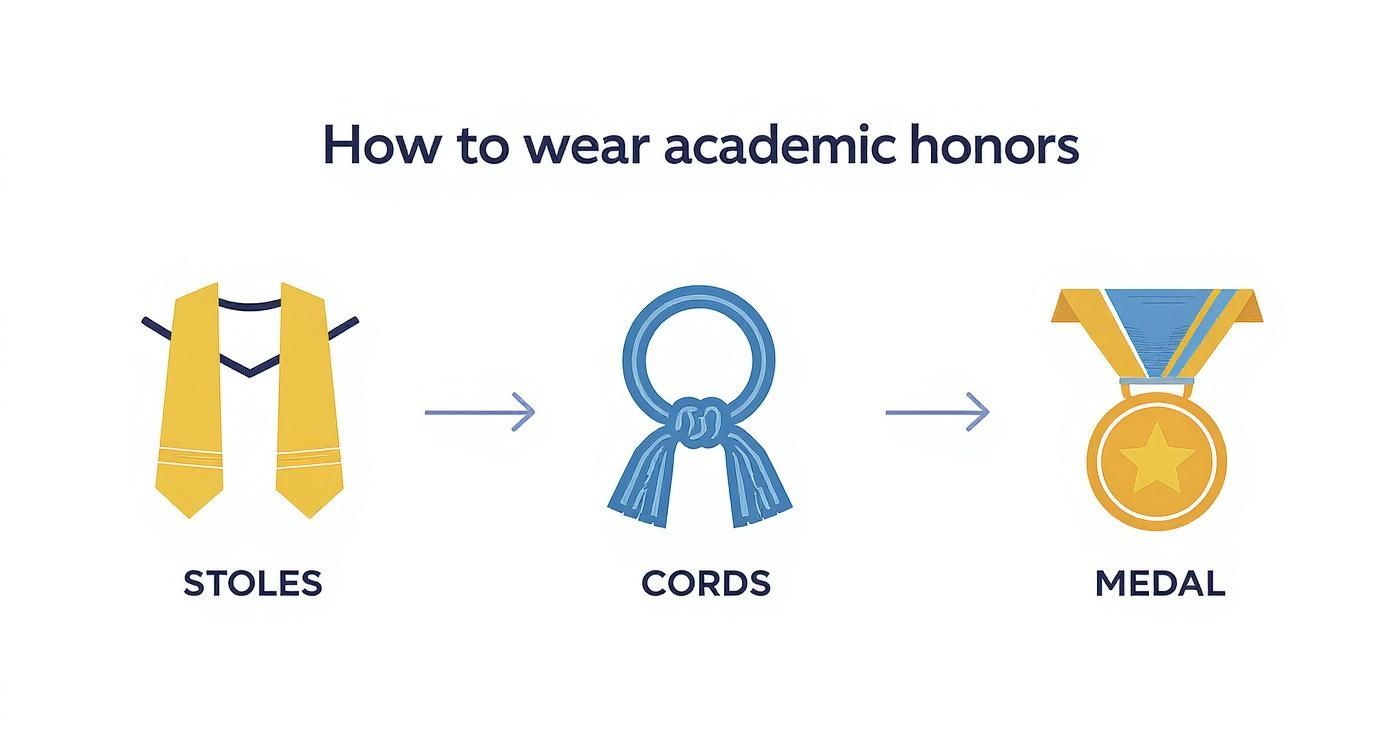
This visual guide gives you a great sense of how your stoles, cords, and medallions should sit in relation to your hood.
The Color Code of Your Field of Study
That velvet trim on your hood isn't just for looks—it’s a universal code that tells everyone your area of expertise. The Intercollegiate Code of Academic Costume assigns specific colors to different disciplines, which is why graduation ceremonies are such a rich tapestry of academic achievement.
Here is a quick reference for some of the most common velvet colors you'll see.
Common Academic Hood Velvet Colors by Field of Study
| Color | Field of Study | Example Degrees |
|---|---|---|
| White | Arts, Letters, Humanities | Master of Arts (M.A.), Master of Fine Arts (M.F.A.) |
| Science Gold | Natural & Physical Sciences | Master of Science (M.S.), Ph.D. in Biology/Chemistry |
| Light Blue | Education | Master of Education (M.Ed.), Doctor of Education (Ed.D.) |
| Drab | Business, Commerce | Master of Business Administration (M.B.A.) |
| Salmon Pink | Public Health | Master of Public Health (M.P.H.) |
| Citron | Social Work | Master of Social Work (M.S.W.) |
| Peacock Blue | Public Administration | Master of Public Administration (M.P.A.) |
Knowing what your discipline's color represents adds a whole other layer of meaning to your regalia. You’re not just connected to your university, but to a global community of scholars in your field. By mastering how to wear your hood, you ensure you represent your hard-earned degree with the distinction it truly deserves.
Beyond the Basics: Care, Etiquette, and Storage
Getting through graduation day smoothly involves more than just knowing how to put on your regalia. A little prep work can make a world of difference in your comfort and confidence when the big day arrives.
The first thing you’ll probably notice when you unbox your gown is the wrinkles from shipping. For a sharp, polished look, I always recommend steaming it a day or two before the ceremony. An easy trick is to hang it in the bathroom while you take a hot shower—the steam will gently release most of the creases.
Just be extremely careful with heat. Never use a hot iron directly on the gown. The fabric is almost always synthetic and can melt in an instant, and that's a disaster you don't need. If you must iron, use a very cool setting with a pressing cloth between the iron and the gown.
Etiquette During the Ceremony
Once you’re dressed, it’s time to think about ceremony etiquette. A graduation is a formal event, and following a few simple traditions shows respect for the moment, the institution, and everyone who has gathered to celebrate. You’ll be doing a lot of sitting and standing, so just follow the cues from the speakers on stage.
It's a long-standing tradition for men to remove their caps during the national anthem and other moments of reverence. Women typically keep their caps on throughout. Your school will probably cover this in their instructions, but it's a good custom to be aware of ahead of time.
Maintaining a sense of decorum honors the significance of the day. It shows respect not just for the tradition, but for every graduate who worked hard to be there with you.
What to Wear Under Your Gown
Choosing what to wear under your gown is all about comfort and common sense. Think about the venue and the weather. Most gowns are made from polyester and can get surprisingly warm, especially if you're in a crowded auditorium or sitting outside in the sun.
Here are a few tips I've learned over the years:
- Lightweight Fabrics: Stick with breathable materials like cotton or linen to help you stay cool.
- Comfortable Shoes: This is a big one. You'll be standing around for a long time and walking quite a bit. Sensible dress shoes, wedges, or smart flats are a much better choice than brand-new stilettos.
- Professional Attire: Business casual is usually a safe bet. A simple dress, or a collared shirt and dress pants, will look great for photos when you unzip your gown after the ceremony.
Post-Ceremony Care and Storage
After all the photos are taken and the celebration winds down, don’t just wad up your regalia and forget about it. With a little care, it can be a wonderful keepsake for years to come. Start by spot-cleaning any small smudges and let it air out completely.
For long-term storage, fold it carefully and place it somewhere cool, dry, and dark. A breathable garment bag is perfect for keeping it safe from dust and pests. Learning the art of storing clothes properly is key to making sure your regalia stays in pristine condition. These simple steps will turn your cap and gown from a one-day rental into a lasting symbol of your achievement.
Answering Your Regalia Questions
Even after you've figured out the gown, hood, and tassel, a few last-minute questions always seem to pop up on the day of the ceremony. Getting these sorted out beforehand can save you a lot of stress and help you focus on enjoying your moment.
Here are the answers to some of the most common things graduates wonder about when it comes to their regalia.
Can I Decorate My Graduation Cap?
This is easily the number one question we get, and the answer is a classic: it depends on your school. Some universities absolutely love seeing the creativity and personal expression that comes with a decorated cap. Others, however, have stricter policies to keep the look of the ceremony uniform and formal.
Your best bet is to check the official graduation guidelines on your school's website. If they give the green light, decorating your cap is a fantastic way to give a shout-out to your family, flash your personality, or even hint at your future plans. If not, it's best to respect the rules.
What Do I Do with My Phone and Keys?
Here’s a pro tip from someone who’s seen it all: travel light. Seriously. Most graduation venues won't let you bring bags, purses, or backpacks in with you, and there's usually nowhere to stash them. You definitely can't walk across the stage clutching your belongings.
Plan Ahead: Your best move is to hand off your phone, wallet, and keys to a trusted family member or friend who will be in the audience. If you absolutely must have something on you, make sure it’s small enough to slip into a pocket, hidden away under your gown.
My Hood Has a Loop, but I'm Not Wearing a Button-Up Shirt. What Now?
This is a very common snag for master's and doctoral candidates, especially those wearing dresses. That little elastic loop on the front of your academic hood is meant to hook onto a shirt button to keep it from riding up your neck. But don't worry if you don't have one.
A small safety pin is your best friend here. Just use it to discreetly attach the loop to the inside of your gown or the fabric of your dress right at the collarbone. It works like a charm to keep the hood anchored in place so it sits properly and comfortably all day long.
At Gradshop, we know how much this day means. We're dedicated to providing top-quality regalia that helps you celebrate your incredible achievement with confidence and style, from high school graduations to doctoral ceremonies. Find the perfect attire for your big day by exploring our full collection at https://www.gradshop.com.