

When you're getting ready for graduation, the first thing to figure out is your cap and gown length. It's all based on one simple measurement: your height. The whole point is to have the gown's hemline fall somewhere between your knee and your ankle.
Think of it like this: you don't want it so short it looks like a lab coat, but you also don't want it so long you're tripping over it on your way to get your diploma. Getting that length just right is what gives the entire graduating class that sharp, unified look.
Your Quick Guide to the Perfect Gown Length
Nailing the right gown length is the key to looking and feeling great on your big day. It might seem like a tricky detail, but it's actually pretty simple. Gown sizes are designed to correspond directly to your total height, measured from the top of your head to the floor. This standardized system makes sure everyone achieves that classic, dignified silhouette.
If you want to get into all the nitty-gritty details, our comprehensive guide on graduation gown length covers every angle.
Finding Your Fit with a Quick Chart
Most suppliers, including us, offer a sizing chart to make things super easy. It takes all the guesswork out of the equation by matching your height to a specific gown size. This is hands-down the most reliable way to make sure you're ordering the right fit from the get-go.
The goal is to find a gown that hangs elegantly without overwhelming your frame or appearing too short. The sweet spot—mid-calf—creates a clean line that works well with formal attire worn underneath, allowing your shoes and any visible trousers or skirt hem to complete the look.
To help you out, we’ve put together a quick reference chart below. It connects your height directly to the recommended gown size and shows you where the hemline should end up. This way, you have a clear visual guide before you even place your order.
Recommended Gown Length by Your Height
Use this chart as a quick reference to find the right gown size and see where the hemline should fall based on your height.
| Your Height (Head to Toe) | Recommended Gown Size | Typical Hemline Position |
|---|---|---|
| 4'9" – 4'11" | 39 | Lower Calf |
| 5'0" – 5'2" | 42 | Mid-Calf |
| 5'3" – 5'5" | 45 | Mid-Calf |
| 5'6" – 5'8" | 48 | Mid-Calf |
| 5'9" – 5'11" | 51 | Mid-Calf |
| 6'0" – 6'2" | 54 | Mid-Calf |
| 6'3" – 6'5" | 57 | Upper Ankle |
Just find your height in the first column, and you'll see the gown size you need and how it’s meant to fit. It’s that simple
Why Your Gown Length Changes With Your Degree
Ever noticed that not all graduation gowns look the same? That’s entirely by design. Think of academic regalia as a bit like a military uniform—the stripes, medals, and other details all signify rank and accomplishment. In the same way, the style and length of your gown evolve as you climb the academic ladder, with each new level bringing a more distinguished design.
This tradition creates a visual shorthand that honors the hard work and dedication poured into higher education. A high school gown is simpler and shorter, designed for practicality and a clean, uniform look. But as you progress, your regalia becomes more elaborate, a clear reflection of your increased specialization and academic commitment.
From High School to Higher Ed
The journey starts with the high school gown, which usually hits around mid-calf. This practical cut keeps things comfortable and ensures everyone looks sharp and unified. It’s the foundational piece of academic wear, symbolizing the successful end of one chapter and the exciting start of another.
Once you hit the university level, the regalia really starts to tell a story:
- Bachelor's Gowns: These are a step up in length, typically falling below the mid-calf. The design is still clean and simple, with traditional pointed sleeves that signify the holder has earned their undergraduate degree.
- Master's Gowns: Now things get interesting. A master's gown features unique oblong sleeves that are closed at the end, with a slit for your arms to pass through. It’s the first major design shift, clearly marking a graduate's advanced studies.
- Doctoral Gowns: Representing the pinnacle of academic achievement, these gowns are the most ornate. They’re fuller, often made of higher-quality material, and distinguished by three velvet chevrons on full, bell-shaped sleeves. You'll also see matching velvet panels running down the front.
It's All About Tradition
These specific design details aren't just for show; they're rooted in a long history of academic tradition. The Intercollegiate Code of Academic Costume, established over a century ago, standardized these elements to create a unified system across different institutions.
For example, the code dictates that even the academic hood grows with each degree. A bachelor's hood is three feet long, a master's is three and a half feet, and a doctoral hood stretches to a full four feet. These established guidelines ensure that anyone familiar with academic tradition can recognize a graduate's level of achievement at a glance.
Want to learn more about the specifics of postgraduate attire? You can get to know the master's degree gown and hood in our detailed guide. Understanding these traditions adds a whole new layer of meaning to the cap and gown you'll wear on your big day.
How to Measure Yourself for a Graduation Gown
Getting the right fit for your graduation gown all comes down to one simple thing: an accurate measurement. Just like getting a suit tailored, starting with the correct numbers is the secret to looking sharp and feeling confident. The single most important measurement for your gown is your height, taken from the top of your head straight down to the floor.
That one number is what determines your gown size. The sizing is standardized, so your height directly translates to a specific gown size code. Getting this right ensures your gown’s hemline hits at the perfect spot, giving you that timeless, classic look for your commencement.
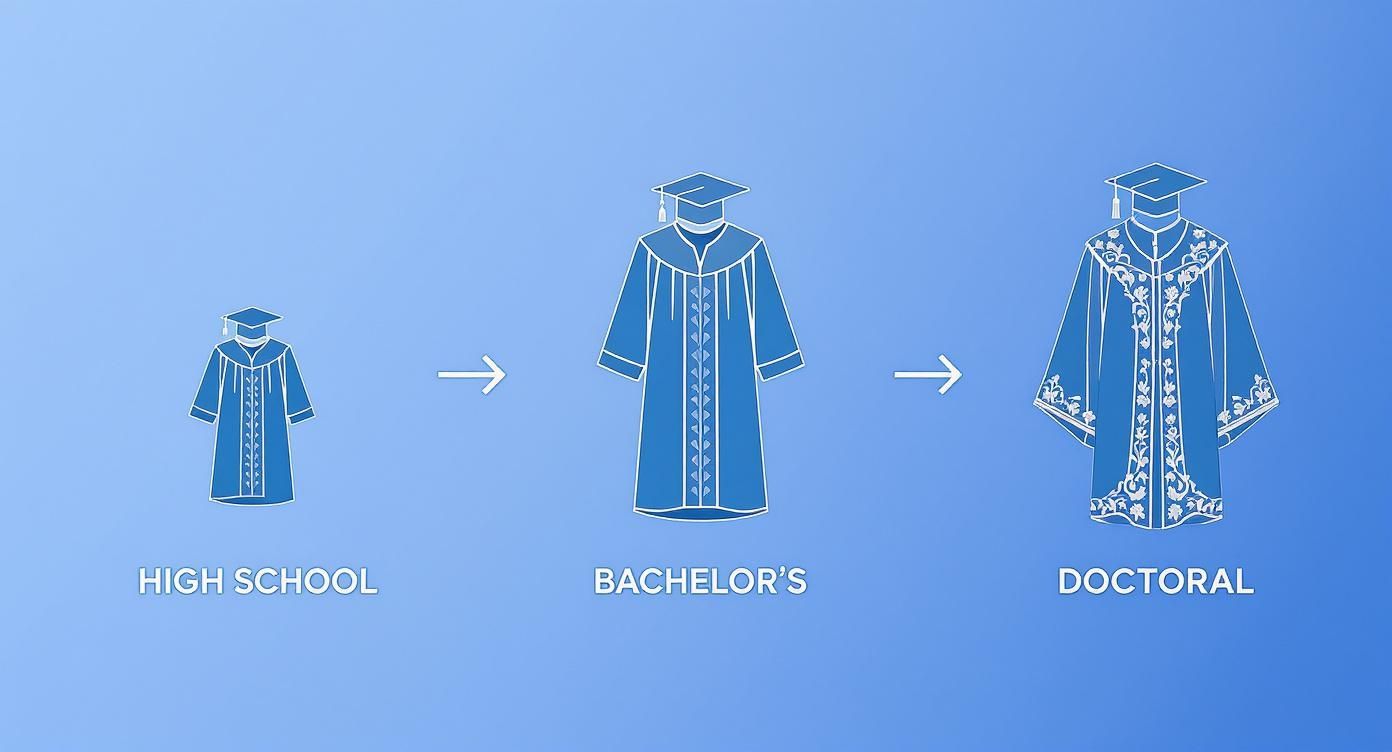
As you move up the academic ladder, the regalia not only becomes more elaborate but also longer, symbolizing the higher level of achievement.
The Step-by-Step Measurement Process
Taking an accurate height measurement is easy, but it helps to have a friend and a tape measure on hand to get it just right.
- Stand Tall: Find a flat, empty wall and stand with your back against it. Your heels, back, shoulders, and the back of your head should all be touching the wall.
- Look Straight Ahead: Keep your chin level and your gaze parallel to the floor. Don't look up or down.
- Mark Your Height: Ask your friend to place a flat object, like a ruler or hardcover book, flat on top of your head. They should then make a small pencil mark on the wall where the bottom of the object rests.
- Measure Up: Now, step away from the wall. Use the measuring tape to find the distance from the floor up to the mark. That’s it—you’ve got your height!
Pro Tip: Don't forget your shoes! It’s a small detail that makes a huge difference. Be sure to measure your height while wearing the exact shoes you’ll have on for graduation day. Even a small heel can alter the gown's length, so accounting for it now prevents any surprises later.
Matching Your Measurement to a Size Chart
With your height measurement in hand, you're ready to find your size. To make things simple, we use a standard sizing chart where your height corresponds directly to a gown size. No guesswork involved.
Here’s a quick guide to help you find your perfect fit. Just take your height—with your graduation shoes on—and find the corresponding size in the table below.
Gown Size Chart by Height Measurement
Find your perfect gown size by matching your height (measured with shoes on) to the corresponding size code in this table.
| Height Range (with shoes) | Standard Gown Size | Full Fit Gown Code (if needed) |
|---|---|---|
| 4'6" to 4'8" | 39 | 39FF |
| 4'9" to 4'11" | 42 | 42FF |
| 5'0" to 5'2" | 45 | 45FF |
| 5'3" to 5'5" | 48 | 48FF |
| 5'6" to 5'8" | 51 | 51FF |
| 5'9" to 5'11" | 54 | 54FF |
| 6'0" to 6'2" | 57 | 57FF |
| 6'3" to 6'5" | 60 | 60FF |
| 6'6" to 6'8" | 63 | 63FF |
If you need a bit more room, the "Full Fit" (FF) option provides extra space through the chest and shoulders without adding unnecessary length.
For a deeper dive, our detailed article explains exactly how to measure for a cap and gown and includes more comprehensive charts to help you lock in your size.
Ultimately, a well-fitting gown helps you focus on your big moment instead of fidgeting with your attire. Taking just a few minutes to measure correctly ensures you’ll feel comfortable and look fantastic when you walk across that stage.
Finding a Comfortable Fit for Your Body Type
While getting the cap and gown length right is the first step, finding a truly comfortable fit is all about your individual body shape. Nothing ruins the moment like a gown that’s pulling at your shoulders or feels too snug across the chest. The whole point is to have a gown that drapes well and lets you move freely—walking, sitting, and especially crossing that stage.
That’s why most sizing charts give you more than just one standard option. Knowing what those options mean is the key to picking a gown that doesn't just look sharp but feels like it was made for you.
Standard Fit vs. Full Fit Gowns
When you start browsing for gowns, you'll almost always run into two choices: Standard Fit and Full Fit. It's a common mistake to think this affects the gown's length—it doesn't. This choice is entirely about the roominess in the upper body.
A good way to think about it is like choosing between a regular-fit and a relaxed-fit t-shirt. They’re both the same length, but one is designed with more fabric to accommodate broader shoulders or a fuller chest. A full fit gown does exactly that, giving you that extra space so the material doesn’t stretch or bunch up in an unflattering way.
Choosing a full fit gown gives you a more generous cut through the chest and shoulders without adding a single inch to the length. This is the secret to getting a comfortable and flattering silhouette if you have a broader build.
So, how do you know which one to pick? A simple rule of thumb is to think about your everyday clothes. If you typically wear plus-size, "big and tall," or just find standard sizes a bit restrictive in the shoulders, the full fit gown is almost certainly your best bet. It’s designed to let you focus on your ceremony, not on your regalia.
Tips for Choosing the Right Gown Width
Getting the fit right is about more than just your height and weight. Your overall build, and especially your shoulder width, makes a huge difference in how a gown will hang and feel.
Here are a few practical tips to help you nail the perfect choice:
- Factor in Your Shoulders: If you have broad shoulders, whether from sports or just your natural frame, a full fit gown will prevent that tight, constricting feeling across your back.
- Look at Chest Measurements: Some sizing charts provide specific chest measurements. It’s always a good idea to compare these to your own to make sure you’ll have enough room without the gown looking too baggy.
- Don't Size Up for More Room: This is the most important tip. Never order a longer gown just to get more width. You’ll end up with a gown that’s way too long. Stick to your correct height bracket and select the full fit option instead.
At the end of the day, graduation is a celebration of all your hard work. Choosing a gown that fits comfortably means you can stand tall, feel confident, and soak in every single moment without giving your outfit a second thought.
Simple Fixes for Common Gown Fit Issues
So, your gown arrived. You tried it on, and even after all that careful measuring, the fit isn't quite perfect. Don't panic! Most small fit problems can be handled right at home without a trip to the tailor.
A few simple tweaks can make a world of difference in how you look and feel on the big day. Whether the hem drags just an inch too low or the sleeves feel a little too roomy, there are some easy, temporary solutions. The idea is to polish your look for photos and the ceremony without permanently changing the gown.
Handling Gown Length and Sleeve Issues
By far, the most common issue is the cap and gown length being a little off. If your gown is slightly too long, resist the urge to get out the scissors. A permanent alteration like cutting or sewing is a bad idea—it can easily damage the fabric and is total overkill for a garment you'll wear for a few hours.
Instead, let's look at a few no-sew tricks that work like a charm:
- Fabric Hem Tape: This stuff is a lifesaver for a quick hem adjustment. Just fold the hem underneath to the length you want, and use this iron-on or press-on tape to hold it in place. It gives you a crisp, invisible line that will easily last through the ceremony.
- Safety Pins: In a real pinch, you can always pin the hem up from the inside. The trick is to use several small pins along the hem to keep the line straight and prevent any awkward bunching.
And if the sleeves feel too baggy? A single safety pin, placed discreetly on the inside seam up near your armpit, can cinch things up just enough.
What to Adjust and What to Avoid
The golden rule here is to keep any adjustments temporary and reversible. You want to be able to return the gown to its original state, especially if it’s a rental or a keepsake you want to preserve.
Never make permanent changes like cutting the fabric or using glue. These can absolutely ruin the polyester material and might even get you in trouble with a rental company. Always stick to fixes that can be undone without leaving a mark.
Easy DIY Fixes (Do This):
- Use hem tape for length adjustments.
- Secure any loose fabric with safety pins on the inside.
- Wear shoes with a slightly taller heel to make up for an extra inch or two in length.
Alterations to Avoid (Don't Do This):
- Cutting the hem or the sleeves.
- Using a sewing machine, which can cause the fabric to pucker and bunch.
- Applying any kind of permanent adhesive or fabric glue.
With these simple strategies, you can fine-tune your fit and walk across that stage feeling confident and looking sharp.
A Look at Gown Traditions Around the World
While the American style of cap and gown is what most of us picture, it’s far from the only game in town. Once you step outside the U.S., you'll find an incredible variety of academic regalia, each with its own story shaped by centuries of university history.
Think of it like a language with different dialects. The core idea of celebrating academic achievement is universal, but the specific "accent"—the cut, color, and length of the gown—changes from place to place. In the United States, the system is pretty straightforward: the higher the degree, the longer the gown. But that's not how it works everywhere.
A Tale of Two Systems: UK vs. US Gowns
The differences really come to life when you compare American regalia to what you’d find in the United Kingdom. Unlike the standardized U.S. system, many UK universities have their own unique dress codes, which means you see a much wider and more eclectic range of styles.
In the UK and across Europe, gown length is often tied to the specific traditions of an individual university rather than a national standard. A classic example is the prestigious University of Oxford. There, a bachelor's gown is traditionally knee-length—much shorter than its American counterpart. Master's and doctoral gowns, however, are typically longer, often extending to the ankle or even the floor. You can read more about the growing global market for graduation attire on OpenPR.com.
This contrast drives home a key point: there is no single "correct" length for a cap and gown. What truly matters are the specific traditions of the institution you're graduating from. Your regalia is a direct reflection of your academic home.
For anyone studying abroad or attending an international university, getting to know these local customs is part of the experience. It’s a fascinating reminder that the cap and gown are more than just ceremonial outfits; they are living symbols of a rich and diverse global history of scholarship.
Common Questions About Gown Sizing and Care
Even with the best measurements, a few last-minute questions always seem to pop up as graduation day approaches. Let's tackle some of the most common ones so you can feel completely confident in your cap and gown.
Should I Size Up if I Am Between Two Sizes?
If your height lands you squarely between two sizes on the chart, the golden rule is to size up. It’s a simple matter of practicality.
A gown that's a touch too long is an easy fix—a pair of heels or even some temporary hem tape can solve it in a pinch. But a gown that’s too short? That’s a much bigger problem and can look awkward in photos. Going with the larger size gives you a little wiggle room and ensures you get that classic, flowing cap and gown length.
How Do I Know if I Need a Full Fit Gown?
The "full fit" option isn't about length; it's all about providing more room through the chest and shoulders. If you often find that shirts or jackets feel a bit snug across your upper body, or if you typically buy plus-size clothing, a full fit gown is probably the right call.
A full fit is designed for comfort. It stops the fabric from pulling or feeling tight, so you can move around easily without feeling restricted during a long ceremony.
Most sizing charts include weight or chest measurements to help guide you. When in doubt, choosing a full fit is a smart move for a more comfortable and flattering silhouette.
Can I Iron My Gown to Remove Wrinkles?
Putting a hot iron directly on your gown is a definite no-go. Most graduation gowns are made from polyester, which can melt or get a weird, permanent shine from direct heat. The best and safest trick is to use steam.
Just hang your gown in the bathroom, turn the shower on hot, and let the steam work its magic on the wrinkles. If you’re still seeing stubborn creases, a handheld steamer on a low setting is your best friend. In a real pinch, you can use an iron on its lowest synthetic setting, but always place a towel between the iron and the gown and test a small, hidden spot first.
From high school milestones to the culmination of a doctorate, Gradshop has the perfect regalia to mark your achievement. Take a look at our huge collection of high school gowns, create your own custom stoles, or find the perfect distinguished Master’s and Doctoral regalia to find your perfect fit today.