

Your master's graduation regalia isn't just a rental for the day; it's a symbolic outfit that tells a story. It’s a tradition steeped in history, with each piece—from the gown and cap to that all-important academic hood—signifying your incredible achievement. This is the attire that sets you apart from the undergraduates and doctoral candidates, marking a unique and hard-earned milestone.
What Your Master's Regalia Represents

Finishing a master’s degree is a huge deal, and the regalia you'll wear is designed to reflect that. It’s a step up from the simpler bachelor's gown, with specific elements that visually narrate your academic journey. This tradition actually dates all the way back to the 12th and 13th centuries in European universities, where academic robes were everyday wear for scholars.
Knowing what each piece means will make wearing it feel even more special. The full ensemble really boils down to three core components: the gown, the headwear, and the academic hood. Each one has features that are unique to the master's level.
Key Components of Your Regalia
Getting familiar with each part of your regalia ahead of time will save you a lot of hassle and confusion on commencement day. Here's a quick rundown of what to expect.
Let's start with a quick overview of the essential components.
Master's Regalia Components at a Glance
| Component | Key Feature | Symbolism |
|---|---|---|
| Gown | Oblong, crescent-shaped sleeves | Signifies an advanced degree, distinct from bachelor's or doctoral gowns. |
| Hood | Velvet trim and satin lining | Represents your specific field of study (velvet) and your university (satin). |
| Headwear | Mortarboard or Tam | Traditional academic headwear, part of the formal scholarly uniform. |
| Tassel | Color corresponds to discipline | Often moved from right to left to symbolize the conferring of the degree. |
Now, let's look at each of these in a bit more detail.
- The Master's Gown: The first thing you'll notice is the sleeves. Unlike the pointed sleeves on a bachelor's gown, a master's gown features distinctive oblong sleeves, which are open at the wrist and have a long, trailing portion in a crescent shape. This is the biggest giveaway that you’re looking at a master's candidate.
- The Academic Hood: This is easily the most colorful and meaningful piece. The velvet trim on the outside of the hood represents your specific field of study—for example, white for Arts or golden yellow for Science. The colorful satin lining on the inside showcases the official colors of the university granting your degree.
- The Cap and Tassel: Most master's graduates wear the classic mortarboard cap. However, some universities or programs offer a soft velvet tam as an alternative, which adds a touch of distinction. The tassel's color usually matches your field of study or your school's colors.
Walking across that stage is the culmination of countless hours of research, writing, and dedication. Understanding the story behind your master's degree graduation regalia connects your personal victory to a centuries-old tradition of scholarship, adding a whole new layer of meaning to the moment.
From the specific cut of the gown's sleeves to the vibrant, telling colors of your hood, every detail is intentional. This guide will walk you through putting it all together, so you can focus on enjoying your day with confidence.
Understanding Your Master's Gown and Cap

The gown is the centerpiece of your academic regalia, and the master's version has a signature feature that sets it apart from a bachelor's robe. It's all in the sleeves. Take a look—they're oblong and crescent-shaped, cut long with a slit at the wrist or forearm. This unique design isn't just for show; it's a traditional marker that signifies your advanced degree.
Most master's gowns you'll encounter are made from a durable polyester with a classic matte finish, which looks sharp and is perfect for the ceremony. Some graduates opt for more premium fabrics, especially if they're buying their regalia as a keepsake or anticipate wearing it again for future academic events. This is often the deciding factor when choosing between renting from the university or purchasing from a supplier like Gradshop.
Finding the Perfect Fit
Nothing spoils a great graduation photo like a sloppy, ill-fitting gown. You might be tempted to just guess your size, but don't do it. Academic gowns are sized almost exclusively by your height, not your t-shirt size.
Getting it right is simple:
- First, take your shoes off and stand up straight.
- Have a friend or family member measure you from the top of your head straight down to the floor.
- Use that exact measurement to find your size on the chart from your university or regalia supplier. A proper fit means the hem should fall somewhere between your knee and ankle.
A well-fitted gown not only looks more polished in photos but also ensures you're comfortable throughout the long ceremony. Taking five minutes to measure your height can make all the difference.
A gown that's too short or drags on the ground can really detract from the formal, dignified look you're going for. Always double-check the sizing chart, as they can vary slightly from one supplier to another.
Mortarboard vs. Tam: A Cap Comparison
Just as crucial as the gown is what you wear on your head. The traditional square mortarboard is still a very common sight for master’s candidates. However, many universities now offer the velvet tam as a more distinguished alternative.
The choice often comes down to your school's tradition and your own personal preference.
- Mortarboard: This is the classic flat, square cap you see everywhere. It’s the standard for many academic levels and is instantly recognizable. It's almost always included in a basic regalia rental package.
- Tam: A soft, velvet cap, typically with six or eight sides. It’s widely seen as a more comfortable and premium option, often associated with master's and doctoral graduates.
Many graduates find the tam more comfortable and prefer its softer silhouette. If your university gives you the choice, it’s worth trying one on. The number of sides—whether it’s four, six, or eight—is usually just a stylistic choice, not a rule tied to your degree.
For a deeper dive into these components, you can learn more by reading about the master's degree gown and hood. Getting these details right will help you feel confident and poised as you celebrate this huge accomplishment.
Understanding the Colors of Your Academic Hood
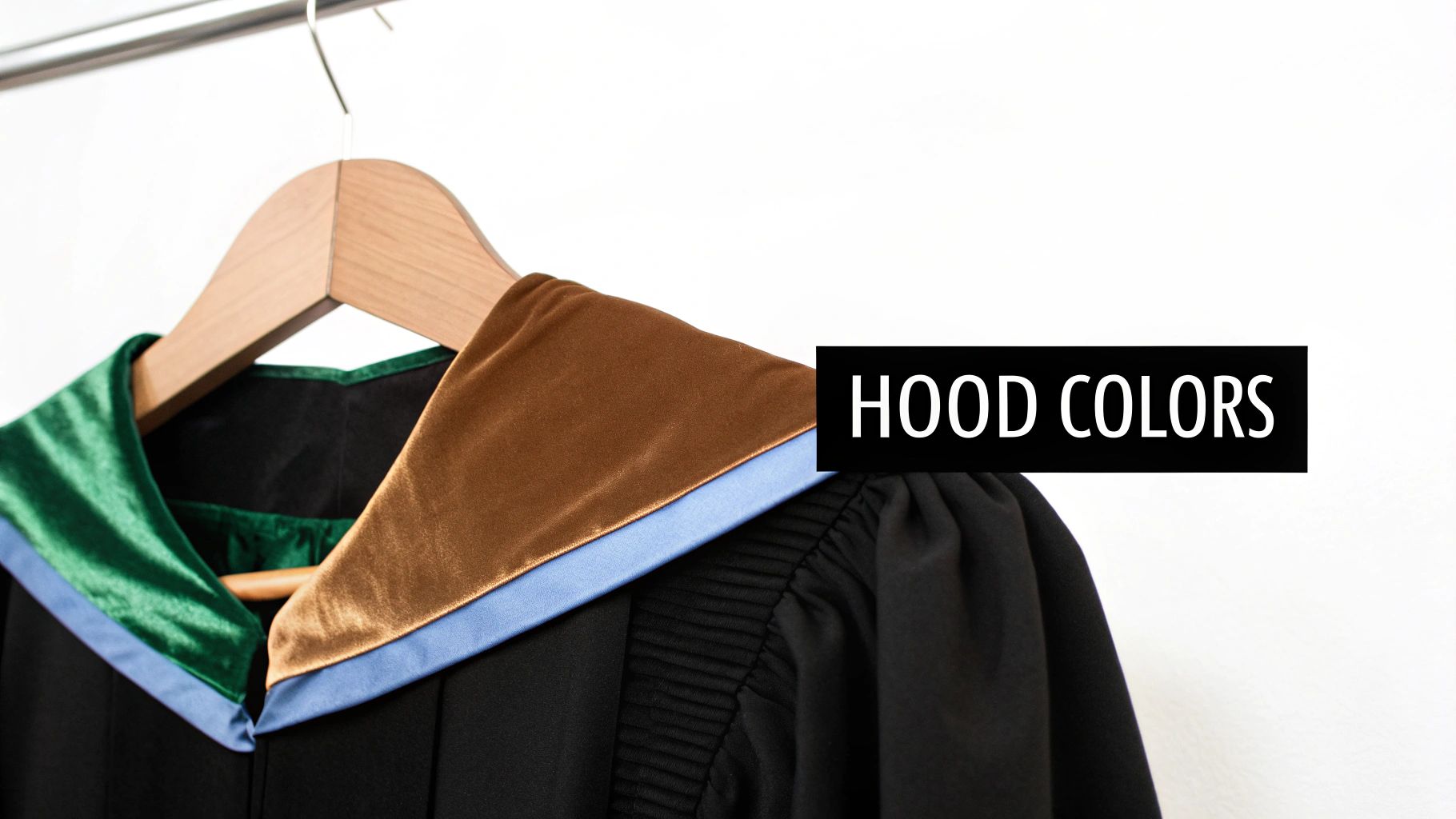
Of all the pieces that make up your graduation regalia, the academic hood is easily the most symbolic. It's more than just an accessory; it's a visual story of your academic journey, telling everyone your field of study and the institution you're graduating from. Think of it as a badge of honor you wear proudly on your back.
The hood has three key parts: the black shell that matches your gown, the satin lining, and the velvet trim. Each one carries a specific meaning, and knowing what they represent makes wearing it on graduation day even more special.
The Velvet Trim: Your Field of Study
The most noticeable color on your hood is the velvet trim. This is the three-inch band that runs along the outer edge, and its color signifies your specific discipline. This color system is standardized across most universities, acting as a universal code that instantly identifies your area of expertise.
For instance, you'll see certain colors over and over again at commencement:
- Light Blue: Education
- Golden Yellow: Science
- Drab (a brownish-khaki): Business, Commerce, Accountancy
- White: Arts, Letters, Humanities
- Citron: Social Work
This system, which comes from the Intercollegiate Code of Academic Costume, creates a beautiful and meaningful order out of the rainbow of colors you'll see at the ceremony. It’s a powerful visual that connects you to a global community of scholars in your field.
To help you identify your own discipline's color, here's a quick reference table of some of the most common fields.
Common Master's Degree Hood Color Codes by Field
| Field of Study | Velvet Color | Examples |
|---|---|---|
| Agriculture | Maize | M.S. in Agronomy, M.S. in Animal Science |
| Arts, Letters, Humanities | White | M.A. in English, M.A. in History |
| Business, Accountancy | Drab | Master of Business Administration (MBA), M.S. in Accounting |
| Education | Light Blue | M.Ed. in Curriculum, M.S. in Special Education |
| Engineering | Orange | M.S. in Civil Engineering, M.S. in Mechanical Engineering |
| Fine Arts | Brown | Master of Fine Arts (MFA) in Painting, MFA in Theater |
| Journalism | Crimson | M.S. in Journalism, M.A. in Communications |
| Law | Purple | Juris Doctor (JD), Master of Laws (LLM) |
| Library Science | Lemon | Master of Library and Information Science (MLIS) |
| Medicine | Kelly Green | Doctor of Medicine (MD), M.S. in Biomedical Sciences |
| Music | Pink | Master of Music (M.M.) in Performance, M.A. in Musicology |
| Nursing | Apricot | Master of Science in Nursing (MSN) |
| Pharmacy | Olive Green | Doctor of Pharmacy (Pharm.D.) |
| Public Administration | Peacock Blue | Master of Public Administration (MPA) |
| Science | Golden Yellow | M.S. in Biology, M.S. in Chemistry, M.S. in Physics |
| Social Work | Citron | Master of Social Work (MSW) |
| Theology | Scarlet | Master of Divinity (M.Div.), M.A. in Theology |
This table covers many of the common disciplines, but remember to always confirm with your specific university, as some programs have unique variations.
The Satin Lining: Your University Pride
While the velvet shows what you studied, the satin lining on the inside of the hood shows where you studied it. This part is designed with your university's official colors. When you wear the hood correctly, this satin lining is flipped outward to reveal the colors in a bold chevron or split pattern down your back.
A graduate from a university with blue and silver colors, for example, will have a hood lined in those specific shades. It’s a powerful visual tie to your alma mater and a huge point of pride.
Wearing your hood correctly is the key to displaying its full meaning. It’s a common point of confusion, but getting it right ensures the velvet and satin colors are perfectly visible for photos and the ceremony itself.
Don't be surprised if a ceremony marshal or a helpful friend has to assist you with flipping the lining out right before you walk across the stage—it's a common ritual! If you want to get it perfect beforehand, our detailed guide on how to wear a master's hood will walk you through every step. A properly draped hood is the finishing touch to a look you've worked so hard to earn.
Accessorizing Your Look: Tassels, Cords, and Stoles
Once you have your gown and hood sorted, it's time for the finishing touches. The accessories you choose—the tassel, honor cords, and stoles—are where you can really showcase your personal academic journey and specific achievements. They're more than just decoration; each piece tells a part of your story.
The tassel is easily the most iconic part of graduation, famous for that symbolic flip across your cap. You'll start the ceremony with the tassel on the right side of your tam or mortarboard. Then, once your degree is officially conferred, you’ll join your classmates in moving it to the left side. It’s a small gesture, but "the turning of the tassel" is a powerful moment that marks your official shift from candidate to graduate.
What Your Tassel Says About You
Just like the velvet on your hood, your tassel color is a key identifier. It usually matches the color assigned to your specific field of study.
While a black tassel is a common, classic choice for master's candidates, many wear one that corresponds to their discipline. A Master of Science graduate, for instance, would likely have a golden yellow tassel, while someone with a Master of Arts in Education would sport a light blue one. It's a quick visual shorthand that connects you to your academic community.
Honor Cords: A Mark of Distinction
Honor cords are all about celebrating significant accomplishments. These braided ropes are draped over your shoulders, instantly signaling that you’ve earned special recognition for your hard work.
You'll typically see students wearing cords for a few key reasons:
- Academic Honors: Graduating with Latin honors—cum laude, magna cum laude, or summa cum laude—is often recognized with cords, usually in the university's colors.
- Honor Society Membership: Groups like Phi Kappa Phi and other discipline-specific societies have their own official cords for members to wear with pride.
- Military Service: It's common for universities to provide red, white, and blue cords to honor graduates who are veterans or active-duty service members.
A quick tip on layering: If you have multiple cords, the standard practice is to arrange them neatly over your shoulders, letting them rest on top of your hood. It’s always a good idea to double-check your university’s commencement guide, as some have rules about which honors can be displayed.
Stoles: The Story of Your Journey
Stoles, also called sashes, are where you can really bring your personality and unique experiences to the forefront. These wide strips of cloth drape around your neck, hanging down the front of your gown, and can be customized with all sorts of text, flags, and symbols.
A stole can represent almost any affiliation or experience that was meaningful to you, such as:
- Membership in a fraternity or sorority.
- Participation in a study abroad program (often featuring the host country's flag).
- Involvement in a cultural club or student organization.
- Special recognition from your academic department.
These final pieces tie your entire master’s regalia together, making sure your graduation look is a complete and authentic reflection of everything you've accomplished. Gradshop has a fantastic selection of beautifully made graduation stoles, from classic honor designs to fully custom options to celebrate your one-of-a-kind path.
How to Order and Prepare Your Regalia
Don't let ordering your master's degree graduation regalia become a last-minute panic. I've seen it happen too many times. The whole process usually kicks off months before the ceremony, so it's smart to get ahead of any deadlines your university or its official vendor has set. Jumping on it early means you'll dodge rush fees and the dreaded "out of stock" notice.
Your first stop should always be your university’s commencement website. That's where you'll find the official link to their approved supplier or detailed ordering instructions. Many schools even host a "GradFest" or similar event where you can get measured, see the regalia in person, and place your order right there. If you're studying remotely, they'll have an online portal set up for you.
What You'll Need to Order
Before you even click "add to cart," get a few key details ready. Having this information on hand will make the entire ordering process go much smoother. They'll need more than just your payment info.
Be ready with this info:
- Your exact height (without shoes) to get the right gown length.
- Your head circumference or hat size for a tam that actually fits.
- Your specific degree—like Master of Science or Master of Arts—to get the correct hood with the right velvet trim color.
- Your major or field of study, which they often use for confirmation.
This infographic breaks down how all the different pieces come together after you've ordered your main regalia.
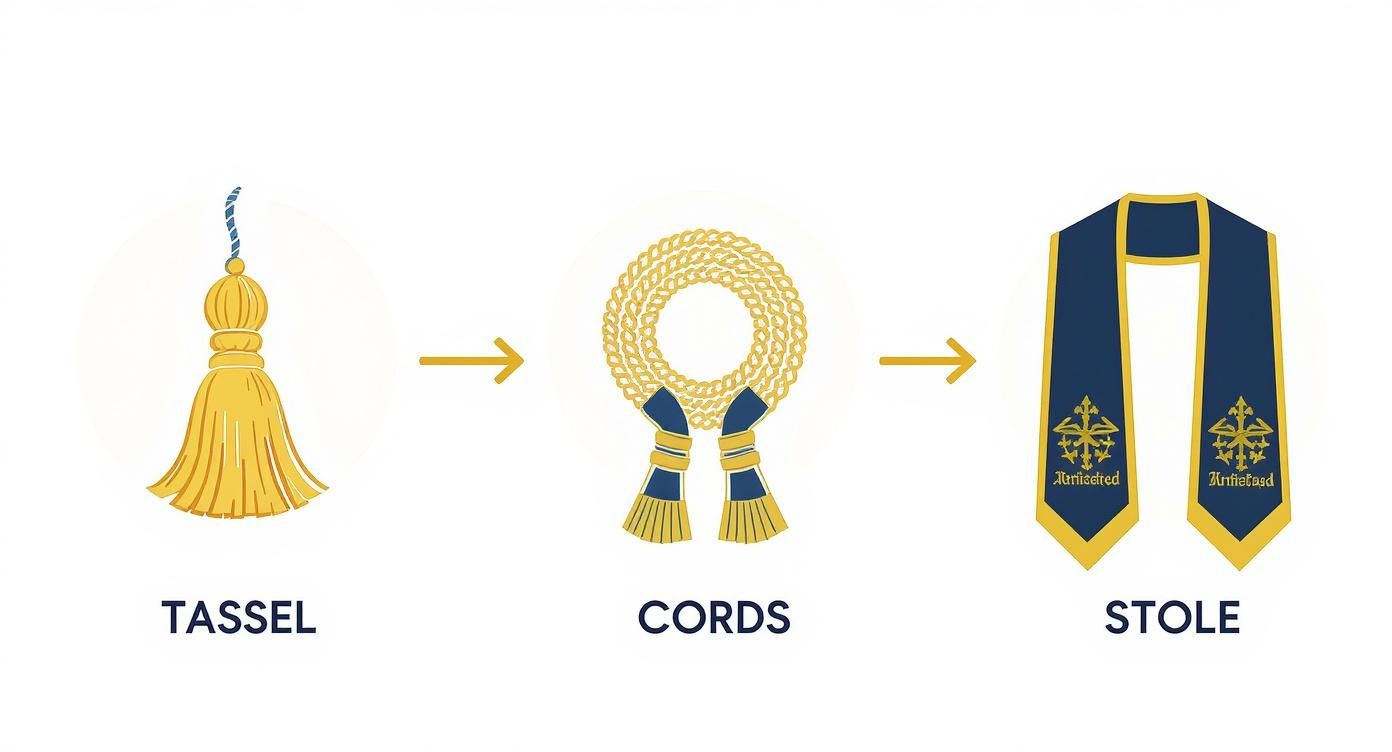
It really shows how each accessory, from the tassel to a custom stole, adds another layer of meaning to your final graduation look.
Once that package arrives on your doorstep, you're not quite done. Most gowns are shipped folded up tightly and come out of the bag looking like a wrinkled mess. If you want to look sharp and polished on the big day, you’ll need to do a little prep work. For a deeper dive, check out these excellent tips for graduation regalia ordering and care.
Crucial Tip: Whatever you do, never put a hot iron directly on your polyester gown. That fabric will melt or get a nasty permanent shine in a heartbeat. The best method is to hang it in a steamy bathroom for a day or two. A handheld garment steamer on a low setting also works wonders to gently release those creases.
Final Prep for a Stress-Free Day
The night before graduation, do yourself a favor and lay everything out. Make a checklist: gown, tam, tassel, hood, any honor cords or stoles. Make sure the tassel is attached correctly to your cap; there's usually a small loop that slips over the button on top.
Getting organized ahead of time means you can actually enjoy the morning's excitement instead of frantically searching for a missing piece of your outfit. A little planning goes a long way in ensuring you walk across that stage feeling confident, composed, and ready to celebrate your incredible accomplishment.
Got Questions About Your Master's Regalia? We’ve Got Answers.
As your graduation day gets closer, figuring out the specifics of your master's degree regalia can feel like one more thing on an already packed to-do list. You're not alone if you're a bit confused. Let's tackle some of the most common questions that pop up so you can walk across that stage with confidence.
From figuring out that mysterious hood to layering all your well-earned accessories, a few details tend to trip people up. Getting it right is about more than just looking the part; it's about honoring the academic traditions you've worked so hard to join.
Can I Wear Cords and Stoles Together?
Absolutely! Most of the time, you can wear both your honor cords and your stoles. The key is to layer them correctly so they don't get jumbled.
Think of it this way: the stole is your base layer. Drape it around your neck first so it hangs evenly down the front of your gown. Then, simply place your honor cords over the top. They'll rest neatly on top of the stole, creating a distinguished, layered look.
A quick heads-up, though: always, always check your university's official commencement guidelines. Some schools are very specific about which honors can be worn or how they should be displayed. A quick look at their website can save you a lot of stress on the day of the ceremony.
Should I Rent or Buy My Regalia?
This is a classic dilemma, and the right answer really comes down to cost versus sentimentality. Renting is usually the cheaper, more straightforward option, often handled directly by your university. If you see it as a one-and-done event, renting is a perfectly practical choice.
On the other hand, buying your master's regalia means you have a tangible piece of your achievement to keep forever. It's a bigger investment upfront, but it’s a smart move if you're heading into academia. You'll likely need it again for future ceremonies as a faculty member.
What's the Difference Between a Tam and a Mortarboard?
The cap is what often sets master's and doctoral graduates apart. You'll likely have a choice between two styles, and it's good to know the lingo.
- Mortarboard: This is the one you probably picture first—the traditional flat, square cap with a tassel. It's standard for bachelor's degrees but is still a common option for master's grads.
- Tam: This is a softer, velvet cap, typically with six or eight corners. It’s seen as a step up in both comfort and prestige, often reserved for master's and doctoral candidates to signify their advanced degree.
Your university will let you know what your options are. If you have the choice, many students opt for the tam. It just looks a bit more distinguished and feels more comfortable after sitting through a long ceremony.
At Gradshop, we make finding the perfect academic attire simple. Check out our high-quality master's and doctoral regalia to get everything you need for your celebration.