

Your master's hood is so much more than a piece of academic regalia. Think of it as the final, most meaningful part of your graduation attire, a symbol of all the hard work that got you to this point. Before you figure out the logistics of how to wear a masters hood, it's worth taking a moment to understand what it all means. The velvet, the satin, the shell—each part tells a story about your degree, your field, and your university.
Understanding Your Academic Hood
The tradition of the academic hood goes way back, hundreds of years in fact, to the practical garments worn by medieval scholars. What you'll be wearing at commencement is the modern evolution of that tradition, and every inch of it is packed with meaning. It's a visual representation of your academic journey.
When you really look at it, the hood has three main components that work together:
- The Shell: This is the main body of the hood. It’s almost always made of black fabric to perfectly match your master's gown.
- The Velvet Trim: This is the colorful velvet band you see on the edge of the hood. It's the most visible part and the color tells everyone your specific field of study.
- The Satin Lining: If you flip the hood over, you’ll see a vibrant satin lining. These are your university's official colors, a proud nod to your alma mater.
Decoding the Details
The design of a master's hood isn't random; it's all carefully standardized. A master's hood, for example, is 3.5 feet long—a bit longer than a bachelor's hood to signify a higher level of achievement.
The velvet trim is where it gets really specific. The color corresponds directly to your discipline. You'll see golden yellow for Science, light blue for Education, and citron for Social Work, among many others. Then, the satin lining proudly displays your university’s colors, making every hood a unique badge of honor.
Wearing your regalia correctly is a sign of respect—for your university, your academic discipline, and most importantly, for your own achievement. Understanding the symbolism behind it just makes the whole experience that much richer.
Why This Matters on Your Big Day
Getting to know the parts of your hood isn't just for trivia's sake; it actually helps you wear it correctly. When you know the velvet trim represents your field, you'll instinctively make sure it's facing forward. And remembering the satin lining is your school's colors will remind you to "turn out" the back of the hood so they're on full display.
At the end of the day, this piece of regalia connects you to a long and proud history of scholars. Taking a moment to appreciate these details will deepen your sense of accomplishment as you walk across that stage. For a more detailed look, check out our guide on getting to know the master's degree gown and hood. This way, you won't just wear your hood—you'll wear it with the honor it truly represents.
The Complete Guide to Wearing Your Masters Hood
Knowing what your master’s hood symbolizes is one thing; putting it on correctly is a whole other challenge. The last thing you want to be worried about as you walk across the stage is whether your regalia looks right. Getting it perfect ensures you not only honor academic tradition but also look sharp for this once-in-a-lifetime moment.
The process can feel a bit awkward at first, but it's really quite simple once you get the hang of it. This guide will walk you through everything, whether a faculty member is doing the honors or you're adjusting it yourself for photos.
Pre-Ceremony Handling: How to Carry Your Hood
Before the ceremony kicks off, you'll most likely be carrying your hood instead of wearing it. Most universities instruct master's candidates to enter the venue with their hoods draped neatly over their left arm. This is both a practical choice and a symbolic one.
When you drape it, make sure the velvet trim—the colorful band that signifies your field of study—is facing up. The rest of the hood should hang smoothly down your arm, keeping it from getting wrinkled and making it ready for the hooding part of the ceremony.
Carrying it this way shows that while you've met the requirements for your degree, it hasn't been formally conferred just yet. It’s a small detail, but a meaningful part of the day's tradition.
Identifying the Parts Before You Begin
When it's time to actually put on the hood, taking a second to get your bearings makes all the difference. Lay the hood out or hold it up in front of you and identify these four key parts:
- The Velvet Trim: This is the colored band running along the edge. It's the heaviest part and will face outward, away from your neck.
- The Satin Lining: This is the colorful fabric inside, representing your university. At first, it will be hidden from view.
- The Front Loop: At the V-neck of the hood, you’ll find a small fabric loop. This is critical for securing the hood to your gown.
- The Rear Cord and Button: On the back of the velvet trim, about halfway down, there's often a small cord and button designed to help you display the colors.
Knowing what you're looking at makes the whole process of wearing your masters hood feel much more intuitive. For a great visual breakdown, this infographic shows exactly how the pieces fit together.
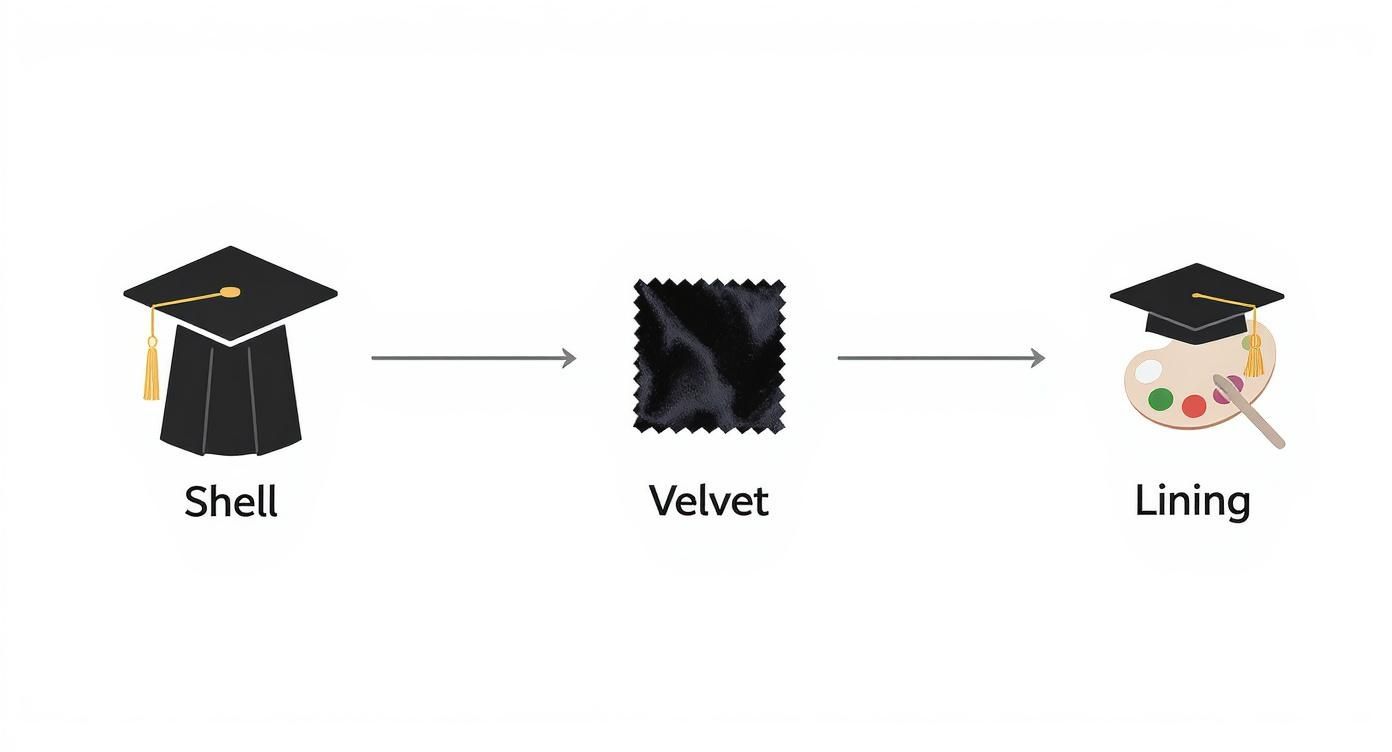
This map shows how the black shell, colored velvet, and university lining all come together to tell your academic story.
Draping and Securing the Hood
Alright, here’s the main event: putting the hood on. The technique is the same whether you're doing it yourself or a faculty member is hooding you on stage.
First, place the hood over your head so it drapes around your neck and settles on your shoulders. The velvet trim should be facing up and clearly visible from the front, framing your gown nicely. The main body of the hood, with the satin lining still hidden, will hang down your back.
Now for the most important step: secure the front loop. That little loop at the front V-point of the hood is designed to fasten onto a button on your shirt or, more often, a button on the front of your academic gown. No button? A safety pin is your best friend here.
Pro Tip: Securing this loop is non-negotiable. It stops the hood from sliding back and choking you, making sure it sits correctly and comfortably for the entire event.
Turning Out the Colors for Full Display
With the hood draped and secured, the final touch is to reveal those brilliant university colors. This is the step that really makes the hood pop, transforming it from a simple black drape into a vibrant symbol of your achievement.
Reach behind you and find the point where the velvet trim meets the satin lining. From there, gently flip or "turn out" the back portion of the hood. The idea is to fold the black shell back on itself so the colorful satin lining is proudly displayed.
Many hoods include a small cord and button on the back to hold this fold in place—if yours has one, use it! The result should be a beautiful cascade of color down your back, perfectly framed by the velvet trim. For anyone who's a visual learner, checking out some expert tips on garment presentation can give you a better feel for how the fabric should drape.
To make things even simpler, here's a quick rundown of the steps.
Quick Steps for Wearing Your Masters Hood
This table summarizes the key actions to ensure your hood is positioned perfectly for the ceremony.
| Action | Description | Pro Tip |
|---|---|---|
| Drape the Hood | Place the hood over your head, with the velvet trim facing outward. | Let it settle naturally on your shoulders before adjusting. |
| Secure the Front | Attach the small front loop to a gown or shirt button. | Use a safety pin if your gown doesn't have a button. |
| Find the Turning Point | Reach behind and locate where the velvet and satin lining meet. | This is usually about midway down your back. |
| Flip the Colors | Gently turn the lining outward to expose the university colors. | Aim for a clean, even fold all the way to the bottom point. |
| Fasten the Back | If available, use the rear cord and button to hold the fold in place. | This keeps the colors from flipping back in on themselves. |
Following these key steps will ensure your regalia looks flawless.
With your hood now worn correctly, you're ready to walk across that stage with confidence, knowing you look every bit the part of a new master's graduate. At Gradshop, we offer a full range of high-quality masters hoods and doctoral hoods to ensure you look your absolute best.
Decoding the Colors of Your Academic Hood
The colors on your academic hood are much more than just decoration; they’re a language all their own, telling the story of your academic journey. At a glance, anyone familiar with academic regalia can see your field of study and your alma mater just by the colors on your hood. Understanding this code adds a whole new layer of meaning to your big day.
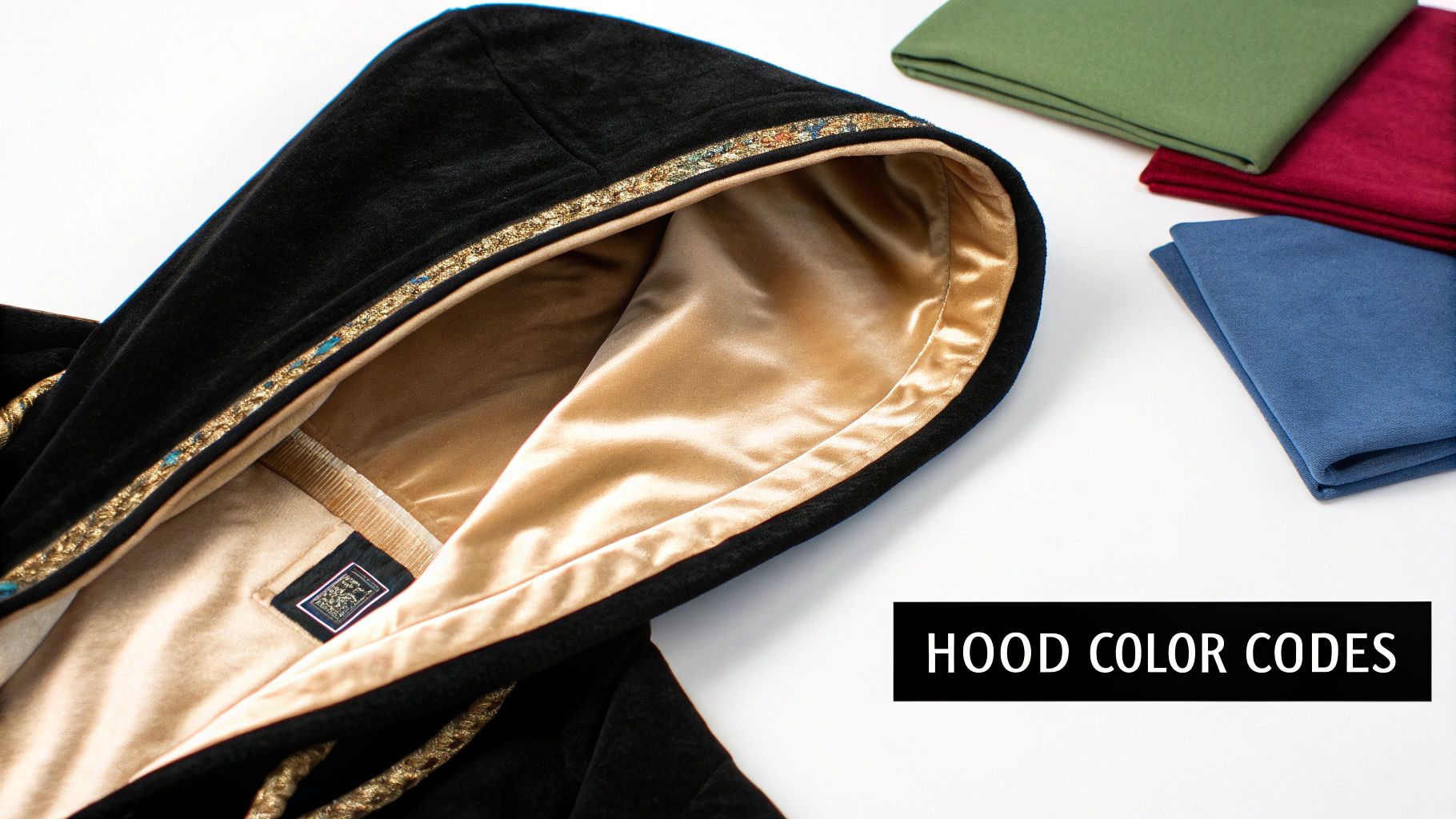
This vibrant display isn't just for show. Each specific color combination is a badge of honor that represents years of hard work and dedication. It's a beautiful, long-standing system designed to celebrate the incredible diversity of knowledge within the graduating class.
The Velvet Trim: Your Field of Study
The most noticeable color on your hood is the velvet trim running along its outer edge. Think of this as your academic signature—it represents the specific discipline where you earned your master's degree. This system is largely standardized across institutions, making it easy to spot fellow graduates in your field.
Take a look around at any large commencement ceremony, and you'll see a rainbow of different hues, each telling its own story. The colors are carefully codified, with the American Council on Education's Intercollegiate Code setting the standard in the United States.
For instance, you'll see golden yellow for science and engineering, dark blue for philosophy, light blue for education, apricot for nursing, and purple for law. It's this color-coding that allows for immediate, visual recognition of your hard-earned expertise.
When you see the procession of graduates, you're not just seeing people in robes. You're looking at a living, breathing representation of the university's collective knowledge—from the arts and sciences to healthcare and beyond.
Common Master's Hood Colors
While the full list of colors is quite long, here are some of the most common velvet trims you'll encounter on graduation day:
- Arts, Letters, Humanities: White
- Business, Commerce, Accountancy: Drab (a tan or khaki color)
- Education: Light Blue
- Engineering: Orange
- Fine Arts, Architecture: Brown
- Journalism: Crimson
- Medicine: Kelly Green
- Music: Pink
- Nursing: Apricot
- Public Health: Salmon Pink
- Science: Golden Yellow
- Social Work: Citron
- Theology: Scarlet
If you're curious about other fields, you'll want to check out our complete list of academic hoods colors. It breaks down the specifics for dozens of different disciplines.
The Satin Lining: Your University's Pride
If the velvet trim represents your discipline, the colorful satin lining on the inside of the hood is all about your institution. These are your university's official colors, displayed proudly for everyone to see as the hood drapes over your back.
The lining is where things get really unique to your school. It might feature one, two, or even three colors arranged in a specific pattern, like a chevron (a V-shape) or an equal division. This is why a Master of Education graduate from one university will have a hood that looks completely different from another, even though both will share the same light blue velvet trim.
This element connects you directly to your alma mater's heritage and the community of graduates who came before you. It's a shared mark of pride. Together, the velvet and satin create a unique symbol of your personal academic story—the "what" and the "where" of your incredible achievement.
Common Hooding Mishaps (And How to Fix Them)
It’s graduation day. The energy is high, you're trying to find your friends in the lineup, and the last thing on your mind is whether your hood is on correctly. Trust me, even after all that preparation, it’s incredibly easy to make a small mistake with your regalia in the excitement of the moment.
Knowing the most common slip-ups ahead of time is the best way to make sure you look polished from the first procession photo to the last. Let's walk through the frequent errors I’ve seen over the years and the simple ways to avoid them.

A little bit of troubleshooting knowledge goes a long way. These quick fixes will help you wear your hood with confidence and focus on what really matters—celebrating your achievement.
Mistake 1: Wearing the Hood Backward
This is, without a doubt, the most common mistake. The hood has a unique, almost confusing shape, and it’s very easy to get it turned around. You'll know it's backward if the long, pointed tail is hanging down your chest instead of your back. The V-shape should rest at your throat, not drape behind you.
The fix is surprisingly simple: before you even lift it over your head, find the velvet trim. That colorful velvet always faces outward, away from your neck. The small loop is at the front, ready to be fastened. A quick peek in a mirror or asking a friend, "Does this look right?" is all it takes to confirm you've got it.
Mistake 2: The Colors Are Hidden
Another thing I see all the time is a hood that just looks like a black cape. This happens when a graduate forgets to "turn out" the satin lining, hiding the vibrant university colors. Those colors are the whole point! They represent your school and your field of study. It’s a crucial final step that often gets missed in the rush.
To avoid this, once the hood is on and secured, just reach behind your shoulders. Feel for the seam where the velvet meets the black shell and simply flip the fabric outward. This one move instantly reveals the colorful satin, completing your academic look and showing off your school pride.
Expert Tip: That final flip is everything. Don't be afraid to ask a faculty marshal or the person behind you in line for help. A quick, "Can you check my colors?" makes a huge difference in photos and shows you're honoring the tradition.
Mistake 3: The Slipping Hood
Is there anything more annoying than a hood that keeps sliding off your shoulders and pulling at your throat? It’s distracting and uncomfortable. This almost always happens for one reason: the small loop at the front of the hood wasn't secured. Without that anchor, the weight of the tail will naturally pull the whole thing backward.
The solution is to always fasten the front loop. Your gown might have a small, dedicated button for this. If it doesn't, a simple safety pin becomes your best friend. Pin the loop securely to your gown or the fabric of your shirt, right near your collarbone. This tiny action keeps the hood perfectly in place all day long, so you can stop adjusting and start celebrating.
Your Final 30-Second Regalia Check
Before you march, run through this quick mental checklist. It takes less than a minute and will save you from fidgeting through the entire ceremony.
- Velvet Facing Out? Is the colored velvet trim visible from the front and not against your neck?
- Loop Secured? Is the front loop attached to your gown with a button or safety pin? Give it a gentle tug.
- Colors Showing? Did you reach back and flip the satin lining out so your university colors are on full display?
- Comfort Check. Does the hood rest easily on your shoulders without pulling or feeling like it's choking you?
Taking just 30 seconds for this final check is the secret to a flawless look. It ensures you’ll look back on your photos with pride, not with the memory of an unruly hood. Of course, starting with the right gear, from high-quality graduation stoles to a perfectly fitted cap and gown, sets the stage for a picture-perfect day.
Getting Ready for Your Big Day
Your academic regalia is so much more than an outfit. It’s a symbol of years of hard work, a major investment in your future, and a keepsake you'll have for life. A little prep work goes a long way in making sure you look and feel confident on graduation day. Knowing how to order, care for, and manage your gown and hood is a key part of the whole commencement experience.
If you plan ahead, you can spend your graduation day focused on celebrating instead of stressing over last-minute wardrobe malfunctions.
Ordering Your Master's Regalia in Advance
Getting your cap, gown, and hood ordered well ahead of time is probably the single most important step. Don't wait. University suppliers and official vendors often have firm deadlines, sometimes as early as two to three months before the ceremony, especially if you need anything customized. Procrastinating can lead to sold-out stock, the wrong size, or hefty rush fees.
When you're ready to order, pull up the sizing chart and take it seriously. A master's gown is sized by your height, but you also need to think about your build. If you find yourself between sizes, it's usually best to go up a size for a more comfortable fit—they’re designed to be worn loosely anyway. Remember, a gown that pulls or feels too tight will only make wearing your master's hood feel awkward.
Your regalia is the uniform for one of the most important days of your life. Ordering early and getting the right fit eliminates a major source of stress, letting you focus on celebrating your accomplishment.
What to Do When Your Regalia Arrives
That moment when your regalia package arrives is a big one! But don't just shove the box in a closet until the big day. Open it up right away to check everything and try it on. This is your window to spot any problems while you still have plenty of time to get them fixed.
Your gown and hood are going to be wrinkled from being folded in a box. Whatever you do, do not iron them directly! The polyester fabric can melt in a heartbeat. The best tool for the job is a simple garment steamer. If you don't have one, just hang your regalia in the bathroom while you take a hot shower—the steam will help a lot of the creases fall out in about 20-30 minutes.
Here’s a quick checklist for delivery day:
- Check the Contents: Make sure the gown, cap, tassel, and hood are all there.
- Verify the Colors: Double-check that the hood's velvet and satin colors are correct for your specific degree and university.
- Try It All On: Does the gown fit well? Is the cap too tight? Give it a quick test run.
- De-Wrinkle Properly: Hang your gown and hood up immediately. Plan to steam them a day or two before the ceremony for a crisp look.
For a complete walkthrough, check out our guide on how to get your graduation regalia ready, which has even more helpful tips. And for other useful tips beyond your regalia, you can find a lot of general graduation information to help prepare for the day.
Storing Your Hood After the Ceremony
Once all the pictures have been snapped and the parties are over, don't just cram your academic hood into the back of a closet. Storing it the right way will preserve it as a meaningful memento. The velvet and satin are delicate and can easily be damaged by dust, sunlight, and pests if you're not careful.
First things first, think about having it professionally dry-cleaned, especially if you were outside or it got a little dirty. Just make sure to find a cleaner who knows how to handle delicate fabrics. Once it’s clean, store it in a breathable garment bag and hang it in a cool, dark, and dry place. Steer clear of plastic bags—they trap moisture and can lead to mildew over time.
By taking care of your regalia from the moment you order it to long after you've crossed the stage, you're protecting a powerful symbol of your academic achievement for years to come.
Answering Your Top Questions About Master's Hoods
Even after you've got the basics down, a few questions always seem to come up right before the big day. It's usually the small stuff—the ceremony logistics or post-commencement etiquette—that can cause last-minute stress. Let's clear up some of the most common queries so you can feel completely confident when it's your turn to walk across that stage.
Getting these little details sorted out ahead of time makes all the difference for a smooth and memorable ceremony.
Who Actually Puts the Hood on You?
The hooding itself is a key moment in the ceremony, steeped in tradition. In almost every case, a designated faculty member will do the honors of placing the hood over your shoulders. This isn't just a random person; it's typically someone who played a significant role in your academic life. Think your thesis advisor, the department chair, or the dean of your college.
You’ll generally walk onto the stage with your hood neatly draped over your arm. When they call your name, you'll hand it off or turn your back to the audience, and the faculty member will ceremoniously drape it over your head. It’s a powerful, symbolic gesture that officially marks the moment you earned your advanced degree.
Can I Wear My Hood for Photos After?
Absolutely! In fact, you should. Your master's hood is the most distinctive and meaningful part of your entire academic outfit. It’s a visual representation of your specific degree, your field of study, and your university, so it’s a must-have for your graduation pictures.
Once the formalities are over, take a minute to make sure your hood is sitting perfectly. Straighten the velvet trim and check that the satin lining showing your school's colors is flipped out and fully visible. This is your moment to capture memories with friends, family, and mentors, and your hood is the centerpiece of that achievement.
Don't rush to take your regalia off after the ceremony ends. You've more than earned the right to wear it with pride during your celebrations and photo sessions. It’s a huge part of the day's story.
What If My Gown Doesn't Have a Button for the Hood?
This is probably one of the most common and frustrating little problems graduates run into. That small fabric loop on the front of your hood is designed to keep it from slipping backward and uncomfortably pulling on your neck. But what if your gown doesn't have a button to attach it to? Many don't.
The fix is surprisingly simple: a safety pin.
Before you line up for the procession, just use a small safety pin to connect the hood's loop directly to the fabric of your gown, right below the V-neck. It’s an invisible solution that works like a charm, creating the anchor you need to keep your hood sitting comfortably and correctly for hours.
A flawless graduation day starts with high-quality regalia. At Gradshop, we offer everything you need for a memorable commencement, from beautifully crafted masters and doctoral hoods to premium caps and gowns and a full range of stoles and other accessories.