

Putting on your academic hood for the first time can feel a little awkward, but it's simpler than it looks. The basic idea is to drape it over your head, velvet-side-up, so the V-shape sits at the front of your neck. You'll then fasten a small loop to a button on your gown (or use a pin) to keep it in place. The final, most important touch is flipping out the colorful satin lining on your back to show off your school colors. This guide will walk you through how to wear your academic regalia hood correctly, ensuring you look polished for your big day.
Understanding the Anatomy of Your Academic Hood

Before you try to put it on, it helps to know what you're working with. This isn't just a random accessory; every part of the hood tells a specific part of your academic story. Think of it as a quick meet-and-greet with a piece of scholarly history.
Knowing what each part means will help you wear your regalia with the pride and precision it deserves. The hood is made up of three main components, and each has a job to do.
Key Components of an Academic Hood
- The Shell: This is the main body of the hood, usually made from the same black fabric as your graduation gown. It creates the hood's overall shape.
- The Satin Lining: Tucked inside, you'll find a vibrant satin lining. These aren't just for decoration—they represent the official colors of the university that granted your degree. When you wear the hood correctly, this lining is turned out so everyone can see it.
- The Velvet Trim: The colored velvet band running along the edge is arguably the most important part. Its color signifies your specific field of study, connecting you to centuries of scholars in your discipline.
This color-coding system is steeped in academic tradition. The code for wearing your academic hood properly displays your discipline through over 60 standardized colors. For instance, that brilliant golden yellow velvet you see on science hoods represents a field that awards roughly 40,000 Ph.D.s annually in the U.S. alone. This system, first formally established in 1895, makes your achievement instantly recognizable to others in academia. For a deeper dive into these traditions, you can explore the history of graduation hoods.
The academic hood is a visual resume of your educational journey. The velvet trim declares your discipline, the satin lining announces your alma mater, and its length signifies the level of your accomplishment.
To help you identify your own field or understand those of your peers, here is a quick guide to some of the most common velvet colors.
Academic Hood Velvet Colors by Field of Study
| Field of Study | Velvet Color | Example Degrees |
|---|---|---|
| Arts, Letters, Humanities | White | Bachelor of Arts (B.A.), Master of Arts (M.A.) |
| Business, Accounting, Commerce | Drab (Light Brown) | Master of Business Administration (MBA) |
| Education | Light Blue | Doctor of Education (Ed.D.) |
| Engineering | Orange | Bachelor of Engineering (B.Eng.) |
| Fine Arts, Architecture | Brown | Master of Fine Arts (M.F.A.) |
| Law | Purple | Juris Doctor (J.D.) |
| Medicine | Kelly Green | Doctor of Medicine (M.D.) |
| Nursing | Apricot | Bachelor of Science in Nursing (B.S.N.) |
| Philosophy | Dark Blue | Doctor of Philosophy (Ph.D.) |
| Science | Golden Yellow | Bachelor of Science (B.S.), Master of Science (M.S.) |
| Theology | Scarlet | Master of Divinity (M.Div.) |
This table covers many common fields, but remember, there are dozens of official colors designated by the American Council on Education.
Master's vs. Doctoral Hoods
While the parts are the same, there are a couple of key differences between master's and doctoral hoods that signal the level of the degree earned.
- Length: A master's hood is typically three and a half feet long. The doctoral hood is a bit longer and more prominent, measuring four feet.
- Velvet Width: The velvet trim on a doctoral hood is a full five inches wide, making a bold statement. In contrast, the trim on a master's hood is three inches.
These might seem like minor details, but they are crucial for maintaining academic tradition. Whether you are searching for a master's degree hood or a distinguished doctoral hood, Gradshop provides options that adhere strictly to these standards, ensuring your regalia perfectly reflects your achievement.
Preparing Your Regalia for a Polished Look
Let’s be honest, your graduation gown and hood probably arrived in a bag looking a bit… crumpled. A little prep work beforehand makes all the difference between looking sharp and looking like you just pulled it out of the packaging moments before the ceremony. A few minutes of prep can save you from a lot of last-minute stress.
The main enemy here is wrinkles. Most regalia is made from synthetic fabric, which means you should never, ever hit it with high heat from an iron. You’ll risk melting or scorching the material.
Getting Your Gown and Hood Ready
The absolute best way to get those stubborn creases out is with a garment steamer. Just hang your gown and hood up and gently steam them, holding the steamer a few inches from the fabric. You'll see the wrinkles just fall away.
No steamer? No problem. Hang your regalia in the bathroom while you take a hot shower. The steam will do most of the work for you in about 20 minutes. If you're really in a pinch, you can use an iron, but be incredibly careful. Set it to the lowest possible heat setting and—this is crucial—place a thin towel between the iron and the fabric to act as a barrier.
Once everything is wrinkle-free, it's time for a quick meet-and-greet with your academic hood. Lay it out flat, velvet side up.
- Front vs. Back: The V-shaped end goes at the front, against your throat. The wider, more colorful part with the satin lining is the back.
- The Loop and Cord: Find the small fabric loop at the very point of the "V." This little thing is your best friend for keeping the hood from sliding around. You may also find a thin cord and button on the back, which helps the hood sit properly.
Getting familiar with these parts now will make putting it on a breeze later. For a complete head-to-toe guide on getting ready, check out our perfect picture academic regalia preparation guide.
Prepping your regalia isn't just about appearances; it's a small act of respect for the massive achievement you're celebrating. A pristine gown and properly prepared hood are a reflection of the hard work that got you here.
Coordinating with Stoles and Cords
If you're also wearing stoles or cords to signify honors or cultural heritage—like a vibrant Kente stole or a classic honor stole—there’s a simple rule for layering. Your academic hood always goes on first, directly over your gown. Then, drape any stoles or cords over the hood.
Finally, think about getting your regalia to the ceremony. A garment bag is a great investment to protect all your hard prep work from dust or new wrinkles. A few minutes is all it takes to ensure you look as accomplished as you feel.
Getting Your Academic Hood On Correctly
Alright, this is where it all comes together. With your gown on and everything prepped, it's time to tackle the hood. Don't worry, it looks more complicated than it is. We'll walk through it step-by-step so you can get it right the first time and focus on the big moment, not on fussing with your regalia.
First things first, let's get it oriented. Hold the hood out in front of you. You want the velvet trim facing up, toward the ceiling, and the satin lining resting against your body. The narrow, V-shaped end should be pointing down and away from you.
Draping and Positioning the Hood
Now, go ahead and lift the hood over your head. Let that V-shaped part settle at the front of your neck, much like you'd wear a scarf. It should sit comfortably right at your throat—not so tight that it's choking you, but not so loose that it feels like it'll slip off.
The rest of the hood will now be hanging down your back. Take a moment to smooth it out so it lays flat against your gown. You want that velvet trim to create a nice, clean border around your neck and over your shoulders. Getting this part right sets you up for a perfect look.
It's amazing to think this one piece of regalia has such a long history. Academic hoods actually date back to the 12th century when medieval scholars wore them to stay warm in drafty universities. Over time, what was once practical became purely symbolic, leading to the Intercollegiate Code of Academic Costume in 1895. This code is why doctoral hoods are 4 feet long with a 5-inch trim, and master's hoods are 3 feet 6 inches with a 3-inch trim.
This quick diagram shows the key prep stages you should have already completed before you even start draping the hood.
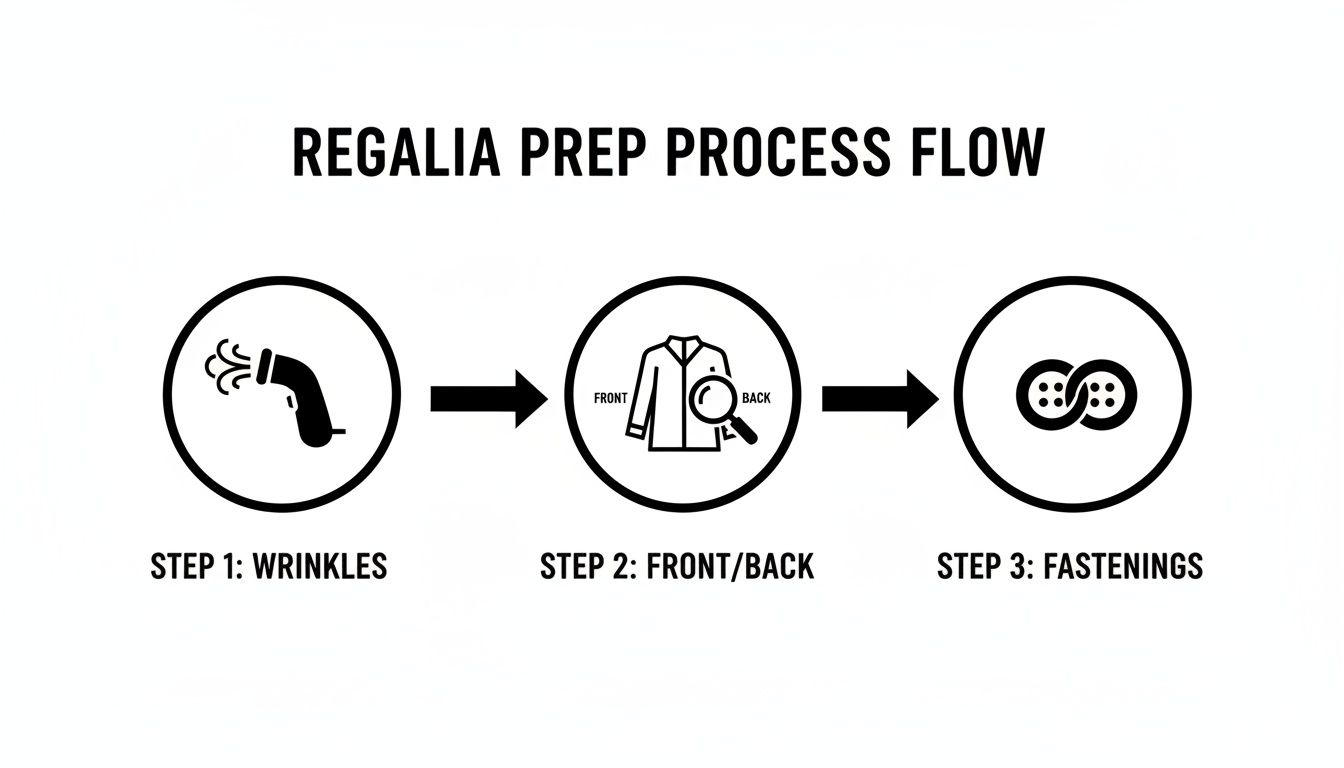
As you can see, getting rid of wrinkles, knowing the front from the back, and finding the fastenings ahead of time is the real groundwork for wearing your regalia correctly.
Securing Your Academic Hood in Place
Properly anchoring your hood is the secret to looking polished instead of disheveled. Your hood is designed with a couple of key fastening points to keep it exactly where it needs to be all day long.
- The Front Loop: Look at the inside point of the "V" at your throat. You should find a small fabric loop there. This is meant to attach to a button on the front of your academic gown, usually right below the zipper. Securing this little loop is crucial—it keeps the hood from creeping up your neck. If your gown doesn't have a button, a small safety pin works perfectly.
- The Back Cord: Now, reach behind you. You should feel a thin cord and button near the top of the hood's back panel. This is designed to fasten to a button on the back of your gown. If there isn't one, you can simply fasten the cord to itself to create a small loop. This anchors the hood and stops it from sliding off your shoulders.
Pro Tip: Seriously, ask a friend or family member for help with this part. Someone standing behind you can see what they're doing, which makes adjusting and securing the back of the hood a thousand times easier and faster.
The Final Flourish: Turning Out the Lining
This last step is the most important one—it’s how you show off your achievement and your school. Once the hood is secure, you need to "turn out" the satin lining to display your university’s colors.
Just reach back and find the velvet trim along the edge of the hood. Gently flip it outward so that the colorful satin lining is visible. Do this on both sides. The goal is to create a beautiful, vibrant drape of color down your back.
This is the whole point of the hood's design—it’s your way of representing your alma mater. The high-quality construction of Gradshop's master's and doctoral hoods is designed to ensure this lining turns out smoothly every time for that picture-perfect finish. For a more detailed walkthrough aimed specifically at master's graduates, be sure to check out our complete guide on how to wear a master's hood.
Navigating Hooding Ceremony Traditions and Etiquette
The hooding ceremony is so much more than just walking across a stage. It's the moment that marks the end of years of hard work, especially for master's and doctoral candidates. This tradition is a powerful, formal welcome into the global community of scholars, and knowing the etiquette lets you soak in the experience without any last-minute stress.
As you line up and get ready to walk, you won't actually be wearing your hood. Instead, you'll carry it draped over your left arm. Make sure the velvet trim is facing out so the audience can see it. This little detail keeps your hood perfectly positioned for the faculty member who will soon place it over your shoulders.
The Hooding Process on Stage
When your name is called, you'll make your way to your designated faculty hooder. This is often your advisor, a favorite professor, or your department head—the person who guided you on your academic journey. The interaction is brief but meaningful, so a little prep makes it go off without a hitch.
Walk up to your hooder, hand them your hood, and then simply turn to face the audience. A great tip I always give graduates is to bend your knees or dip your head just a bit. This is especially helpful if your hooder is shorter than you! It’s a small courtesy that makes a world of difference for them, ensuring they can place the hood over your head smoothly.
The act of being hooded by a faculty member is a powerful symbol of mentorship and the passing of knowledge. It represents their endorsement of your work and your official entry into your academic field.
After they drape the hood around your neck, they’ll take a second to adjust it on your shoulders and turn out the colorful satin lining that displays your university’s colors. Expect a firm handshake and a word of congratulations before you continue across the stage to receive your diploma.
A Few Pointers for Faculty Members
For the professors taking part, a little practice goes a long way in making this a seamless and memorable moment for your student. Here’s a quick refresher on the best way to handle the hooding itself:
- Get the Hood Ready: As the student approaches, hold the hood so the velvet "V" points down, almost like an arrow. This preps it to slide easily over their head.
- Guide, Don't Force: Gently place the hood over their head, being mindful of their cap or hairstyle so you don't snag anything.
- Settle and Flip: Let the hood settle on their shoulders first. Then, reach behind them and flip out the satin colors to reveal the full regalia. This is the finishing touch that everyone in the audience wants to see.
Faculty members are a huge part of their students' success, and their role on stage is a tribute to that commitment. To help them look the part, Gradshop provides a complete collection of distinguished faculty gowns and tams, all made to uphold the highest academic standards. This preparation helps maintain the dignity and respect this tradition deserves.
Sidestepping Common Hood Blunders

Even with the best preparation, the excitement and chaos of graduation day can lead to a few wardrobe snafus. Your academic hood, with its loops, cords, and specific drape, is often the prime culprit. But don't worry—knowing the most common mistakes and how to fix them on the fly will keep you looking sharp and feeling confident from the processional march to the final photo op.
I've seen it a thousand times: the backward hood. This is easily the most frequent mistake. You’ll spot it immediately if the beautiful, colorful satin lining is hidden against your back instead of showing off your school colors. If this happens, just take a deep breath, lift it off, and start over. Make sure that velvet trim is facing up before you drape it over your head.
Another classic issue is the hood that constantly slides off one shoulder. It's an annoying distraction you don't need. This almost always means the front loop or the back cord wasn't secured properly. Take a moment to check that the front loop is hooked onto your gown’s button or firmly pinned in place. That little loop is the anchor for the whole thing.
Keeping Your Hood Looking Its Best All Day
Let's be real—after you've been sitting for a while and then milling around for photos, your hood might get a bit disheveled. The lining can get tucked in, or the velvet gets bunched up. A quick fix is all it takes to get it looking perfect again.
Grab a friend and have them help you flatten the hood against your back. Then, just carefully re-fold the satin lining over the edge of the velvet trim. This simple touch-up makes a world of difference in your photos, ensuring your hard-earned university colors are displayed proudly.
Pro Tip: A properly worn hood should feel secure but never restrictive. The velvet 'V' should rest comfortably at the base of your throat, not feel like it's choking you. The weight should be distributed evenly across your shoulders, preventing that annoying backward pull.
To make things even easier, consider one of Gradshop's all-in-one graduation packages. These bundles come with a gown, cap, and tassel designed to work perfectly with our academic hoods, ensuring all the fastening points and loops line up just right.
Troubleshooting on the Go
Things can go wrong in the heat of the moment. I've put together a quick troubleshooting table to help you identify and solve the most common hood problems you might run into. Think of it as your graduation day cheat sheet.
Quick Fixes for Common Hood Wearing Issues
| Common Problem | How to Spot It | Quick Fix Solution |
|---|---|---|
| The Backward Hood | Your colorful satin lining is hidden against your back, leaving just the black shell showing. | Take it off and re-drape it. Make sure the velvet trim faces up so the "V" forms at your throat. |
| Slipping Shoulders | The hood keeps sliding off one or both shoulders, especially when you move. | Check your anchors. Fasten the front loop to your gown's button or a safety pin. Secure the rear cord. |
| Hidden Colors | The satin lining is tucked in, so the back of your hood just looks like a black triangle. | Have a friend reach behind you and gently flip the velvet trim outward. This "turns out" the hood to reveal the colors. |
| Choking Feeling | The "V" at the front is riding up your neck and feels uncomfortably tight. | This is almost always caused by the hood pulling back. Secure the rear cord to take the weight off the front. |
A quick glance at this table before you line up for the ceremony can save you a lot of fidgeting and help you walk across that stage in style.
What to Do With Your Regalia After Graduation Day
The ceremony is over, the pictures are taken, and the celebration is winding down. Now what do you do with the cap, gown, and hood that symbolize such a huge accomplishment? Don't just toss them in the back of the closet. With a little care, your academic regalia can be a pristine keepsake for decades.
First things first, let's talk cleaning. After a long day, your gown has definitely earned a refresh. Most standard polyester gowns can be gently hand-washed in cool water with a mild detergent. But if your regalia has any velvet, like the trim on a doctoral hood, or delicate custom embroidery, take it to a professional dry cleaner. It's the safest bet to protect the fabric's texture and color. Always double-check the care label just in case.
How to Properly Store Your Hood and Gown
Folding your academic hood correctly is key to avoiding permanent creases, especially in that beautiful velvet trim. Lay the hood flat, with the colorful satin lining facing down. Carefully fold it in half lengthwise, bringing the two velvet edges together. From there, you can either gently roll it or fold it loosely—the goal is to avoid any sharp, hard creases.
For long-term storage, a breathable garment bag is a non-negotiable. It's the perfect defense against dust and sunlight, which can cause colors to fade surprisingly quickly. Steer clear of plastic dry-cleaning bags, as they can trap moisture and lead to mildew. A good garment bag will keep your entire set, from a high school cap and gown to a full doctoral robe, looking brand new.
Your academic hood is more than just fabric and thread; it's a tangible symbol of your entire academic journey. Storing it properly isn't just about maintenance—it's about honoring the work and dedication that went into earning it.
Displaying Your Hard-Earned Accomplishment
Why hide your regalia away in a closet? It deserves to be seen. A shadow box is a fantastic way to turn your graduation memories into a piece of art. You can arrange your academic hood, tassel, and diploma in a display for your office or home.
If you wore any extras, like an honor cord or a custom stole, you can add those in, too. It creates a meaningful tribute that serves as a constant, visual reminder of what you can achieve.
Got Questions? We’ve Got Answers.
When it comes to graduation day, the details matter. We get a lot of questions about getting the academic hood just right, so let's tackle some of the most common ones. Here’s some quick advice to make sure you look your best when you walk across that stage.
What If My Gown Doesn’t Have a Button?
This is a classic problem, and thankfully, it has a simple fix. Not all gowns come with that little button at the collar for the hood’s loop.
No button? No problem. Just grab a small safety pin. Fasten the hood's loop to the gown right beside the zipper, but make sure you pin it from the inside. This way, the pin stays completely hidden, and your hood will be just as secure as it would be with a button.
How Do I Wear My Hood with Other Regalia?
There’s a definite pecking order for academic regalia, and getting it right makes all the difference. Think of your academic hood as the foundation—it always goes on first, right over your gown.
Everything else gets layered on top.
- Honor Cords: Drape your cords around your neck after the hood is on. They should hang evenly down the front of your gown, resting on top of the hood's velvet trim.
- Stoles: A Kente stole or a classic honor stole also goes over the hood. It should lie flat against your shoulders and drape smoothly down your chest.
Following this order ensures every piece of your hard-earned regalia is displayed correctly and doesn't get bunched up.
The golden rule is this: The hood is the main academic piece. Any other honors you've earned, like cords or stoles, are displayed over it, never underneath.
Is There a Difference in Wearing a Master's vs. a Doctoral Hood?
Nope! The actual technique for putting on a master's hood versus a doctoral hood is exactly the same. You’ll drape it, secure the front loop, and turn out the colorful lining in the back using the same steps.
The real difference is in the hoods themselves. They’re designed to signify the degree level. Doctoral hoods are a bit more substantial at four feet long with a wide, five-inch velvet trim. Master's hoods are slightly shorter at three-and-a-half feet and have a three-inch trim.
Can I Iron My Academic Hood?
Please be careful with this one. We generally advise against taking a hot iron directly to your hood. The velvet trim, in particular, is very sensitive to heat and can be easily crushed or melted, which is the last thing you want.
The best and safest way to get wrinkles out is with a garment steamer.
If you don't have a steamer, hanging the hood in the bathroom while you take a hot shower works wonders. Let it sit in the steam for about 20 minutes. If you're in a pinch and an iron is your only option, turn it to the absolute lowest setting, place a clean, thin cloth over the hood as a barrier, and press very gently.
Ready to celebrate your achievement in style? To guarantee a perfect fit and a polished look for your graduation, check out the full collection of high-quality academic regalia at Gradshop. We offer everything from master's and doctoral hoods to complete cap and gown sets to make your day memorable.