

Let's get right to the big question: where does the tassel go? Before your name is called and your degree is officially conferred, your tassel hangs on the right side of your cap. Once you've officially graduated, you'll move it over to the left. It’s a simple, symbolic gesture that speaks volumes, marking your official transition from candidate to graduate.
The Graduation Tassel Turn Explained: Right to Left
That moment when the entire graduating class moves their tassels in unison is one of graduation's most iconic traditions. It's a powerful, silent announcement that you've done it—you've completed your studies and earned your degree. It's a moment of unity, a shared acknowledgment of a massive accomplishment.
This tradition isn't new; it has a history as rich as the institutions that practice it. The act of moving the tassel from right to left dates back over a century, symbolizing the profound journey from student to graduate. Historical records from 1902 actually point to its early adoption at the Woman’s College of Baltimore (now Goucher College). As The Baltimore Sun reported on June 4, 1902, undergraduates turned their tassels as the last senior received her diploma, signifying they had "turned another corner in their college career." From there, the practice spread and became a standard part of commencement ceremonies by the mid-20th century.
If you're getting ready for your own ceremony, Gradshop is your one-stop shop for all your regalia needs. We have everything from classic High School Caps & Gowns to a huge selection of Graduation Tassels with custom year charms to match your school colors perfectly.
Understanding The Symbolism
So, what does it all mean? Think of the right side as representing your time as a student—the journey of learning, growth, and working toward your degree. The left side, on the other hand, represents your new status as a graduate, an alumnus, and a proud holder of an academic credential. That physical act of moving the tassel is a rite of passage, closing one chapter of your life and beginning the next.
This simple gesture is more than just tradition; it's a public declaration of achievement. Each graduate participates in a collective moment that connects them to generations of scholars who have come before.
This simple decision tree helps visualize the core rule of tassel placement.
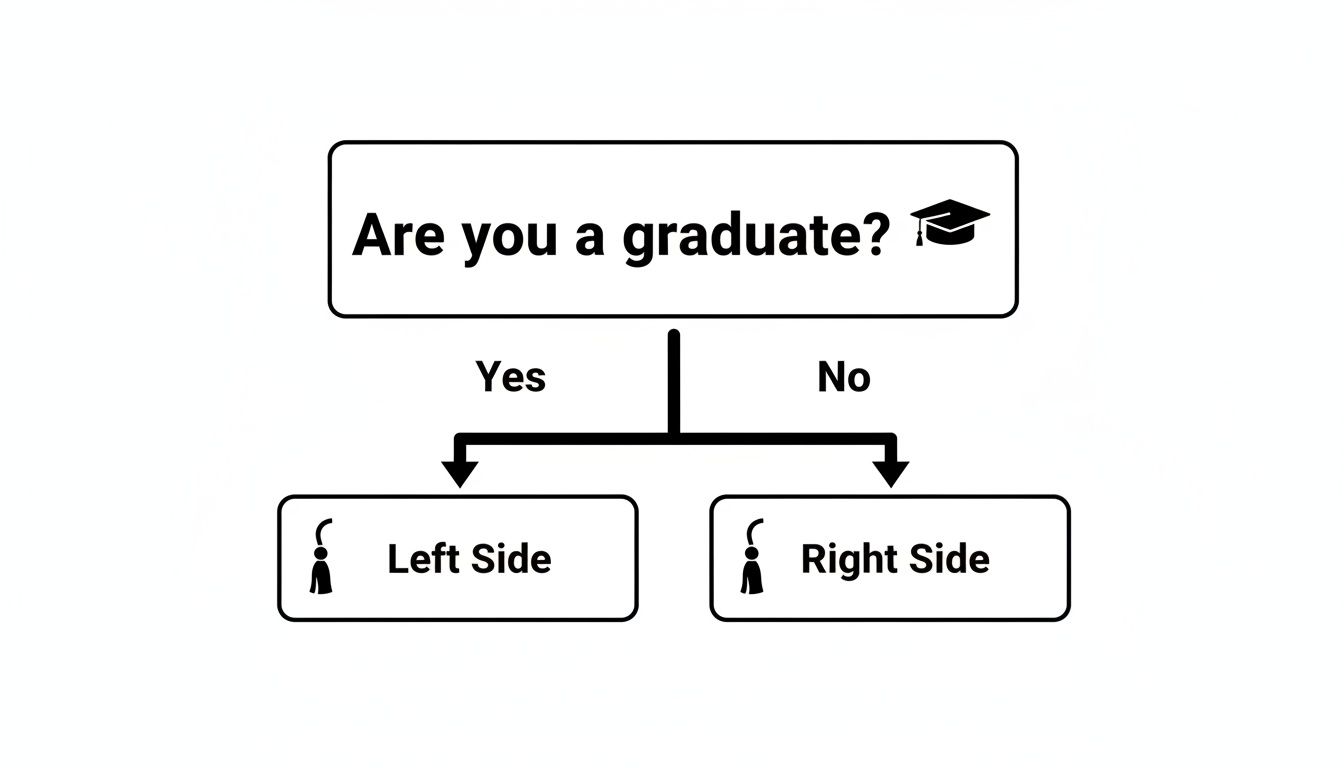
The flowchart makes it pretty clear: your status determines the tassel's position. While this right-to-left rule is the standard for most, there are some important exceptions for advanced degrees that we’ll get into. If you want to dive deeper into the different parts of academic regalia, check out our guide on what is a graduation tassel.
Navigating the Tassel Turn for High School and Bachelor's Degrees
For high school and undergraduate students, the tassel turn is the moment. It's that single, powerful gesture that physically marks your transition from student to graduate. Before your degree is officially conferred, your tassel should be on the right side of your cap, a clear sign that you're a candidate ready for that diploma.

The tradition of moving the tassel from right to left isn't just for show—it's surprisingly practical. This right-to-left shift, which really took off in the last 50 years or so, helps create fantastic photo opportunities. Many schools actually plan their stage walks so the tassel starts on the right, facing the cameras and the audience. This small detail, confirmed by event planners, makes for much better pictures for families.
The Two Ways to Turn the Tassel
Schools usually handle this big moment in one of two ways. Knowing which one to expect helps you stay in the moment instead of fumbling with your cap.
- The Individual Turn: This is common at many universities. As you walk across the stage and your name is called, you'll pause, move your tassel from right to left, and then receive your diploma cover. It's a personal, triumphant moment just for you.
- The Collective Turn: A truly cinematic and unifying experience, often seen at high school ceremonies. After the final name is read, a speaker—maybe the principal or valedictorian—will instruct the entire class to move their tassels in unison. The sound of hundreds of tassels moving at once is unforgettable.
No matter how it happens, that one simple motion declares you've officially graduated.
Expert Tip: When it's time, use your whole hand to gently guide the tassel by its knot over the top of your cap. A smooth, controlled sweep looks much better than a quick flick, which can easily send your cap flying into the crowd (and not in a celebratory way!).
Gearing Up for the Big Day
Of course, the first step to a perfect ceremony is having the right gear. For schools planning their events, our complete High School Graduation Packages provide everything in one simple bundle. If you're a college student buying individually, our high-quality Cap and Gown sets will ensure you look the part.
You can also make your regalia more personal and meaningful. Showcase your academic achievements with distinguished Honor Cords, or represent your club, sport, or cultural group with a beautiful Custom Stole. These aren't just accessories; they tell the story of your hard work. For more ideas, check out our guide on designing the perfect high school cap and gown.
Tassel Rules for Master's and Doctoral Graduates? It's a Different Story.
While turning the tassel is a huge moment for high school and undergraduate students, things work a bit differently once you get to advanced degrees. If you’re about to receive a Master's or Doctoral degree, don't be surprised when you're told to start with your tassel on the left side.
That’s right—for post-graduates, the tassel starts on the left and stays there. It’s not an oversight; it's a deliberate tradition. The placement signifies that you've already completed a previous degree and are building upon that academic foundation.
It's All About the Hood
So, if there's no big tassel flip, what's the main event? The ceremonial hooding.
For Master's and Doctoral candidates, the act of receiving the academic hood is the most significant part of the ceremony. This moment is far more symbolic than the tassel turn. A faculty member or dean will place the hood—adorned with colors representing your university and specific field of study—over your shoulders, officially marking your new, elevated academic status.
This practice has deep roots. The right-to-left tassel turn became popular for undergraduates in the early 20th century as a simple, visual way to represent receiving a diploma. Post-graduate ceremonies, however, held onto the much older tradition of hooding as the central rite of passage.
The hooding ceremony is the pinnacle of the post-graduate experience. It represents years of intense research, specialized study, and a real contribution to your field. In this context, your tassel has already "arrived" on the left because you've already completed one academic journey.
Finding the Right Regalia for Your Advanced Degree
This focus on the hooding ceremony is precisely why getting the right academic dress is so crucial. Your regalia isn't just a uniform; it’s a reflection of your hard-earned achievement.
-
Master's Regalia: This set is distinguished by a gown with unique oblong sleeves (the pouch-like part at the wrist), a cap or tam, and of course, the hood itself. Our premium Master's Gowns, Tams, & Hoods are designed to meet the specific requirements for this level of academia.
-
Doctoral Regalia: This is the most elaborate of all academic attire. It typically includes a plush velvet tam instead of a mortarboard, a gown with three velvet chevrons on each sleeve, and a larger, more ornate hood. You can explore our collection of distinguished Doctoral Regalia to find the perfect ensemble for your big day.
The colors on your hood are incredibly important, as they tell everyone your specific discipline at a glance. You can find the correct colors for any field of study in our comprehensive Academic Hoods collection. For a complete guide, check out our article on how to properly wear doctoral regalia.
Nailing Your Graduation Day Look and Photos
Let's be real: these are the photos you'll look back on for years. You want to see pure joy, not a crooked cap or a rogue tassel. A little prep work goes a long way in making sure you look confident and feel great in every single shot.
The classic graduation mishap? A cap that just won't stay put, especially during that big tassel-turning moment. The secret weapon here is bobby pins—and lots of them. Use pins that match your hair color and secure that cap from all angles: front, back, and sides. This creates a solid foundation that won't shift when you move your tassel from right to left.
Mastering Your Photoshoot
When it comes to your photos, timing is everything, and your tassel tells a story. Think of your photo sessions in two parts.
- Before the Ceremony: For all those excited, "can't-believe-it's-happening" pictures, your tassel belongs on the right side. This is your "candidate" look, full of anticipation for what's to come.
- After the Ceremony: The moment your degree is officially conferred, it's time to celebrate! Make sure that tassel is flipped over to the left side for all the photos with proud family and friends. This is your "I did it!" look.
Paying attention to this little detail adds a genuine, narrative quality to your photo album, capturing the day's progression perfectly.
Quick tip from experience: In the post-ceremony chaos, it's so easy to forget to move your tassel. Before you start posing for pictures, do a quick "tassel check" and make sure it's on the left. You'll be glad you did.
Dealing With Outdoor Ceremony Challenges
Outdoor graduations are gorgeous but bring one major wild card: wind. Nothing ruins a perfect photo like a tassel flying right into your face at the exact wrong moment. To avoid this, try a little trick: a tiny piece of double-sided fabric tape. Just use it to lightly stick the tassel's string to your cap. It'll keep it from whipping around but won't stop you from making a smooth turn when the time comes.
If you really want to guarantee that every moment is captured perfectly, consider hiring professional event photography services. A pro knows how to handle tricky lighting and catch those candid, once-in-a-lifetime shots.
Of course, the tassel is just one part of your look. You can personalize your regalia with our beautiful Graduation Stoles to showcase your academic honors, club, or heritage. And to keep everything looking sharp, a sturdy Garment Bag is a must. Finally, give your hard-earned diploma the home it deserves in one of our elegant Diploma Covers.
What Do All the Tassel Colors and Cords Mean?
While moving the tassel is a huge moment, its color is what really tells your story. That little splash of color hanging from your cap isn't just for show—it's a symbol of your field of study, connecting you to generations of scholars in your discipline. Sometimes, it can even represent your school's specific colors or a special academic honor you've earned.

This color-coding tradition is part of a system established by the American Council on Education, and it creates a kind of universal language at graduation ceremonies. When you see a graduate with a light blue tassel, you know they've likely earned a degree in education. A golden-yellow tassel? That usually signals a degree in the sciences. It’s a neat, visual way to see the diverse fields of study all in one place.
The Full Picture: Cords, Hoods, and Other Honors
Your tassel is just one piece of the puzzle. Other regalia, especially for those with academic honors or advanced degrees, add more detail to your graduation day look. Think of it all working together to show off everything you've accomplished.
The two most common additions you'll see are honor cords and academic hoods.
-
Honor Cords: Those braided ropes worn around the neck are a big deal. They signify high academic achievement (like graduating cum laude) or membership in a specific honor society. The colors mean something, too. Gold cords often represent summa cum laude (the highest honors), while other colors might denote different levels of distinction. You can check out a huge variety of Honor Cords to find the right ones for your achievements.
-
Academic Hoods: This is the main event for Master's and Doctoral graduates. These intricate garments, which drape over the shoulders, are packed with symbolism. The color of the velvet trim tells you the graduate's field of study, while the satin lining showcases the official colors of the university granting the degree. It’s a really prestigious part of the cap and gown tradition. You can see the different designs in our collection of Academic Hoods.
Think of your full regalia—the gown, cap, tassel, cords, and hood—as a visual resume of your time in school. Each piece represents a different part of your story of hard work, late nights, and eventual success.
The table below gives you a quick guide to some of the most common colors you'll see on tassels and the velvet trim of academic hoods. Knowing what they mean can make watching the ceremony even more interesting.
Common Tassel and Hood Colors by Field of Study
This guide breaks down the standard academic colors used to represent different fields of study for both tassels and the lining of master's and doctoral hoods.
| Field of Study | Tassel & Hood Color | Associated Degrees |
|---|---|---|
| Education | Light Blue | B.Ed., M.Ed., Ed.D. |
| Sciences | Golden Yellow | B.S., M.S. |
| Business & Accounting | Drab (Tan) | BBA, MBA |
| Nursing | Apricot | BSN, MSN |
| Engineering | Orange | B.Eng., M.Eng. |
| Arts & Humanities | White | B.A., M.A. |
| Music | Pink | B.M., M.M. |
| Fine Arts | Brown | BFA, MFA |
Once you understand these details, you start to see the graduation ceremony in a whole new light. It’s not just a sea of caps and gowns; it’s a colorful display of the diverse knowledge and hard work of the entire graduating class.
Answering Your Top Graduation Tassel Questions
Even after you've got the basics down, a few questions always pop up. Graduation day is a whirlwind of excitement and tiny details, and it's completely normal to want everything to be perfect. We’ve been there. So, we’ve pulled together the most common questions we hear about tassels and regalia to help you walk across that stage with total confidence.

What If I Move My Tassel Too Early?
First off, don't panic! In the excitement of the moment, it happens all the time. Remember, the tassel turn is a symbolic tradition, not a rule that could somehow invalidate your degree. No one is going to take your diploma back.
If you catch the mistake before the official moment, you can just discreetly flip it back to the right side. The most important thing is to soak in the experience. For all your post-ceremony photos, just make sure it’s on the left to show off your brand-new graduate status.
Can I Decorate My Graduation Cap?
This is a huge question, and the answer comes down to one thing: your school's policy. Many high schools and universities love seeing the creativity and encourage decorating your cap as a form of self-expression. Others, however, have strict rules to keep a uniform look during the ceremony.
Our best advice: Always check your school’s graduation handbook or ask an administrator before you break out the glue gun. If they give you the green light, have fun with it! Just make sure your masterpiece doesn’t get in the way of the tassel’s big move from right to left.
What Should I Do With My Tassel After Graduation?
Your tassel is more than just a piece of regalia; it’s a tangible piece of your journey. Many grads hang it from their car's rearview mirror or even use it as a special holiday ornament each year. It’s a fantastic keepsake.
A really popular and polished way to preserve it is by displaying it in a shadow box right next to your diploma. Gradshop has a beautiful selection of Diploma Frames, and many come with a built-in tassel holder. It creates a timeless display for your home or office that you'll be proud to look at for years to come.
Which Side Does the Tassel Go on for a PhD?
Doctoral candidates, along with Master's candidates, play by a different set of rules. For them, the highlight of the ceremony isn't the tassel turn—it's the prestigious hooding ceremony.
Because of this, their tassel starts on the left side of their tam and stays there for the entire event. The act of being "hooded" is what symbolizes their transition from candidate to doctor. To find authentic academic tams, gowns, and hoods, be sure to browse our dedicated Doctoral Regalia collection.
Here at Gradshop, we've got everything you need to celebrate your academic achievements in style, from individual tassels to complete cap and gown packages. Explore our full collection at https://www.gradshop.com to find the perfect gear for your big day.