

Before you can properly wear your doctoral regalia, you need to know what you’re working with. Getting dressed for commencement isn't just about putting on a robe; it's about understanding the story each piece tells. Your attire is made up of three distinct components—the gown, the hood, and the tam—and each one is packed with symbolism celebrating this incredible milestone.
Understanding Your Doctoral Regalia Components

The first step is simply to lay everything out and get familiar with it. Unlike the simpler regalia for other degrees, every part of your doctoral ensemble is designed to communicate your specific academic journey. Think of it as your final lesson: one in history, tradition, and personal achievement.
This tradition of academic dress is a serious throwback, originating in the 12th and 13th centuries. Scholars at early European universities wore heavy robes to stay warm in drafty, unheated halls. By the 15th century, these practical garments had evolved into official symbols of scholarly identity.
While certain features, like velvet, are now standard, designs still vary. For example, U.S. doctoral gowns almost always have three velvet stripes on the sleeves. You won't see that as often in the United Kingdom, where regalia tends to be much more specific to each university.
Your Doctoral Regalia at a Glance
Use this quick reference to identify each piece of your regalia and understand its unique symbolism before you get started.
| Regalia Piece | Key Identifiers | What It Represents |
|---|---|---|
| The Doctoral Gown | Full, bell-shaped sleeves with three velvet chevrons; two wide velvet panels down the front. | The highest level of academic scholarship. The velvet trim color often denotes the specific field of study. |
| The Academic Hood | Drapes over the shoulders, with a satin lining and velvet trim. | The satin lining shows the university's official colors. The velvet trim color signifies the academic discipline (e.g., dark blue for Ph.D.). |
| The Tam | A soft, velvet cap, often with six or eight sides, and a gold bullion tassel. | A distinction reserved for doctoral degree holders, setting it apart from the traditional mortarboard. |
Getting to know these elements will make the process of putting them on much more intuitive and meaningful.
The Doctoral Gown
The gown is the foundation of your entire look. You'll immediately notice it’s more substantial and ornate than the gowns worn by bachelor's or master's graduates, and for good reason—it signifies the highest level of academic attainment.
Here’s what to look for:
- Velvet Panels: Running down the front of the gown are two wide, plush velvet panels. This is a signature feature of doctoral regalia.
- Sleeve Chevrons: Each full, bell-shaped sleeve is adorned with three velvet bars, known as chevrons. These three bars are exclusive to the doctoral degree.
- Color Variations: While classic black is most common, some universities have gowns in their official school colors. The velvet trim is also key; its color typically represents your specific field of study.
The Academic Hood
This is where things get really interesting. The academic hood is easily the most symbolic and visually complex piece you'll wear. When draped over your shoulders, it tells a detailed story of your academic credentials through a specific color code.
The hood tells everyone two important things: where you studied and what you studied. Its satin lining displays your university's colors, while the velvet trim color signifies your academic discipline.
For instance, the dark blue velvet you see so often is the official color for a Doctor of Philosophy (Ph.D.). A Doctor of Education (Ed.D.), on the other hand, will have light blue trim, and a Doctor of Science (Sc.D.) will have golden yellow. Learning to spot these differences adds a whole new layer of appreciation for the diverse academic community you're joining.
If you're interested in the finer details, you can learn more about what comprises PhD academic regalia in our complete guide.
The Tam or Mortarboard
Finally, there's the headwear. As a doctoral graduate, you get something special. Instead of the familiar flat mortarboard worn by undergraduates, you'll wear a tam—a soft, velvet cap, usually with six or eight sides. This alone is a clear signal of your doctoral status.
The tassel is different, too. It’s typically a fancier gold or gold-bullion style, setting it apart from the simple, single-color tassels of other degrees. One more thing: at the doctoral level, the tassel usually stays on the left side for the entire ceremony. You’ve already earned your degree, so there's no need to "turn the tassel."
Nailing the Foundation: How to Wear Your Doctoral Gown
Your doctoral gown is the centerpiece of your entire academic ensemble. Getting it right is the first step to looking and feeling the part on your big day. Before you even touch the hood or tam, let's focus on the gown itself. After all, you want those impressive velvet panels and distinctive bell sleeves to look their absolute best.
First things first: wrinkles are the enemy. Your regalia will almost certainly arrive with creases from being packaged and shipped. Never, ever wear a wrinkled gown to commencement. A handheld steamer is your best tool here; just gently glide it over the fabric, being careful not to linger too long on the velvet panels. No steamer? No problem. Hang the gown in your bathroom, turn the shower on hot, and let the steam work its magic for an hour or so.
Creating a Clean, Dignified Silhouette
With the wrinkles gone, it's time to put it on. The goal is a crisp, distinguished look, which all comes down to how the gown drapes over your shoulders and hangs. Think of it less like a robe and more like a finely tailored coat—the structure should complement your own.
Unzip the gown all the way and slide it on like you would a jacket. Now for the most important adjustment: the shoulders. The seams should sit right on your natural shoulder line, not sliding down your arms or creeping up toward your neck. Taking just ten seconds to get this right makes a world of difference.
Once the shoulders are set, zip the gown up completely. A common mistake is to leave it partially unzipped, creating a sloppy V-neck that distracts from the clean lines. The zipper is meant to be hidden, allowing those rich velvet panels to be the star of the show.
Showcasing the Gown’s Unique Features
A doctoral gown isn't just any gown; its details set it apart. The full, flowing bell sleeves, in particular, add a real sense of gravitas and tradition. You want to make sure they hang naturally and look intentional.
Here’s a quick mental checklist for the sleeves:
- Let them hang freely. They shouldn't be caught up under your arms. Give your arms a little shake to let the fabric fall to its full, impressive length.
- Make sure the chevrons are visible. Those three velvet bars on each sleeve are the signature of your doctoral achievement. Ensure they're facing forward, not twisted around to the back.
- Check your shirt cuffs. If you’re wearing a long-sleeved shirt, make sure the cuffs are neat and not bunching up inside the wide opening of the bell sleeves.
An Old Pro's Tip: Just before you head out the door, do a final check in a full-length mirror. Better yet, have a friend or family member give you a once-over. Is it hanging evenly? Are the panels straight? A quick final adjustment can catch any last-minute flyaway fabric.
What to Wear Underneath Your Gown
What you wear under your gown is surprisingly important for both comfort and appearance. Commencement ceremonies can feel like a marathon, with lots of sitting and standing, so you'll want to be comfortable. Think lightweight, breathable fabrics.
Here are a few solid choices for a polished look:
| Clothing Choice | Why It Works Best |
|---|---|
| A Dress Shirt and Tie | The collar is the perfect place to anchor your academic hood later, and it adds a classic, formal touch at the neckline. |
| A Collared Blouse | Just like a dress shirt, a good collar gives a tidy appearance and a secure spot to fasten your hood’s loop. |
| Dark, Comfortable Trousers or a Skirt | Stick with dark colors like black, navy, or charcoal gray so they don't show through the gown. Comfort is king here. |
| Comfortable Dress Shoes | You'll be on your feet more than you think. Pick shoes that look sharp but won't have you regretting your choice by the end of the day. |
Ultimately, your gown is a symbol of years of dedication. Taking a few extra minutes to prepare it and put it on with care is a small way to honor that massive achievement. From finding the perfect doctoral gown to all the accessories you'll need, Gradshop is here to help you celebrate in style.
How to Drape and Secure Your Academic Hood
The academic hood is easily the most impressive piece of your doctoral regalia. It’s where your degree, field of study, and alma mater all come together in a brilliant display of color and velvet. But let's be honest—it can also be the most confusing part of the outfit.
When you first pick it up, the hood can seem like a jumble of fabric. It’s not immediately clear how this V-shaped garment with its loops, velvet, and satin is supposed to sit. The good news is that with a few tried-and-true techniques, you can get it to drape perfectly, ensuring it looks sharp and feels comfortable all day long.
Starting with the Right Orientation
First things first, get the hood facing the right way before you even think about putting it on. The easiest way to do this is to lay it on a flat surface. You'll see that one side has that rich velvet trim, and the other has a satin lining. The velvet side is the front—it's meant to be seen.
The pointed end of the hood drapes down your back, while the wider V-shaped opening goes over your head and rests on your shoulders. The trick is to get the velvet trim to frame your gown’s neckline smoothly. It should lie flat against your shoulders and chest, creating a clean ‘V’ in the front without bunching up.
This infographic provides a simple visual for the key steps in gown preparation, which sets the foundation for a perfectly draped hood.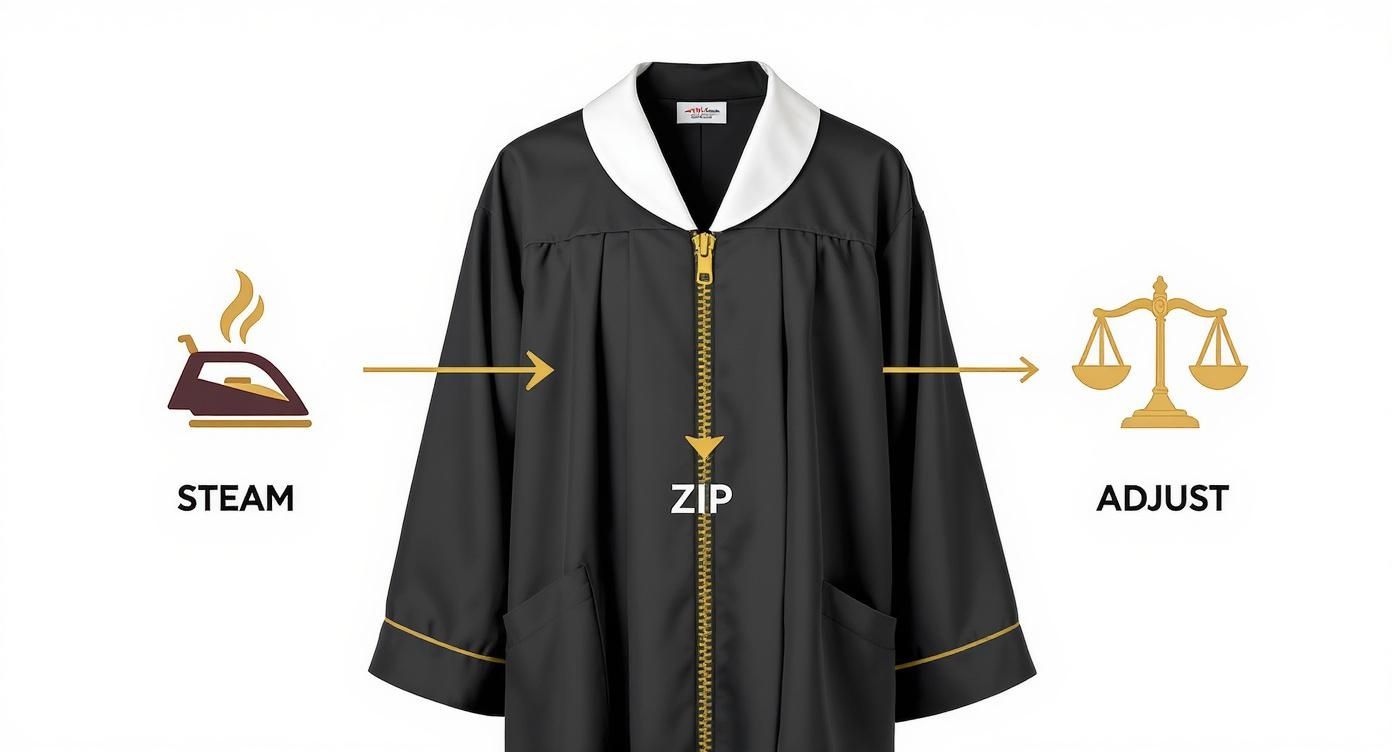
Making sure your gown is zipped up and wrinkle-free creates a smooth canvas, which is essential for letting the hood sit correctly without catching on any fabric.
Revealing Your University Colors
The real magic of the academic hood is in the "reveal." That colorful satin lining represents your university, and it’s meant to be shown off. Once the hood is comfortably draped over your shoulders, have a friend (or try reaching yourself) find the pointed end of the satin lining at the very bottom of the hood on your back.
Gently flip this satin part outward, turning it "inside-out" so it drapes over the black shell. This creates the iconic slash of color that makes academic hoods so striking. You’ll want to adjust it until the colors are showing evenly and the fold looks neat. Don’t be afraid to ask for help with this—getting it symmetrical can be tough on your own.
For a closer look, our guide on putting on graduation hoods offers an easy-to-follow walkthrough.
Anchoring Your Hood for a Secure Fit
An unsecured hood is a rookie mistake. It will constantly slide backward, pull at your neck, and ruin the look of the velvet V-neck in front. To stop this from happening, find the small cord or fabric loop on the front, inside point of the hood's "V." This little detail is your best friend for keeping everything in place.
Pro Tip: Don't skip this step! Securing the hood is the single most important thing you can do for both comfort and appearance. A properly anchored hood won’t budge, no matter how much you’re walking around or celebrating.
You have a couple of solid options for anchoring it:
- A Shirt Button: If you're wearing a button-down shirt, this is the gold standard. Just loop the cord around the top button for the most secure fit.
- The Gown's Zipper: You can also loop the cord around the zipper pull of your gown. This works, but a shirt button provides a much more stable anchor.
- A Safety Pin: In a pinch, a small safety pin can fasten the loop to the inside of your gown. Just be sure to place it where it won’t be seen.
This whole process is part of a long tradition. The standards for academic dress in the United States were more formally codified in the late 19th century, with major updates in 1987 to standardize doctoral regalia. That was the year dark blue was officially adopted as the color for all Ph.D. graduates, a rule that affects over 3,600 institutions. These guidelines also set standards for materials and discouraged extra adornments, though many schools still have their own unique customs.
Positioning the Doctoral Tam and Tassel Correctly

The final piece of your academic regalia is the headwear—the crowning touch on years of hard work. For doctoral graduates, this isn't the standard mortarboard but a soft, velvet tam. Getting the fit and placement right is what pulls your entire distinguished look together.
Think of it this way: every other part of your attire, from the velvet chevrons on your gown to the rich colors of your hood, tells the story of your achievement. The tam is the final chapter.
Achieving the Perfect Tam Fit and Position
Unlike a stiff mortarboard, a doctoral tam is meant to be worn with a certain level of comfort and security. The ideal placement is squarely on your head, with the velvet band resting about an inch above your eyebrows. You want the top to be level with the floor—not tilted back or angled to the side. A properly positioned tam looks intentional and respectful.
Here's a pro tip from someone who's seen it all: bring bobby pins. If you have fine hair or your tam feels just a little loose, a couple of well-placed pins will be a lifesaver. Simply slide them through the inner band into your hair on both sides. This little trick keeps it from shifting while you walk, shake hands, or pose for photos.
A well-fitted tam should feel snug but never tight. If you have to keep adjusting it, it's not secure. Taking a minute to pin it in place before the ceremony starts lets you focus on the moment, not on your headwear.
Doctoral Tassel Placement: A Sign of Arrival
This is one of the most important distinctions in academic tradition. Graduates earning bachelor's and master's degrees participate in the "turning of the tassel," moving it from right to left after their degree is conferred.
As a doctoral candidate, you follow a different rule. You’ve already done the work. Your degree is earned.
Because of this, your tassel begins on the left side and stays there for the entire ceremony. There is no turning of the tassel for doctors. This small detail is highly significant; it shows you are arriving at the ceremony already a member of the scholarly community.
The Significance of the Gold Tassel
That tassel isn't just any tassel, either. While other graduates often wear tassels in their school colors, the doctoral tam is almost universally paired with a special gold tassel.
Here’s what sets it apart:
- Material: It’s typically crafted from a thick, weighty gold bullion or a silky metallic thread, giving it a much more substantial and formal look than standard tassels.
- Symbolism: Gold is the color of highest achievement. It’s an immediate visual cue that you have reached the pinnacle of your academic discipline.
While some universities might offer a tassel in your specific field's color, the gold tassel is the classic, most recognized standard. Gradshop carries a great selection of high-quality doctoral tams with gold tassels that honor this tradition beautifully.
Institutional Variations to Keep in Mind
While these guidelines are standard across most American universities, always double-check your institution’s specific commencement instructions. You never know when you'll run into a unique local tradition.
For instance, some schools might specify that a particular point of the tam must face forward. Others could have historical preferences for tassel colors or even the style of the tam itself. For a closer look at these nuances, our guide provides more details about the doctoral tam with its gold button and tassel.
Ultimately, wearing your tam with confidence is the final step in presenting yourself to the world as a new doctor. You've more than earned the right to wear it well.
Final Checks and Commencement Day Advice
Knowing how to properly wear your doctoral regalia is half the battle. The other half is navigating the actual commencement day, which can be a whirlwind of excitement and logistics. With a bit of foresight, you can sidestep the stress and focus entirely on celebrating your incredible achievement.
Let's talk about what goes on underneath the gown, because it matters more than you might think. Graduation days are long, and comfort is king. Choose lightweight, breathable fabrics to avoid overheating, especially if the ceremony is indoors or in a warm climate. Simple, dark-colored trousers or a skirt are a safe bet, as they won’t show through the fabric of your gown.
And please, choose your shoes wisely. You'll be standing and walking far more than you expect—from lining up for the procession to crossing the stage and finding your family afterward. Comfortable dress shoes are an absolute must. Trust me, this is not the day to break in a new pair or test-drive those stylish-but-painful heels.
The Hooding Ceremony: What to Expect
The hooding ceremony is the pinnacle moment for any doctoral candidate. It’s a deeply symbolic tradition where a faculty mentor or dissertation chair officially welcomes you into the community of scholars. The logistics, however, can differ quite a bit from one university to another.
You'll almost always be instructed to do one of two things:
- Carry Your Hood: The most common approach is for you to process in with your hood neatly folded over your arm. You’ll then hand it to your mentor on stage, who will place it over your shoulders for the first time.
- Wear Your Hood In: Some institutions prefer candidates to wear their hoods into the ceremony already draped. The on-stage moment then becomes more of a ceremonial recognition rather than the act of hooding itself.
The key is to check your university’s specific instructions well in advance. This information is usually sent out with all the other commencement details. Knowing exactly what to expect will help you avoid any awkward fumbling on stage, allowing you to be fully present for your big moment.
Your mentor has probably done this a dozen times. Don't hesitate to have a quick chat with them beforehand. They can offer a reassuring word or a practical tip to make sure the hand-off and draping go off without a hitch.
Getting Your Regalia There—and Back—Safely
You’ve steamed and prepped your regalia to perfection; now you just need to get it to the ceremony wrinkle-free. A breathable garment bag is your best friend here. It will protect your gown from wrinkles, dust, and any potential mishaps during the trip. Hang it carefully in your car—avoid folding it into a bag at all costs.
Keep your tam in its original box so it doesn't get crushed, and gently drape your hood over the gown's hanger inside the garment bag. For a complete look at managing all the moving parts of your big day, this ultimate event planning checklist can be a lifesaver.
After all the photos are taken and the celebrations wind down, your regalia becomes a treasured memento. To keep it in pristine condition, professional dry-cleaning is the only way to go, as it will protect the delicate velvet. Once it's clean, store it in the garment bag in a cool, dry place.
Proper care ensures this powerful symbol of your hard work and dedication will last a lifetime, ready for any future academic events where you might march as a faculty member.
Your Commencement Day Regalia Checklist
Run through this quick checklist on graduation morning to ensure every piece of your regalia is perfectly in place.
| Check Item | Action to Take | Expert Tip |
|---|---|---|
| Gown | Zipped up fully, with pleats hanging straight. | Give it a final shake-out to remove any last-minute wrinkles from the car ride. |
| Hood | Draped correctly, with the institution's colors visible. | Ask a friend or marshal to check that the lining is turned out properly on your back. |
| Tam | Positioned squarely on your head, not tilted. | It should feel snug but not tight. You don't want to be adjusting it on stage. |
| Tassel | Secured to the button on top of the tam. | For doctoral candidates, the tassel typically stays on the left side at all times. |
| Footwear | Comfortable and appropriate for walking and standing. | A quick polish can make even the most comfortable shoes look sharp. |
Taking a final moment to check these details ensures you'll walk across that stage feeling confident, comfortable, and ready to celebrate. Congratulations, Doctor
Answering Your Top Questions About Doctoral Regalia
It's perfectly normal to have a few last-minute questions, even after you've done a practice run with your regalia. Your commencement is a major life milestone, and wanting to get every detail right is part of the experience. Let's tackle some of the most common questions I hear from doctoral candidates so you can walk across that stage with total confidence.
Most of the confusion tends to circle around the specific symbols and traditions. You’re stepping into a long history of academic tradition, and understanding the nuances—like why your hood is a certain color—makes the day even more meaningful.
That velvet trim on your hood, for instance, isn't just a random pop of color. It’s a code, instantly telling everyone in the room your specific field of study.
What’s the Difference Between a PhD and Other Doctoral Regalia?
The biggest difference comes down to the color of the velvet trim on your gown's front panels and your academic hood. The traditional Doctor of Philosophy (PhD) uses a specific dark blue velvet. This isn't just any blue; it represents the mastery of philosophy, which is seen as the historical root of all other disciplines.
Other doctoral degrees have their own designated colors to signify their unique fields of expertise. You’ll see a whole rainbow of colors at a large commencement, each with a specific meaning.
- A Doctor of Education (EdD) is distinguished by light blue velvet.
- A Doctor of Medicine (MD) is designated by a rich green velvet.
- A Doctor of Theology (ThD) is represented by a vibrant scarlet velvet.
For the most part, though, the core components stay the same. The classic bell sleeves, full front panels, and the eight-sided tam are standard across most doctoral degrees in the United States.
Can I Wear Honor Cords or Stoles with My Gown?
Generally, the answer is no. Doctoral regalia is meant to be the pinnacle of academic dress, and the tradition is to keep it clean and unadorned. The gown, hood, and tam are powerful symbols on their own, and most institutions prefer to let them make the statement without extra accessories. Cords and stoles are much more common for bachelor's and master's graduates.
However, this isn't a hard and fast rule everywhere. Some universities do make exceptions for very specific, high-level honors, like a prestigious doctoral honor society or for graduates with military service.
The Bottom Line: You absolutely have to check your university’s official commencement guidelines. They are the final authority. When in doubt, it’s always safest to stick with the traditional three pieces: gown, hood, and tam.
My Tam Keeps Slipping! How Do I Keep It On?
You are not alone! This is probably the most common day-of frustration, but thankfully, the fix is easy. The last thing you want is to be fidgeting with a sliding tam when your name is called.
First, make sure you have the right size. If it's the correct size but still feels a little wobbly, bobby pins are your best friend. Seriously. Just slide two or three pins through the inside band of the tam and into your hair. Angle them so they get a good grip. This simple trick will keep your tam securely in place from the processional to the final photo op.
What’s the Best Way to Care for My Regalia After the Ceremony?
If you've purchased your regalia, you have a wonderful keepsake of an incredible achievement. A little bit of care will keep it looking pristine for years to come. The number one rule is to never iron the velvet directly. The heat will crush the pile and permanently ruin the fabric. Your safest bet is to take the entire set to a professional dry cleaner.
For storage, a breathable garment bag is perfect for protecting the gown and hood from dust. To keep your tam from getting crushed, store it in a box. With proper care, this symbol of your dedication will look just as impressive decades from now as it did on your big day.
At Gradshop, we understand just how much this day means. We're committed to providing high-quality doctoral gowns and tams and perfectly crafted academic hoods, ensuring every detail is right for your celebration.