

You've got the gown on, the hood folded over one arm, and the tam sitting on the table while people you respect are already taking their seats. That moment can feel louder than the ceremony itself. The good news is that doctoral regalia meaning is simpler than it looks, because every part is doing a specific job: it shows your degree level, your field or discipline, and your institution at a glance.
The Moment You First Put On Doctoral Regalia
The first time you slip into doctoral regalia, the outfit feels less decorative than instructive. Each piece has to sit in the right place before anyone else can read it correctly, because the clothing itself works like a credential at a distance. Academic gowns were already established in European universities as early as the 12th century, and the modern American system became standardized in 1895 through the Intercollegiate Code of Academic Costume UNE's overview of academic costume history.
That history matters because the robe you are adjusting is not random theater. It gives the audience a quick read on your degree level, field or discipline, and institution without waiting for a name card or diploma. The hood's length, the velvet edge, and the lining all work together, so the outfit can look busy until you know what each part is saying.
Practical rule: if a detail looks decorative, pause and check whether it is identifying your academic rank, field, or university.
For a useful comparison outside academia, rethink your wardrobe with faux fur shows how fabric and silhouette can carry meaning, not just style. Doctoral regalia works the same way. The message is academic, and every visible part contributes to it.
By the time you finish this guide, you should be able to look at the gown, hood, and tam and say what each part means, why it is there, and how to wear it without second-guessing yourself in front of the platform party.
Anatomy of the Doctoral Outfit
The gown
The doctoral gown is the part people see first, and it usually carries the clearest visual signals. In the American system, it is typically full-length, flowing, and cut with oversized bell-shaped sleeves. The front panels and sleeves are usually faced or trimmed with velvet, and the sleeves commonly show three horizontal velvet bars USCA regalia history.
The hood
The hood is the part that turns the outfit into a readable academic code. The velvet edging identifies the academic field, while the silk lining identifies the institution that awarded the degree. Some hoods also include a chevron inside for an additional institutional color Clemson doctoral commencement guide.
The tam or beefeater
Doctoral candidates often wear a tam, although some institutions authorize a beefeater or other headwear. The exact choice depends on the university's ceremony rules, so a single universal chart does not fit every graduate. A tam usually sits more softly than a mortarboard, which helps balance the scale of the doctoral gown and hood.
The tassel
In many U.S. ceremonies, doctoral recipients wear a gold bullion tassel, which marks doctoral status rather than a discipline color. That distinction matters, because the tassel can tell the audience that the wearer is a doctoral graduate even before the hood is placed. In the same ceremony, the hood does the heavier lifting, because it shows both the field and the institution.
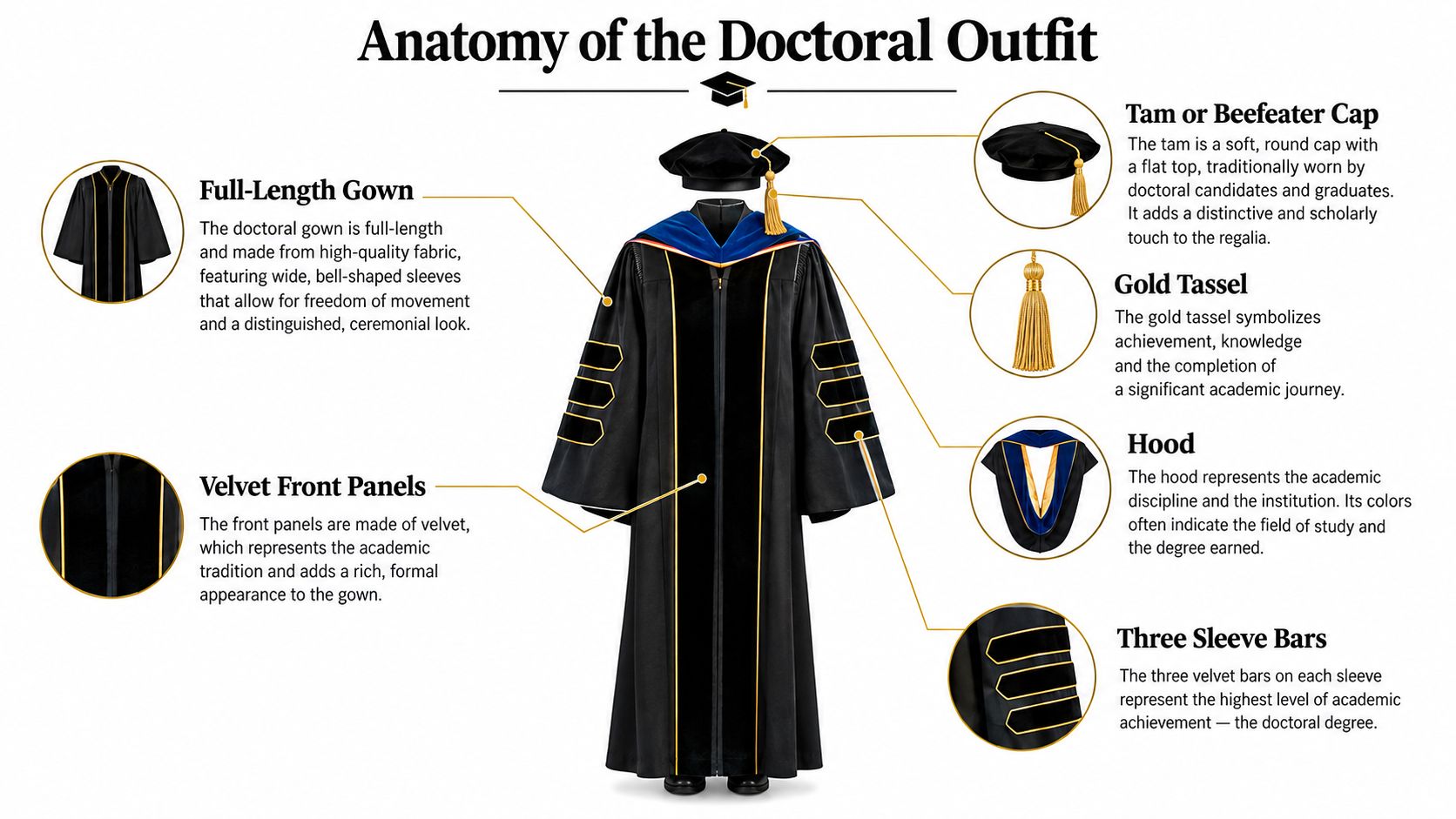
A quick way to keep the outfit straight is to read it in layers. The gown says “doctoral,” the hood says “what field and where from,” and the headwear helps the ceremony office sort your rank and role. If you want a plain-language breakdown of the garment parts, parts of a graduation gown gives the basic structure, but doctoral regalia adds more coded detail than bachelor's or master's dress.
Reading the Color Code on a Doctoral Hood
A doctoral hood works like a compact credential you can read at a distance. The trim and the lining carry different information, so start by separating them in your mind. Velvet trim usually identifies the academic field, while the lining points to the awarding institution. That is why two graduates from different schools may share the same discipline color, while graduates from one university may wear different trim colors.
A simple example from one university
The University of Wisconsin–Milwaukee regalia examples show this pattern clearly. Its Ph.D. hoods use the university's gold lining with dark blue velvet, because dark blue signals philosophy. Doctor of Nursing Practice hoods use gold-lined interiors with apricot velvet, and Doctor of Social Work hoods use gold-lined interiors with citron velvet. University of Wisconsin–Milwaukee hood examples
Why the hood reads from a distance
The hood is the largest of the standard doctoral pieces, so its colors are meant to be seen across a stage or a crowded hall. Its scale gives the ceremony team a fast visual cue, and it gives family members a clear read before they hear the degree title. In that sense, the hood works less like decoration and more like a signal panel.
The lining tells you where the degree came from, the velvet tells you what field it belongs to.
Some institutions also add a chevron inside the hood, which gives the same garment another layer of institutional meaning. That extra detail is one reason generic color charts can miss the full picture. A better approach is to read the hood as a layered identifier, not as a single swatch.
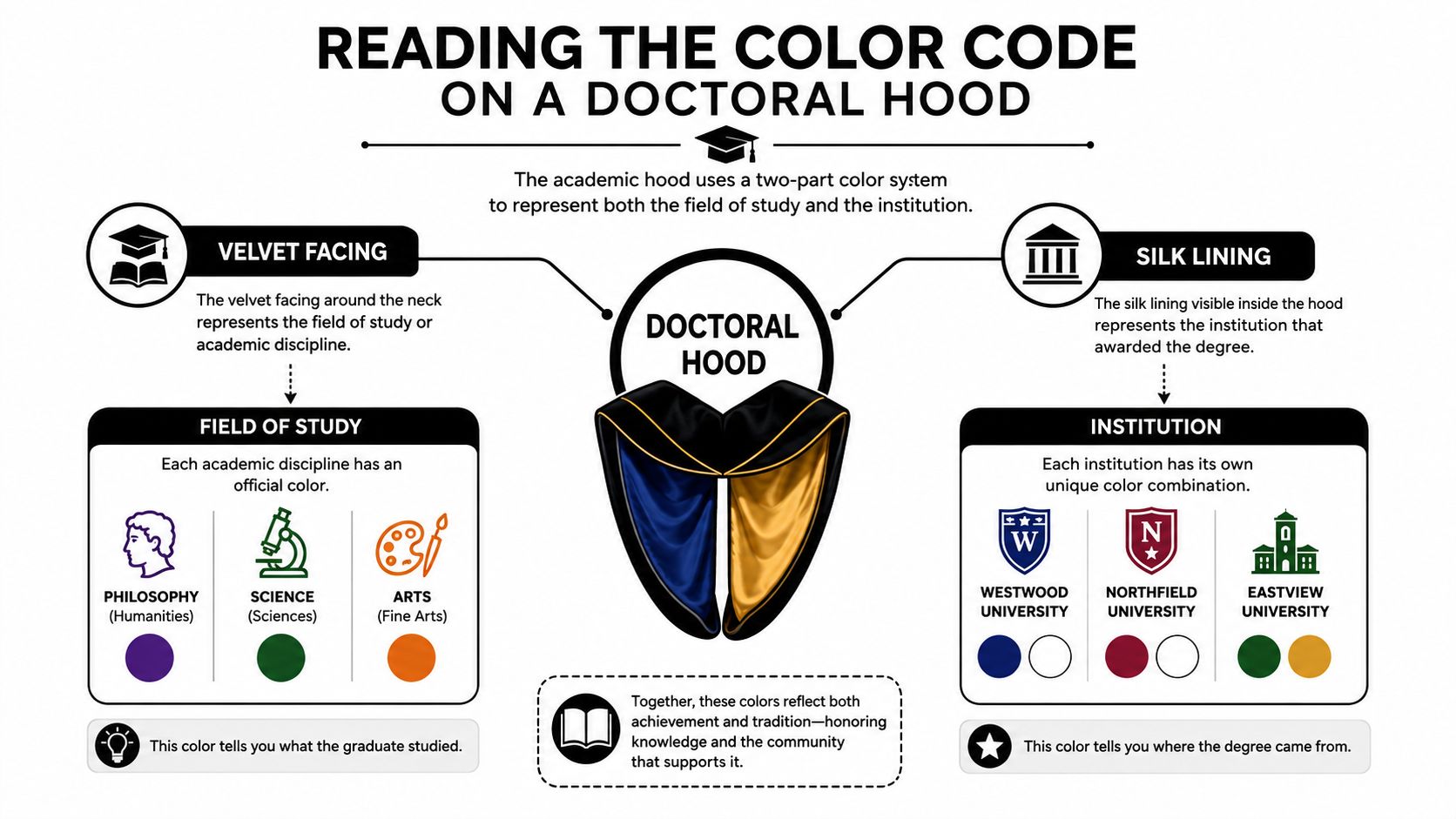
If you are comparing hoods while shopping, doctoral hood colors meaning is useful because it focuses on hood structure instead of treating every color as universal. That matters for interdisciplinary and professional-doctorate graduates, whose regalia may follow the university's own code more closely than a generic chart.
Why Generic Color Charts Often Mislead Doctoral Graduates
A lot of charts make doctoral color selection look cleaner than it really is. That's where people get tripped up, especially candidates in interdisciplinary or professional doctorates. A Ph.D. in Engineering normally uses philosophy's dark blue trim, not engineering orange, because the degree title is Doctor of Philosophy. The color follows the degree convention, not the subject label on the dissertation abstract.
The decision path that avoids mistakes
The safest sequence is straightforward. First, identify the exact doctoral degree. Second, check the conferring institution's regalia instructions. Third, select the hood trim and lining after those two checks, not before.
Practical rule: don't buy a hood from a generic color chart until you've confirmed the university's ceremony rules.
That matters because some universities publish their own color distinctions for degrees such as DBA, DNP, DrPH, and D.Eng. Others specify separate colors for Ph.D. and Ed.D. The point isn't that the system is confusing on purpose. The point is that doctoral regalia often follows the institution's ceremony language, not a single global chart.
For shoppers comparing options, a simple reference table is easier to trust than a loose color diagram:
| Field of Study | Velvet Trim Color | Example Degree |
|---|---|---|
| Philosophy | Dark blue | Ph.D. |
| Education | Light blue | Ed.D. |
| Medicine | Green | Medical doctorate |
| Law | Purple | Law doctorate |
| Arts and humanities | White | Humanities doctorate |
| Science | Golden yellow | Science doctorate |
If you're still unsure after checking the degree title, ask the graduate school before ordering. That's the least dramatic way to avoid a color mismatch on commencement day.
How Doctoral Gowns Differ From Master's and Bachelor's
At a distance, academic gowns can blur together. Up close, the cut tells the rank story quickly. The doctoral gown is the most ornate of the three, while bachelor's and master's gowns are simpler in sleeve shape and trim. The fastest way to tell them apart is to look at the sleeves, the velvet, and the hood size together.
Bachelor's, master's, and doctoral side by side
Bachelor's gowns are generally the simplest, with pointed sleeves. Master's gowns usually have an oblong or round sleeve and can be worn open or closed. Doctoral gowns add velvet facings, the three sleeve bars, and the largest hood Virginia Tech doctoral gown guidance.
What the sleeve bars are doing
The three velvet bars are not extra decoration. They signal doctoral status. Virginia Tech describes doctoral gowns as black gowns faced with black velvet and three bars across the sleeves, while Clemson notes full bell-like sleeves and velvet front borders. The University of North Dakota adds that the bars may appear in the color distinctive of the discipline.
That black base can still mislead people who rely on generic charts. Black is still the common base color in the American system, but some universities authorize institution-specific gown colors or embroidered seals. A doctoral gown is not always a single-rule garment, even when the overall structure stays consistent.
The fit of the clothing underneath matters too. A formal outfit should stay quiet enough not to compete with the robe, especially around the neck and shoulders. For families choosing that layer, dresses for graduation ceremonies can help with necklines and hemlines that work with regalia.
How to Wear Doctoral Regalia Correctly on Stage
The most nerve-racking part of commencement is usually not the walk itself. It's the handful of seconds when the marshal is watching and you're trying not to twist the hood the wrong way. The cleanest approach is to put the gown on first, then the tam, then carry the hood the way your ceremony team expects.

Carrying the hood before the hooding moment
For doctoral candidates, the hood is usually carried into the ceremony and placed during the hooding moment rather than worn from the start. Fold it vertically and drape it over your arm so it can be handed over smoothly. That keeps the lining and velvet from bunching, and it gives the faculty member a clean shape to work with doctorate wearing guidance.
Wearing the gown and tam
The gown should sit fully closed, with the velvet facing visible and the sleeve bars set straight. The tam sits flat on the head rather than tilted back, and the tassel should be positioned according to your institution's instructions. If your tam has a strap or closure, place it so it doesn't show awkwardly in photos.
Once the hood is placed
After hooding, the lined portion should fall down your back, with the trim visible from behind. Some ceremonies ask the candidate to hold still while the faculty adjust the hood so the lining and edging are both visible. If someone in your line looks uncertain, that's normal. The marshals are there to fix the fit before the stage photo, not after it.
A good ceremony rule is simple: don't improvise after you enter the stage area. If your university has a specific hooding order, follow that order exactly, because doctoral regalia is only readable when it sits the way the institution intended.
What Changes When Doctoral Regalia Crosses Borders
The American code is useful, but it isn't universal. Other universities may use different headwear, different hooding customs, or different ways of marking rank. North Dakota State University describes doctoral students wearing velvet tams and receiving hoods during a hooding ceremony, while other institutions may use a beefeater or a different ceremony format altogether NDSU academic regalia overview.
That matters for international graduates and joint-degree candidates, because the same person may cross between two systems that treat garments differently. A hood, tam, or tassel can mean one thing at one university and something slightly different at another. In U.S. ceremonies, doctoral recipients often wear gold bullion tassels, which helps separate them from discipline-colored graduate tassels, but even that convention should be checked against local rules.
Best practice: when the university changes, the regalia rules can change with it.
For bulk buyers, the safest checklist is not color alone. Confirm the degree type, the sleeve-bar design, embroidery requirements, headwear, and tassel rules before production. That protects departments ordering for a single event and avoids costly mismatches when the ceremony combines faculty, visiting scholars, and graduates from different academic systems.
Your Action Plan for Choosing, Renting, or Buying Doctoral Regalia
Start with the degree and the university. That two-step check protects you from the most common hood mistakes, especially when a professional doctorate doesn't match the subject name you'd expect from a generic chart. From there, decide whether you need a rental or a custom purchase, then lock in the hood lining, trim color, headwear, and tassel.
A quick ordering checklist
- Confirm your exact doctoral degree: Ph.D., Ed.D., DNP, DBA, or another title can change the trim color and gown details.
- Check the university's commencement page: institution-specific rules can override a general academic costume chart.
- Match hood lining and trim: lining shows the institution, trim shows the field or degree convention.
- Verify headwear: tam, beefeater, or another approved cap can depend on the ceremony.
- Review the tassel rule: doctoral tassels may differ from the ones used for graduate or undergraduate regalia.
If you're comparing options for a full ceremony outfit, Gradshop carries doctoral regalia, hoods, tams, beefeaters, and related academic apparel alongside broader graduation categories like high school caps and gowns, master's regalia, and custom stoles. For a gift-minded add-on, it can also help to browse men's graduation gifts when you're pairing the robe with something more personal for the graduate in your life.
When time is tight, order early enough to account for shipping and any institution review you still need to do. Once the hood color, gown style, and headwear are confirmed, the rest is just fit and timing.
Gradshop offers doctoral regalia, academic hoods, tams, beefeaters, and graduation essentials for many levels, so you can match the garment to the ceremony instead of guessing from a generic chart. If you're getting ready for commencement, visit Gradshop to compare regalia options and choose the pieces that fit your degree, institution, and stage moment.