

The morning of commencement often starts with a small but stressful question: will the cap for graduation stay on long enough for the ceremony, the walk across the stage, and the family photos? Hair volume, outdoor wind, a tilted mortarboard, or a tassel that keeps slipping can distract from an important milestone. The right cap, correct size, secure placement, and institution-approved accessories make the day feel much easier.
Graduation regalia also carries more meaning than decoration. A cap can signal completion, a hood can identify degree level and discipline, and cords or stoles can represent achievements or affiliations. This guide explains how to choose, measure, wear, customize, and care for caps for graduation across high school, college, master's, and doctoral ceremonies.
Why Caps for Graduation Still Matter Today
On commencement morning, a graduate may check the gown hem, adjust a stole, and steady a square cap over carefully styled hair. Outside, a gust of wind can shift the board. Inside, a loose fit can turn a stage walk into a series of quick adjustments while family members wait with cameras ready. The right cap helps the graduate look composed from the ceremony through the photographs.
A cap also completes the visual language of academic dress. It frames the face, gives the group a consistent appearance, and marks a transition families may remember for years. Its practical role is easy to overlook until the cap tilts, slips, or fails to stay in place.
The tradition reaches back to medieval European universities founded in the 12th and 13th centuries, where students and professors wore gowns and hoods as academic dress. The square mortarboard is generally believed to have developed in the 15th century from square clerical headwear. By the 1700s, the square, flat cap had become the dominant form associated with commencement. Herff Jones traces the history of graduation caps and gowns from these academic beginnings to the ceremony attire familiar today.
From university dress to a shared milestone
Academic clothing gradually became part of wider ceremonial use. Oxford is credited with requiring robes for baccalaureate-style ceremonies as early as 1321, while a University of Oxford tradition in 1432 required students to wear a cap for the occasion. Brown University later announced in 1786 that bachelor's candidates should wear black flowing robes and caps similar to those used at other universities. These milestones are documented in this history of graduation caps.
Formal standardization in the United States came much later. The 1895 Intercollegiate Code required black caps and specified a long tassel attached to the middle point at the top. That standard helped establish the mortarboard as the recognizable graduation symbol used across high school, college, and graduate ceremonies worldwide.
Practical rule: Treat the cap as part of the ceremony's visual language, not as an optional accessory.
What the cap communicates today
For a high school student, the cap often represents completion of secondary education and the beginning of the next stage. For a college graduate, it marks the end of an undergraduate program. Master's and doctoral graduates may wear specialized regalia, including academic hoods, tams, or beefeater caps that indicate advanced degree status.
The details also matter to institutional buyers. A school coordinator needs caps and gowns that look consistent in group photographs, fit students with different head shapes and hair volume, and follow ceremony rules. A university department may need particular hood colors, trim specifications, or cap styles for graduates and faculty. Those requirements should be confirmed before ordering, rather than inferred from a generic color chart.
A visual diploma is a useful comparison for the mortarboard. The diploma records achievement on paper. The cap makes that achievement visible in the auditorium, on stage, and in photographs. Choosing a cap for graduation therefore means matching the academic level, ceremony policy, gown, hair, and conditions expected that day. Size and security matter just as much as appearance, especially for outdoor ceremonies, formal portraits, and long stage walks.
Mortarboard Tam and Beefeater Caps Explained
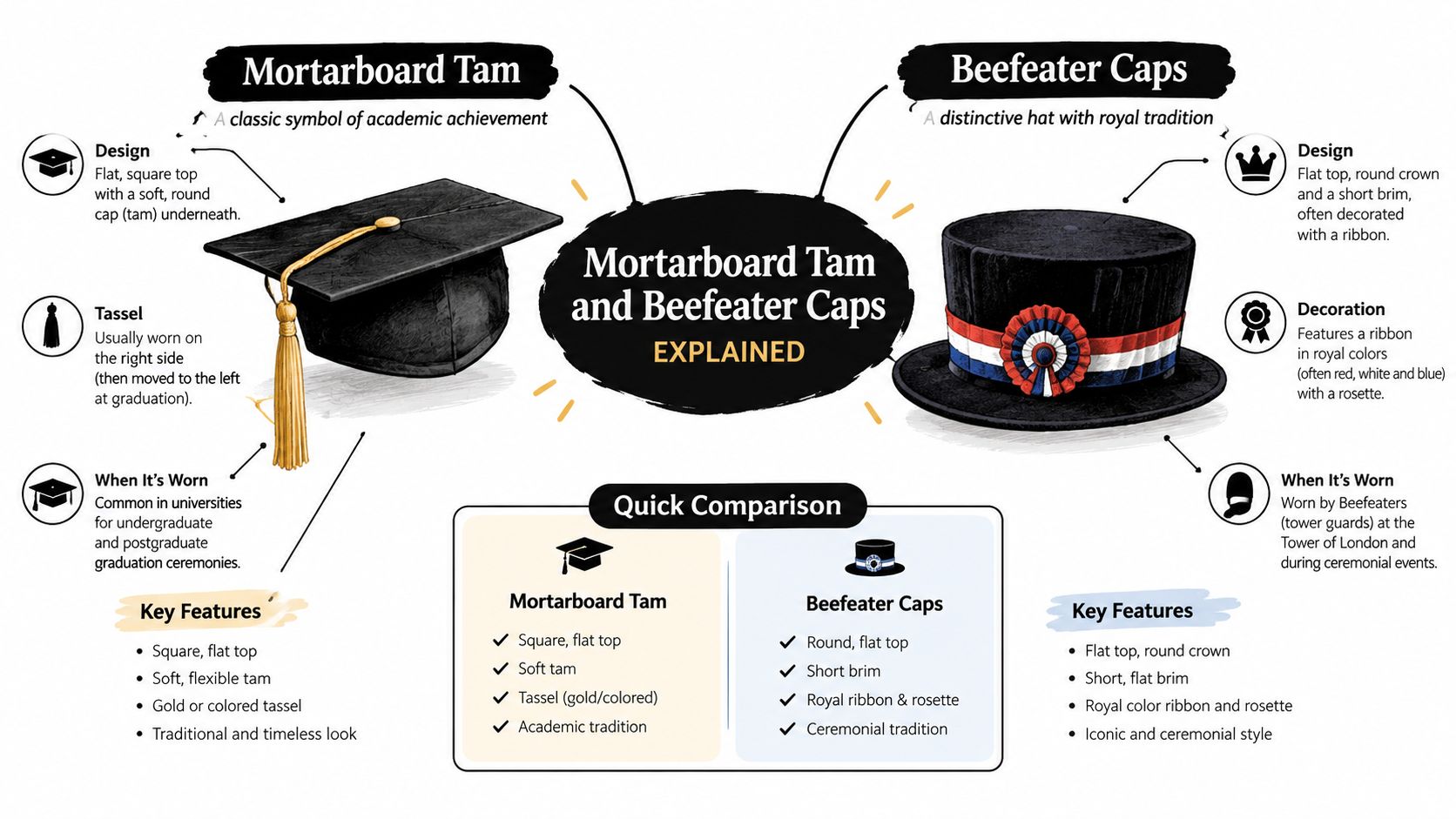
Graduation caps can look similar online until you compare their shape. The mortarboard has a firm square board and a fitted skullcap. A tam has a soft, rounded crown, often associated with master's and doctoral regalia. A beefeater cap is a distinctive doctoral style with a fuller, structured appearance.
The simplest analogy is a picture frame. A mortarboard's square board acts like a frame that must sit level on the head. A tam behaves more like a soft academic crown, so it creates a rounded silhouette instead of a flat square. A beefeater cap adds a more formal doctoral profile and is usually chosen when the ceremony or institution calls for that style.
Start with the mortarboard
A mortarboard cap consists of a rigid horizontal square board with a skullcap beneath it. Common board dimensions are approximately 10 to 12 inches on each side, according to this mortarboard construction and wear guide. That geometry gives the cap a stable, recognizable shape across adult head sizes.
The tassel usually attaches at the center of the board. During many ceremonies, the tassel begins on the right side and moves to the left after the degree is conferred. The exact protocol can vary, so graduates should follow the ceremony instructions supplied by their school.
A mortarboard is the usual choice for many high school and undergraduate ceremonies. It's also common in other academic settings when the institution's regalia policy specifies a square cap.
Know when a tam fits better
A tam is softer and rounder than a mortarboard. It's commonly worn with master's and doctoral regalia, particularly when the academic dress includes an advanced-degree gown and hood. The tam can accommodate a more formal graduate silhouette, but it still needs to sit securely and evenly.
A tam isn't a larger mortarboard. Its construction, crown shape, and relationship to the gown are different. Before ordering, check whether your institution specifies a tam, mortarboard, or another doctoral cap style. The Gradshop guide to mortarboards and tams offers a direct comparison for shoppers who aren't sure which style belongs with their degree.
Understand the beefeater cap
The beefeater cap is associated with doctoral-level academic dress and has a distinctive, fuller shape. It may be selected for doctoral ceremonies, faculty regalia, or institutional traditions that call for a formal doctoral cap rather than a square mortarboard.
Use this quick identification checklist before opening a product page:
- Square board: Choose a mortarboard-style cap when the ceremony uses the traditional flat square design.
- Rounded soft crown: Look for a tam when your master's or doctoral regalia instructions specify a soft academic cap.
- Distinctive doctoral profile: Consider a beefeater only when your institution permits or requires that doctoral style.
- Matching ceremony rules: Confirm the cap type with the school before ordering for a group or advanced-degree ceremony.
The cap shape should follow the academic level and institution's expectations. It shouldn't be chosen only because one silhouette looks more fashionable in a product photograph.
Materials Finishes and Colors That Define Your Cap
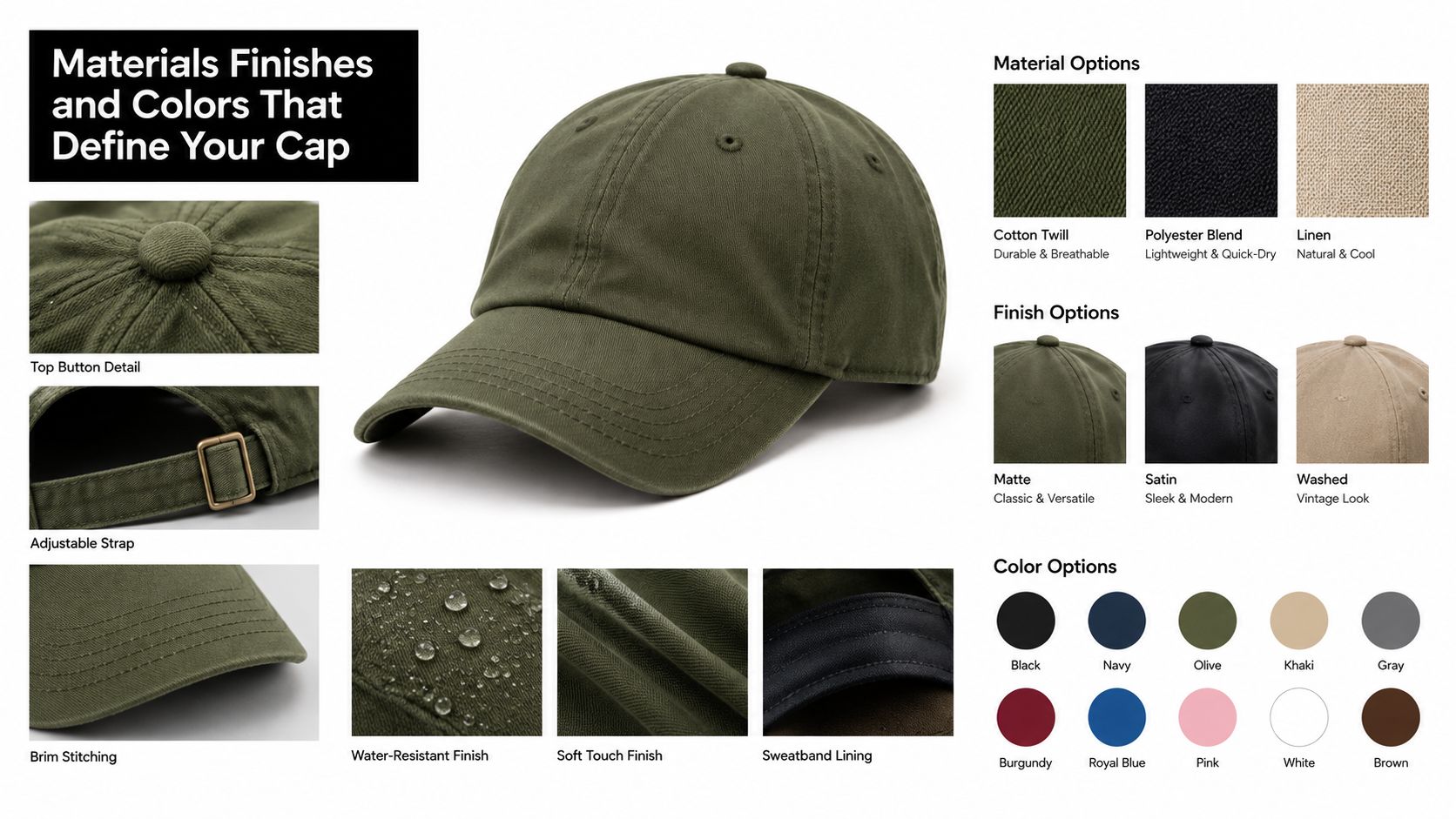
Once you know the cap type, material and color become the next decisions. The right option depends on the gown, ceremony setting, school tradition, degree level, and the amount of wear the cap must handle.
A matte fabric creates a restrained, traditional appearance and tends to photograph without strong reflections. A shiny finish catches more light and can stand out in stage photography, but it may show creases or glare more visibly. A lightweight fabric can feel easier to wear during a long ceremony, while a more structured material can hold the intended shape more firmly.
Compare finish and setting
For an indoor ceremony, almost any approved finish can work if it coordinates with the gown. Stage lighting makes consistency important, especially when a school orders caps for an entire graduating class. Outdoor ceremonies require more attention to security, because wind can lift or rotate a cap regardless of its finish.
Use the following comparison when reviewing high school graduation caps or college graduation caps and gowns:
| Choice | Visual effect | Practical consideration |
|---|---|---|
| Matte finish | Quiet, traditional appearance | Often easier to coordinate in group photos |
| Shiny finish | Brighter stage presence | May reflect strong lighting |
| Structured fabric | Holds its shape clearly | Check comfort and head fit |
| Soft fabric | Flexible and comfortable | May need careful handling during storage |
Material also matters for advanced degrees. A master's or doctoral tam may use velvet or another formal fabric to create the expected graduate-level appearance. A doctoral buyer should compare the cap with the gown, hood, and institution's regalia specifications rather than mixing unrelated pieces.
Choose color with care
Cap color usually follows the gown and school tradition, not personal preference alone. Many high school ceremonies use a school-selected color or a traditional black cap and gown. Colleges and universities may use institution-specific colors, while advanced-degree regalia may introduce discipline colors through the hood rather than the cap itself.
A custom cap decoration can express personality, but it shouldn't cover required markings, interfere with the tassel, or conflict with a school's decoration policy. Families should confirm whether graduates may decorate the top board before attaching letters, glitter, photographs, or other elements.
For a coordinated order, compare the cap color against the gown in natural light and indoor light. A cap that appears to match on a screen may look different under auditorium lighting. Schools ordering in bulk should approve a physical sample when available and keep the selected color consistent across the order.
How to Measure Size and Keep Your Cap Secure
A cap that looks correct on the product page can still slip, tilt, or create pressure if the measurement is wrong. The reliable method is simple: measure the head where the cap will sit, compare that measurement with the product's sizing information, and test the fit before commencement.
Use a soft measuring tape. Wrap it around the fullest part of the head, generally across the forehead and above the ears, keeping the tape level rather than angled upward at the back. If hair will be worn in a style with significant volume, measure with that planned hairstyle in mind, or allow room for the hairstyle without forcing the cap to sit too high.
Measure in a repeatable way
- Keep the tape level. A tilted tape can produce a misleading result.
- Avoid pulling tightly. The tape should touch the head without compressing it.
- Measure more than once. If the results differ, use the consistent measurement rather than guessing.
- Compare the chart. Use the specific size chart attached to the cap or gown product, such as the guidance in Gradshop's cap and gown measuring guide.
- Plan for hair. Braids, curls, buns, locs, and thick protective styles can change how the cap sits.
A snug cap should stay in place without causing a headache. If the cap leaves a deep pressure mark, feels painful after a short trial, or forces the wearer to tilt the board, reassess the size and placement.
Secure the cap without ruining the shape
Bobby pins are useful, but placement matters. Insert pins through the skullcap area near the sides, not through the center of the square board. Matching pin color to the hair or cap can make the support less visible in photographs.
For long hair, place the pins where they can grip hair and the cap together. A low hairstyle may give the skullcap a stable base, while a high bun can push the mortarboard upward and make the board appear tilted. Test the planned hairstyle with the cap several times before the ceremony.
Outdoor conditions deserve their own check. Wind can catch the flat board, especially when the wearer turns or walks across an open stage. Keep pins ready, avoid carrying the cap loosely by the board, and ask the ceremony coordinator whether additional fastening methods are permitted.
Run a comfort and photo test
Have the graduate wear the complete outfit while standing, sitting, walking, and turning. Check the cap from the front, side, and back. The board should look level, the tassel should hang freely, and the wearer should be able to move without repeatedly touching the cap.
Photo-readiness check: Take a few test photos from the same general angle family members will use. A cap that feels level can still look tilted from the front.
For families and school coordinators, this checklist catches problems early:
- Head measurement: Record the measurement before ordering.
- Hair plan: Test the cap with the actual ceremony hairstyle.
- Fastening: Keep approved bobby pins available.
- Weather: Prepare for wind if the ceremony is outdoors.
- Comfort: Wear the cap long enough to identify pressure points.
- Photos: Check the board, tassel, and hair from multiple angles.
How to Wear Your Cap With Tassels Stoles and Hoods
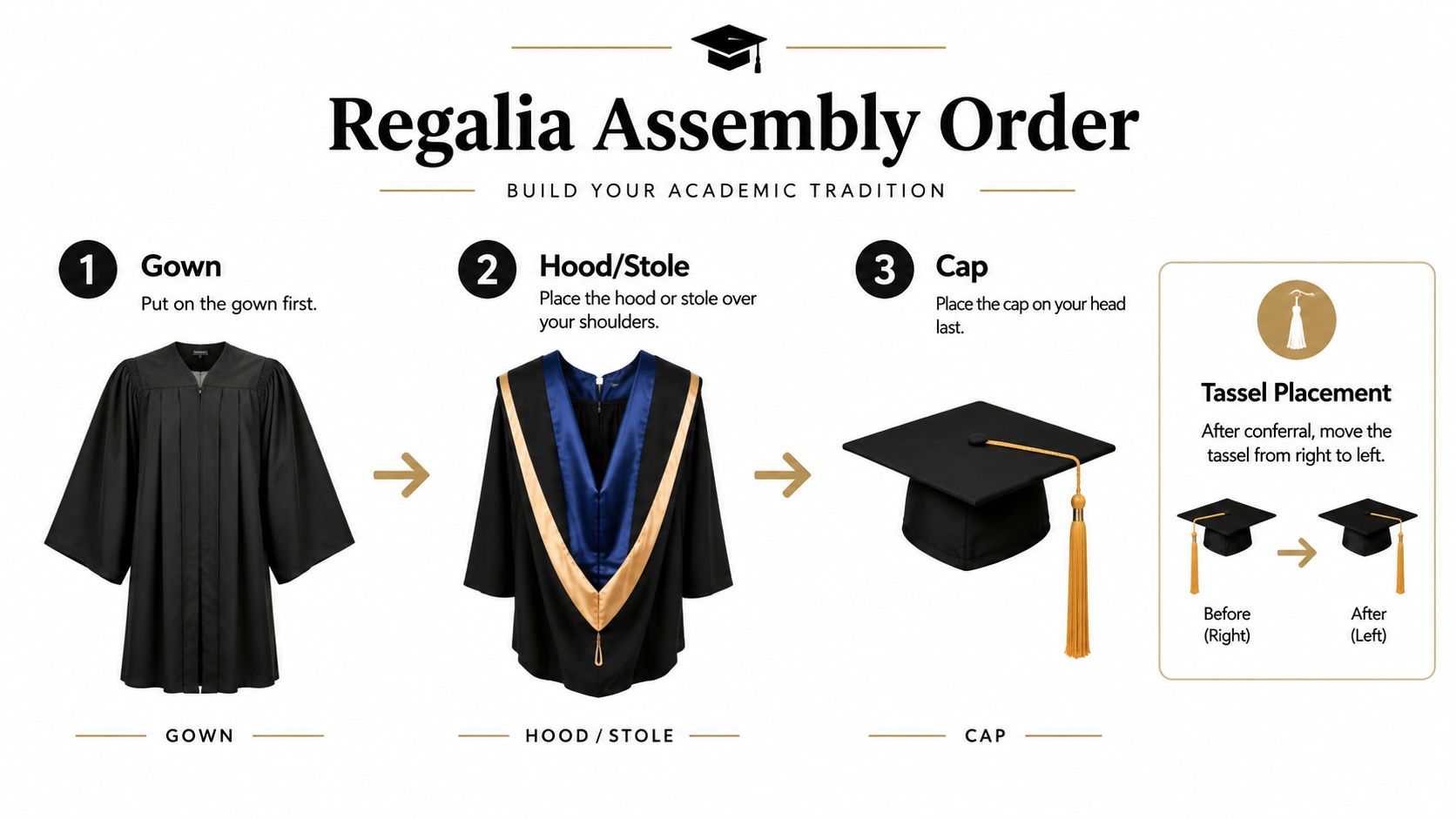
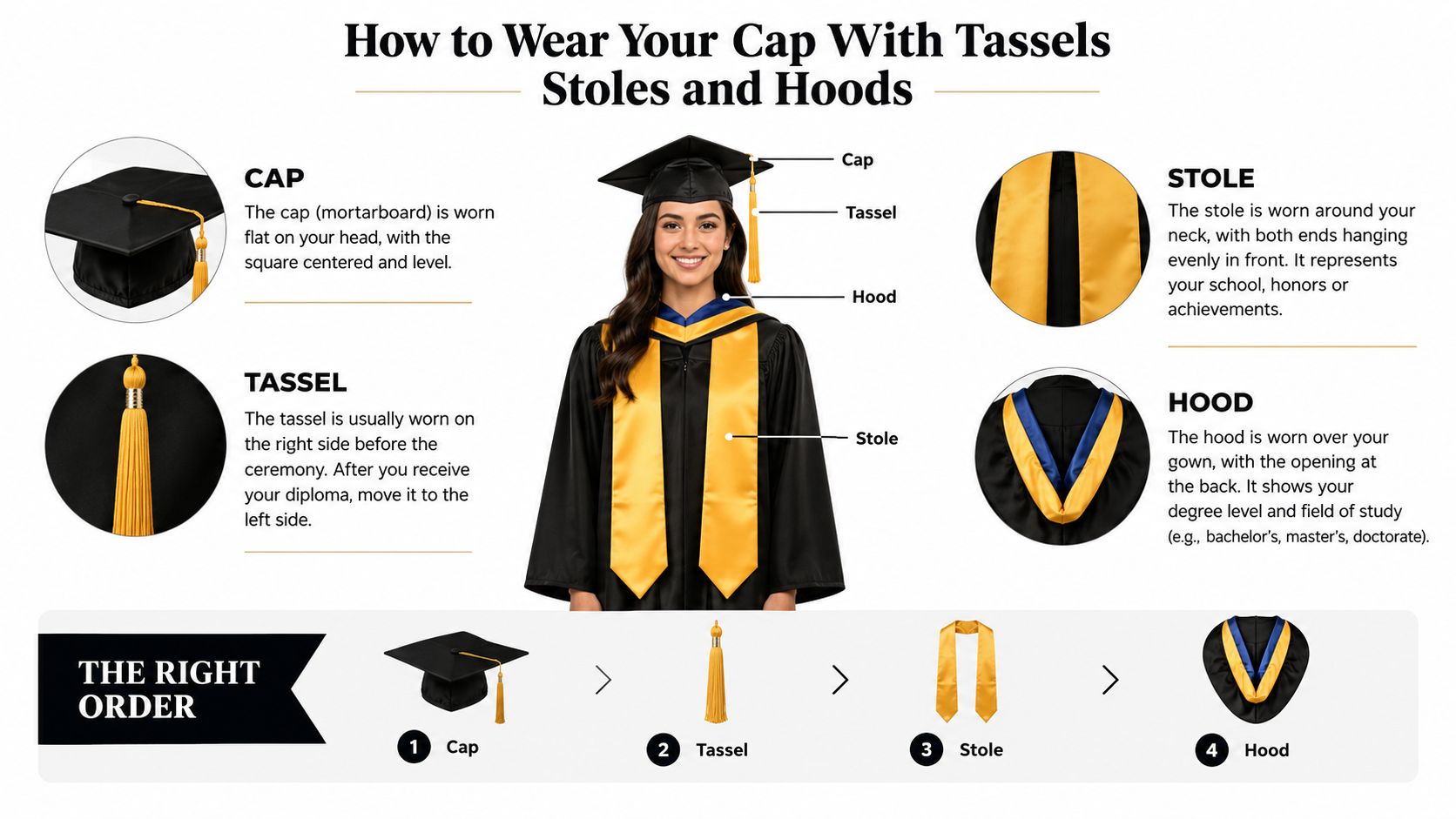
Putting on academic regalia in the right order prevents the cap from competing with the hood or stole. Start with the gown, place the hood or stole over the shoulders, and put on the cap last. This order keeps the shoulder pieces arranged while you position the headwear and tassel.
The mortarboard should sit flat and level. The point of the board should face forward, and the skullcap should rest securely rather than perch on the top of the hairstyle. The tassel should hang from the center point without being trapped beneath the board or twisted into the hair.
Place tassels according to ceremony protocol
The tassel is typically attached at the middle of the cap. Many ceremony protocols have graduates wear it on the right side before the degree is conferred, then move it to the left side afterward. Since institutions can set their own procedures, follow the instructions from the school, department, or commencement speaker.
A tassel can also carry school or degree colors. That color isn't automatically a universal academic code. Ask the institution which tassel is approved, particularly when ordering for a class, department, or organization.
Layer stoles over the gown
A stole lies over the shoulders and down the front of the gown. It usually sits outside the gown's neckline and should hang evenly on both sides. If the graduate is wearing more than one stole, the institution's rules should determine whether that combination is allowed and which piece belongs closest to the body.
Stoles may represent culture, Greek life, study abroad, organizational membership, honors, or class identity. They are different from academic hoods, which are tied to degree level, institution, and discipline. The guide to wearing a graduation stole can help graduates check placement before ceremony photos.
Read an academic hood correctly
In the United States, an academic hood uses several visual signals. The lining represents the institution granting the degree, while the velvet trim represents the discipline. The hood shell matches the robe fabric, and one academic regalia guide notes that the shell is black under the U.S. code. If more than one institutional color appears in the lining, it's commonly arranged as chevrons or equal divisions. These specifications are described in this academic regalia color guide.
Hood length and trim width also vary by degree level:
| Degree Level | Hood Length and Trim | Example Discipline Color |
|---|---|---|
| Bachelor's | 3 feet long with 2-inch trim | Education, light blue |
| Master's | 3.5 feet long with 3-inch trim | Engineering, orange |
| Doctoral | 4 feet long with 5-inch trim | Philosophy, dark blue |
The discipline examples come from academic hood specifications and color guidance. Education uses light blue, Engineering uses orange, and Philosophy uses dark blue. Other documented examples include Law in purple, Medicine in green, Music in pink, Science in yellow, Theology in scarlet, and Veterinary Science in gray, as listed in Grand Valley State University's academic regalia guide.
Avoid mixing honors without checking policy
A cord may recognize grades, an honor society, service, leadership, military service, or program completion. A stole may identify an organization or community. Neither accessory should be assumed to have the same meaning at every institution.
| Regalia piece | What it may communicate | What to verify |
|---|---|---|
| Cap and tassel | Graduation status and school tradition | Approved style and tassel placement |
| Stole | Organization, culture, class, or affiliation | Whether multiple stoles are permitted |
| Honor cord | Specific achievement or membership | Awarding office and approved color |
| Academic hood | Degree level, discipline, and institution | Length, trim, lining, and shell requirements |
Thomas Edison State University provides concrete examples of institution-specific cord policies. Its listed combinations include burgundy-and-gold for Alpha Sigma Lambda Honor recipients, purple-and-gold for Delta Mu Delta business honor recipients, red-white-and-blue for students who have served or currently serve in a U.S. military branch, green for graduates who made a monetary gift toward the TESU Foundation, and blue-and-gold for Order of the Sword and Shield National Honor Society recipients. Review the university's honor-cord examples before treating any color as universal.
Customization Bulk Ordering and Timelines Made Simple
Ordering a single cap for graduation is different from outfitting a school, department, faculty group, or student organization. The safest buying path begins with the ceremony requirements, then separates standard in-stock pieces from custom items.
For an individual, the sequence is straightforward. Confirm the cap type, gown color, size, tassel, and any approved stole or hood. For a school coordinator, create a roster that records each student's size, degree or grade level, required color, and approved accessories. Keep custom requests separate from standard items so a personalization decision doesn't delay the entire order.
Match customization to the wearer
Custom graduation accessories can express identity while remaining tied to the ceremony. Common options include:
- Kente stoles: Use when the institution or organization has approved a Kente design.
- Military stoles: Select for military recognition when the ceremony permits them.
- International flag stoles: Coordinate the flag or flags with the graduate's identity and school policy.
- Greek-life stoles: Confirm organization approval and placement rules.
- Class-year styles: Use a class design when the school has selected a shared look.
- Honor accessories: Order cords or stoles only after the awarding office confirms eligibility.
The same principle applies to master's hoods and doctoral tams. The product must match the degree level, discipline color, institution lining, and ceremony requirements. A visually attractive hood can still be incorrect if the trim width or lining doesn't follow the university's specifications.
Decide between individual and bulk purchasing
An individual order allows the buyer to focus on one complete outfit. A bulk order requires a shared standard, reliable data collection, and a plan for replacements or late changes. Schools and departments should request clear sizing information and confirm whether graduates will receive a complete package or select accessories separately.
Gradshop offers individual and institutional paths for graduation caps, gowns, tassels, stoles, hoods, tams, beefeaters, and related ceremony products. Buyers can review affordable graduation caps, high school cap and gown packages, master's regalia, and doctoral regalia according to the ceremony level.
Build the timeline around customization
In-stock regalia generally offers a simpler path for tight schedules, while custom caps, stoles, and tassels may require design approval, production, and delivery coordination. Same-day dispatch or fast shipping may be available on qualifying items, but buyers should confirm the current product page, destination, and order details rather than assuming every item follows the same timeline.
A practical ordering flow looks like this:
- Confirm ceremony rules: Ask the school what cap, gown, hood, tassel, cord, and stole combinations are allowed.
- Separate standard from custom: Identify which pieces are ready-to-ship and which require personalization.
- Approve artwork early: Review names, colors, class details, affiliations, and spelling before production.
- Collect measurements: Use one consistent method for every student or faculty member.
- Review delivery options: Check availability, dispatch information, and destination-specific timing.
- Plan a fitting day: Leave enough time to identify missing pieces or fit problems.
Budget-conscious buyers can also compare package options and review any applicable lowest-price promise. Schools should compare the full delivered order, including customization, accessories, and replacement needs, rather than judging the cap price alone.
Care Storage and Final Checks Before Commencement
A graduation cap keeps its shape when you protect the square board from pressure, moisture, and careless packing. Store a mortarboard flat rather than folding or placing heavy items on it. Keep the gown and accessories on hangers or in a garment bag so they arrive clean and organized.
Steam the gown carefully according to its fabric instructions. Avoid pressing directly on decorations, printed elements, tassels, velvet trim, or structured cap components. A garment bag makes transportation easier, especially when the graduate must travel from home to a school, auditorium, stadium, or reception.
The final check should happen before leaving for the ceremony:
- Cap level: Confirm that the board sits straight from the front and side.
- Tassel secure: Check the center attachment and required starting side.
- Hair compatible: Make sure the hairstyle doesn't push the cap upward.
- Stole even: Confirm that both sides hang at the same length.
- Hood positioned: Check that the lining and discipline trim are visible as intended.
- Pins packed: Carry approved bobby pins or other permitted fasteners.
- Photos tested: Take a quick mirror or phone-camera check.
- Accessories complete: Include cords, medals, diploma covers, and garment bags if required.
A few quiet minutes of preparation can prevent repeated adjustments on stage. The cap should support the moment, not become the moment's distraction.
Gradshop offers graduation caps and gowns for high school, college, master's, and doctoral ceremonies, along with tams, beefeaters, hoods, tassels, honor cords, stoles, diploma covers, and garment bags. Review the sizing and color details, confirm your institution's requirements, and visit Gradshop to choose an individual set or plan a coordinated bulk order.