

You're standing in front of the mirror, trying to settle a white graduation cap over your hairstyle while someone checks whether the tassel belongs on the other side. The gown looks right, but the questions keep coming. Does the cap need to match the tassel? Is white required? And did you order the right style for your ceremony?
White graduation caps are easier to choose when you separate school requirements from personal preferences. Start with the approved regalia, then work through fit, finish, accessories, and care. That approach works whether you're buying for a high school senior or coordinating academic dress for a graduate department.
Why White Graduation Caps Carry More Meaning Than You Think
The graduate in the mirror might be following a school color scheme, a longstanding commencement tradition, or an academic color convention. The cap alone doesn't tell you which. That's why a photograph from another school isn't a reliable shopping guide for your own ceremony.
White has a documented history in commencement dress. UCLA historian Marina Nye described students wearing white at graduation for at least 140 years, with photographs of women in white graduation gowns dating to the 1870s; the same account explains that the American academic color code established in the 1890s assigned white to arts and humanities, as reported in the Daily Bruin's history of changing graduation attire.
Tradition isn't the same as a dress code
That history helps explain white's ceremonial importance, but it doesn't create a universal purchasing rule. A family shopping for a high school ceremony should treat the school's written instructions as the authority, rather than trying to infer requirements from historical symbolism.
For example, a school might specify a white cap and gown for its graduating class. A university graduate might encounter white as an academic field color elsewhere in the outfit. Those situations can look similar in photographs while requiring different purchases.
The distinction between ceremonial appearance and academic identification is useful when reading about why academic regalia comes in various colors.
Practical rule: Buy the color your institution approves, not the meaning you assume that color carries.
Read the whole outfit
Before treating white as an honors designation or a degree marker, check which garment the instructions describe. A reference to white hood edging isn't necessarily permission to substitute a white cap.
Keep these questions beside the order form:
- Approved color: Does the school explicitly require or permit white?
- Matching requirement: Must the cap come from the same approved range as the gown?
- Accessory rules: Are tassels, stoles, and cords specified separately?
A clear answer to those questions matters more than choosing the most attractive white regalia photograph online.
Cap Anatomy and How to Pick the Right Size
Fit comes from the crown, not the square board. The crown is the fabric portion that sits around your head. The rigid board creates the familiar silhouette, while the top button anchors the tassel loop.
Academic dress developed long before modern commencement shopping. American academic costume was formally standardized through an intercollegiate code in 1895; square tasseled mortarboards became the dominant form, while master's and doctoral graduates and faculty often wear round velvet tams, according to Purdue University Northwest's history of academic regalia. That standardization doesn't mean every manufacturer uses an identical fit.

Measure for the hairstyle you'll actually wear
Use a flexible measuring tape around the area where the crown will sit. Keep it level and comfortably close to the head, without pulling it tight. Measure with your planned hairstyle in place, particularly if braids, curls, or an updo will change how the crown rests.
Compare the result with the specific product's size chart and the guidance on standard graduation cap sizing. Don't assume that a standard or XL label has the same meaning across different cap styles.
- Standard versus XL: Choose by the published fit range, not by hair thickness alone.
- Elastic or adjustable crowns: Check how the adjustment works before relying on it.
- Custom fit: Ask the coordinator whether an alternative crown or approved accommodation is permitted.
Cap Style by Ceremony Level
| Ceremony Level | Common Cap Style | Notes on White |
|---|---|---|
| High school | Square mortarboard | Confirm the approved white cap and gown combination. |
| Bachelor's | Square mortarboard | Follow the institution's complete regalia specification. |
| Master's | Mortarboard or institution-approved tam | Don't substitute styles without checking ceremony instructions. |
| Doctoral and faculty | Often a round velvet tam | Confirm cap style and color before shopping for a white mortarboard. |
Once the cap arrives, try it on rather than leaving it sealed until commencement morning. Look forward, turn your head, and sit down while wearing it. The crown should feel secure without forcing the board into an awkward tilt.
If you'll use discreet hairpins, test them during that fitting. They can help secure a suitable cap, but they shouldn't be the only thing preventing a poorly fitting crown from slipping.
Materials, Finishes, and Sustainability Trade-Offs
A matte white graduation cap and a shiny white graduation cap can satisfy very different visual preferences. Finish, fabric composition, and construction are separate buying decisions. Don't assume a shiny appearance tells you what the fabric contains or how durable the complete cap will be.
For an individual purchase, compare the cap with the gown you already have. For a school order, request a physical sample when available and inspect both pieces together. A screen image isn't enough to judge whether the whites and surface finishes look consistent.
Compare appearance without guessing performance
Matte finishes offer a less reflective appearance, while satin-finish or shiny options have more visible sheen. Neither description alone establishes breathability, comfort, or environmental impact. Ask for the fabric specification and inspect the crown construction.
The guide to materials used for academic wear provides useful terminology for comparing product descriptions.
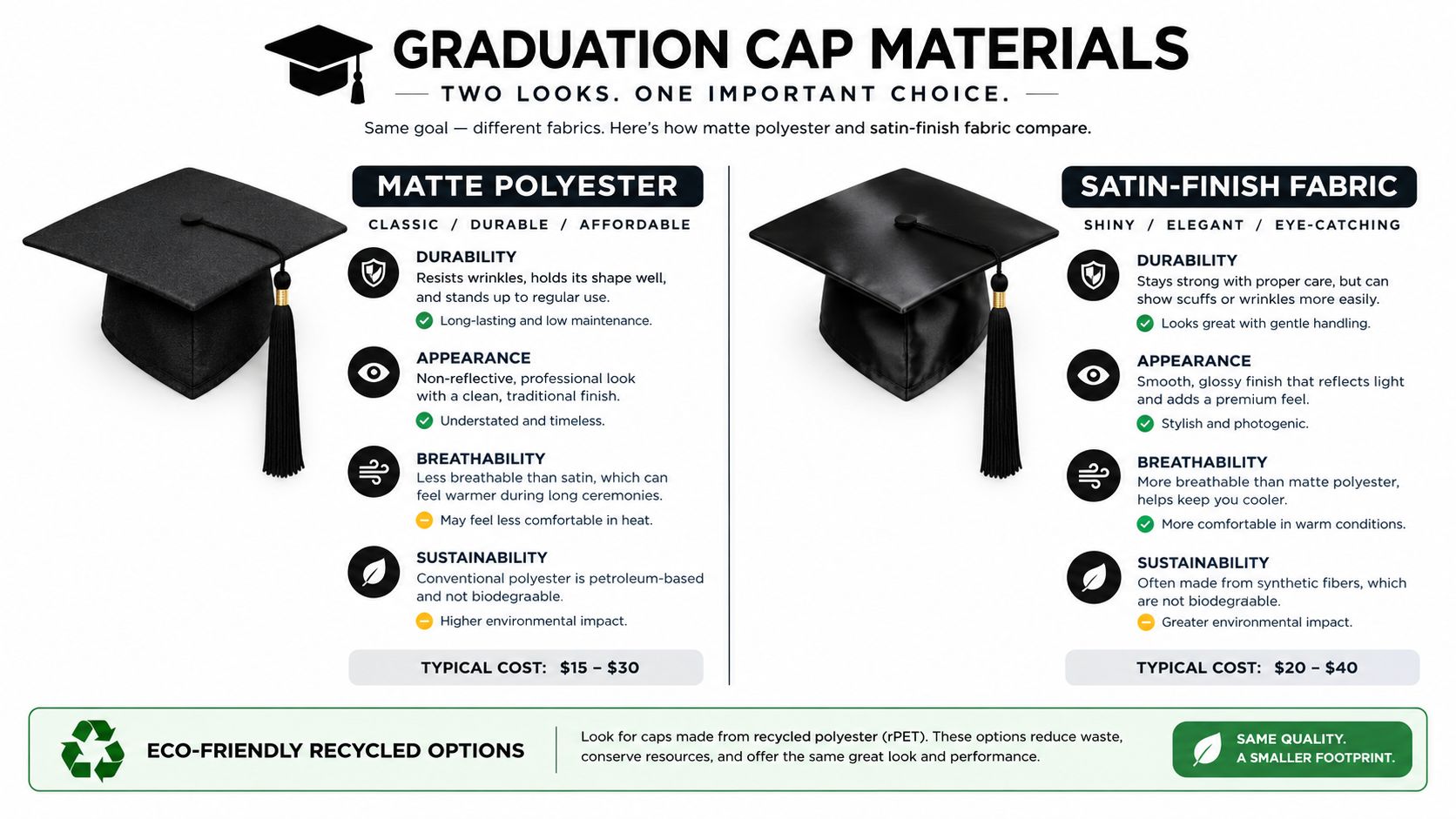
Use a sample to assess details that a finish label can't answer:
- Surface appearance: View the cap and gown together in daylight and indoor lighting.
- Board construction: Check that the square holds its shape and arrives without bent corners.
- Comfort: Try the crown on rather than judging comfort by fabric sheen.
- Transport: Check whether the packaging protects the board from pressure and moisture.
Treat recycled content as a starting point
Michigan State's 2025 graduation gowns were reported as made entirely from post-consumer recycled plastic, with each set using approximately 23–27 plastic bottles, according to The State News's reporting on recycled graduation gowns. That report concerns the gowns; it shouldn't be extended into an unsupported claim about every cap or accessory.
A recycled-content label describes material sourcing. It doesn't, by itself, answer how the entire outfit will be used, cleaned, transported, or discarded.
For purchasing decisions, consider the lifecycle rather than the label alone. Could a sibling reuse the cap? Does a rental arrangement include cleaning? Will an institution retain a reusable inventory?
These are practical evaluation questions, not proof that buying or renting always has the lower impact. Ask suppliers to explain exactly which components contain recycled material and what care or end-of-use options they support.
Pairing White Caps With Gowns, Tassels, and Hoods
Don't build a complete outfit by matching everything to the cap. Academic accessories can follow rules independent of the cap's color. Start with the school's required gown and headwear, then select the accessories listed for that ceremony.
For high school buyers, the immediate task is visual and procedural consistency. Confirm the approved gown color and finish, then check whether the package includes the required tassel. A white cap purchased separately shouldn't become an accidental mismatch with a school-issued gown.
Choose tassels by ceremony policy
Virginia Tech specifies gold tassels for doctoral students and black cap tassels for master's students in its guidance on selecting academic regalia. These are institution-specific instructions, not permission to override another university's requirements.
A white cap therefore doesn't automatically call for a white tassel. When comparing the graduation tassel collection, select the required color before considering decorative preferences.

Also check whether the ceremony specifies tassel placement or movement. Don't borrow instructions from a different degree ceremony because the graduates wear similar caps.
Order the correct gown and hood together
Gown shape is another reason not to assemble graduate regalia from appearance alone. Doctoral gowns have fuller bell-shaped sleeves and commonly include three velvet sleeve bars; the University of New England's guide also specifies a master's hood of 3 feet 6 inches with 3-inch velvet trim, compared with a doctoral hood of 4 feet with 5-inch trim and side panels, in its explanation of academic costume construction.
Those differences make a generic graduate hood a risky choice. Order the hood for the exact degree, then confirm its colors and the gown it will accompany.
For a practical pairing check, lay out the complete outfit before removing tags:
- Gown: Verify degree designation, size, color, and finish against the order.
- Hood: Confirm the degree level and requested academic colors.
- Tassel: Check the ceremony-approved color and attachment.
- Stoles and cords: Confirm eligibility and permission to wear each item.
For bachelor's and master's ceremonies, don't substitute a gown based only on a matching black or white fabric. Use the product's degree designation and the institution's instructions. For doctoral ceremonies, verify the entire specification rather than assuming that a white cap can replace required headwear.
Matching the Right Collection to Your Ceremony
Your degree level should determine where you start shopping. Searching only for “white graduation caps” may locate a suitable cap while leaving you with the wrong gown or an incomplete graduate outfit.
For high school buyers, Matte White High School Cap & Tassel and Shiny White High School Cap & Tassel packages are relevant options to ask about. They're cap-and-tassel purchases, so confirm whether you also need a gown rather than assuming the package includes one.
Use the ceremony as your shopping filter
| Buyer | Appropriate Shopping Category | Confirm Before Purchasing |
|---|---|---|
| High school senior or family | High school caps and gowns, or a white cap-and-tassel package | Approved finish, gown inclusion, cap fit, and tassel color |
| Master's graduate | Master's regalia and academic hoods | Exact degree hood, gown specification, and permitted headwear |
| Doctoral candidate | Doctoral regalia, hoods, and tams | Institutional design, degree-specific hood, and cap or tam requirements |
| School or department | Coordinated regalia packages and custom accessories | Written specifications, sample approval, and individual sizing |
| Student organization | Custom stoles and sashes | Design approval, ceremony permission, and personalization details |
The hood's velvet edging offers a useful example of why these categories shouldn't be treated as interchangeable. Standard widths are approximately 2 inches for bachelor's, 3 inches for master's, and 5 inches for doctorates, as outlined in Valdosta State University's academic regalia history. Use the degree-specific shopping category even when several products share the same field color.
Keep personal recognition separate from required regalia
A Kente stole, international flag stole, honors stole, or Greek-life sash may be meaningful to the wearer. It still needs to fit the ceremony's rules. Ask whether the institution permits the style and whether any award or membership is required.
For administrators, maintain a written distinction between required academic dress and optional recognition items. That prevents families from treating a decorative product photograph as an official uniform specification.
For individual buyers, save the approved product name, finish, and accessory choices before checkout. If a coordinator needs to review the order, a precise item description is more useful than a cropped photograph of a white outfit.
Care, Storage, and Stain Prevention for White Regalia
White fabric makes cleanliness a practical part of graduation planning. Makeup transfer, dusty surfaces, food, and outdoor grass are worth anticipating before you dress. A simple handling routine is easier than trying an unfamiliar stain treatment just before the ceremony.
Keep the cap protected while you prepare, and handle it with clean, dry hands. Choose a clean indoor surface for laying out the gown and accessories.
Before leaving for commencement
- Protect the cap: Keep it in its protective packaging or garment bag until you're ready to put it on.
- Finish grooming first: Apply makeup and hair products before dressing, then allow products to settle.
- Separate food and drinks: Eat before putting on the regalia where practical.
- Check the route: Plan where the cap will go during travel, rather than leaving it on a car floor or exposed seat.
- Follow tassel instructions: Use the ceremony's required placement rather than choosing a side solely for photographs.
Care caution: Never fold the rigid mortarboard square to make it fit into luggage. Pack around its shape and protect the corners.
After the ceremony, inspect the crown, gown neckline, and sleeve areas before putting everything away. If you find a mark, read the care instructions before treating it. Test any permitted cleaning method on an inconspicuous area, and avoid assuming that a treatment suitable for the gown is safe for the cap.
Clean and store each component appropriately
Don't soak a mortarboard or apply heat to it unless the manufacturer explicitly permits that treatment. For gown wrinkles, use steaming or pressing only as directed by the care label. Keep moisture and heat away from components whose construction you can't verify.
Let cleaned items dry fully before storage. Support the board flat, without heavy objects pressing on it, and fold the fabric crown only if the product's construction allows it. Store the tassel separately if that helps prevent tangling or pressure marks.
Keep cords and stoles clean, dry, and protected from snagging. If you plan sibling reuse, rental return, donation, or resale, retain the size information and care instructions with the outfit. Check the next school's reuse policy before promising that the cap will satisfy a future ceremony.
Putting It All Together and Ordering With Confidence
A ceremony-ready order is more than a white cap that looks right in a photograph. It's a set of items that agrees with the school's instructions, fits the graduate, and arrives with enough time for inspection.
Use a final checkout review to resolve unanswered questions. Don't let an attractive accessory distract you from a missing gown, an unconfirmed hood specification, or an unsuitable cap style.
Review the order as a complete outfit
- Approval: Keep the school's written regalia requirements beside your cart.
- Fit: Match the chosen size to the relevant chart and your actual measurements.
- Package contents: Read what's included, especially when ordering a cap-and-tassel package rather than a complete gown set.
- Degree details: Check graduate-level items against the exact qualification and institution.
- Recognition items: Confirm that each stole or cord is permitted and appropriate.
- Delivery: Review item availability, customization requirements, and the stated dispatch options.
For a high school ceremony, stay focused on the approved cap-and-gown combination. Master's graduates should review their graduate gown and hood selections together. PhD and EdD candidates should have their department confirm any institution-specific doctoral details before submitting an order.
Give group orders a written approval point
Administrators should collect size choices and accessory eligibility before finalizing quantities. Keep a record of approved colors, finishes, customization text, and delivery information. Ask another staff member to check the order against that record, especially when several programs share a ceremony.
For late purchases, distinguish dispatch from delivery. Same-day dispatch on eligible items doesn't mean same-day arrival, and custom work may require different arrangements. Confirm the applicable timing before relying on fast shipping.
If you're comparing a lowest-price promise, read its terms and check that the products being compared have equivalent contents. A cap-only listing and a complete cap-and-gown package aren't the same purchase.
The most useful final question is straightforward: could someone dress for this specific ceremony using only what's in the order? If the answer is uncertain, resolve the missing detail before checkout rather than on graduation morning.
Gradshop offers white cap-and-tassel options, high school caps and gowns, master's and doctoral regalia, and accessories for completing an approved ceremony outfit. Visit Gradshop with your school's requirements and measurements ready, then select the matching pieces and confirm availability before ordering.