

Figuring out what to wear under your graduation gown doesn't have to be complicated. The golden rule is to stick with business casual or semi-formal attire that feels both comfortable and respectful. You want an outfit that looks great in photos but isn't so bulky that you're sweating under that heavy robe. The whole point is to look sharp while letting your cap, gown, and hard-earned achievements take center stage.
Your Essential Guide to Graduation Day Attire
Graduation day is a huge deal—it's the finish line after years of grinding and dedication. While your cap and gown are definitely the main event, what you wear underneath plays a surprisingly important supporting role. You're looking for that sweet spot between formal, comfortable, and a little bit of your own personal style. Think of your outfit as the foundation for your entire look; it’s what will keep you feeling good through a long ceremony and looking great in photos you'll have forever.
Believe it or not, academic gowns have a long history. Back in the 12th and 13th centuries, scholars wore them to keep warm in drafty, unheated university halls. That tradition of functional, formal wear still shapes today’s dress codes, which is why graduates are expected to wear something neat and professional underneath. Since the gown is usually open at the front, what you're wearing is definitely on display, making a polished outfit a must.
Building Your Graduation Day Look
The trick is to choose clothing that complements your regalia, not competes with it. Your gown, cap, and any special stoles or honor cords are the real stars of the show. Your outfit should be their backup singer, not try to steal the spotlight. For most people, this means classic styles, clean lines, and simple, solid colors work best.
Here are a few core ideas to keep in mind as you plan your outfit:
- Respect the Occasion: Graduation is a formal ceremony, and your clothes should match that vibe. It's best to leave the jeans, t-shirts, and super casual clothes at home.
- Comfort is Key: You’re going to be doing a lot of sitting, standing, and walking for a few hours. Pick fabrics that breathe and shoes you can actually walk in so you can focus on the moment, not on how much your feet hurt.
- Think About the Climate: An outdoor ceremony in the summer sun calls for a totally different outfit than an indoor event in the middle of winter. Lightweight materials are a lifesaver in the heat, while smart layers are perfect for colder venues.
- Be Ready for Photos: Your outfit will peek through in pictures, especially once you unzip your gown for post-ceremony celebrations. Wear something you’ll be happy to see in photos for years to come. For more tips, check out our guide on looking your best for college graduation.
To make it even easier, here's a quick cheat sheet for planning your graduation day look.
Quick Guide to Graduation Day Dress Code
| Attire Element | What to Wear (The Do's) | What to Avoid (The Don'ts) |
|---|---|---|
| Tops | Dress shirts, blouses, simple shells | T-shirts, hoodies, anything with large logos |
| Bottoms | Dress slacks, chinos, skirts | Jeans, shorts, leggings, athletic wear |
| Dresses | Sheath, A-line, or simple cocktail dresses | Anything too casual, flashy, or very long |
| Colors | Neutrals, solids, or subtle patterns | Bright neons, distracting patterns, clashing colors |
| Footwear | Dress shoes, wedges, block heels, smart flats | Sneakers, flip-flops, stilettos (they sink in grass!) |
| Accessories | Simple, classic jewelry | Overly large or noisy jewelry, big hats |
Ultimately, the best outfit is one that lets you feel confident and comfortable so you can soak in every moment of your big day.
The perfect graduation outfit is one you don't have to think about once you've put it on. It should be stylish enough for photos, comfortable enough for the ceremony, and respectful enough for the institution, allowing you to focus entirely on celebrating your achievement.
Dressing for Success at Every Academic Level
Graduation isn’t a one-size-fits-all event. It’s a series of milestones, and what you wear underneath that gown should match the moment you’re celebrating. The outfit you’d pick for a high school ceremony is worlds away from what’s expected at a doctoral commencement, so let’s get into the unwritten rules for each academic level.
Think of it as dressing for a job interview that gets progressively more important. A high school grad is aiming for an entry-level look—smart, professional, but not overly stuffy. A doctoral candidate, on the other hand, is dressing for a senior role, where a higher degree of formality isn't just suggested, it's expected. This natural progression ensures your outfit honors the specific academic journey you just conquered.
This decision tree gives you a quick visual on how to make the right call for your big day.

As you can see, it really boils down to two things: the formality of the event and your own comfort. Nail those two, and you’ll have a practical, appropriate outfit ready to go.
High School Graduation: A Smart Start
For high school graduation, the vibe is typically smart-casual. This is a clear step up from your daily school clothes but stops short of requiring a suit and tie or a cocktail dress. The real goal here is to look polished and respectful.
- For Guys: You can't go wrong with a classic button-down shirt and dress slacks or chinos. It’s an unbeatable combination. A tie can be a nice touch, but it isn't always mandatory—be sure to check your school's guidelines.
- For Girls: A knee-length dress, a nice skirt and blouse combo, or even a stylish jumpsuit are all fantastic options. Stick with lighter fabrics to stay cool under the surprisingly warm material of a high school cap and gown.
This is not the time for jeans, t-shirts, or sneakers. You’re looking for an outfit that will look great in all those family photos long after the ceremony ends.
Bachelor's Degree: A Step into Professionalism
Finishing your bachelor's degree is a huge leap toward your professional life, and what you wear should reflect that transition. The standard here moves up to business-casual, which is basically what you’d wear in a modern office or to an important meeting.
Your outfit should be sharp enough for the formal ceremony but comfortable enough for the celebratory dinner that's sure to follow. It needs to work for both without feeling out of place.
Your outfit for a bachelor's degree ceremony sets the tone for your entry into the professional world. It should convey competence and confidence, mirroring the achievement itself.
I always recommend sticking with solid colors or very subtle patterns. This ensures your clothes won't clash with your gown or any honor stoles you might be wearing. A crisp, light-colored dress shirt or blouse looks fantastic against a dark gown and helps make your face the focal point in pictures.
Master's and Doctoral Degrees: The Pinnacle of Formality
When you reach the master's or doctoral level, you're at the very peak of the academic mountain. These ceremonies are steeped in tradition, and your attire needs to match that elevated sense of formality. Here, the dress code is firmly business-formal.
It’s time to break out your most professional clothing. Your outfit has to hold its own against some seriously elaborate regalia, from colorful master's gowns to the distinguished and symbolic doctoral hoods.
- For Men: A dark suit, a dress shirt, and a tie is the gold standard. This creates a sharp, cohesive look that shows respect for the gravity of the occasion.
- For Women: Think tailored. A sophisticated suit, a classic sheath dress paired with a blazer, or a formal business dress are all excellent choices. You want an outfit that looks polished and authoritative.
For more general guidance on dressing professionally and maintaining your personal style, these insights are great for any formal setting, including graduation. At this level, every detail counts—from your well-pressed clothes to your polished shoes. It all reflects the immense discipline and dedication it took to earn your advanced degree, making your outfit the final, perfect piece of the puzzle.
Navigating Climate and Venue for Optimal Comfort
Your graduation ceremony is a marathon, not a sprint. The last thing you want is to be distracted by feeling too hot, too cold, or just plain uncomfortable. Thinking about the climate and venue isn't just a minor detail—it's a core part of planning what to wear under a graduation gown so you can actually enjoy your big day.
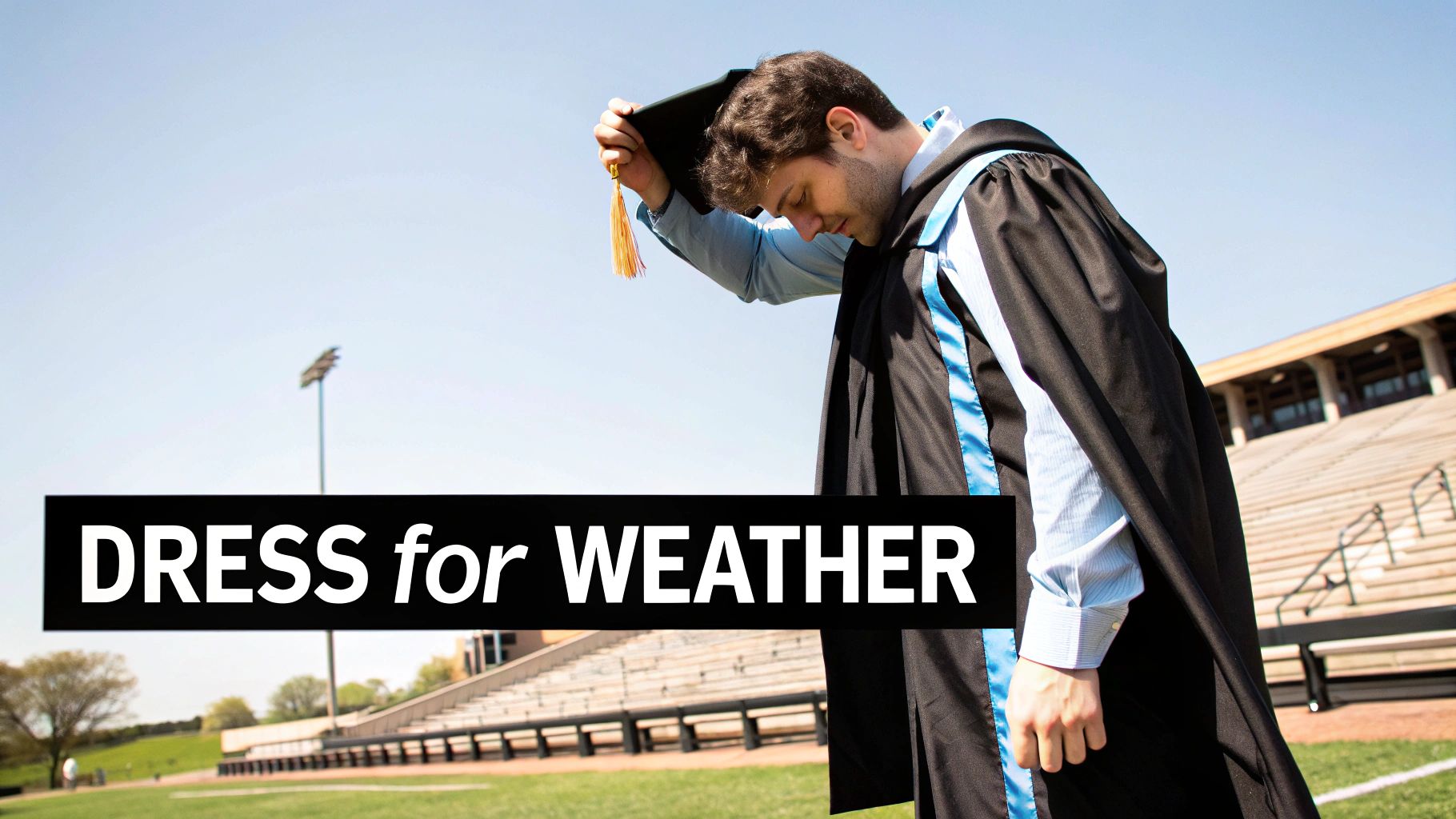
A heavy, dark-colored gown can feel like your own personal sauna on a sunny afternoon, while a drafty auditorium can leave you shivering. The trick is to anticipate the conditions and dress proactively. Your outfit should act as your personal climate control, keeping you comfortable from the moment you line up for the processional until the very last photo is snapped.
Dressing for Warm Weather and Outdoor Ceremonies
An outdoor graduation on a warm day sounds idyllic, but it can quickly turn into an endurance test. With the sun beating down, that polyester gown is going to trap a lot of heat. This is where your choice of fabric becomes your greatest ally.
Think lightweight and breathable. Natural fibers are your best bet for staying cool and collected.
- Cotton: It's a classic for a reason. Cotton is soft, breathable, and helps pull moisture away from your skin. A light cotton dress or a crisp poplin dress shirt is an excellent foundation.
- Linen: Known for its incredible breathability, linen allows air to circulate freely. A linen-blend dress or a pair of trousers can make a world of difference.
- Rayon and Viscose: These semi-synthetic fabrics come from natural sources and have a silky, lightweight feel. Best of all, they won't stick to you when the heat is on.
Color also plays a huge role. Lighter colors like white, beige, pastels, and light gray reflect sunlight instead of absorbing it, which helps keep you cooler. It’s a simple but incredibly effective strategy for beating the heat.
Conquering Cold Climates and Indoor Venues
On the flip side, a ceremony in a colder climate or a heavily air-conditioned hall presents its own set of challenges. The goal here is to stay warm without adding so much bulk that your gown looks lumpy or feels restrictive. This is where smart layering comes into play.
A practical approach involves choosing layers that are thin but effective. A fine-gauge merino wool sweater over a dress shirt or blouse offers fantastic warmth without the puffiness of a thicker knit. For women, thermal or silk under-layers beneath a dress can provide a hidden—but very welcome—layer of insulation.
Ultimately, climate dictates what to wear under a graduation gown. Summer ceremonies in warmer regions often see graduates in light fabrics; in fact, about 70% opt for short sleeves or sleeveless dresses to stay comfortable. Conversely, winter events require smart layering, with studies showing that 40-50% of graduates in colder climates wear dress shirts with sweaters or light jackets to stay warm while still looking sharp.
Striking the Right Balance for Any Situation
At the end of the day, your outfit has to be versatile. Many graduations involve moving between different environments—you might be waiting outside in the sun before moving into a chilly, air-conditioned hall. A removable layer, like a light blazer or cardigan you can easily take off, gives you much-needed flexibility.
Pro-Tip: Always try on your complete outfit with your gown before the big day. This dress rehearsal lets you see how the fabrics work together and ensures your layers don’t add any weird bulk under the robe’s specific cut.
The materials in academic regalia are designed for durability and looks, not necessarily for temperature control. Getting familiar with the materials used for academic wear can help you anticipate how your gown will feel and choose the right clothes to wear underneath. By planning for your specific environment, you ensure comfort is one less thing to worry about on a day that’s all about celebrating your success.
Choosing the Right Footwear and Accessories
Your outfit isn't truly complete without the right shoes and accessories. These aren't just finishing touches—they're what will keep you comfortable and confident through a surprisingly long day. What you put on your feet and how you arrange your academic honors are the final, critical details in figuring out what to wear under a graduation gown.

Think of your shoes as the very foundation of your entire day. You’re going to be standing for long stretches, walking quite a bit, and maybe even crossing a grassy field or climbing steep stairs. The wrong shoes can quickly turn a celebration into a painful memory, so comfort is absolutely non-negotiable.
Selecting the Perfect Graduation Day Shoes
The best graduation shoe walks the line between style and stability. For most people, this means staying away from the extremes. Stiletto heels, for example, are notorious for sinking into soft grass, making every step a potential trip hazard. On the other end of the spectrum, brand-new shoes that aren't broken in are a surefire recipe for blisters.
Here are some of the smartest footwear choices for the big day:
- Wedges: They give you the height of a heel but with way more stability since they distribute your weight evenly. A fantastic choice, especially for outdoor ceremonies.
- Block Heels: A modern and much more comfortable alternative to stilettos. Block heels provide a solid base that makes standing and walking a breeze.
- Dressy Flats: Never underestimate a good-looking pair of flats. Pointed-toe styles, elegant loafers, or classic ballet flats can look just as polished as heels, minus the pain.
- Classic Dress Shoes: For men, you can't go wrong with a pair of well-polished oxfords, loafers, or derbies. Just be sure to pick a pair you know is comfortable and that works with your trousers.
Crucial Tip: No matter what style you pick, wear your shoes around the house for a few days before the ceremony. This one simple step will break them in and help you spot any potential comfort issues before they can ruin your day.
Accessorizing with Elegance and Purpose
When it comes to jewelry, the old saying "less is more" definitely applies here. Your academic regalia—the gown, hood, stoles, and cords—is already the main event. Your personal accessories should complement the look, not compete with it.
Stick with simple, classic pieces. Think stud earrings, a delicate necklace, or a timeless watch. Big, dangly earrings or a stack of noisy bracelets can easily get tangled in your gown or hood, which is a distraction you don't need. If you're wearing a classic LBD, you can find great tips on styling jewelry with a black dress for a perfectly sophisticated look.
Arranging Your Stoles and Cords
Your honor stoles and cords are much more than just accessories; they're symbols of your incredible achievements. Wearing them correctly is a way of showing respect for all the hard work they represent.
The stole should be draped evenly around your neck so that both sides hang straight down the front of your gown, lying flat and smooth. If you have multiple cords, they should be neatly pinned together and draped over the stole. For more detailed guidance, our post on how to wear graduation honor cords breaks it all down step-by-step.
Getting the placement right ensures your regalia looks distinguished and stays put, letting you walk across that stage with pride and without any last-second fidgeting. It's that final bit of polish that makes you look photo-ready from every angle.
A Global Perspective on Graduation Attire
While the cap and gown are instantly recognizable symbols of graduation across the globe, what lies beneath them tells a much richer, more personal story. The outfits graduates choose are a fascinating mix of school rules, cultural heritage, and simple common sense, like dressing for the weather. Taking a look at these worldwide traditions helps put our own graduation dress codes into a broader, more interesting context.
In many Western nations, especially in North America, the expected attire is deeply tied to the idea of professional readiness. Graduation is seen as the final step before entering the workforce, so the clothing often reflects that "ready for business" mindset. This tradition has also created a huge industry for academic regalia.
The global market for graduation gowns hit about $1.2 billion in 2024, and North America accounts for a massive 38% of that. This isn't too surprising, given the sheer number of universities and the cultural importance placed on the ceremony. In fact, an estimated 75-85% of graduates in the U.S. and Canada stick to business-formal or business-casual outfits under their gowns, which really cements this professional norm. You can dig deeper into the numbers on the global academic apparel market.
Cultural and Climatic Adaptations
Once you step outside North America, the rules start to change. In many places, the decision of what to wear is guided more by local customs and climate than by corporate dress codes.
- Tropical and Warm Climates: It just wouldn't make sense to wear a heavy suit or a layered dress in the heat of Southeast Asia, Latin America, or Africa. Instead, graduates often wear elegant and lightweight traditional garments made from breathable materials. It's a beautiful sight to see vibrant, culturally significant attire that proudly celebrates national or ethnic heritage.
- European Variations: While plenty of European universities lean toward formal dress codes similar to those in the U.S., you'll find plenty of regional flair. In some Scandinavian countries, for example, it's not uncommon to see graduates incorporating traditional folk costumes or opting for a more minimalist, understated style of formal wear.
- Evolving Asian Trends: The Asia-Pacific region is a great example of tradition meeting modernity. With a booming middle class and skyrocketing university enrollment, graduation has become a massive family affair. The clothing worn under the gown reflects this, ranging from sharp, Western-style suits to incredibly ornate traditional outfits that showcase both global trends and deep cultural pride.
The Symbolism of Under-Gown Attire
What a graduate chooses to wear is so much more than just clothes—it's a statement. For some, wearing traditional dress is a powerful way to express their identity and honor their family and community at a major life milestone. This is a beautiful contrast to the Western model, where the outfit often signals an individual’s launch into their professional life.
Understanding these global perspectives reminds us that there is no single "right" way to dress for graduation. The goal is always the same: to honor the achievement in a manner that is respectful, culturally appropriate, and personally meaningful.
This quick trip around the world shows that the simple question of "what to wear under a gown?" connects to much bigger ideas about tradition, identity, and the future. Whether it’s a tailored suit in New York, a vibrant barong in the Philippines, or a chic dress in Paris, the outfit under the robe is a personal and cultural celebration of a truly universal achievement.
Common Questions About Graduation Attire
Even after you've planned everything out, a few last-minute questions always seem to pop up as the big day approaches. Here are some quick, straightforward answers to the most common things people ask about what to wear under a graduation gown, so you can handle those final details without any stress.
Can I Wear Jeans Under My Graduation Gown?
As comfortable as they are, jeans are a definite "no" for graduation. This is a formal ceremony, and your school will expect you to dress the part—usually business-casual at a minimum. Jeans just look too informal and will feel out of place, especially in pictures when your gown is open.
Stick with dress pants, chinos, a skirt, or a dress. It’s about respecting the occasion and making sure you look put-together for every photo op that comes your way.
What Is the Best Dress Length to Wear Under a Gown?
The goal is for your dress to be completely hidden by the gown. A knee-length or midi-length dress is your best bet, as it creates a clean, uniform silhouette when you're walking.
A maxi dress, on the other hand, is one to avoid. It’ll likely peek out from under the hem of your gown, which looks messy. More importantly, it can become a serious tripping hazard when you’re walking up and down stairs to get your diploma.
A good rule of thumb is to make sure your dress or skirt hem is at least a few inches shorter than your gown's hem. A quick check in the mirror beforehand will ensure a safe and seamless walk across the stage.
How Should I Style My Hair for My Cap and Gown?
Your hairstyle really comes down to one thing: making sure your graduation cap can sit flat and stay put. Big, high-volume styles like a high ponytail, a top knot, or any kind of intricate updo just won’t work with a mortarboard.
Low styles that sit at the nape of your neck are the way to go. Here are a few simple but elegant options:
- Hair Down: You can't go wrong with wearing your hair down, whether it’s straight or styled with some soft waves. It's a classic for a reason.
- Low Ponytail or Bun: A sleek, low ponytail or a simple bun at the base of your neck keeps your hair neat and out of the way of your cap.
- Half-Up Style: A small, low half-up style is perfect for keeping hair out of your face while still allowing the cap to fit securely.
No matter which style you pick, always use bobby pins to lock that cap in place. You don't want it shifting or falling off at the wrong moment!
What Should I Bring on Graduation Day?
When it comes to graduation day, think minimalist. You won't have a place to store a bag, so plan on carrying only what you absolutely need. Everything should fit into your pockets or a tiny, discreet clutch you can easily manage.
Here's your essential checklist:
- Your phone (with a full battery!)
- Keys
- ID and a credit card or some cash
- A couple of extra bobby pins for cap emergencies
- A safety pin or two for any unexpected gown issues
Leave the backpacks and bigger purses with a family member or friend who will be watching from the audience.
At Gradshop, we have everything you need to look and feel great on your graduation day. From classic high school caps and gowns to distinguished masters gowns and traditional doctoral hoods, our collection has the perfect regalia for your ceremony. You can explore our full selection at Gradshop.com.