

You're holding a red-and-white cord in one hand and a cap or stole in the other, and the first question is simple: what does this mean at your school? The honest answer is that red and white cords don't carry one universal meaning. Their meaning comes from the ceremony rules of the institution, the program, or the organization that issued them, not from the colors alone.

That's why a verification-first approach matters. Millersville University notes that academic regalia traditions trace back to medieval Europe, while the United States adopted a discipline-color system in 1893, and it also shows that schools assign cord colors locally rather than globally (Millersville University academic symbolism). For families helping a younger student prepare, a practical starting point is a clear career-planning resource like career guidance for grades 7-12, especially when a school's honors system, pathway awards, or service recognitions can change the meaning of the same colors.
What a Red and White Cord Means
A red-and-white cord is a school-specific symbol, not a universal badge. One campus may use red for honors, another may reserve white for a separate academic distinction, and a third may assign the same pairing to leadership or service. Start by checking the ceremony office, handbook, or published regalia policy before ordering.
Start with the school, not the color chart
If a school does not publish a meaning for the cord, no outside chart can safely fill that gap. Red and white cords are not governed by one universal color code, and the meaning is assigned by the institution that runs the ceremony (Millersville University academic symbolism). That applies to high school, college, and graduate ceremonies alike.
For families helping a younger student prepare, a practical starting point is a clear career guidance for grades 7-12. It can help students and parents sort through honors, pathway awards, and service recognitions before they choose a cord.
A simple rule helps first-time buyers stay on track:
Practical rule: if the school has not written down the meaning, do not assume the color pairing automatically signals academic honors.
The same visual combination can stand for very different achievements. Some schools use red for departmental honors and white for cum laude, while others assign those colors to different distinctions altogether. If you are buying for a student, a parent, or a school office, confirm the approved meaning before selecting the product.
Why Gradshop product pages need more than a color
A regalia listing has to do more than show a cord in the right colors. It should let the buyer identify the institution, ceremony year, and cord construction, because those details determine whether the cord fits the event. That matters most for bulk school orders, where the same color pairing may need to match a published color key instead of a generic “red and white” label.
Administrators, counselors, and families usually need to make the choice in three steps. First, verify the meaning. Then match the material and style. Finally, confirm how the cord will be worn with the cap, gown, hood, and stole. That order helps avoid the common mistake of buying a cord that looks correct but is not approved for the ceremony.
Common Meanings Across High Schools and Universities
A red and white cord can point to very different achievements, depending on the school. One institution may reserve it for honors, while another uses the same colors for leadership, service, or a career pathway. Treat any “common meaning” list as a starting point, not a final answer.
Common associations versus official institutional meaning
| Institution | Cord Color or Combination | Assigned Meaning |
|---|---|---|
| Millersville University | Red | Departmental Honors |
| Millersville University | White | Cum Laude |
| Frostburg State University | Red, black, and white | Student Government Association membership |
| University of Memphis | White | Distinction |
| University of Memphis | Red or crimson | High distinction |
| University of Southern Indiana | White | University Honors Program |
| Katy Independent School District | Red and white | Skills pathway recognition |
These examples show how much the meaning can shift from one campus to another. The same color family can mark academic honors in one place and student organization membership or pathway recognition in another. Frostburg State University assigns red, black, and white cords to Student Government Association membership (Frostburg State University cord colors and meanings), which helps show why color alone is not enough to identify the purpose.
What families should verify before ordering
The safest approach is to verify the school's written wording first, then choose the cord.
- Confirm the official meaning: Ask whether the cord represents honors, leadership, service, or a pathway award.
- Check the exact color sequence: Some schools use one color, others use a two-color combination.
- Ask who approves it: The registrar, honor society adviser, or ceremony office may control eligibility.
- Verify whether it can be worn with other regalia: Some cords are allowed with stoles or hoods, but school rules still decide what is permitted.
- Match the school's published wording: “Honors,” “distinction,” and “membership” are not the same label.
If the school has not written down the meaning, a red-and-white cord should not be treated as a default sign of academic rank. That is especially true in high school settings, where the colors may refer to a technical track or a student program instead of class standing. Browse the full range in our guide to graduation honor cords color meaning if you need a reference point before comparing options.
Families and staff can also use school examples to cross-check what they see on a product page. The University of Memphis lists white for distinction and red or crimson for high distinction. When a catalog description does not match the institution's published meaning, the written policy should win every time.
Choosing the Right Material, Width, and Length
Once the meaning is settled, the next question is practical. A cord has to look good on stage, lay cleanly over the gown, and feel appropriate for the ceremony it's part of. Material, width, and length shape all three.

Materials change the look more than people expect
Satin gives a smooth, polished finish. Polyester is usually chosen for durability and easier bulk ordering. Metallic braided cord adds more texture and visual presence, which can matter if the cord is meant to stand out on stage or in photos.
Northeastern State University–Oklahoma defines an honor cord as braided cords with tassels on both ends and states that cords can signify academic achievement or membership in a recognized academic honor group or society (Northeastern State University–Oklahoma commencement dress and conduct guidelines). That definition is useful because it shows how construction and meaning work together. The cord is not just color, it's also form.
Some schools care more about the approved construction than buyers realize. If the policy names a braided cord, don't substitute a plain one just because the colors match.
Width and length should match the wearer
Width affects visibility. A cord that's too narrow can disappear against a dark gown, while a wider cord may hold up better on stage and in photos. Length matters too, especially if the wearer is shorter, taller, or planning to knot or twist the cord in a specific way.
A simple way to choose:
| Wearer profile | Better fit | Why it works |
|---|---|---|
| High school student | Lighter cord with clean drape | Easier over a standard gown |
| College graduate | Standard visible cord | Balanced look for ceremonies and photos |
| Leadership or service recognition | Braided or knotted style | More visual weight and structure |
| Bulk school order | Published color-match construction | Keeps the entire ceremony consistent |
For school buyers, the safest move is to match the published color first and the construction second. For individual buyers, the best test is how the cord sits over the gown and whether it stays centered when the wearer walks. If you're unsure, pick a construction that matches the ceremony's tone rather than relying on color alone.
Single-Color, Two-Color, and Braided Cord Styles
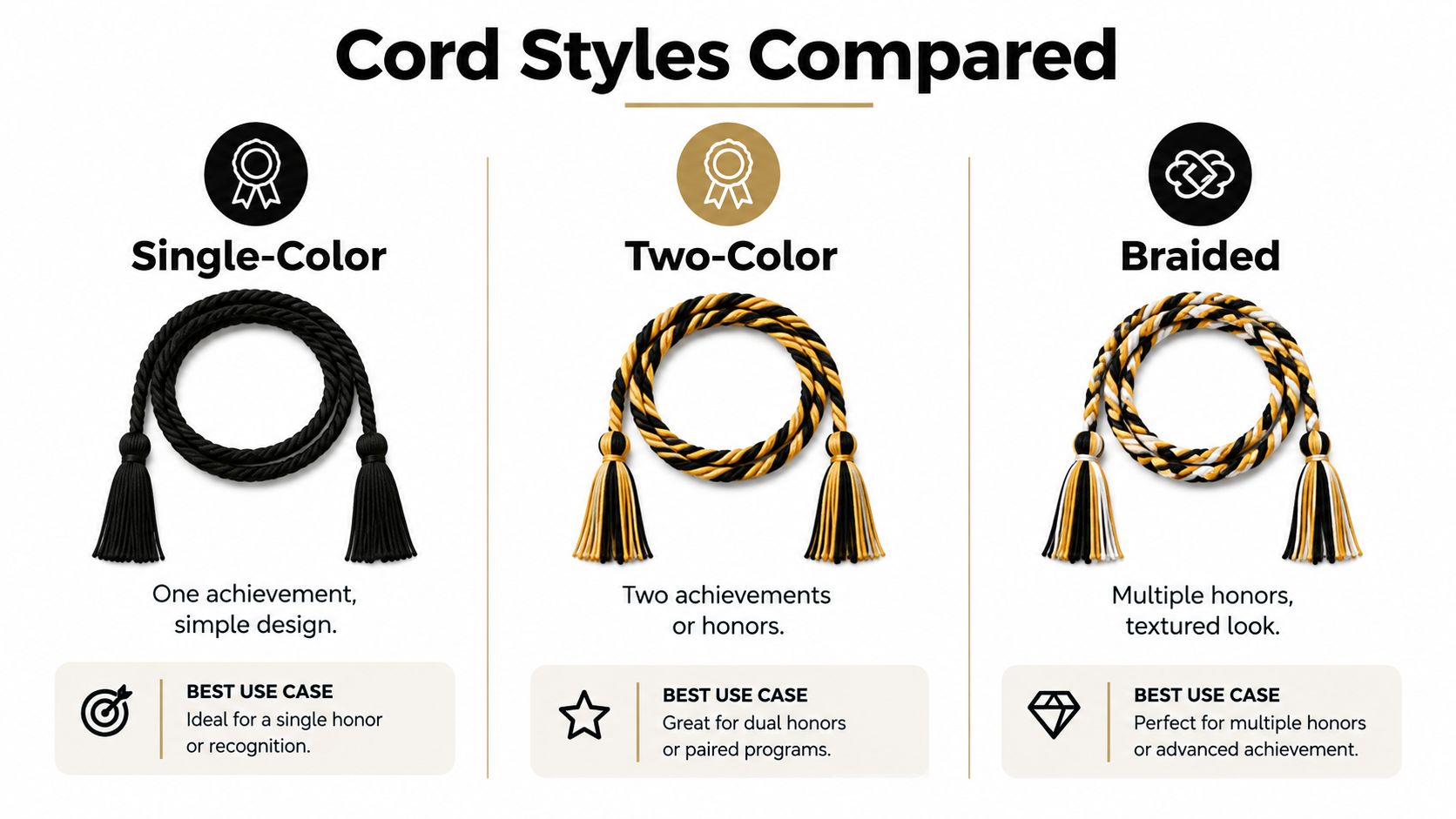
Graduation cords don't all look the same, even when they share the same colors. A single-color cord, a two-color cord, and a braided cord each create a different visual effect, and schools often choose among them for a reason. The style can signal one achievement, two related honors, or a more formal leadership or service recognition.
How the style changes the message
A single-color cord is the simplest option. It works well when the school has assigned one clear distinction, such as an honors program or a Latin honors category. A two-color cord is better when a school publishes a combined color key and wants both colors visible at once. A braided cord adds texture and is often used when the recognition feels more ceremonial or more formal.
The University of New England shows how style and meaning can diverge by program. UNE uses a solid red cord for students who complete its College of Arts and Sciences Honors Program and a braided navy-and-white knotted cord for leadership connected with university colors (UNE commencement program). That's a good reminder that the construction itself can be part of the signal.
Choosing the right style for the setting
- Single-color: Best when the school wants a clean, simple honor marker.
- Two-color: Best when both colors need to be visible and clearly paired.
- Braided or knotted: Best when the ceremony calls for a more textured, distinguished look.
Style also affects how the cord falls against the gown. A smoother cord can blend into a polyester gown more easily, while a braided cord may hold its shape better under movement on stage. If the school has a style requirement, follow that first. If it doesn't, choose the structure that best matches the level of recognition and the look the student wants in photos.
How to Wear Cords With Caps, Gowns, Hoods, and Stoles
A red and white cord can be correct in color and still look wrong if it sits low, twists under a stole, or disappears against the gown. Placement affects how the whole regalia set reads on stage and in photos.

The basic placement rule
Cords are worn over the gown, not beneath it. They should fall evenly across both shoulders so the tassels hang at a balanced length in front. If a stole is part of the outfit, the cord usually sits above it or outside it, depending on the school's order of wear and how the ceremony office wants the full look to appear.
Seattle Colleges describes cords and stoles as optional regalia worn over the gown to identify academic achievement, leadership, organizational membership, degree type, or affinity groups, with red, white, and blue assigned to U.S. military veterans and red to Running Start (Seattle Colleges academic regalia). That makes the hierarchy clear. The gown forms the base layer, and the cord and stole are the visible identifiers placed on top.
Order of wear matters
A good order of wear keeps each piece readable. Put on the gown first. Add the hood if the degree level uses one. Place the stole so it lies flat. Drape the cord evenly over both shoulders. Then adjust the tassel so nothing twists during the walk.
If a student wears both a hood and a cord, the hood usually sets the graduate look while the cord signals the honor. The pieces should sit together without crowding one another. For a full walkthrough, see our guide on how to wear graduation honor cords. When the colors are close, spacing and symmetry matter even more, because the eye needs a clear break between each part of the regalia.
A cord can be the right color and still look off if it clashes with the stole arrangement or sits unevenly on the gown. The best result comes from choosing the cord style first, then checking how it works with the cap, gown, hood, and stole before graduation day.
Matching the Cord to the Recipient and the Occasion
A cord should match the recipient's role, not just the color on a swatch. High school students, undergraduates, graduate students, and military-affiliated graduates all wear cords for different reasons, and the meaning changes with the occasion. The clearest choice comes from matching the cord to the approved category first.
Different recipients need different logic
A high school student may be wearing a cord for a skills pathway, an organization, or a school-recognized award. A college undergraduate may be wearing one for honors or academic distinction. A graduate student may wear a cord with a hood, and a military-affiliated graduate may wear red, white, and blue for service rather than GPA.
At the University of Memphis, undergraduate cords correspond to GPA-based distinctions with white indicating distinction, red or crimson indicating high distinction, and gold indicating highest distinction, with eligibility spanning approximately a 3.25–4.0 GPA range (University of Memphis cord and stole policy). That's useful because it shows how a school can connect cord color directly to academic standing.
A simple decision matrix
| Recipient profile | What to verify | Cord choice logic |
|---|---|---|
| High school graduate | Award type and school approval | Use the school's published meaning, not a generic chart |
| College undergraduate | Honors level or organization status | Match the official distinction or society |
| Graduate student | Hood, stole, and cord order | Confirm how cords sit with advanced regalia |
| Military-affiliated graduate | Service eligibility | Use the school's service color rules, not academic honors rules |
Do this first: ask whether the cord is tied to GPA, membership, pathway completion, or military status before you place an order.
Schools also set limits on approval. Some allow only university-recognized academic honors, honor societies, and military service. Others prohibit students from modifying approved accessories or wearing unauthorized cords. That's why the recipient profile matters as much as the color family. If the context is wrong, the cord is wrong, even if the colors look right.
Ordering, Verifying, and Finalizing Your Gradshop Purchase
The last step is a checklist, not a guess. Confirm the school's color key, verify who qualifies, choose the cord construction, and then match the cord with the rest of the graduation outfit. Simmons University is a good reminder that cords can be defined very specifically, since it describes them as twisted colored strings with tassels and assigns different combinations to recognized programs, including blue-and-white cords for its Honors Program and red, silver, and gold cords for Latin honors (Simmons University commencement).
Before you place the order, check these points:
- Meaning: What does the cord represent at this school?
- Eligibility: Who is allowed to wear it?
- Construction: Single-color, two-color, or braided?
- Length: Will it sit properly on the wearer's gown?
- Accessories: Does it need to coordinate with a stole, hood, cap, or gown set?
If you're buying for a school, department, or family, the cleanest workflow is to confirm the ceremony rules first and the product details second. That keeps the order aligned with the award instead of just the colors. It also avoids last-minute corrections when the regalia is already being handed out.
If you're ready to order cords, caps and gowns, stoles, or regalia for a school ceremony, visit Gradshop to compare cord styles, check matching options, and choose the right pieces for your graduate. For high school, college, and advanced degree ceremonies, the right setup starts with the school's rules and ends with the right regalia in hand.