

Does a rainbow honor cord mean the graduate earned Latin honors, or does it mean something the transcript never measures? Most families treat every cord as a GPA badge. That habit misses the point. Rainbow honor cords are recognition regalia. The symbol is widely shared. The rule that lets someone wear it is written by one school, one center, or one ceremony, and it is not a national academic standard.
What Rainbow Honor Cords Mean at a Glance
A rainbow honor cord is a recognition cord, most often worn by LGBTQ+ graduates and their allies to affirm identity, community, and inclusion. It is not a standard academic distinction, and it does not stand in for cum laude or any other GPA label.
The Ithaca College commencement program states that multicolored rainbow cords are worn by some LGBTQ+ and allied graduates, and that the college's students have used the tradition since 2003 through its annual Lavender Celebration. The same program names the six traditional rainbow colors and what each one stands for.
| Color | Traditional meaning |
|---|---|
| Red | Life |
| Orange | Healing |
| Yellow | Sunlight |
| Green | Nature |
| Blue | Art and harmony |
| Purple | Spirit |
| Multicolor rainbow cord | Worn by some LGBTQ+ and allied graduates; each school sets the official meaning |
The multicolor cord is the piece most graduates see on the gown. Those color meanings are general symbolism. The award rule is local. Think of the colors as the symbolism in a community flag, and the campus policy as the rulebook that decides who may wear the cord at that ceremony. The useful next question is always who issued the cord, and under which written rule.
Where the Rainbow Cord Tradition Began
The colors on today's cords trace back to a flag rather than to a registrar's honors list. San Francisco artist Gilbert Baker created the Pride flag in 1978. The Ithaca College commencement record ties the original flag's colors to life, healing, sunlight, nature, art or harmony, and spirit.
Campus adoption came later, school by school. The same record reports that Ithaca College has presented rainbow cords to LGBTQ+ and allied students since 2003, folding the practice into its Lavender Graduation program. Ceremonies in this family exist to recognize LGBTQ+ students' achievements and contributions, and each one was built by the campus that hosts it rather than by a national body.

Because the custom grew out of identity recognition, the cord works like a club pin rather than a diploma seal. A pin says you belong to a group, or that you stood with one. It does not rank your grades, and it says nothing about whether the degree is a high school diploma, a bachelor's, a master's, or a doctorate.
Allied graduates can wear the cord when the issuing program includes them. High schools, colleges, and graduate schools all borrow the symbol, yet none inherits a single national eligibility test handed down from 1978. Who receives the cord is a local decision. The flag supplied the symbol. Each campus writes its own rule.
How Campuses Run Rainbow Cord Programs
No national office issues rainbow cords. Each campus builds its own program, and the results differ enough that a cord accepted at one school can be refused at the next.
| Campus practice | What graduates receive | Who is included |
|---|---|---|
| Rutgers Rainbow Graduation | A rainbow tassel at a dedicated ceremony | LGBTQIA+ students and allies, undergraduate and graduate |
| Ithaca College Lavender Graduation | Rainbow cords | LGBTQ+ graduates and allies in that program |
The University of Houston Division of Student Affairs reported that its Spring 2023 Lavender Graduation drew 125 attendees and recognized 32 graduates, with attendance up 13.7% from Spring 2022. The gap between those two figures is instructive: a celebration can welcome a large crowd while the cord itself goes only to the graduates being honored. The university's LGBTQ Resource Center estimated roughly 285 Lavender Graduations taking place across the United States, with about 10 of them in Texas.
What those programs share
The Rutgers Rainbow Graduation listing describes a single dedicated ceremony. Other campuses fold the cord into a lavender celebration, and some reserve it for people who attend a separate gathering. The shared pattern is institutional. A cord may be worn over the gown at main commencement, or it may exist only inside the recognition event where it was issued. A few schools extend the same symbol to rainbow stoles, and whether allies may wear the cord changes from campus to campus.
Practical rule: If your cousin wore a rainbow cord at one university, that does not clear the cord at your high school or at a different college.
Before you drape anything, read a plain guide on how to wear graduation honor cords so the cord sits correctly alongside a hood or stole. Then confirm the local rule with the office running your ceremony rather than borrowing a neighboring district's policy for your own.
Rainbow Cords Versus Latin Honor Cords
The mix-up is easy to spot on the stage. Latin honors such as cum laude are GPA distinctions that a university defines. Rainbow cords recognize identity, allyship, or participation in a program. They are not interchangeable, even when both hang on the same gown.
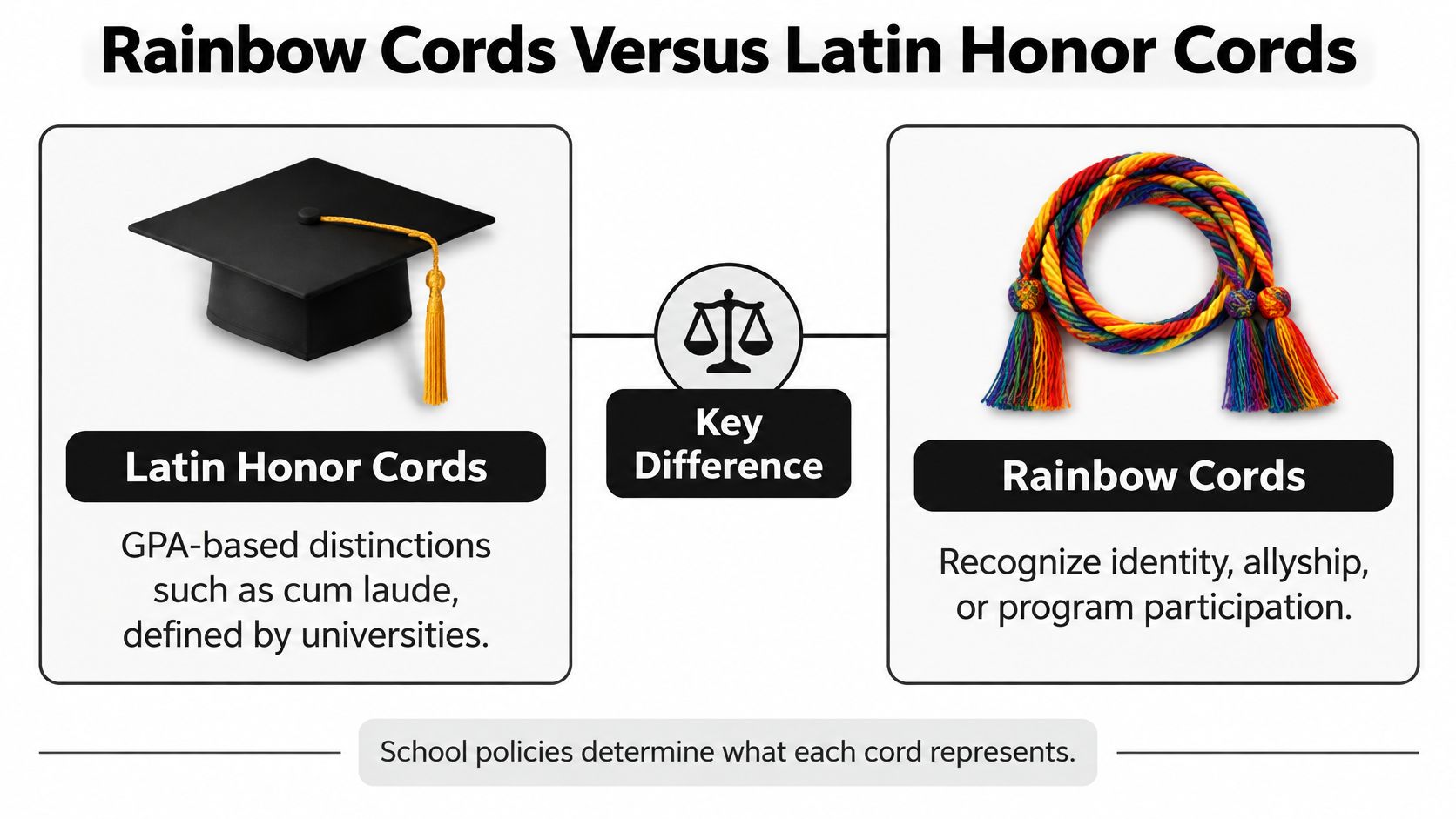
Each university sets its own thresholds for academic honors, and there is no single national standard. The Georgia Tech registrar requires undergraduates to complete at least 60 institutional credit hours and sets minimum GPAs of 3.15 for honor, 3.35 for high honor, and 3.55 for highest honor. The matching cords are double white, double gold, and white-and-gold braided. Other schools run the same system on different numbers. Oregon State University, for example, sets its own credit minimums and its own GPA bands for cum laude, magna cum laude, and summa cum laude. Two campuses can award the same Latin phrase on very different academic records.
| Cord or institution | Basis for the cord | Published threshold | Cord or format |
|---|---|---|---|
| Rainbow honor cord | Identity, allyship, or program participation set by the issuer | No GPA threshold by default | Rainbow cord or tassel |
| Georgia Tech | Latin honors | 60 credit hours; 3.15 honor, 3.35 high honor, 3.55 highest honor | Double white, double gold, white-and-gold braided |
| Oregon State University | Latin honors | School-set credit minimum plus its own GPA band for each honor level | No cord color published with those bands |
| University of the Incarnate Word | Latin honors and approved organizations | Registrar-published GPA bands for each level | Only registrar-approved cords or sashes |
A verdict by situation
Say a senior is told "gold means honors, so rainbow must mean honors too." That reading fails. Gold, white, and braided pairs at Georgia Tech track credit hours and GPA. A rainbow cord has no GPA threshold by default.
A Latin honor works like a grade on the transcript: earned, calculated, and certified by the registrar. A rainbow cord works like a program badge: the issuing office decides who receives it and why. Treat the rainbow cord as a recognition item unless the issuing school explicitly ties it to an academic cutoff. If the school never publishes that cutoff, do not describe the cord as proof of a Latin honor, a class rank, or a degree level. Ask the registrar or the commencement office how the rainbow cord relates to those separate honors before anyone orders a second cord to "match."
Rainbow Cord Colors and Listed Prices
Shoppers usually see a multicolor intertwined cord, but listings vary more than the photo suggests. A school may allow a single cord, a double cord, or only one of those styles, and a retailer's color photo only shows what is in stock. The written campus policy decides what counts, so match the cord to that policy before you pay.
| Retailer listing | Rainbow cord price | Pricing note |
|---|---|---|
| Graduation Cap and Gown Depot | From $6.09 | Rainbow intertwined graduation honor cord |
| TasselNFringe | From $3.75 | Rainbow honor cords |
| Graduation Outlet | $4.40 | Volume pricing; listed price of $7.50 without it |
In 2026, Graduation Cap and Gown Depot listed a rainbow intertwined graduation honor cord at a price as low as $6.09. TasselNFringe listed rainbow honor cords at a price as low as $3.75. Graduation Outlet listed rainbow honor cords at $4.40 with volume pricing, compared with a listed price of $7.50.
How to read the spread
The lowest starting price is not automatically the lowest cost. A $3.75 listing may be a different cord style, a smaller quantity break, or a price before shipping. Volume pricing pulls a $7.50 listing down to $4.40, which is why a student organization outfitting a whole group can pay less through a quantity tier than through the cheapest sticker price on the page.
Compare like with like: the same cord style, the same tassel length, the same quantity. Then add shipping and weigh it against the ceremony date.
Prices move. This table reflects 2026 listings, so recheck each page before you purchase.
Color is the second checkpoint. Some programs present lavender cords instead of rainbow ones, so confirm which color the school issues before anyone orders. A general chart of graduation honor cord color meanings shows what each color commonly symbolizes, but the campus program decides which cord it hands out.
Check Your School Policy Then Order
A cord bought before the policy check can be unusable on stage. Permission and meaning follow the institution's regalia rules.
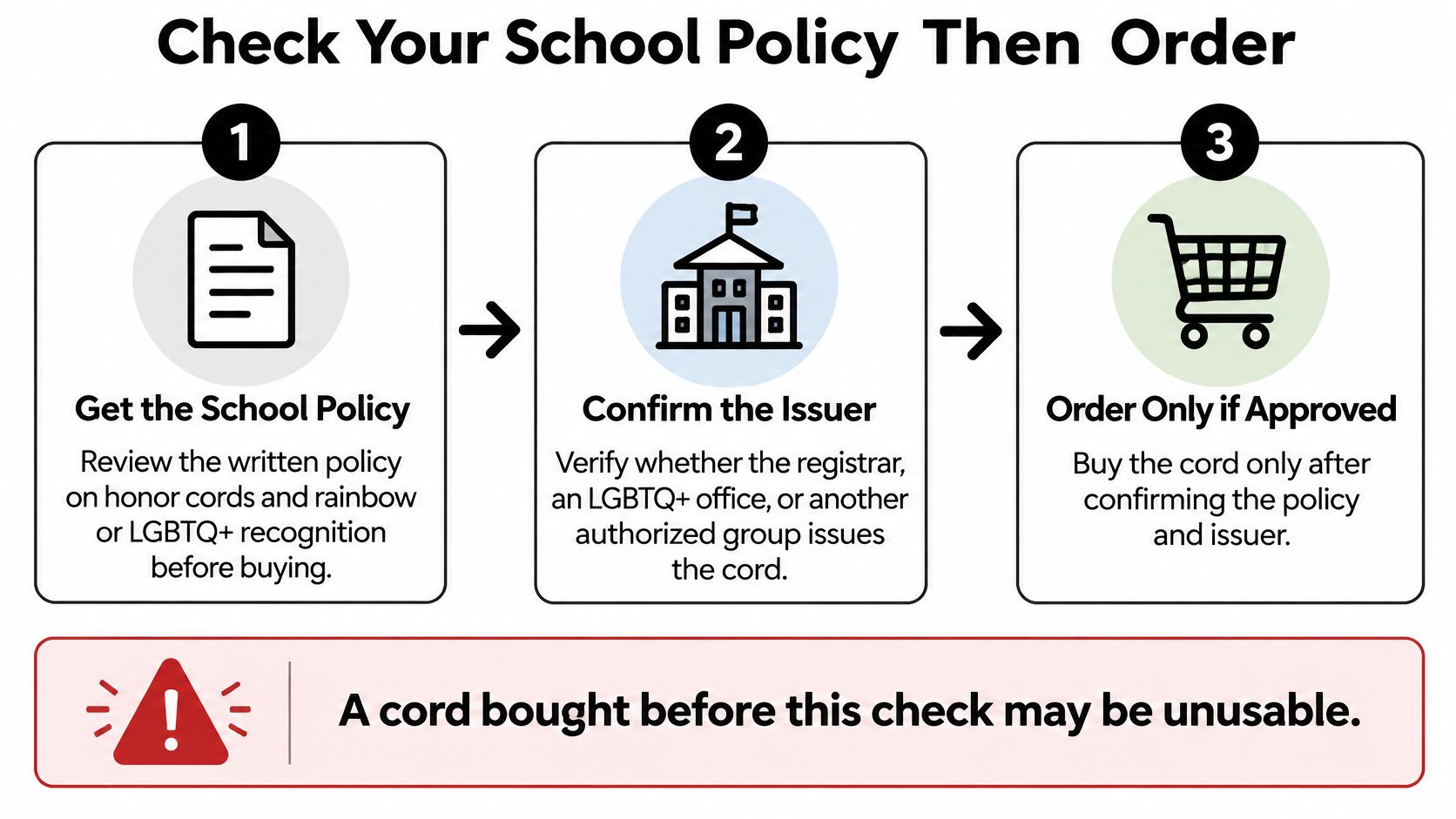
The University of the Incarnate Word registrar states that only sashes or honor cords approved through its Graduation Stole Policy may be worn with academic regalia, and it limits permitted cords or sashes to recognized honor societies and leadership organizations listed by the registrar. That split is the lesson. Cord permission can be entirely separate from Latin honors. Don't treat a rainbow honor cord as proof of a GPA band unless your own school writes that meaning down.
Rutgers University's Rainbow Graduation recognizes LGBTQIA+ and allied undergraduate and graduate students. Ithaca documents rainbow cords as part of an LGBTQ and ally commencement tradition established there in 2003. Schools should publish whether the cord means identity, allyship, program participation, organization membership, or another achievement, so staff don't confuse it with a GPA honor.
Eight checks before you buy
- Get the written policy. Ask the school for the honor-cord rules and any LGBTQ+ recognition guidance. A receipt from a retailer doesn't override a commencement dress code.
- Name the issuer. It might be the registrar, an LGBTQ+ resource center, a student organization, or the commencement office. The issuer decides whether the cord marks identity, allyship, participation, or membership.
- Confirm color and construction. Ask whether a single cord or a double cord is allowed. A double cord can be turned away where only singles are permitted.
- Confirm the event. The cord may be allowed at the main commencement, or only at a dedicated gathering such as a rainbow graduation or a lavender graduation.
- Check pre-registration. Some ceremonies require a signup and a deadline. Missing it can mean the cord stays in the bag.
- Separate it from Latin honors. Academic cords follow their own credit and GPA rules. The rainbow cord doesn't inherit those rules.
- Order the approved style. We sell honor cords with hoods, tassels, stoles, medals, collars, diploma covers, and garment bags, in custom and in-stock regalia for students and faculty. High school caps and gowns come in 16 colors, alongside honor cords and stoles. Master's packs bundle gown, cap, tassel, and hood, and faculty lines include doctorate caps, gowns, hoods, and tams. Start from the Gradshop catalog only after the school names the style.
- Count heads, then add spares. Order the eligible number plus a few extras, and compare the delivery date with the ceremony. If you need a local pickup plan, use a practical note on where to buy graduation cords after the policy is settled, not before.
Who should ask first
Policy governs what you may wear. The product page does not. High school families should ask the school before they order, because a district rule can differ sharply from a university lavender program. Administrators placing a bulk order should publish the award criteria, the approved color, the issuer, and whether the cord is allowed at the main ceremony.
Read the written policy today. That one document decides whether the cord is worn.
Gradshop carries graduation accessories for high school, college, and advanced degrees, including honor cords, stoles, hoods, tassels, medals, and diploma covers, with custom and in-stock regalia for students and faculty. If your school has approved a rainbow honor cord, you can match that style alongside caps, gowns, and master's or doctoral hoods instead of guessing from a color chart. Visit Gradshop to order the confirmed cord and the rest of the regalia your ceremony allows.