

The morning rush is already moving before you've finished the mirror check. Your gown is on the bed, the hood is folded over one arm, and the cap is sitting there like it knows something you don't. If you're holding a master's hood and gown for the first time, that little burst of panic is normal, and it usually comes from one simple problem: the pieces look ceremonial, but they're coded.
A master's hood isn't just decoration, and the gown isn't just a black robe. Each part carries information about degree level, academic field, and sometimes the university itself. That's why getting dressed correctly matters before the photographer calls your name, before you line up with your class, and before anyone on stage has time to fix a twisted hood.

If you want a quick visual reference while you compare what's in front of you, the compare graduation hat prices guide can help you separate cap choices from the rest of the outfit. For a simple product walkthrough, the related Gradshop graduate regalia readiness guide is also useful when you're matching pieces to ceremony day.
The Moment Before You Step Onto the Stage
The most familiar commencement scene is also the most stressful. A graduate stands in front of a mirror, gown in hand, hood looped over one wrist, trying to decide which end belongs down the back and which side shows the color. That is usually the moment when the outfit feels more complicated than it looked online.
Why this moment matters
Commencement leaves little room for error, because everyone can see when the regalia is off. A hood worn backward hides the lining. A gown with the wrong sleeve shape signals the wrong degree level. A cap that sits crooked keeps showing up in every photo, long after the ceremony ends.
The system is easier once you separate the pieces. The gown signals degree level. The hood carries the discipline and, in many cases, the institution. The cap or tam completes the look, but it does not carry the same information weight as the hood.
Practical rule: identify the gown, hood, and cap one by one, and the outfit becomes much easier to check.
A little history also helps. Academic dress did not appear all at once, and it did not settle into one fixed pattern overnight. At Oxford, the Laudian Code of 1636 created the first coherent rules for academic clothing, and Oxford's system was not fixed in its present form until 1957, when R. E. Clifford and D. E. Venables published Academic Dress of the University of Oxford (Oxford archives). In the United States, Columbia adopted a national academic-dress code in 1895, a related code followed in 1897, and most universities were using it by 1902.
That background explains why the outfit carries meaning in every seam and trim line. If you want a quick product-side check while you compare what you have at home, the Gradshop graduate regalia readiness guide is a useful place to match the parts before ceremony day. If you also need a quick cap reference, the compare graduation hat prices guide helps you separate cap choices from the rest of the outfit.
Anatomy of the Master's Hood, Gown, and Cap
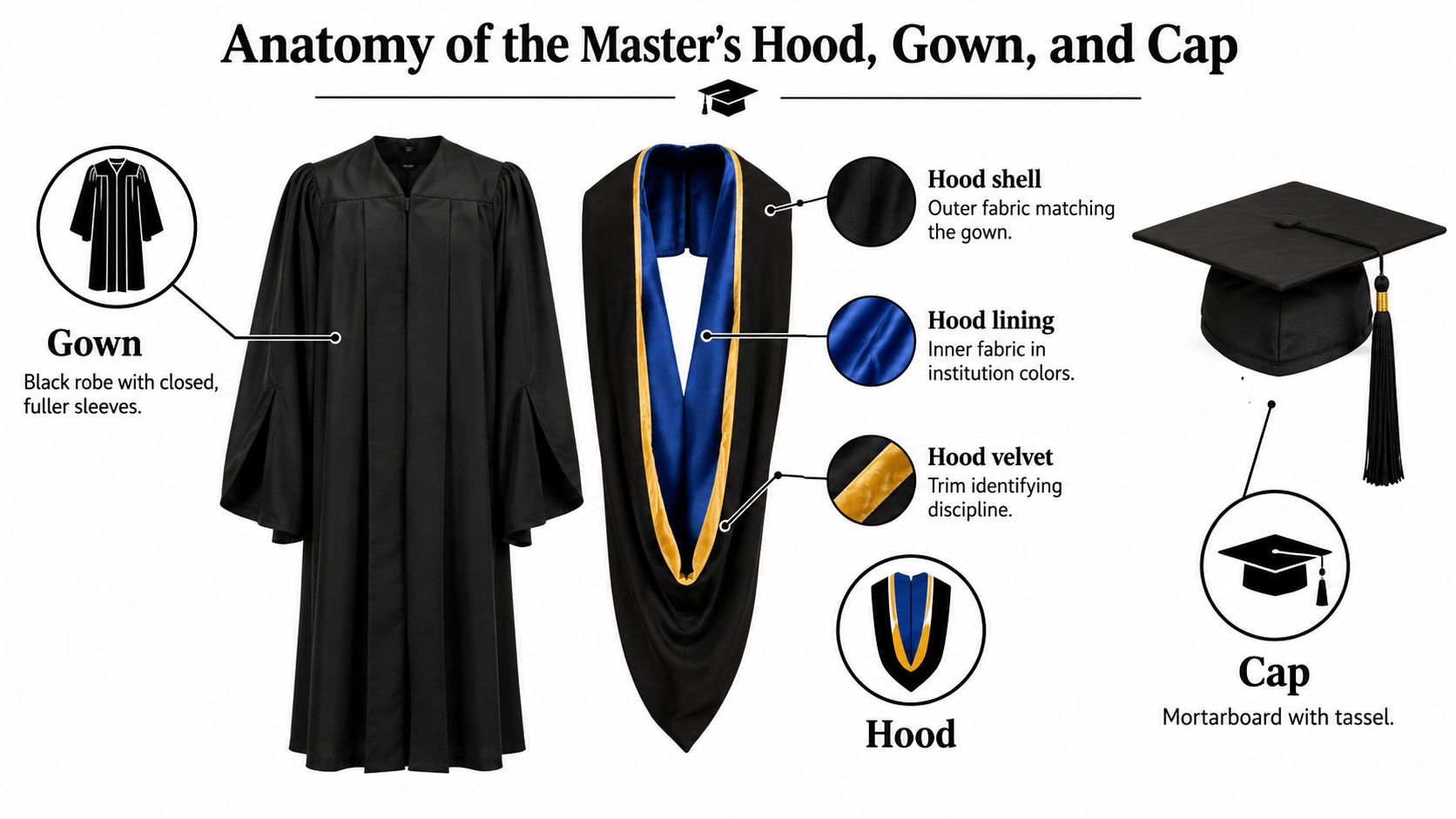
Start with the gown
The master's gown is a black robe with full-length, oblong sleeves that stay open at the wrist, and the sleeves are fuller than a bachelor's gown. Purdue's commencement guidance notes that the master's gown does not use the doctoral sleeve bars or velvet panels, so it reads differently even before anyone looks at the hood (Purdue attire guide). In practical terms, you want the gown to hang cleanly, close properly, and sit comfortably over whatever you're wearing underneath.
For a visual shopping reference, the Gradshop masters and doctoral regalia collection is the place to compare master's gown styles beside other academic pieces.
Then add the cap
Most master's candidates wear a black mortarboard with a black tassel. Some fields or ceremonies use a velvet tam instead, especially when institutions want a more formal doctoral-style presentation. The cap is easy to treat as an afterthought, but it finishes the silhouette, and if it sits badly, the whole outfit looks off in photos.
The cap should support the regalia, not compete with it.
Understand the hood as a system
The hood has three visible parts. The outer shell usually matches the gown, the velvet trim identifies the academic discipline, and the inner lining shows the degree-granting institution's approved colors. Standard specifications describe a master's hood as approximately 3.5 feet long with roughly 3-inch velvet edging (UNE regalia guide). That gives you a concrete mental picture, a hood that is long enough to drape down the back but still shorter than a doctoral hood.
The fastening details matter too. A front cord or loop helps anchor the hood, and a rear button-and-cord system keeps it from slipping. For a clearer breakdown of the garment itself, the Gradshop parts of a graduation gown guide is a helpful companion page when you're matching the gown to the hood.
Reading the Academic Color Code
A master's hood gives you two different cues at a glance. The velvet trim identifies the discipline, and the lining shows the institution's approved colors. Once you know that split, the hood becomes easier to read, even from a distance or in a crowded row of graduates.
Discipline is read through the velvet edge
Faculty, family, and photographers usually notice the trim first. That narrow band is the field marker, the part that says what area the degree represents. The color system was codified in the United States between 1895 and 1902, and the practical result is straightforward, the velvet border lets observers identify the academic discipline quickly.
The lining is the institution's signature
The lining carries the second signal. It shows the degree-granting university's approved colors, so the hood is not just a general accessory in the right discipline shade. A hood can look close enough at first glance and still be incorrect if the lining does not match the school's pattern.
For a quick visual check of common discipline options, the Gradshop masters graduation hood colors guide lets you compare trims against real product examples. That makes it easier to verify whether a hood color matches the field before you order. If you are also comparing related academic accents, the Gradshop stoles collection can help you separate one color cue from another.
Don't confuse the two signals
The trim is not the lining, and the lining is not the trim. That mix-up causes many last-minute errors, especially when a color looks right from the front but the inside lining belongs to a different school. Treat the hood as a matched system, where both parts have to agree.
Working model: trim equals field, lining equals university.
How Master's Regalia Differs from Bachelor's and Doctoral
A lot of confusion clears up when you compare the three degree levels side by side. Bachelor's regalia is simpler, master's regalia adds structure and the hood, and doctoral regalia adds even more distinction through velvet details and a different cap style. If you borrow the wrong level of robe, the color may look close, but the academic signal will be off.
| Feature | Bachelor's | Master's | Doctoral |
|---|---|---|---|
| Gown silhouette | Simpler robe, generally less full | Black gown with fuller shape | More ornate gown with velvet accents |
| Sleeve construction | Open sleeves are typical | Full-length, oblong sleeves that stay open at the wrist | Velvet sleeve details and bars |
| Hood length | Shorter or absent in many settings | Shorter than doctoral, with discipline trim | Longer and fuller |
| Headwear | Mortarboard and tassel | Mortarboard, sometimes a tam, plus tassel | Tam is common, often with tassel |
| Visual signal | Degree completion | Advanced degree and discipline | Highest degree level |
The master's outfit sits right in the middle for a reason. It is more formal than bachelor's attire, but it is not supposed to look like a doctorate. That's why a bachelor's robe borrowed from a friend, or a doctoral gown swapped in because it “looks fancier,” can create the wrong read on stage.
For a direct product comparison, the Gradshop masters and doctoral regalia collection makes it easier to compare hooded master's sets against doctoral-style pieces, including doctoral tam options and beefeater listings when a ceremony uses those formats.
Wearing the Hood and Gown Step by Step
The easiest way to avoid last-minute mistakes is to dress in the same order every time. Start with the gown, then add the cap, then settle the hood so the trim and lining stay visible. If you rush the sequence, the hood usually ends up twisted or too high on the neck.
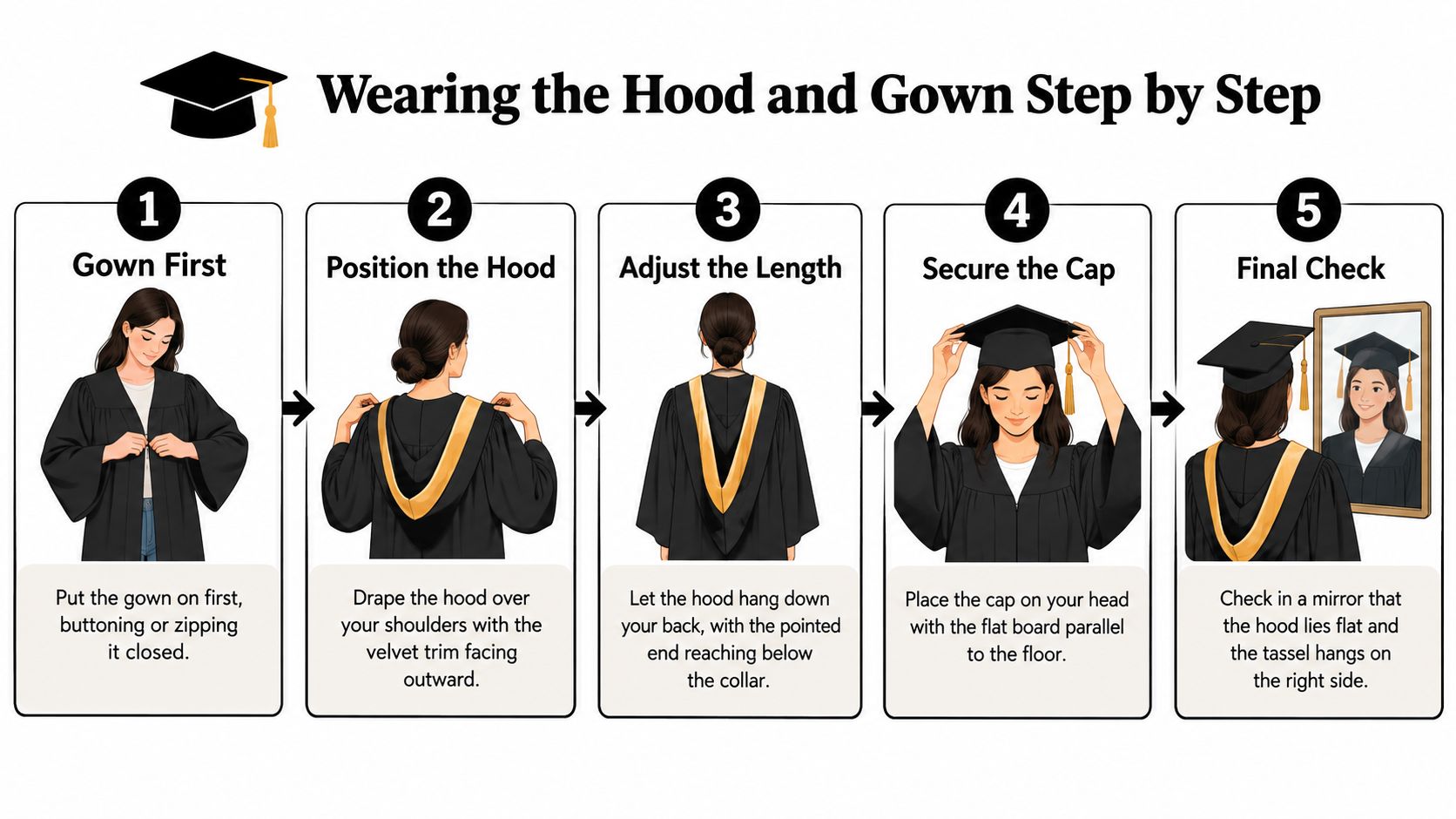
Put the gown on first
Slide the gown on over your clothes and close it in front. If it zips, zip it fully. If it buttons, make sure it sits flat so the front doesn't pull once the hood is added.
Settle the hood on your shoulders
Drape the hood over your shoulders with the velvet facing outward. The larger back section should hang down your spine, not bunch up around your neck. The lining should be visible when the hood is fluffed into place.
Secure the fasteners
The front cord should attach to a shirt button or be pinned to a blouse or dress. A rear button-and-cord system helps keep the hood from slipping during the procession. Carnegie Mellon's regalia instructions note that the hood should sit with the velvet border visible on the outside and the lower-back portion folded so the lining shows (Carnegie Mellon regalia instructions).
Finish with the cap
Place the mortarboard flat on your head, or position the tam according to your school's instructions. The cap should feel secure but not tight. For a quick wardrobe cross-check, you can compare cap and gown basics against the Gradshop high school caps and gowns collection and related Gradshop stoles collection if you're coordinating tassels or accent pieces for the ceremony.
Before you leave, check two things in the mirror. Fluff the hood so it lies flat, and make sure the lining color is visible before you step out the door.
Choosing the Right Hood When Colors and Degrees Conflict
A master's hood can become confusing fast when the degree title, field color, and school rules point in different directions. An MBA, M.Ed., interdisciplinary degree, dual degree, or school-specific program may each call for a different result. The right hood is the one that follows the university's written instructions, not just the broad name of the degree.
Use a four-part checklist
Start with the degree level, because master's and doctoral hoods are not interchangeable. Then check the institution lining, the academic-field trim, and the gown size or length. Those four details usually tell you more than a generic color chart does.
Some universities make the decision local. Virginia Tech says its color list is guidance, not a contract, and that graduates may choose a hood color based on university-store availability or another source. North Dakota State lists separate colors for business, education-related fields, engineering, nursing, pharmacy, and science, which shows how closely the final choice can depend on the school's own mapping.
Why the commencement office wins
That local control solves the problem. A hood can look correct online and still be wrong if the lining or trim does not match the university's instructions. The safest reference is the commencement office and its published regalia guidance.
For product comparison, the Gradshop masters and doctoral regalia collection shows the hood and gown range, and the Gradshop high school caps and gowns collection can help you compare size and proportions when you are checking fit for younger graduates in the family.
One quick rule helps here: color charts start the search, but the university decides the final answer.
Sizing, Materials, Ordering, and Care
The right outfit is the one that fits, arrives on time, and still looks good when you need to wear it again or hand it down. That means you have to think about sizing, fabric, ordering windows, and storage together, not as separate decisions.
Sizing starts with the body, not the package
Graduation sets are usually ordered by height or standard size chart, but you should also check sleeve length, gown length, and how much room the gown needs over clothing. Families buying for younger graduates can use the Gradshop high school caps and gowns collection as a simple reference point for inclusive sizing and package comparison. For master's candidates, the fit has to leave room for the hood to sit cleanly across the shoulders without tightening at the neck.
Material choice affects comfort and photos
A lightweight polyester gown makes sense for warm ceremonies or long lines outside. A more structured matte finish is often chosen for photographs because it hangs neatly and reduces shine under stage lights. The important part is not the label alone, it's whether the fabric holds the hood in place and looks smooth once you move.
Ordering should match the calendar
If a department is ordering for a group, same-day dispatch and bulk options matter because commencement dates don't move. Custom stoles also belong in the ordering plan, especially for Kente, military, international flag, and Greek life designs from the Gradshop stoles collection. Those pieces don't replace the hood, but they often sit alongside it, so they need to fit the ceremony's dress code too.
Care extends the life of the set
As soon as the ceremony ends, hang the gown right away so wrinkles don't settle in. Spot-clean the velvet trim gently, fold the hood loosely, and store the set in the garment bag so it keeps its shape. If you're looking for a storage reference, protect garments with dark wood hangers is a helpful reminder that proper hanging matters when you want regalia to last beyond one ceremony.
That approach also supports reuse. A sturdy black gown can be worn again, passed down, or donated, while the hood still needs to match the university's approved lining and trim. Sustainability works best when the reusable parts stay reusable and the institution-specific parts stay accurate.
If you're getting ready for commencement, browse Gradshop for master's gowns, hoods, caps, stoles, and related regalia pieces you can match to your university's instructions. The right set keeps your ceremony calm, your photos clean, and your academic colors exactly where they belong.