

Your master's degree is a huge deal, and the gown you wear on graduation day is more than just a piece of clothing—it's the uniform you've earned. It's a traditional academic robe worn at commencement ceremonies to celebrate finishing your master's program. What makes it special? The sleeves. They have a unique oblong shape that immediately sets you apart from those earning bachelor's or doctoral degrees.
When you put it on, you're not just getting dressed for a ceremony. You're connecting with centuries of academic tradition and honoring all the hard work that got you to this point.
What Defines Your Graduation Gown
Think of your master's gown as a symbol of your journey—a story told in fabric. It represents all those late nights hitting the books, the challenging research, and the sheer grit it took to earn an advanced degree. It’s not a rental costume; it's a mantle of achievement that links you to every scholar who has walked this path before you.
This gown is part of a larger set of academic regalia, a formal dress code with roots in medieval European universities. Every piece, from the gown and hood to the tam on your head, has a specific meaning. Together, they create a visual language that tells everyone your level of education and your field of study. The gown is the foundation of this entire distinguished look.
The Story Woven Into the Fabric
The design of academic gowns isn't random; every detail is deliberate. The clearest giveaway of a master's gown is its sleeves. They're nothing like the simple, pointed sleeves on a bachelor's robe or the full, bell-shaped sleeves of a doctoral gown. Instead, master's gowns have long, oblong sleeves with a slit near the wrist.
Historically, this design gave the wearer more freedom of movement (and some say the sleeve even doubled as a handy pouch). Today, it’s the most recognizable sign of your academic rank. This tradition is honored worldwide, which has created a massive market for academic apparel and shows just how much we value higher education.
The global graduation gown market was valued at around $1.2 billion and is expected to hit $2.1 billion by 2033, growing at a rate of 6.3% each year. This boom reflects the growing number of graduates and the lasting importance of formal commencement ceremonies. You can dig deeper into these trends in the full report on Marketintelo.com.
Key Features of a Master's Gown at a Glance
To really understand what makes a master's gown unique, it helps to see its defining features laid out. The table below breaks down the key components so you can spot one in an instant.
| Feature | Description | Significance |
|---|---|---|
| Sleeve Design | Long, oblong sleeves with an arc-shaped cutout at the front. | The primary visual differentiator from bachelor's (pointed) and doctoral (bell-shaped) gowns. |
| Gown Body | Typically made of black polyester or a similar fabric, worn closed at the front. | Represents the formality and tradition of advanced academic achievement. |
| Overall Cut | A simple, unadorned robe without the velvet panels seen on doctoral regalia. | Signifies a degree level between the foundational bachelor's and the terminal doctorate. |
In short, the sleeves tell the main story, while the simple, elegant cut confirms that the wearer has achieved a significant milestone that sits proudly between a bachelor's and a doctorate.
Decoding Your Full Academic Regalia
Putting together your graduation regalia piece by piece is a great way to appreciate the details of this long-standing tradition. Your academic attire is so much more than an outfit—it's a visual story of your hard work, with every component sharing a chapter of your journey. Getting to know the gown, hood, headwear, and tassel will help you wear them with the confidence and pride you've earned.
The centerpiece, of course, is the master's degree graduation gown. Its most telling feature is the unique sleeve design, which is an immediate signal of your academic rank. This infographic breaks down the core elements that give the gown its symbolic meaning.
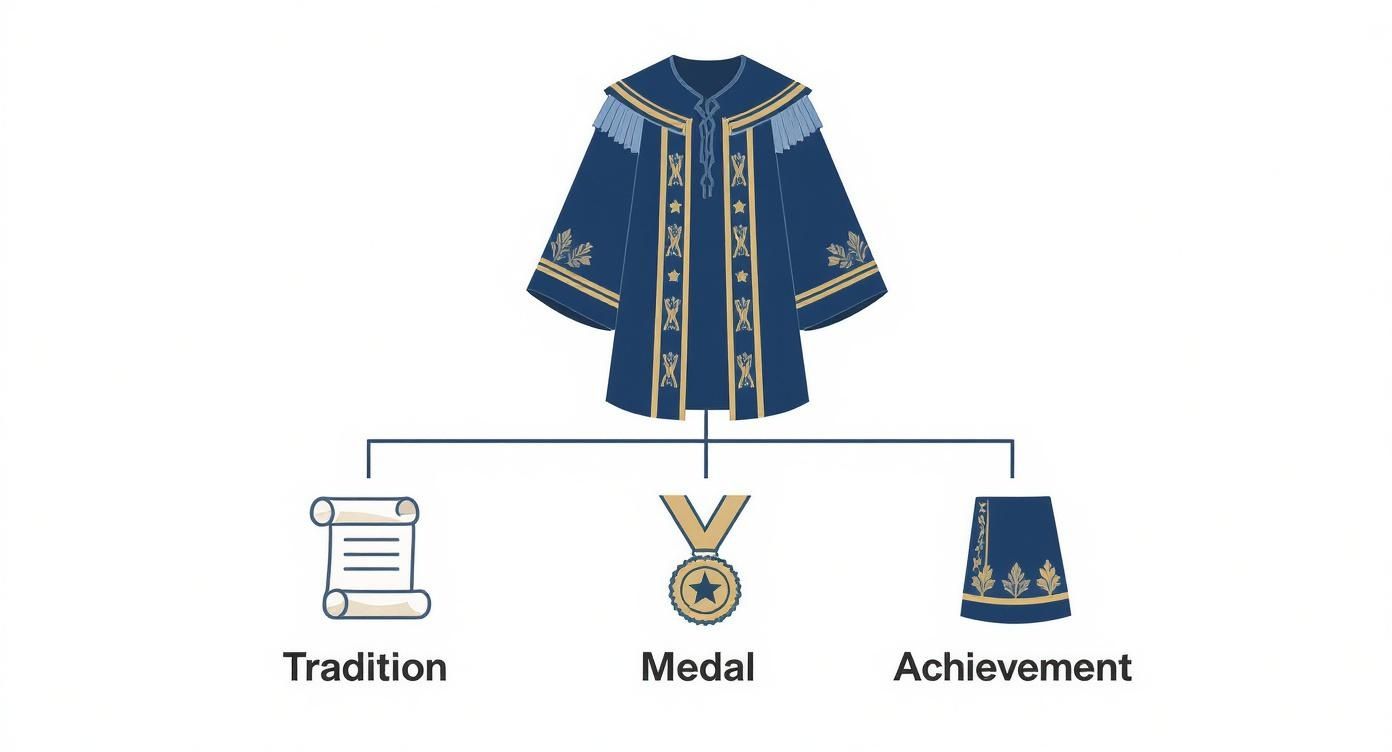
As you can see, the gown is a blend of tradition and accomplishment, and it's instantly recognizable by those signature oblong sleeves. This is the key detail that separates you from other graduates in the crowd.
How Does Master's Regalia Compare?
At first glance, all graduation gowns might look the same, but the subtle differences between Bachelor's, Master's, and Doctoral regalia are full of meaning. Each level has its own distinct style for the gown, hood, and headwear.
This table breaks down the key differences, so you can easily spot what makes your Master's regalia unique.
Academic Regalia Comparison: Bachelor's vs. Master's vs. Doctoral
| Regalia Component | Bachelor's Degree | Master's Degree | Doctoral Degree |
|---|---|---|---|
| Gown | Plain design, pointed sleeves, worn closed. | Oblong sleeves with a slit at the wrist, can be worn open or closed. | Full, bell-shaped sleeves with three velvet bars, plus velvet panels down the front. |
| Hood | Worn only in some cases, shorter length (3 feet), simple design. | Worn by all graduates, medium length (3.5 feet), wider velvet trim. | Worn by all graduates, longest length (4 feet), wide velvet panels. |
| Headwear | Mortarboard cap. | Mortarboard cap or a velvet tam. | Velvet tam, often with a gold bullion tassel. |
Understanding these distinctions really brings the ceremony to life, allowing you to appreciate the specific traditions tied to your new, advanced degree.
The Gown And Its Unique Sleeves
The sleeves are what truly set a master's gown apart. Think of them as the perfect middle ground between the simple, pointed sleeves of a bachelor's robe and the ornate, bell-shaped sleeves of a doctoral gown. This specific style is rooted in centuries of academic history and immediately identifies your level of achievement.
In the United States, master’s gowns are traditionally black and designed to be worn open or closed. The most important feature is the oblong sleeve, which has a slit at the wrist. This allows your arm to pass through, letting the long, decorative part of the sleeve hang down. It's a functional yet elegant design that’s been part of academic tradition for generations.
The Academic Hood: A Splash Of Color
The academic hood is easily the most colorful and personal part of your regalia. Draped over your shoulders, it tells everyone your story through a specific color code. It’s like a wearable badge of honor.
The hood’s colors are broken down into two key areas:
- Velvet Trim: The color of the velvet edging shows your field of study. Light blue, for instance, represents Education, golden yellow is for Science, and drab signifies Business.
- Satin Lining: The colors on the inside lining are your university’s official colors. This is where you proudly display where you earned your degree.
The specific blend of velvet and satin colors makes every hood unique to the graduate. It’s a powerful visual that links you to both your academic discipline and your alma mater. For more guidance, you can learn all about what the different hood colors mean in our detailed article.
Headwear: The Tam vs. The Mortarboard
While undergraduates almost always wear the flat, square mortarboard, master’s graduates often get to upgrade to a tam. A tam is a soft, multi-sided velvet cap that signals a higher level of academic achievement. Many find it more distinguished and, frankly, more comfortable to wear during a long ceremony.
The choice between a tam and a mortarboard can sometimes come down to your school's tradition, but the tam is widely recognized as the proper headwear for an advanced degree.
The Tassel: The Finishing Touch
Last but not least, the tassel pulls your entire look together. Its color is usually black or matches the velvet trim on your hood, connecting it to your field of study. But just as important is where you wear it.
For master’s candidates, the tassel typically starts and stays on the left side of your tam or mortarboard. The iconic "turning of the tassel" from right to left is a symbolic act for bachelor's graduates, marking the moment they officially receive their first degree. Since you've already been there, your tassel placement signifies your advanced status right from the start of the ceremony.
How to Select and Order Your Gown
Getting your master's degree graduation gown can feel like one last hurdle before the finish line, but it doesn't have to be a headache. With a few simple steps, you can make sure your regalia fits perfectly, meets all the university's rules, and shows up with plenty of time to spare. This guide will walk you through everything, from measurements to the final order.
Think of it like preparing for a big presentation—a little bit of prep work beforehand ensures you walk across that stage feeling confident and looking sharp. You’ll need to think about sizing, your school’s specific requirements, and whether renting or buying makes more sense for you, all while keeping an eye on the calendar.
Securing the Perfect Fit
Nothing ruins graduation photos faster than an ill-fitting gown. A gown that’s too long is a tripping hazard waiting to happen, while one that’s too short just looks awkward. The goal is a comfortable, dignified fit that truly honors the gravity of the occasion.
Thankfully, sizing for academic gowns is pretty straightforward; it’s almost entirely based on your height. Still, getting accurate measurements is the crucial first step.
-
Measure Your Height: Kick off your shoes and stand with your back straight against a wall. Have a friend measure from the floor to the very top of your head. This number is what you'll use to find your size on the retailer's chart.
-
Measure for Your Tam: If you're going with a tam instead of a classic mortarboard, you'll need to measure your head. Grab a soft measuring tape and wrap it around your head about an inch above your eyebrows, right where the tam will naturally sit.
Nailing these two measurements is the most important part of getting a gown that looks like it was made for you. For a more detailed walkthrough, check out this guide on measuring your graduate cap and gown to be absolutely sure.
Confirming University Requirements
Hold on before you click "buy"—you absolutely must check your university's specific rules for regalia. Many schools have very strict guidelines to make sure everyone has a uniform, formal look on commencement day.
Be on the lookout for details about:
- Custom Colors: Does your university require a specific color for its master's gowns, or is the traditional black the standard?
- Official Emblems: Some schools mandate an embroidered university crest or seal on the gown.
- Approved Vendors: It's not uncommon for a university to have an exclusive contract with a single supplier for all official regalia.
You can usually find this information on your university’s commencement website or by checking in with the campus bookstore. A quick check now can save you the major headache of ordering a master's degree graduation gown you can't even wear.
To Rent or To Buy Your Gown
This is one of the biggest decisions you'll make in the process. Should you rent your regalia for the day, or buy it to keep? Both have their pros and cons, and the best choice really comes down to your budget and how much sentimental value the gown holds for you.
Renting is for convenience; buying is for the keepsake. Your gown is a powerful symbol of your hard work and achievement. Owning it allows you to preserve that memory for years to come.
Let's break down the two options.
| Aspect | Renting Your Gown | Buying Your Gown |
|---|---|---|
| Cost | A lower upfront cost makes it a great budget-friendly option. | A higher initial investment, but it's yours to keep forever. |
| Convenience | A very simple process, often handled directly by the university. Just return it after the ceremony. | You’re responsible for ordering, caring for, and storing the gown yourself. |
| Condition | The gown has been worn before and might show some minor signs of wear. | You get a brand-new, pristine garment that's never been worn. |
| Keepsake Value | None. It's a temporary rental for a single day. | It becomes a cherished memento of a huge academic milestone. |
| Future Use | Not available for future academic events or photoshoots. | You can wear it again if you attend ceremonies as an alum or faculty member. |
While renting saves you a bit of money in the short term, buying your master's gown gives you a tangible, lasting symbol of everything you've accomplished.
Your Ordering Timeline
When it comes to graduation, procrastination is not your friend. Academic regalia, especially if it's customized, takes time to produce and ship. Start the process early to sidestep rush fees, low stock, and unnecessary stress.
- 3-4 Months Out: Start your research. Find out your university's requirements and decide if you're going to rent or buy.
- 2-3 Months Out: Time to measure up and place your order. This is the sweet spot, giving you plenty of buffer room, especially for custom hoods or gowns.
- 1 Month Out: Your regalia should have arrived. Try everything on the moment it comes in to make sure the fit is right and all the pieces—gown, hood, tam, and tassel—are correct.
- 1-2 Weeks Out: Take the gown out of its packaging and hang it up. This will give the wrinkles time to naturally fall out before the big day.
Following this timeline turns what could be a frantic last-minute scramble into just another smooth, manageable step on your way to graduation.
How to Wear Your Regalia on Graduation Day
Graduation day is a huge milestone, and the last thing you want to be fumbling with is your regalia. Getting dressed in your full academic gear can feel a little awkward at first, especially when you get to the academic hood. Let's walk through it step-by-step so you can put your look together with total confidence.

Think of it like putting on a uniform—every piece has its place and a reason for being there. Nailing these steps will make sure you not only look sharp but also feel comfortable and proud when you walk across that stage.
What to Wear Under Your Gown
The first layer of your graduation day outfit is whatever you choose to wear under your master's degree graduation gown. The trick is to find a good balance between looking professional and staying comfortable, since commencement ceremonies can drag on and sometimes take place outside.
Stick to business-casual attire. That could be anything from dress pants and a collared shirt to a simple dress or skirt and blouse. It's a good idea to choose dark, neutral colors like black, navy, or gray, as they won't be visible through the gown's fabric. And please, wear comfortable shoes—you’ll be on your feet a lot more than you think.
Mastering the Academic Hood
The academic hood is easily the most confusing part of the whole outfit. But getting it right is a big deal, since it’s what shows off your university colors and your specific field of study. Don't sweat it; it's simpler than it looks.
Here’s how to put your hood on perfectly:
-
Unfold the Hood: Lay your hood out flat to see what you're working with. You'll notice the velvet trim on one side and the satin lining—with your university's colors—on the other.
-
Drape It Over Your Head: Place the hood over your head so it hangs down your back. The velvet side should face up, with the V-shaped point resting at the front of your neck, just below your chin.
-
Secure the Front: To keep the hood from sliding around (or choking you!), look for a small loop on the inside of the V-point. You can fasten this to a shirt button or use a small safety pin to attach it to your dress or blouse. This keeps everything in place.
-
Turn Out the Colors: This is the magic touch, and you'll probably need a friend to help. The satin part with your school colors is meant to be seen. Have someone reach behind you and flip the lining outward at the base and shoulders of the hood. Done right, the velvet trim will frame the colorful satin, creating a striking display down your back.
A correctly worn hood should lie flat against your back, showcasing its vibrant colors. It’s the most symbolic part of your master’s regalia, so taking a moment to adjust it properly is well worth the effort.
Positioning Your Tam and Tassel
The finishing touches are your headwear and tassel. As a master's degree recipient, you'll most likely wear a soft, multi-sided velvet tam instead of the traditional flat mortarboard. It’s a subtle nod to your advanced academic achievement.
Place the tam so it sits level on your head—not tilted back or forward. The tassel placement is just as important. For master's candidates, the tassel stays on the left side for the entire ceremony. That "turning of the tassel" tradition is for bachelor's graduates, marking the conferral of their first degree. Since you've already done that, your tassel starts and finishes on the left.
By following these simple guidelines, you'll look the part on your big day. For a complete look at the whole ensemble, you can learn more about how to wear academic regalia in our detailed guide.
Global Traditions in Academic Dress
When you slip on your master's degree graduation gown, you're not just wearing a piece of fabric—you're stepping into a worldwide tradition. It’s easy to think of your regalia as unique to your school, but it’s actually part of a global tapestry of scholarly attire with centuries of history behind it.
Looking beyond the familiar American style reveals a fascinating world of different customs, colors, and designs. Each one tells a story about its region's unique academic history. This bigger picture adds a whole new layer of meaning to your own ceremony, connecting you to a global community of scholars.
A Look at Regalia Around the World
The academic dress we see in the United States—with its specific sleeve shapes and color-coded hoods—is just one take on a very old tradition. Many other countries have their own distinct styles, often shaped by their oldest and most prestigious universities.
- United Kingdom: Over in the UK, a master's gown isn't a one-size-fits-all affair. Ancient universities like Oxford and Cambridge have their own specific designs that are quite different from the more standard black gowns you'll see elsewhere. The exact length and even the type of fabric can be dictated by statutes that are hundreds of years old.
- Australia: Australian universities often take their cue from the UK system but add their own local twists. You might see some institutions using unique colors for their gowns to stand out from the traditional black.
- Europe: The traditions across mainland Europe are incredibly diverse. In Spain, for example, the regalia can be incredibly elaborate and colorful, with different styles for each faculty. Meanwhile, some other European countries have moved away from formal academic dress altogether.
This variety just goes to show that while celebrating academic achievement is universal, the way we do it is beautifully local. The market for a master's degree graduation gown really highlights these differences. Think about it: over 800,000 master’s degrees were awarded in the U.S. in 2020 alone, each requiring a specific style of gown. But practices elsewhere vary. In South Africa, master's graduates usually wear black gowns, but in Sri Lanka, they might wear red. You can dive deeper into these global academic dress customs on Wikipedia.
Blending Cultural Heritage with Academic Robes
One of the most powerful trends we're seeing today is graduates weaving their personal cultural heritage into their academic regalia. People are finding beautiful and meaningful ways to honor their identity right alongside their scholarly success, creating a stunning fusion of tradition and personal history.
This movement makes the graduation ceremony so much richer, turning it into a vibrant display of the diversity that makes a campus great. It’s a way of celebrating the whole person—not just the student, but the individual with a unique story to tell.
By incorporating cultural attire, graduates make a powerful statement: "My heritage is part of my academic journey." It’s a celebration of identity that adds profound personal meaning to an already momentous occasion.
Here are a few common ways graduates are making their regalia their own:
- Draping a traditional garment, like a kente cloth stole or a beautiful sari, over their academic gown.
- Adding culturally significant jewelry or headwear to their look.
- Customizing their stoles with specific patterns or textiles, like the ones you can create with our stoles of gratitude.
This wonderful trend proves that academic tradition isn't frozen in time. It’s a living practice that continues to evolve, making room for personal expression and cultural pride. It connects your achievement not only to a global community of scholars but to your own unique roots.
Caring for Your Gown After the Ceremony
Your master's degree graduation gown isn't just a rental for the day; it's a tangible symbol of all your late-night study sessions, hard work, and that final, triumphant walk across the stage. Taking a little time to care for it properly will ensure it looks sharp for photos and stays in great shape as a keepsake.

The first thing you should do when your regalia arrives is get it out of the box. Just hanging it up right away will help most of the wrinkles from shipping relax and fall out on their own. For any stubborn creases that just won't quit, a light steaming is the way to go.
A word of caution: never put a hot iron directly on your gown. These garments are almost always made of polyester or a similar synthetic fabric, which will melt or scorch in a heartbeat under direct heat. A garment steamer is your best friend here. Alternatively, you can hang it in the bathroom while you take a hot shower for about 20 minutes to let the steam do the work.
Post-Ceremony Preservation
Once the photos are taken and the celebration winds down, what you do next depends on whether you own the gown or just rented it. If it's a rental, be sure to follow the return instructions to the letter to avoid any surprise late fees.
But if you bought your gown, a little TLC will keep it looking pristine.
Start by checking the care tag inside. Most gowns will need to be professionally dry-cleaned to get rid of any dirt or small stains from the big day. After it's clean, it’s all about storing it correctly.
Here are a few simple tips for keeping it safe:
- Get a breathable garment bag. Skip the plastic dry-cleaner bags; they trap moisture and can cause mildew over time. A proper cloth bag, like the ones from Gradshop, will protect it from dust while letting the fabric breathe.
- Choose the right spot. Find a cool, dark, and dry place, like the back of a closet. Basements and attics are often too damp or have wild temperature swings that can degrade the fabric.
- Keep the whole set together. Store your hood, tam, and tassel with the gown. That way, your complete academic story is all in one place, ready whenever you want to take a look back at your incredible accomplishment.
Answering Your Top Questions About Master's Gowns
Getting the details of your regalia right can feel a little overwhelming, especially with everything else going on. It's totally normal to have a few last-minute questions—you want to look and feel your best on such a big day.
Think of this section as your final, quick-reference guide. We'll clear up the most common points of confusion so you can walk across that stage with complete confidence.
What Is the Correct Way to Wear My Master's Hood?
The academic hood is easily the trickiest part of the whole outfit. I've seen countless students struggle with it just moments before the procession begins.
Start by draping it over your head, letting it settle on your shoulders. The velvet trim, which signifies your field of study, should be facing out. In the front, the V-shape should lie flat against your chest. You can use the small loop on the inside to hook it onto a shirt button or use a pin to keep it from sliding around.
The final touch is the most important: you'll need a friend to help you "turn out" the satin lining on the back. This reveals the vibrant colors of your university, so don't skip this step!
Can I Decorate My Graduation Tam or Cap?
This is probably the number one question we get. The answer? It completely depends on your school. Some universities love the tradition of decorated caps and see it as a wonderful form of creative expression. Others, however, enforce strict rules to keep a uniform, formal look for the ceremony.
Always check your university’s official graduation guidelines before you get out the glue gun. A quick search on the commencement page of their website or a call to the registrar’s office will give you a clear "yes" or "no." It's better to know for sure than to be asked to remove your masterpiece on graduation day.
Which Side Does the Tassel Go On for a Master's Degree?
Here’s a key difference from your undergrad days. For a master's degree, your tassel starts on the left side and stays there for the whole ceremony.
The big "tassel flip" from right to left is a tradition that symbolizes earning your first degree (i.e., your bachelor's). Since you've already accomplished that, you get to skip the flip. It's a subtle but important marker of your advanced academic standing. As always, double-check your institution’s specific protocol, but this is the standard.
What Is the Difference Between a Tam and a Mortarboard?
The headwear is another clear signal of your academic level. You're probably familiar with the mortarboard—it's the flat, square-topped cap that’s standard for high school and bachelor's degree graduates.
The tam, on the other hand, is the soft, plush cap (usually velvet) with multiple sides. It’s reserved for master's and doctoral graduates. Think of the tam as the more distinguished option, a piece of regalia that reflects a higher level of scholarly achievement.
At Gradshop, we make sure every graduate has the perfect regalia to celebrate their incredible success. From high school graduations to doctoral commencements, our collection has you covered. Check out our high-quality master's gowns, custom stoles of gratitude, and complete academic packages. Find everything you need at Gradshop.com today.