

At first glance, a Master's cap and gown might not seem all that different from a Bachelor's, but the real distinctions are in the details. The most obvious difference is the addition of a decorative academic hood for Master's graduates. You'll also notice the gown itself has unique oblong sleeves, a departure from the simpler, pointed sleeves of a Bachelor's gown.
Decoding the Differences in Graduation Attire
Graduation is a massive achievement, and wearing the right attire is a key part of celebrating life's milestones in style. While every graduate wears a cap and gown, the specific design elements for a Master's degree are steeped in tradition and carry real significance. These visual cues do more than just mark your academic level; they connect you to a long history of scholarly achievement.
So, let's break down exactly what sets them apart. The three big differentiators are the gown's sleeves, the mandatory academic hood, and occasionally, the style of the cap itself. Understanding these details helps you appreciate the rich symbolism of your regalia and ensures you're wearing the right pieces on your big day.
For an even more detailed look at how regalia evolves from one degree to the next, check out our guide on graduation gown differences by degree level.
The image below gives you a quick visual summary of the most noticeable distinctions between Bachelor's and Master's regalia.
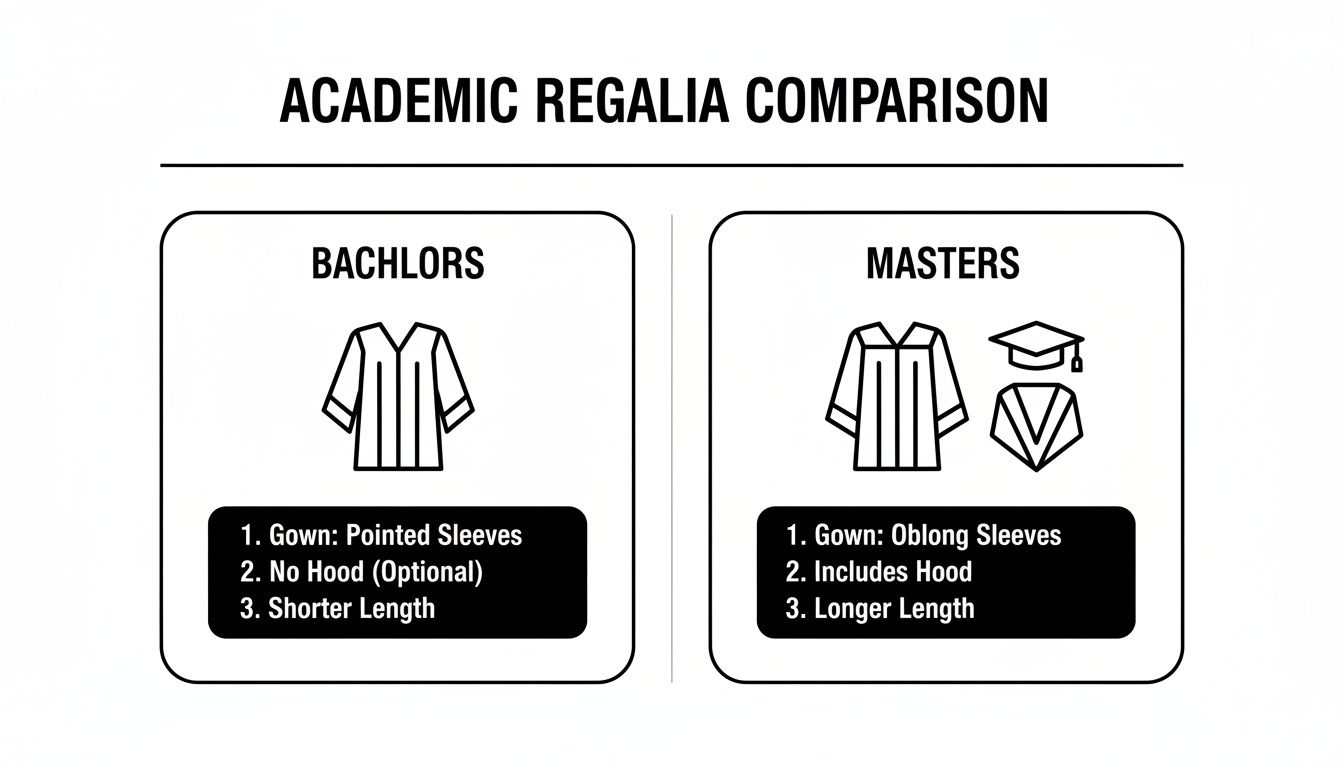
As you can see, the Bachelor's gown features a straightforward pointed sleeve, while the Master's gown introduces the more elaborate oblong sleeve and, of course, that all-important academic hood.
Core Differences in Bachelors vs Masters Academic Attire
To quickly see what sets the two apart, here’s a simple side-by-side comparison. This table clearly outlines the standard components for each degree level, making it easy to spot the differences when you're ordering or just observing a ceremony.
| Regalia Component | Bachelors Degree Standard | Masters Degree Standard |
|---|---|---|
| Gown Style | A simple design without velvet. Its most defining feature is the long, pointed sleeves. | A more formal gown distinguished by its unique oblong sleeves, which have a slit for the arm. |
| Academic Hood | Not worn by Bachelor's graduates. This is the single biggest visual difference. | Mandatory. A decorative hood is draped over the gown, showcasing the university's colors and the discipline's velvet trim. |
| Cap Style | The classic black mortarboard cap—flat and square—is the universal standard. | A mortarboard is still common, but many graduates prefer a soft, multi-sided velvet tam as a sign of their advanced degree. |
| Tassel | A standard tassel is worn, typically in black or one of the university's main colors. | A standard tassel is also worn, but the hood takes center stage as the primary element of color and symbolism. |
Ultimately, these elements come together to create a distinct look for each academic milestone. While the Bachelor's regalia is elegant in its simplicity, the Master's attire adds layers of symbolism that honor the graduate's advanced work and specialized field of study.
The Bachelor's Gown: A Universal Symbol of Achievement
The bachelor's gown is instantly recognizable. For most people, it's the very picture of graduation day—a simple, elegant garment that signifies the culmination of years of hard work. Its unadorned design is intentional, reflecting the foundational nature of an undergraduate degree. This classic look creates a powerful sense of unity when thousands of graduates gather for commencement.
What really sets the bachelor's gown apart are its sleeves. They feature a distinct, pointed cut at the end, a subtle but important detail that differentiates them from the more ornate sleeves you'll see on master's or doctoral gowns. It’s a clean, timeless design that keeps the focus on the shared accomplishment of the graduating class.
Another key differentiator is what's missing. Unlike master's regalia, the bachelor's gown is traditionally worn without an academic hood. This is probably the most significant difference when comparing masters cap and gown vs bachelors attire, making the gown itself the star of the show.
Classic Design and Fabric Choices
While the cut is standard, you do have options when it comes to the finish. Most bachelor's gowns come in either a matte or a shiny fabric, letting you (or your university) choose the look that feels right for the ceremony.
- Matte Finish: A popular choice for its classic, non-reflective appearance. It has an understated elegance that photographs beautifully, avoiding glare from stage lights or camera flashes. Our Matte Black Bachelor Gown is a perfect example of this timeless style.
- Shiny Finish: This option has a slight, satin-like sheen. It catches the light nicely, adding a little extra celebratory pop as you walk across the stage.
The bachelor's gown is, by far, the most common piece of academic regalia you'll see in the United States. Its standardized design ensures that whether you're graduating from a small liberal arts college or a massive state university, the symbol of your achievement is consistent and universally understood.
The numbers really put it into perspective. In Spring 2025 alone, an estimated 2,167,569 bachelor's degrees were awarded, accounting for a massive 50.8% of all college graduates. That figure is roughly 2.5 times the number of master's degree recipients, making bachelor's regalia the cornerstone of the academic apparel market. You can explore more data on the number of college graduates and degree trends to see just how significant this milestone is.
Ensuring the Perfect Fit
Getting the fit right is crucial for looking your best on the big day. A bachelor’s gown should hang somewhere between your knee and your ankle. Any shorter and it can look awkward; any longer and you risk tripping.
When you order a bachelor graduation cap and gown package, sizing is almost always based on your height, measured from head to toe. Don't just guess—take a moment to check the provided sizing chart. It's the best way to guarantee a polished, comfortable fit for your ceremony.
The Master's Gown: A Mark of Specialized Study
Earning a Master’s degree is a huge step up from your undergraduate studies. You've gone deeper, specialized, and really honed your expertise. Your graduation gown should reflect that. It’s not just a longer version of your Bachelor’s robe; it’s a distinct piece of regalia that immediately signals your advanced standing.
The biggest giveaway is the sleeves. Look closely, and you'll see a Master's gown has unique oblong sleeves. They’re not the simple, pointed sleeves you see on a Bachelor's gown. Instead, they’re designed to drape elegantly below the wrist and have a functional slit near the elbow, which frees up your arms.
This design isn't just for looks; it has a history rooted in academic tradition. Those sleeves are an instant visual cue that sets postgraduates apart, marking them as scholars who have completed a rigorous, specialized course of study.
Symbolism Woven into the Fabric
Everything about the Master's gown is intentional. The design is meant to convey a real sense of prestige and accomplishment. Those flowing, oblong sleeves add a layer of formality and seriousness that you just don't get with undergraduate attire.
The growing number of Master’s degree holders highlights a major shift in career advancement. The unique design of the Master’s gown has become an increasingly common sight at commencements, reflecting the demand for specialized, high-level expertise in the modern workforce.
The numbers back this up. Postgraduate education is booming. In 2025 alone, it's projected that around 864,457 students earned master's degrees in the United States. You can see this trend clearly in fields like business, where degrees climbed to 205,750—that's 23.4% of all master's graduates—by 2022. It really shows how much value our world places on specialized credentials. If you want to dive deeper, you can learn more about the evolution of bachelor's and master's graduates.
Selecting Your Master's Gown
When it's time to get your regalia, you want to make sure you're getting a gown that properly represents all your hard work. Our Master's Degree Graduation Gown is crafted to meet the exact academic standards for this level of achievement, complete with those signature oblong sleeves.
To make sure you get the right look for your big day, keep these points in mind:
- Sleeve Design: The number one thing to check for is the oblong sleeve with an arm slit. It should absolutely not have the pointed sleeves of a Bachelor's gown.
- Fit and Length: A proper fit is key. The gown should fall somewhere between your knee and ankle for a distinguished, professional look.
- Fabric Quality: You'll often find that Master's gowns are made from a higher-quality fabric, which reflects the significance of the degree you've earned.
Paying attention to these details will help you fully appreciate the rich symbolism of your regalia as you celebrate a massive academic milestone.
Decoding the Academic Hood: A Master's Degree Essential
When you compare a Master's cap and gown vs a Bachelor's, the academic hood is hands down the most important and visually striking difference. This draped, colorful accessory is a required piece for any Master's graduate, and you simply won't find it on a Bachelor's uniform. It’s the ultimate symbol of advanced, specialized study, and every inch of it is packed with meaning.
Think of the hood as a story told through fabric. It drapes over your shoulders and down your back, instantly communicating three key facts about your degree without you saying a word. Once you understand what each element means, you can truly appreciate the deep tradition you're stepping into.

The Anatomy of the Academic Hood
Every part of a Master's hood has a specific job, following a code that’s recognized by colleges and universities everywhere. It’s made of three main parts: the shell, the velvet trim, and the satin lining. The shell is usually the same black fabric as the gown, which keeps the whole look unified.
The real stars of the show are the velvet and satin, as they carry all the symbolic weight.
- The Velvet Trim: This colored band represents your specific field of study. The width of this velvet—three inches for a Master's degree—is also a clear indicator of your academic rank.
- The Satin Lining: The bright, often multi-colored, interior of the hood proudly displays the official colors of the university that granted your degree.
The academic hood isn't just a decorative accessory; it's a formal piece of regalia that instantly identifies the wearer's degree level, discipline, and alma mater. It's the one feature that truly sets Master's regalia apart from undergraduate attire.
Colors and Their Meanings
The color of the velvet trim is dictated by your degree's discipline. This standardized system lets anyone familiar with academic tradition spot your area of expertise from across the room. If you want to get into the nitty-gritty of this tradition, you can learn more about what a hood is for graduation in our detailed guide.
Here’s a quick look at some common velvet colors and the fields they represent:
| Field of Study | Velvet Color |
|---|---|
| Arts, Letters, Humanities | White |
| Business, Accountancy | Drab (a tan/khaki color) |
| Education | Light Blue |
| Engineering | Orange |
| Fine Arts, Architecture | Brown |
| Nursing | Apricot |
| Science | Golden Yellow |
This color-coding system adds a vibrant and meaningful layer to the commencement ceremony, creating a visual tapestry of all the different fields of knowledge gathered in one place. When you put on your Master's Hood, you're wearing a proud emblem of your hard-earned expertise.
Completing Your Look With Caps, Tassels, and Cords
The gown and hood are the main event, but the smaller details—the cap, tassel, and cords—are what truly complete your graduation look. These pieces bring a sense of tradition and highlight your personal journey. They're also key points of difference when you’re looking at a masters cap and gown vs bachelors setup.
Bachelor's degree candidates almost universally wear the classic mortarboard cap. It’s that iconic flat, square hat everyone pictures when they think of graduation. Once you get to the Master's level, though, you often have a choice. You can stick with the traditional mortarboard or upgrade to a soft, multi-sided velvet tam, which immediately signals a higher degree.

The Significance of the Tassel
Don't underestimate the tassel. This small accessory is central to the ceremony itself. For graduates at every level, the tassel starts on the right side of the cap. The big moment comes during the "turning of the tassel," when everyone moves it to the left side in unison. It’s a powerful, symbolic gesture marking your official transition from a student to a graduate.
While the tradition is the same for everyone, the tassel's appearance might differ. Some schools keep it simple with a plain black tassel for all graduates. Others get more specific, using colors that represent the university or the graduate's field of study. If you're looking for a classic option that fits any ceremony, our collection of Graduation Tassels has you covered.
Understanding Honor Cords
Honor cords are those braided ropes you see draped over a graduate's shoulders. They're worn to signify special academic achievements, memberships in honor societies, or other unique distinctions. Unlike the academic hood, which is reserved for graduate-level degrees, honor cords can be earned and worn by students at any level.
A key thing to remember: While both Bachelor’s and Master’s graduates can wear honor cords, these cords are never a substitute for the Master's hood. Cords represent optional, supplemental honors. The hood, on the other hand, is a mandatory part of the official regalia for a Master's degree.
The colors of the cords are packed with meaning, usually set by the university or the specific organization that awarded them. Here are a few common examples:
- Gold Cords: Almost always signify high academic honors, like graduating cum laude, magna cum laude, or summa cum laude.
- Red, White, and Blue Cords: Often used to recognize graduates who are military service members or veterans.
- Royal Blue and Gold Cords: Frequently tied to leadership-focused honor societies.
These splashes of color add a personal story to your gown, showing off the hard work and unique experiences that got you to this day. You can find a wide variety of colors to represent your achievements proudly in our extensive collection of Graduation Honor Cords.
Choosing and Ordering Your Graduation Regalia
Getting your graduation regalia right is a huge part of feeling prepared for the ceremony. It all starts with getting accurate measurements to make sure everything fits just right on your big day.
First up, the gown. You’ll need your height, measured from the very top of your head straight down to the floor. This single measurement is what most sizing charts rely on, so grab a measuring tape and a friend to get it spot-on.
Next is your cap. For the classic mortarboard, you'll want to measure the circumference of your head about an inch above your eyebrows. While most are designed to be one-size-fits-all, if you're upgrading to a more distinguished Master's or Doctoral Tam, that head measurement becomes absolutely essential for a comfortable, professional fit.
Placing Your Order
With your measurements in hand, you're ready to place your order. Timing is everything, whether you're getting a straightforward high school cap and gown or a complete Master's regalia package.
- Mind the Deadlines: Your school sets firm deadlines for a reason. Mark them on your calendar, because missing them might mean you can't walk with your class.
- Confirm All the Pieces: When looking at a masters cap and gown vs bachelors set, the contents will differ. A Master's package isn't complete without the gown, cap, tassel, and the all-important academic hood. Double-check that all components are included.
- Group and Bulk Orders: For faculty or administrators handling the ordering, buying in bulk is the way to go. It typically leads to better pricing and guarantees every graduate has a matching, uniform look.
Expert Tip: Plan to order your regalia at least 4-6 weeks before the ceremony. This gives you a comfortable cushion for shipping and allows plenty of time for any exchanges if the sizing is off, so you're guaranteed to look your best.
Your Top Graduation Regalia Questions Answered
When it comes to graduation day, the details matter. You've earned the degree, and now you want to make sure you're wearing the right regalia to celebrate. Let's tackle some of the most common questions we hear from graduates about their academic attire.
Can I Wear My Bachelor's Gown for My Master's Ceremony?
This is probably the most frequent question we get, and the answer is a straightforward no. It might seem like a small detail, but the difference between a masters cap and gown vs bachelors outfit is a big deal in academia. The Master's gown has unique oblong sleeves, a clear visual marker of an advanced degree. Wearing your old bachelor's gown would be like showing up in the wrong uniform—it just doesn't represent the achievement you're celebrating.
What's the Difference Between a Stole and a Hood?
It’s easy to get these two mixed up. A graduation stole is an optional, decorative sash worn over the shoulders. You'll often see them used to represent honor societies, clubs, or cultural affiliations at any degree level.
The academic hood, on the other hand, is a mandatory part of Master's and Doctoral regalia. It's a formal piece whose colors signify your specific university and field of study. Think of the stole as an optional accessory and the hood as a required symbol of your advanced degree.
Is a Cap Required for a Master’s Degree?
Yes, you'll definitely need headwear to complete your official academic look. Graduates earning a Master's degree usually get to choose between two styles:
- The Mortarboard: This is the classic square cap you see everywhere. It's perfectly acceptable for any degree, including a Master's.
- The Velvet Tam: Many Master's and Doctoral candidates opt for this soft, multi-sided cap. The velvet fabric immediately signals a higher academic honor and is often seen as a more comfortable, distinguished choice.
A Quick Tip from the Experts: Always double-check your university’s specific dress code. While the tam is a popular and appropriate choice for Master's graduates, some schools require every student to wear the same style for a uniform look. A quick look at their guidelines will ensure you show up perfectly dressed for the big day.
Getting these details right isn't just about following rules; it's about wearing your hard-earned achievements with pride and accuracy.
At Gradshop, we specialize in high-quality regalia for every academic milestone. Whether you're celebrating a high school graduation or receiving your doctorate, we have everything you need. Find the perfect attire for your ceremony at Gradshop.