

The ceremony date is on the calendar, the class photo is being planned, and someone needs to choose the sashes. A parent may be comparing colors while a teacher is wondering whether the same size will fit every child, including the child who dislikes scratchy clothing or wears a supportive harness.
Kindergarten graduation sashes are a safety, inclusion, and budget decision before they're a style decision. Start with how children will wear them, decide what they represent, and then choose the colors and lettering. Copying college regalia customs can create unnecessary confusion for a celebration that should feel welcoming and straightforward.
Sash Sizes by Height and Age
For initial planning, a height range of 40 to 46 inches, roughly 100 to 117 centimeters, can serve as a reference band, not a claim about every kindergartner's height. Don't use age alone to select a sash. Children in the same class can need different lengths, and sellers may measure their products differently.
The useful measurement is from the shoulder point to just above the hip, not from the top of the head. Ask whether the seller's listed length describes the finished shoulder-to-hip drop, the entire fabric strip, or a folded garment. Those measurements aren't interchangeable.
Use height bands as a starting point
Kindergarten sash size guide by child height
These are reference bands for choosing a sash, not standardized apparel sizes. Check the final length against the seller's own size chart.
| Child height (approx.) | Typical age group | Sash width (approx.) |
|---|---|---|
| Under 40 in (under 102 cm) | Preschool, about 4 years | 2 to 3 in (5 to 8 cm) |
| 40 to 44 in (102 to 112 cm) | Kindergarten, about 5 years | 2 to 3 in (5 to 8 cm) |
| 44 to 48 in (112 to 122 cm) | Kindergarten, about 6 years | 3 to 4 in (8 to 10 cm) |
Width affects comfort as well as appearance. A broad sash may crowd a small shoulder, while lettering on a very narrow sash can be difficult to read. Use a fabric strip or paper mock-up to judge the proportions before selecting a finished size.
Measure in ceremony clothing
- Stand naturally. Have the child stand straight in the shoes and clothing they'll wear.
- Measure the intended drop. Use a flexible tape from the shoulder point to the hip, following the intended sash position.
- Allow for the diagonal. As a fitting allowance, add approximately 2 to 3 inches for a sash crossing the body, then check that allowance against the seller's construction and size chart.
A jacket or winter coat needs extra room, so measure over it rather than guessing. Coordinate headwear separately using this guide to graduation caps for kindergarten.
Have the child walk, sit, and reach forward during the fitting. A sash that rides up the neck, hangs below the intended waist position, or trails toward the floor needs correction. Order a size up only when the child is clearly between the seller's bands, and confirm that the larger size still passes the movement check.
Safe Materials and Construction for Small Graduates
Choose a short, fitted, non-adjustable shoulder sash without drawstrings, dangling cords, toggles, knots, or detachable ornaments. A decorative accessory shouldn't require a child to manage loose ends while walking, climbing onto a platform, or sitting beside classmates.
The U.S. Consumer Product Safety Commission's drawstring guidance identifies entanglement and strangulation hazards and explains that ASTM F1816 prohibits hood and neck drawstrings in children's upper outerwear sizes 2T through 12. A sash may not be classified as upper outerwear, so use this as a conservative safety benchmark, not a blanket statement about the legal requirements for every sash.
Compare fabric and finished construction
Fabric names don't tell the whole story. Satin describes a fabric structure, while polyester and nylon describe fibers, so a polyester sash can also have a satin finish. Ask for the composition and examine the finished sample rather than treating these labels as mutually exclusive.
Sash materials compared for kindergarten use
| Material | Feel and durability | Best use | Watch for |
|---|---|---|---|
| Satin | Smooth, bright sheen; some versions wrinkle easily | Photo-ready class sashes | Fraying at unfinished cut edges |
| Polyester | Often lightweight, color-holding, and washable when the care label allows | Bulk school orders | Low-cost finishes can look plain |
| Nylon | Light and tough | Long events with repeated wear | Sheen depends on the weave; compare with the gown |
| Felt | Thick, stiff, and resistant to fraying | Sashes with cut-out lettering | Extra weight and creasing |
| Tricot | Smooth, sturdy knit | Sets matched to tricot gowns | Confirm weight and stretch before ordering |
Touch both sides of the sample, including the seams. The outward-facing fabric may feel smooth while the backing, embroidery, or edge binding irritates the child's neck.
Inspect the sample before approval
- Trim attachment: Choose flat-stitched or securely sewn decoration rather than dangling additions.
- Edges: Look for rounded or enclosed edges without exposed sharp components.
- Weight and length: Keep the fabric lightweight and the fixed drop within the child's torso.
- Seam strength: Apply a gentle pull at joins and inspect for separating stitches, loose threads, or detachable pieces.
Practical rule: Reject a sample that needs a safety pin, knot, or improvised neck tie to stay in place.
These checks matter during processions and group photos, when children stand close together. Loose trim can catch on a chair, another child's clothing, or a neighboring sash. Supervise wearing and removal, and take the sash off before active play.
What Sash Colors Mean and How to Set a School Policy
The common mistake is assuming that kindergarten sash colors follow a universal college code. They don't. A school can choose a meaningful color without claiming that it carries a nationally recognized academic distinction.
Graduation Authority's history of academic regalia traces European academic dress to the 12th and 13th centuries and identifies revisions to the Intercollegiate Code of Academic Costume in 1932, 1959, and 1986. That code primarily addresses caps, gowns, and degree hoods, not universal meanings for cords, stoles, or sashes.

Separate recognition from degree symbolism
A kindergarten sash is a recognition garment, not a degree marker. The University of Miami's regalia explanation distinguishes academic hoods by degree and explains that their velvet bands identify disciplines while their linings identify institutions.
Even college color assignments need context. Montana State University assigns light blue to education, orange to engineering, golden yellow to science, white to arts and letters, and purple to law.
Honor accessories also have separate eligibility rules. The University of Wisconsin–Milwaukee identifies gold cords with commencement honors, while its Honors College stole requires completion of Honors College requirements and an overall GPA of at least 3.5. Those are distinct awards, and neither transfers automatically to kindergarten.
Publish a short local policy
- Define the meaning. State whether the sash represents class membership, kindergarten completion, school identity, or a classroom role.
- Explain participation. Say whether every graduating child receives one.
- Specify the color. Identify the approved school color or class-year color.
- Communicate before ordering. Give families the same written instructions before purchases open.
A guide to graduation stole color meanings can help explain terminology, but the school's published policy should settle the actual choice. Avoid GPA-linked or honor colors unless the school has formally established and communicated that recognition. For young children, a shared class color is usually the clearer educational choice.
Customizing Wording, Colors and Matching Gowns
A child's sash should be readable in a class photo and comfortable to wear through the ceremony. Keep the wording brief, such as Kindergarten Graduate, Moving Up, or the school's name. A short phrase is easier to read at a distance and leaves more room for clear lettering.
Make design decisions in order
- Text line: Choose the class name, school name, or graduation year. A year-based layout can serve as a template, with the year updated for each cohort.
- Base color: Use the color already selected for the school or class.
- Lettering: Choose a contrasting color and a clear font. Elaborate scripts can make small names harder to read.
- Width and closure: Confirm the finished width and how the sash stays in place. If a clasp is proposed, check its attachment and position.
- Embellishment: Decide whether a medal or name tag is needed. Printed or securely stitched details avoid loose attachments.
For online customization, the custom graduation stoles guide can help organize artwork decisions before the design is submitted. Review a full-size proof when available; small previews can hide crowded text or awkward placement.
Compare the sash with the actual gown
The Shiny Black Kindergarten/Preschool Gown and Shiny Red Kindergarten/Preschool Gown are two options to consider when coordinating a sash with a gown.
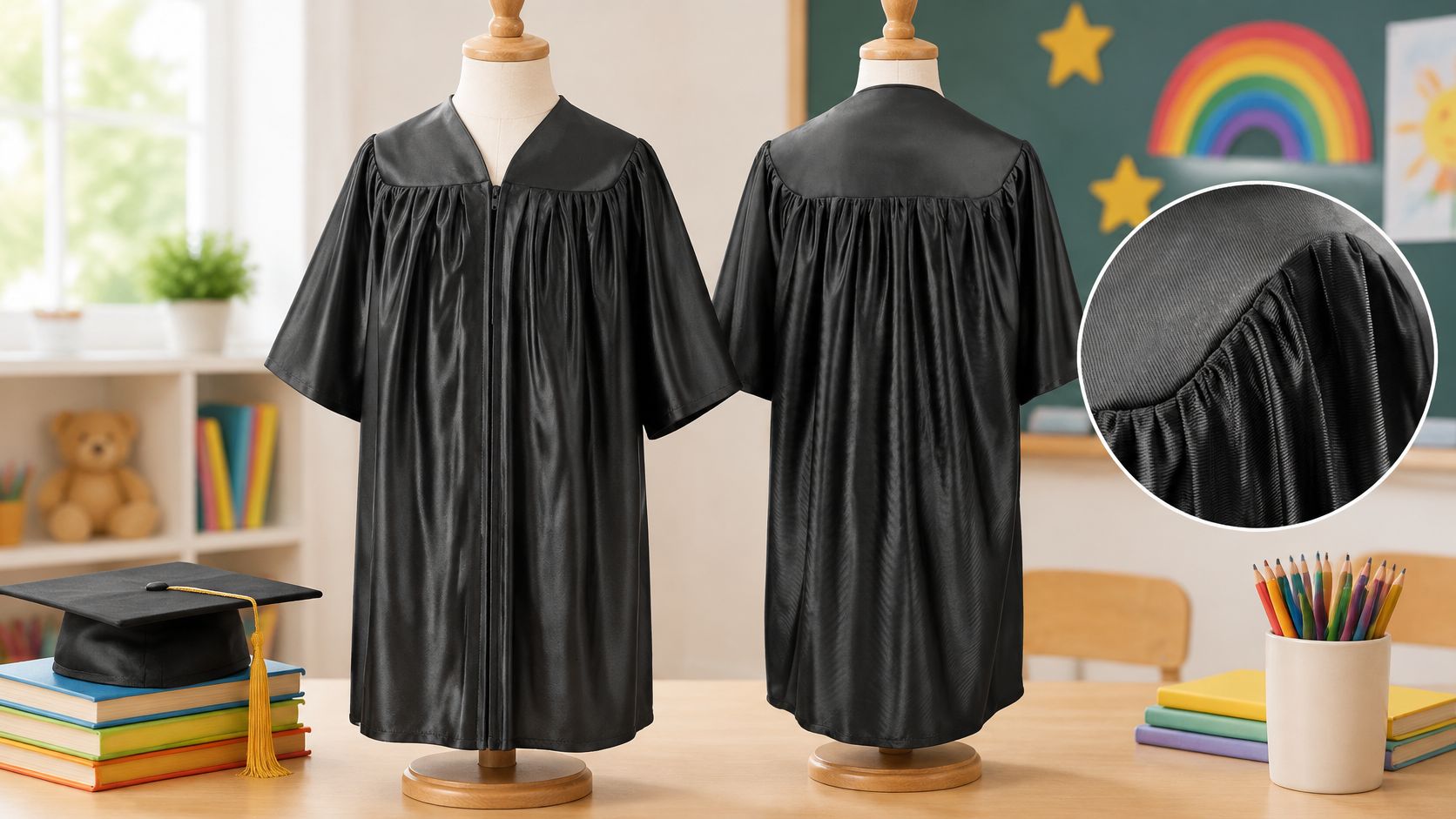
Lay a sash sample over the chosen gown and check the combination in daylight and indoor lighting. Fabric sheen and room lighting can change how colors appear compared with a digital preview.
Approve the complete outfit, not separate color swatches.
Check every personalized name against the school's confirmed list, including accents, spacing, and preferred names. Have another adult review the proof before ordering. A production-ready design still needs accurate spelling.
Keeping Sash Programs Inclusive and Affordable
A pay-to-participate sash program can exclude children before the ceremony begins. Premium customization shouldn't determine who looks like a member of the class. Decide how every child can participate before inviting families to purchase extras.
Readiness isn't uniform: the Trying Together kindergarten-transition white paper reports that 64% of U.S. children ages three to five were on track toward kindergarten readiness in 2022, with state differences exceeding 20 percentage points. These are readiness measures, not kindergarten graduation criteria, and they shouldn't become sash eligibility rules.
Decide access before appearance
- Funding: Will the school supply sashes without charge, or maintain a loan pool?
- Fit and access: Can children wear the design comfortably over uniforms, adaptive clothing, or religious garments?
- Personal information: Will names and pronouns be optional?
- Absence: How will children who miss the ceremony receive their recognition and any keepsake?
Ask families privately about accommodations. A child who uses a wheelchair may need a different sash position to avoid a harness or wheel, while another child may need no garment touching the neck. Don't assume that a standard size solves either situation.
Adapt the fit without adding hazards
An inclusive design uses lightweight, non-scratch fabric and offers a workable fit across different bodies and clothing. Where adjustment is necessary, have an adult establish the fit before the event and secure the finished arrangement without dangling ties or neck cords. Offering different fixed lengths may be better than using an adjustable sash.
Large-print identifiers or securely integrated tactile markers can help when appropriate. Provide multilingual instructions, allow a brief try-on, and accept a child's decision not to wear the sash. Recognition shouldn't depend on tolerating an uncomfortable garment.
Overdeck Family Foundation's early-learning overview describes family engagement as associated with stronger social-emotional development, attendance, and academic outcomes. That supports treating the ceremony as a welcoming family event rather than an apparel requirement.
Belonging first: Distribute school-funded and family-funded sashes in the same way so children aren't identified by who paid.
Celebrate participation, growth, persistence, and community membership. Avoid rank-based labels that overlook disability, language differences, interrupted attendance, or different learning pathways.
Budget and Bulk Ordering Tips for Schools
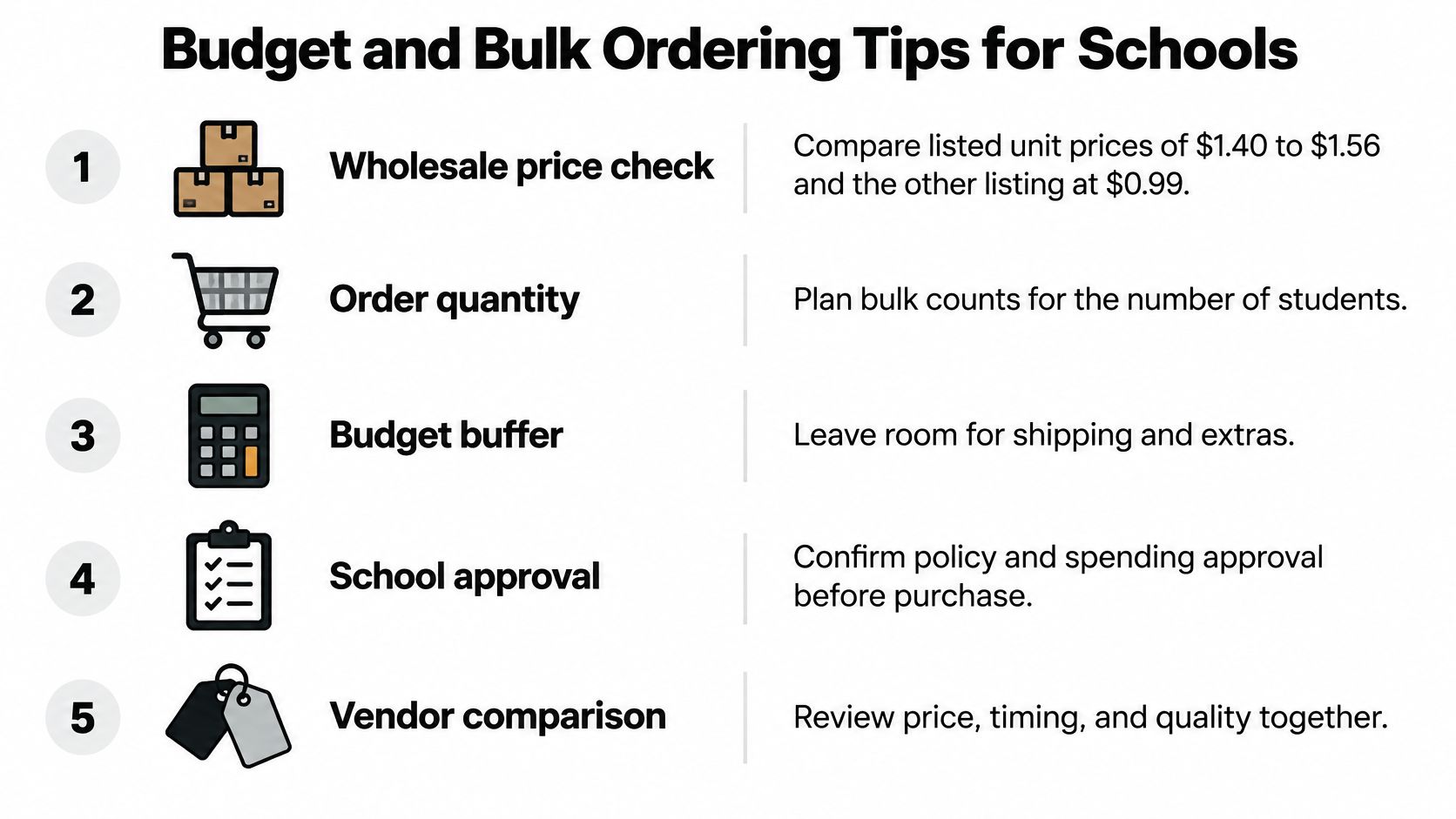
Marketplace prices provide a reference point, not a finished school quote. Accio's kindergarten sash listing reported wholesale prices of $1.40 to $1.56 per unit in 2026, while its separate graduation sash listing reported $0.99 to $1.89 per unit in 2026.
Those ranges don't establish what your order will cost or why individual listings differ. Compare fabric, finishing, personalization, quantity requirements, and shipping before treating any listed unit price as your budget. Finished retail orders may cost more, and the cheapest unit can become expensive if the school needs replacements.
Follow a sample-first ordering sequence
- Count children and plan spares. As a purchasing allowance, consider adding 5 to 10 percent for late additions and replacements, then adjust to the school's actual enrollment uncertainty.
- Group by measured fit. Use height bands to organize the list, but record the required shoulder-to-hip drop.
- Request representative samples. Check each proposed size band rather than approving the whole order from a single garment.
- Approve the finished specification. Record accepted seams, length, wording, color, and decoration in writing.
- Confirm delivery. Agree on a shipping date that leaves room for inspection and correction before the ceremony.
Compare complete quotes
Ask for the quantity-price break before placing the order. Confirm whether personalization, artwork setup, packaging, and shipping are included, and keep a consistent style across the class.
For coordinating personalized items alongside regalia, InchBug's tips for custom school essentials offer a useful companion resource. Keep those items on the same purchasing checklist so staff don't duplicate orders or miss approvals.
Use a broader preschool graduation supplies checklist to account for ceremony essentials beyond sashes. Assign one staff member to maintain the final order sheet and another to approve changes, especially after personalization begins.
Confirm Your Sash Order Before You Buy
A kindergarten sash order fails in predictable places: a misread height band, a misspelled name, a color that photographs differently than expected. Before payment, compare the order confirmation with the approved sample and class list. Keep the proof, measurements, and delivery agreement together so another staff member or family member can check the order without reconstructing earlier decisions.
Complete the final check
The checks have each been done once already: fit against the measured shoulder-to-hip drop, seams and trim on the physical sample, wording against the approved roster, color against school policy, and the sash against the gown it will sit over. Run each one a final time against the written confirmation rather than from memory. A confirmation that matches the approved sample on paper is the closest thing to a rehearsal the order will get.
Choose the right buying approach
For a school, begin with the bulk sample and a single approved specification. Gradshop can personalize graduation products for a school ceremony; have the authorized school contact approve the artwork and roster before production begins. Keep accommodation information private and send only the details needed to fulfill the order.
For a parent, choose the gown color the school approved rather than relying on a photograph of another class. Check the sash against your child's measurements, and request a side-by-side color comparison before the set ships when that is possible. If the school is coordinating a class order, confirm whether a separate purchase is necessary before buying.
One distinction helps at this last step. College regalia rules are strict about who may wear which stole; a kindergarten ceremony usually is not. If the school's policy is silent, a simple, consistent sash for every child is a defensible default, and it avoids importing honors conventions that children this young cannot yet earn.
A successful order is one children can wear comfortably and families can understand. The photograph matters, but the child's experience matters more.
Gradshop offers kindergarten and preschool graduation apparel, graduation packages, and personalization for school ceremonies. Visit Gradshop to explore coordinating options, then prepare your measurements, approved wording, and school color policy before placing your sash order.