

The morning of a kindergarten graduation often starts the same way. A child is excited for the gown, unsure about the cap, and more interested in the snack table than the ceremony order. A parent is trying to smooth hair, find safety pins, and keep the tassel from spinning sideways. A teacher is lining up students who are wiggling, hugging, turning, and sitting on the floor.
That's why graduation caps for kindergarten need their own buying logic.
A cap for a five-year-old isn't just a smaller version of a high school mortarboard. Young children move more, tolerate discomfort less, and usually wear formal regalia for a very short stretch of time. What looks fine in a product photo can slide over the eyes, pinch at the forehead, or fall apart in warm, humid conditions once real children start walking, waving, and squirming.
Parents, teachers, and school coordinators usually get stuck in the same places. They wonder which cap style is easiest to keep on. They guess size by age instead of measuring the head. They decorate too heavily, then the cap tips backward. Or they buy a cute paper cap for the ceremony and only discover later that it warps before class photos.
The good news is that this is manageable once you treat the cap as three separate decisions. First comes fit. Then safety and handling. Then the complete look, including gowns, tassels, stoles, and keepsake details.
Introduction to Graduation Caps for Kindergarten
One of the most common scenes I see at early-years ceremonies is a child happily wearing the gown while holding the cap in both hands like a treasure box lid. That tells you something important. The gown usually feels simple. The cap is the part that needs thought.

With little graduates, the cap has to do several jobs at once. It needs to sit securely on a small, active head. It has to look neat in photos from the front and side. It should be light enough that the child doesn't start pulling at it after a few minutes. And if you're organizing a class event, it has to be easy for adults to place quickly without turning the lineup into chaos.
Why kindergarten caps need a different approach
A teenager can usually tolerate a slightly awkward cap for a while. A kindergartener usually won't. If the band scratches, the cap tilts, or the top feels too stiff, you'll know immediately. The child will remove it, twist it, or ask a grown-up to “fix it” every few steps.
That's why I encourage families and staff to stop shopping by age label first and start shopping by use. Ask these questions instead:
- Ceremony use: Will children walk, sit, sing, and turn often?
- Photo use: Do you need a polished look for portraits, stage pictures, or both?
- Climate use: Is the event indoors, outdoors, or in a warm room where paper materials may soften?
- Handling use: Will the child wear the cap continuously, or mostly hold it until the photo moment?
Practical rule: For younger children, a cap is part clothing, part costume piece, and part photo prop. If it fails any one of those roles, the whole experience gets harder.
What helps families and teachers most
Most parents don't need regalia theory. They need plain answers. What style stays on best? How do you measure? What counts as safe for children? When should the cap go on? Those are the decisions that prevent tears, retakes, and rushed replacements.
Teachers and school coordinators often need one more layer. They need a class-wide system for sizing, labeling, storing, and distributing caps quickly on ceremony day. If your school also wants polished portraits, it can help to look at examples of private school visual content to see how simple styling decisions affect the final image set.
The mindset that makes buying easier
Think of the cap like children's shoes for a special event. You wouldn't pick shoes by age alone, and you wouldn't choose the stiffest pair just because they look formal in the box. You'd check fit, movement, comfort, and how long the child needs to wear them.
That same mindset makes the rest of this process much simpler.
Understanding Kindergarten Graduation Cap Types and Materials
A kindergarten graduation cap may look simple in the package. On a four- to six-year-old, though, it has a bigger job. It needs to stay put long enough for the class walk, feel comfortable enough to avoid constant tugging, and photograph well under bright lights or outdoor sun.
That is why it helps to treat cap shopping as a fit and wear problem first, and a style choice second.
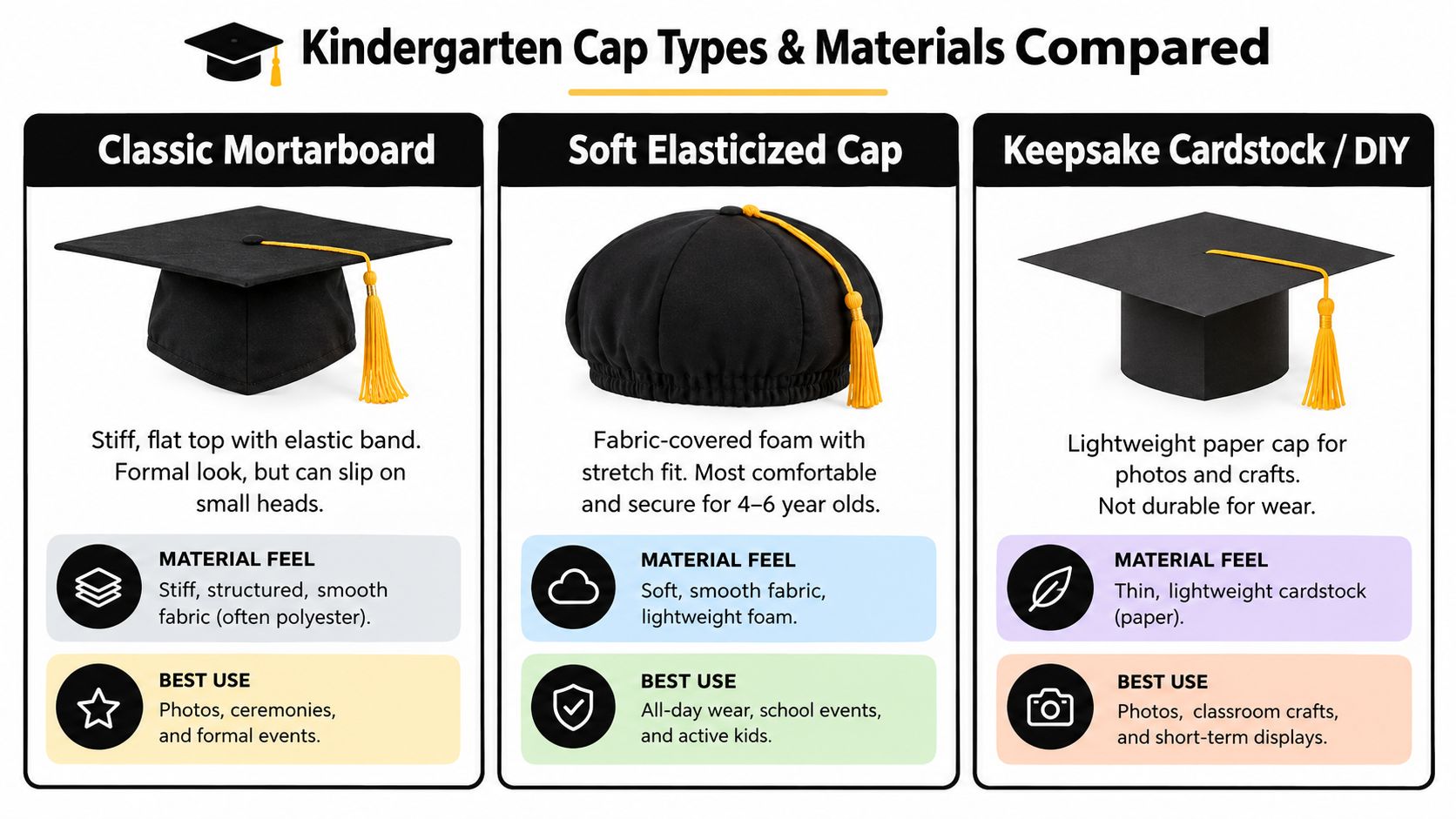
Classic mortarboard caps
This is the square cap many parents expect. It has the traditional flat top and a firmer band underneath, so it gives the clearest "graduation day" look in stage photos.
For young children, classic mortarboards work a bit like dress shoes for a special occasion. They look polished, but they usually need careful fitting and a shorter wear window. If the band is even slightly loose, the cap can tip during waving, singing, or stepping up for a diploma photo.
Classic caps usually make sense when:
- The event is brief: Less time on the head usually means less fidgeting.
- The school wants a formal look: The square shape reads clearly in group photos.
- Adults can help with placement: A teacher or volunteer can straighten caps just before the ceremony starts.
Soft elasticized caps
Soft elasticized caps are often easier for kindergarteners to tolerate. The band has more give, and the overall feel is usually gentler on children who are sensitive about hats or hair pressure.
This style often solves a problem families do not notice until the big day. A cap that looks fine on a table may feel completely different once it sits over curls, clips, braids, or very fine hair. A softer cap usually adjusts better to those real-life details.
These caps often suit:
- Children who resist structured headwear.
- Programs with lots of movement, songs, or classroom procession.
- Warm rooms or outdoor celebrations where lighter construction feels better.
- Schools trying to reduce last-minute cap swapping.
Keepsake cardstock and DIY caps
Cardstock and DIY caps are best for short-use moments. They work well for a classroom photo corner, an art activity, or a memory display that children carry for a few minutes rather than wear through a full event.
They are popular because they are easy to personalize. Teachers can add names, handprints, class themes, or simple decorations without much cost.
Their weakness is durability. Paper-based caps can bend, soften, or lose shape, especially if the room is warm, children handle them repeatedly, or the event runs longer than planned.
A keepsake cap can be perfect for a portrait station and frustrating during a full ceremony. The difference is wear time.
Materials matter more than color alone
Parents often start with color because it is easy to see. Material matters just as much, because material affects comfort, shape, shine, and how the cap looks in photos.
A matte fabric finish usually gives a softer appearance in close-up pictures. Shinier fabric can look more formal, but it may reflect overhead lights and show creases more clearly. A firmer build helps the square top stay crisp. A lighter build may feel better for children who only agree to wear the cap for a short stretch.
If you want a closer look at how academic garments are commonly made, Gradshop's guide to materials used for academic wear explains the standard fabric and construction basics.
Picking the right type for your event
A useful way to choose is to match the cap to the child's wear window and the event setup, not just to the school colors.
| Ceremony situation | Cap type that often fits | Why it tends to work |
|---|---|---|
| Formal stage walk with posed photos | Classic mortarboard | Gives the strongest traditional silhouette |
| Active classroom celebration | Soft elasticized cap | Usually stays comfortable through movement |
| Craft table, portrait station, or keepsake display | Cardstock or DIY cap | Easy to personalize for short use |
| Warm room or outdoor ceremony | Sewn fabric cap | Holds shape better than paper-based options |
If you are choosing between a basic cap and an upgraded option, start with the child's likely tolerance. A cap that stays on calmly for ten minutes will usually outperform a prettier one that comes off after thirty seconds. That measurement-first approach also makes Gradshop-style upgrade paths easier to judge later, because you can compare features after you know what fit and wear time your child needs.
How to Measure and Fit Kindergarten Graduation Caps
A kindergarten cap that looks fine in the package can slip over a child's eyes the moment the class starts waving to the audience. That is why fit comes first. For four to six year olds, a graduation cap is less like a smaller teen cap and more like a short-use event item that has to stay comfortable, stay put, and still look neat in photos.
For this age group, head circumference does most of the sizing work. Age, height, and gown size can point you in a general direction, but they do not tell you how the cap band will sit around the head. As noted in cap fitting guidance, measuring around the head and choosing a cap with an adjustable band helps reduce slipping during active ceremonies.
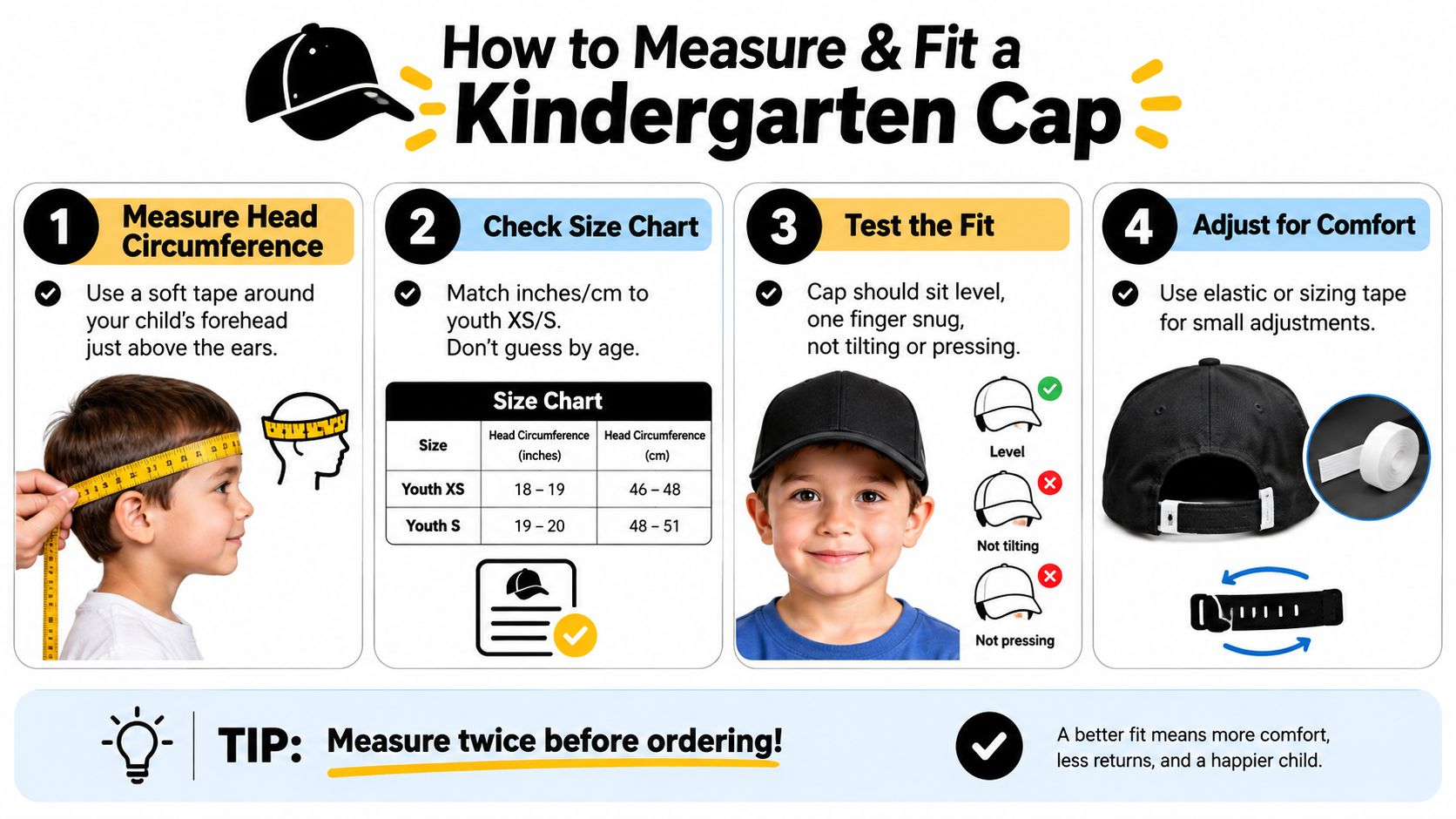
How to measure at home
You only need a soft measuring tape. If you do not have one, use a piece of string and compare it against a ruler afterward.
Place the tape where the cap band will rest. For most children, that means across the forehead and just above the ears. Keep it level all the way around. If the tape rides up toward the crown, the number will read too small and the cap may pinch or pop up.
A calm, two-minute routine usually works best:
- Measure with the planned hairstyle in mind: Large clips, high ponytails, and thick braids can change the fit.
- Keep the tape flat against the head: Twists can add or subtract enough to affect sizing.
- Take two readings: Young children wiggle, turn, and laugh mid-measurement.
- Write the number down right away: This avoids mixing up siblings, classmates, or later re-measures.
If you want a visual reference before comparing store charts, the Dirt Cheap Product hat size chart shows the usual measuring line around the head.
Kindergarten Cap Size Chart by Head Circumference
Use the seller's own size chart first. Youth size names are not perfectly standard from one store to another, so this table works best as a planning guide.
| Head Circumference | Recommended Size | Fit Notes |
|---|---|---|
| Smaller end of the youth range | Youth XS | Helpful if caps often slide low on the forehead |
| Mid youth range | Youth S | Common starting point for many kindergarten students |
| Upper youth range | Youth M | Gives more room for fuller measurements or bulkier hair |
What a good fit looks like
A well-fitted cap sits level, much like a picture frame hung straight on the wall. If one side rises or the front drops into the eyebrows, the whole look changes in photos and the child usually starts touching the cap to fix it.
Use a simple movement check. Ask the child to turn their head, look up, sit down, and stand again. The cap should stay in place through those small motions without rocking, tipping back, or covering the eyes.
Parents often ask how snug is right. A useful guide is the one-finger check. The band should feel secure, but you should still be able to slip one finger under the edge comfortably. Deep marks mean it is too tight. Constant shifting means it is too loose.
Why adjustable bands help younger children
Kindergarten ceremonies have a very short wear window, but that short window is active. Children wave, bend for certificates, look for family members, and sometimes tug at anything that feels unfamiliar.
That is where adjustable bands earn their keep. They help fine-tune the fit after you measure, which matters because little differences in head shape show up quickly in a cap. If you are comparing cap sets with the rest of the outfit, Gradshop's guide on how to measure for cap and gown can help you line up cap sizing with gown planning.
When to do the final fit check
Do the try-on about a week before the event. That timing gives you room to exchange sizes, switch hairstyles, or choose an upgraded cap option if the first one shifts too much.
This is also the easiest point to check photo logistics. See how the cap sits with the child's hair done the way it will be worn on the day. Test it during a short practice, not a long afternoon at home. Five to ten minutes tells you more than an hour on the sofa, because ceremony problems usually show up during movement, not quiet sitting.
Quick checklist for parents and teachers
- Measure the head, not the age group
- Keep the tape level across the forehead and above the ears
- Check fit with the planned hairstyle
- Test walking, sitting, and looking up
- Do the final try-on about a week before graduation
- Choose adjustability over guesswork if the child is between sizes
A good kindergarten cap should feel almost forgettable to the child. That is usually the fit that photographs best too.
Safety Decoration and Photo Ready Handling for Little Graduates
At kindergarten graduation, the cap is less like a tiny version of a high school mortarboard and more like a timed costume piece for a busy 4 to 6 year old. Children this age wiggle, look up, hug friends, and forget they are wearing something on their head. So the goal is simple. Keep the cap light, safe, and ready for the short parts of the day that matter in photos.
Safety starts with the product, not the decoration
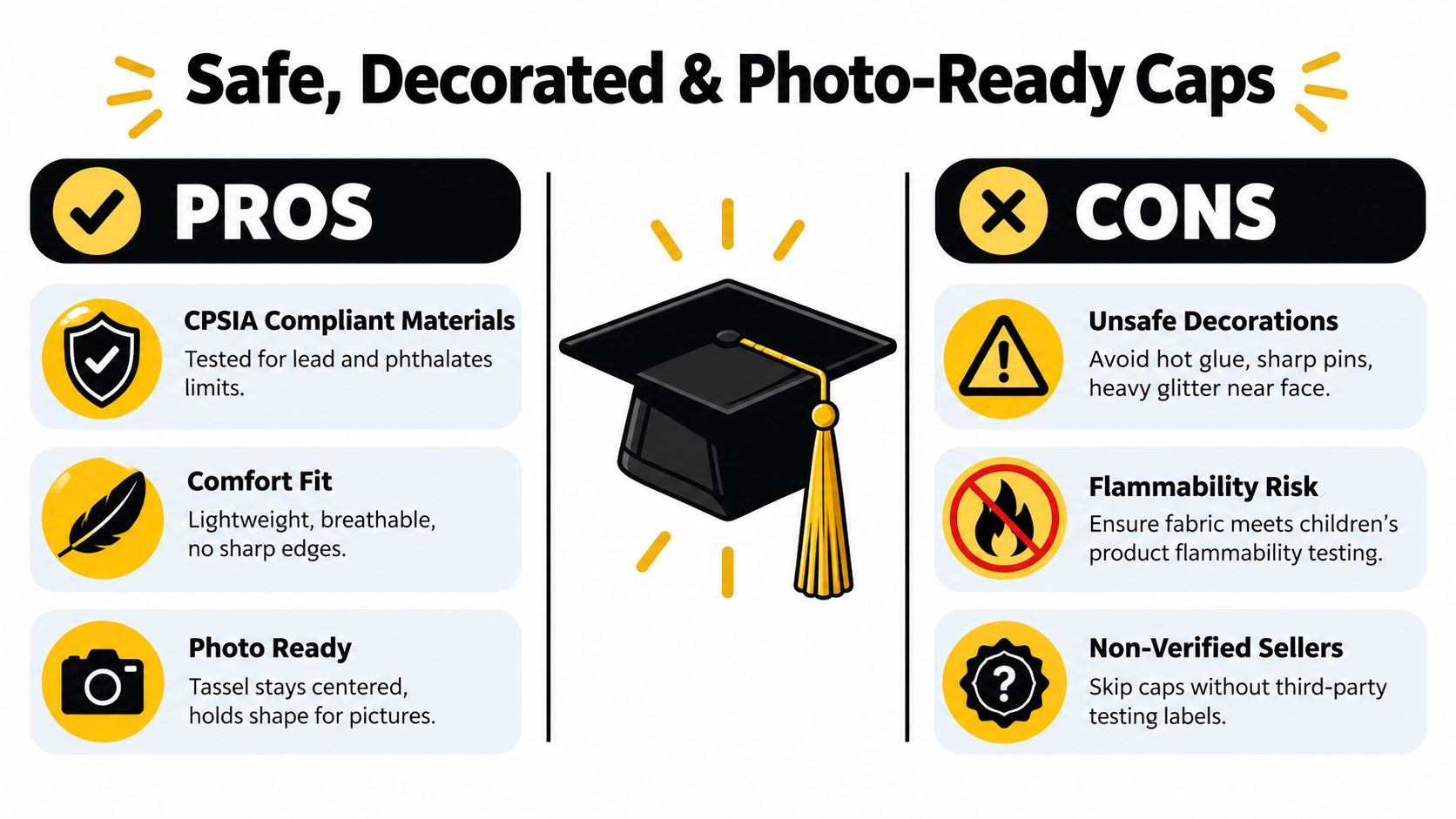
A cap can look neat and still be the wrong choice for young children. What matters first is whether the materials were made and tested with children's use in mind. The children's product safety guidance gives parents and schools a useful standard to check against, including product testing, flammability checks, and Children's Product Certificates.
If a seller cannot explain what the cap is made from or whether it meets children's product requirements, I would pause there.
A quick school or parent checklist helps:
- Third-party testing: You want verification beyond the seller's description.
- Lead and phthalate compliance: Children handle caps closely, so material limits matter.
- Flammability testing: Fabric items should be checked for this.
- Children's Product Certificate: This helps identify the product if questions come up later.
Decorations should stay flat and light
Young children do not wear decorated caps the way older students do. A teenager may tolerate extra weight or a slightly tilted cap for a long ceremony. A kindergartener usually will not. Even a pretty design can become a nuisance if it changes balance, scratches the forehead, or drops glitter near the eyes.
The safest decorations are usually the simplest ones. Names, class year numbers, a small paper shape, or a printed topper attached smoothly to the top panel tend to work well.
Try this rule. If the cap feels different on the child's head after decorating it, the decoration is probably too heavy.
Avoid:
- Sharp pins
- Stiff wire pieces
- Loose glitter
- Thick ridges of hot glue
- Tall toppers that catch on sleeves, hair, or other children
Use a short wear window
This is one of the biggest differences between kindergarten regalia and older-student regalia. Little graduates do better when the cap goes on late and comes off early.
A good comparison is dress shoes for a wedding. They may look lovely in the photos, but no one expects a five year old to wear them happily for hours. Graduation caps work the same way. Put them on close to the processional, the stage walk, or the formal photo block. That short wear window often keeps the cap looking straighter and the child feeling calmer.
If the ceremony schedule is long, let children carry the cap between key moments. Many of the sweetest photos come from a child holding the cap at their side or against their gown, then wearing it only for the classic portrait shot.
A handling plan helps adults more than children
Children do best when adults already know who is placing the cap, when it goes on, and when it comes off. Without that plan, caps get adjusted by too many hands and end up crooked just as the photos begin.
For schools, I usually suggest assigning one clear use point for each part of the event:
- Portrait use: The child holds the cap until the photographer is ready.
- Line-up use: An adult places the cap just before walking.
- Stage use: The cap is worn for the main ceremony moment, then removed after the formal pictures.
For families, keep it even simpler. Decide in advance whether the cap is for arrival photos, the ceremony itself, or the after-event pictures in better light.
Photo-ready handling without fuss
Photo success usually comes down to three small checks. Is the front edge level. Is the tassel sitting where you want it. Can you see the child's eyes clearly.
That is enough.
You do not need extra sparkle or oversized add-ons to make the cap photograph well. A relaxed child in a cap that stays put will nearly always look better than a child in a heavily decorated cap that needs constant fixing. If you plan to turn the pictures into a keepsake afterward, these collage resolution tips for print can help you choose images that still look crisp once printed.
A calm child photographs beautifully. That is the standard worth designing for.
Matching Gowns Tassels Stoles and Personalization Options
Once the cap is sorted, the rest of the outfit becomes much easier. For kindergarten ceremonies, the goal isn't to layer on every regalia element possible. It's to create a clean, balanced look that feels festive without overwhelming the child.
That usually means thinking in bundles. Cap, gown, tassel, and then one optional personalization piece if the school wants it.
The simplest combinations
A matching cap and gown set gives the most uniform appearance in group photos. This is often the least stressful option for teachers because every child reads as part of the same class, even if shoes and hairstyles vary.
Tassels add movement and make the cap look complete. For kindergarten, I usually suggest treating the tassel as a visual accent rather than a symbol-heavy tradition. Younger children don't need complex cord or stole logic to look polished.
Here's a straightforward way to compare options:
| Combination | Best for | What to watch |
|---|---|---|
| Cap and gown only | Minimalist school ceremonies | Cleanest setup, least handling |
| Cap, gown, and tassel | Traditional graduation look | Check tassel placement before photos |
| Cap, gown, tassel, and stole | Special themes or school branding | Avoid making the outfit feel bulky |
When a stole makes sense
A stole can work beautifully in kindergarten when it has a clear purpose. Some schools use them for bilingual programs, faith-based settings, school identity, or a class-year design. Others add a stole because adults like the look, even when the child already feels overloaded.
That's where restraint helps. One stole is usually enough. If the gown color is bright, a simpler stole often photographs better than one with too many competing elements.
Schools that want personalized options can compare layouts, colors, and theme styles through custom graduation stoles.
Personalization that still feels child-friendly
For little graduates, personalization works best when it's easy to read and emotionally meaningful. The most successful details are usually:
- First name: Helps identify keepsakes later.
- Graduation year: Gives the item lasting value.
- School name or logo: Useful for school-wide consistency.
- Class theme element: A star, rainbow, book, or simple mascot graphic can be enough.
What I'd avoid is overloading the cap and stole at the same time. If the cap top is decorated, keep the stole cleaner. If the stole carries the name and year, leave the cap more classic.
Keepsake lens: Choose one feature the child may recognize now, and one feature the family will treasure later.
Borrowing ideas from older regalia without copying it
Families often browse older student regalia and assume the same rules apply downward. Some visual ideas transfer well. Too much symbolism usually doesn't.
For example, in higher education and formal commencement settings, cords and stoles can carry specific meanings. One university regalia guide explains that gold cords may identify bachelor's and associate degree candidates who received commencement honors for high academic achievement, while a pewter-colored stole can recognize undergraduate students receiving an Honors Degree. The same guide also notes red, white, and blue cords for veterans and military service members and a fountain-mist teal cord for student donors (cord color meanings).
That's useful context for families planning ahead for older siblings or future ceremonies, especially if they're also shopping for high school caps and gowns, stoles, or later academic regalia such as master's and doctoral hoods and tams. For kindergarten, though, the cleaner approach is usually better. Use the formality of the set, not the full symbolism of advanced regalia.
A note on tassel placement
At this stage, tassel placement is mostly about appearance and comfort. Make sure it hangs neatly and doesn't brush directly into the child's face. If the child keeps swatting at it, that's not a discipline problem. It's a sensory cue.
Before photos, adults should do one quick sweep. Straighten gown shoulders, center the stole if there is one, and position the tassel so the child isn't peeking out from behind it.
The best complete look is the one the child can wear happily long enough to enjoy the moment.
Bulk Ordering Timelines Shipping Care and Storage Made Simple
The week before graduation often looks calm on the calendar and busy in the classroom. One child enrolls late. Another has braids added after the first fitting. A box of caps arrives, and suddenly the question is not “Did we order enough?” but “Will each 4 to 6 year old get the right cap, at the right moment, without tears or photo delays?”
That is why bulk ordering for kindergarten works best as a fit and timing system. These caps are being worn by young children for a short ceremony window, a class photo, and maybe a few proud minutes with family after pickup. Plan around that wear window, and many last-minute problems get smaller.
Build the order from measurements, not from grade level
Start with one class list that includes each child's name, head measurement, gown size, and any note that affects fit on the day, such as full curls, a protective style, or a planned hair bow. Keep head size and gown length in separate columns. Parents and newer staff often mix those two because both are part of one outfit, but they solve different problems. The gown is about height. The cap is about circumference and staying comfortably in place during a short, active event.
Order early enough to leave room for three steps: delivery, sorting, and one calm fit check. For kindergarten, that middle step matters more than adults expect. A cap can be technically the right size and still need a second look if the child wears it too far back, too low over the forehead, or over a hairstyle that changed after measuring.
If you are ordering through Gradshop or another supplier with youth sizing options, use the measurement list first and the product page second. That keeps the order tied to children's actual head sizes rather than a guess based on age.
A classroom-ready way to sort and distribute
One practical method is to pack each child's set in a large zip bag labeled with the child's name and table group, such as Blue Table or Ladybugs. Teachers can then hand out regalia the same way they hand out center materials. It feels familiar to children, and it helps adults spot mix-ups quickly.
A late-enrollment student is the test of any ordering plan. If a child joins two weeks before the ceremony, measure that child's head the same day, compare it with your existing size groups, and check whether one of your extra caps would fit before assigning it. “Close enough” often fails in kindergarten photos because a loose cap tilts, slides, or comes off during lineup.
Give the calendar more room than you think you need
School orders need more time than family orders because there are more hands involved. Office staff may receive the boxes, teachers may sort them, and families may need to confirm a hairstyle change or a missing measurement. Each handoff adds time.
A helpful rule is simple. Count backward from the ceremony date and protect a fit-check week, not just a delivery day.
That week gives you time to:
- check each name against each item
- try caps on children when the class is calm
- spot size problems before rehearsal
- request replacements or use extras without rushing
Rush shipping can help with a single replacement. It should not be the main plan for a full class.
What to check when something seems wrong
A cap problem is usually one of three things. The measurement was off. The cap was assigned to the wrong child. The child's hair or cap placement changed the fit.
Check in that order.
First, compare the written head measurement with the size ordered and the item received. Next, place the cap on the child during a quiet part of the day rather than during hallway practice, when children are already stimulated and less patient. Then look at the details parents often do not realize matter, such as a high bun, thick beads, or a wide headband.
Keep replacement items in a separate, clearly marked bag or box. Once extras drift back into the general pile, staff lose time rechecking every set.
Care before the ceremony
Young children do not need heavily handled regalia. They need clean, flat, easy-to-identify pieces.
Hang gowns early so folds can relax. Store caps flat, with nothing heavy on top of the mortarboards. Keep food, paint, glitter, and damp wipes away from the sorting area. If a cap needs attention, use a gentle spot clean rather than soaking it.
Keep each child's full set together from the moment you sort it. That one habit prevents many morning problems.
Storage after the ceremony
Some families keep kindergarten regalia as a first-school keepsake. Some schools save sample sizes, extras, or one display set for future planning. In both cases, simple storage works well.
Let the gown dry fully if it picked up any moisture. Fold it neatly. Store the cap flat so the top keeps its shape, and keep the tassel untangled. Label school-held extras by size and color so next year's team is not starting from guesswork.
A cap left crumpled in a car footwell often looks worse in one afternoon than it did through the whole ceremony.
Good ordering and storage may sound like back-office tasks, but for kindergarten they protect the child's experience. The result is a cap that fits, a pickup table that runs calmly, and photos that look organized without asking young children to wait too long in full regalia.
Your Next Steps to a Joyful Kindergarten Graduation
On ceremony morning, the difference between calm photos and constant cap-fixing usually starts much earlier, with one small task at the kitchen table or in the classroom. Measure first.
Kindergarten graduation caps work best when they are chosen for a four to six year old child who will walk, wiggle, look up, and wear the cap for a short window, not for a teenager standing still through a long program. That shift helps parents and teachers make better choices faster. A cap that fits the head properly is easier to keep on, safer to handle, and much more likely to look neat in photos without repeated adjustments.
If you are a parent, start with head circumference, then choose the cap style that suits your ceremony setting. An indoor stage event, an outdoor class celebration, and a quick photo session can call for slightly different priorities. After that, add only the personalization that will not affect fit or comfort.
If you are a teacher or school coordinator, collect measurements first and schedule one brief fit check before final distribution. It works like labeling shoe sizes before sports day. You solve the practical problem early, so the children can focus on the fun part later.
For families planning across several school milestones, it also helps to keep categories separate. A kindergarten cap is a first-school item with its own fit and wear needs. Older students may need different regalia, such as high school caps and gowns, stoles, tassels, hoods, or tams, and those pieces follow different expectations for structure and use.
The clearest next step is simple. Measure head circumference first, choose the cap type for your ceremony setting second, then add personalization last.
If you are ready to compare options with that fit-first approach, Gradshop offers graduation caps, cap-and-gown sets, stoles, tassels, and advanced academic regalia in one place. It is a practical option for families buying for multiple grade levels and for schools that want clear product choices, shipping support, and straightforward ordering during ceremony season.