

Mastering Your Academic Hood

Getting your hood set up feels like second nature once you break down the steps. The key is letting the velvet drape at the nape of your neck and flipping the satin so your school colors shine.
Before the ceremony kicks off, nail these quick adjustments:
- Drape the Hood: Position the velvet trim on your shoulders—this frames your collar and keeps the hood steady.
- Flip the Lining: Have someone fold the satin back about 2 inches so your institution’s colors peek through.
- Anchor for Stability: Loop the cord over a gown button or use a discreet pin to prevent slipping.
Even a light breeze or a fast camera flash can turn an unsecured hood into a distraction. A few extra seconds of fine-tuning means more confidence on stage.
Understanding the story behind each element gives it weight. The velvet hue links back to your discipline, while the lining tells your alma mater’s tale.
Degree-Specific Details
Every degree level has its own hood profile:
- Master’s Hoods: Roughly 3.5 feet in length with velvet trim about 2 inches wide.
- Doctoral Hoods: Around 4 feet long, featuring a broader velvet band (up to 5 inches) and extra satin for a dramatic sweep.
Troubleshooting Common Hood Issues
- Sagging Trim? Fasten the loop under a button or add a safety pin on the velvet band.
- Wind Snags? Tuck a bit of satin behind your gown’s shoulder seam to weigh it down.
- Lopsided Look? Stand in front of a mirror and nudge the velvet until it sits evenly.
Decoding Your Academic Hood
Here’s a quick-reference guide to understanding the parts of your academic hood and what they represent:
| Hood Component | What It Signifies | Example |
|---|---|---|
| Velvet Trim | Field of study | Golden yellow for Science |
| Satin Lining | University colors | Blue and white chevrons |
| Cord and Loop | Attachment method | Loop fits over button or pin |
Keep this chart within reach as you arrange and secure your hood. It turns your regalia into a badge of all the late nights and breakthroughs that brought you here.
Putting It All Together
Once your hood lies flat and feels comfortable, you’re set to stride across the stage without a second thought about your wardrobe. A quick dress rehearsal before the big day helps every flip and anchor become muscle memory.
For more on caps, gowns, and custom hoods, explore Gradshop. You’ll also find detailed instructions in our article on how to wear academic regalia.
What the Colors on Your Hood Mean
Think of your academic hood as a visual resume, telling a story of your journey and accomplishments at a single glance. It's far more than just a piece of your graduation uniform. Every color, fabric, and inch of its length is steeped in tradition, connecting you to a long line of scholars who came before.
When you understand the symbolism, the regalia transforms from a simple garment into a proud emblem of all your hard work. Let's break down what it all means.
The Velvet Trim: Your Field of Study
The first thing you’ll probably notice is the plush, velvet border running along the edge of your hood. This color is the key to your academic discipline—it immediately tells everyone the specific field you've dedicated your studies to.
The system is pretty standardized across most universities, which makes it a kind of universal language at academic ceremonies. You've likely seen the deep, dark blue on a doctoral hood—that color represents the Doctor of Philosophy (Ph.D.), no matter the specific research area.
Here are a few other common examples you'll see:
- Light Blue: The classic color for the field of Education.
- Golden Yellow: Signifies a degree in the Sciences.
- White: Represents Arts, Letters, or Humanities.
- Drab (a light brownish-tan): Corresponds to Commerce, Accountancy, and Business.
This isn't a new idea. The practice of assigning colors to different faculties goes back centuries and is now guided by a code that keeps academic ceremonies consistent. To dive deeper, check out our detailed guide on doctoral hood colors and their meanings.
The Satin Lining: Your University's Identity
While the velvet trim tells people what you studied, the colorful satin lining on the inside of the hood shows them where you studied. This part proudly displays your university's official colors, often arranged in a pattern that's unique to your alma mater.
It could be a single solid color, or you might see two colors split by a chevron (that classic V-shape). A graduate from one school might have a hood lined in royal blue and gold, while another’s features crimson and white. This is the most personal element of the hood, linking your achievement directly back to the institution that granted you the degree.
This whole system—the colors, the length, the design—follows a surprisingly specific set of rules. The modern code for academic regalia was first formally adopted in the United States way back in 1895. It established guidelines for everything, from the length of the hood (a master's hood is 3 feet 6 inches, while a doctoral hood is 4 feet) to the precise colors of the lining and trim. It's a system that most North American universities still follow today.
Key Takeaway: Your academic hood is a symbolic garment where the velvet trim signifies your degree field (like science or arts), and the satin lining displays the unique colors of your university.
Draping Your Hood for a Perfect Fit
Getting your hood to drape smoothly starts with unfolding it completely. You’ll spot the plush velvet trim on one side and the vibrant satin lining on the other. Hold the velvet side up so the pointed satin tip hangs straight down.
Next, lift the hood over your head, letting it rest around your neck and shoulders. The velvet trim should frame your gown’s neckline, and the narrow V-shape of the trim ought to sit comfortably at the front of your neck.
The Essential Flip Technique
Revealing the lining can be tricky at first, but it’s all about the right motion. Ask a friend or faculty member to stand behind you and find the velvet strip running down the back.
From just below your shoulders, have them gently turn that strip outward along the seam. This flip exposes the satin lining and any chevrons, letting your school’s colors cascade down your back.
Insider Tip: Begin the flip at the midway point on your back. Keep the top section around your neck and shoulders flat with the velvet outward. That way, you’ll look crisp in front and colorful behind.
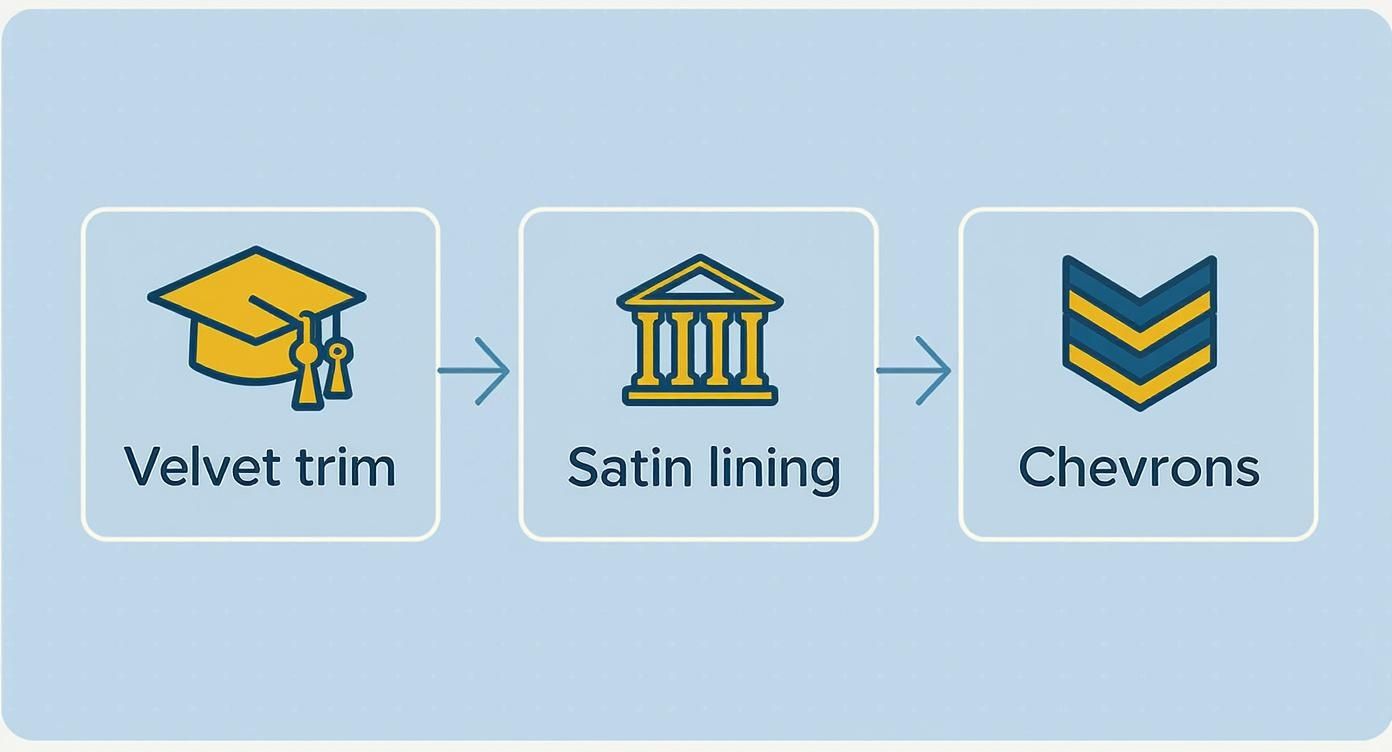
As the infographic shows, each element of your hood—the bold velvet trim, the bright satin lining, and any chevrons—tells part of your academic journey, from field of study to alma mater.
Making Final Adjustments
Once the lining is flipped out, pause to fine-tune the fit. Your hood should lie flat against your back and rest comfortably on your shoulders.
Here are a few common fixes:
- Too Much Pulling: Gently tug the back of the hood to release tension at your throat and lower the V-neck.
- Uneven Draping: Have your helper check that the lining shows evenly on both sides.
- Bunching Fabric: Smooth any wrinkles in your gown so the hood lays flat.
With these tweaks, you’ve mastered the art of wearing an academic hood. When you’re ready to complete your look, explore our Master’s Hoods Collection or browse our Doctoral Hoods Collection at Gradshop.
How to Keep Your Hood Securely in Place
Nothing spoils a distinguished academic look faster than a hood that won't stay put. We've all seen it: the graduate constantly tugging at their regalia, the hood slipping back and choking them, or just looking plain sloppy. On a day that’s all about celebrating your hard work, the last thing you want is a wardrobe malfunction.
Thankfully, keeping your hood picture-perfect from the processional to the final handshake is easier than you think. It just takes a little know-how.
Most academic hoods are designed with a small loop or cord right at the front, near the point of the velvet. This little feature is your secret weapon for stability. Its entire job is to anchor the hood to your gown or clothing, preventing that dreaded backward slide that tightens around your neck.

Using the Built-In Attachment Cord
If you happen to be wearing a button-down shirt, you're in luck. Just loop that cord around the top button before you zip up your gown. This creates a solid, completely hidden anchor point that will keep your hood from pulling all day long.
But what if you aren't wearing a button-down? No problem. Many graduation gowns have a built-in fix. Take a look inside, right along the zipper—you might find a small, discreet loop made for exactly this purpose. If not, you can simply loop the cord around the zipper pull itself. It works just as well to keep everything secure.
Pro Tip: Always attach the hood before zipping your gown all the way up. It’s a game-changer. You can see what you’re doing and make sure the cord is properly fastened without fumbling around blindly.
When You Need a Backup Plan
Let's be real: not all gowns are made the same, and sometimes there's just no obvious place to attach the cord. When that happens, your best friend is a simple safety pin. It’s a reliable, discreet solution that works with any gown or outfit combination.
Here’s how to use a pin without it being seen:
- First, drape the hood over your shoulders just how you want it to sit, making sure it’s centered and feels right.
- Pinpoint the spot where the velvet V-neck rests on your chest. That's your anchor point.
- Now for the trick: work from underneath your gown. Push the safety pin through the gown's fabric first, then through the velvet trim of the hood.
- Fasten the clasp, and you're set. By pinning from the inside, the pin stays completely out of sight.
This tiny adjustment makes a world of difference. It stops the hood from riding up your neck and keeps you looking sharp. For a deeper dive, our guide on the best graduation hood attachment methods has even more tricks to guarantee a perfect fit. After all, when your regalia is secure, you can stop worrying and just soak in the moment.
Understanding Different Hooding Ceremonies
Putting on your hood is only half the celebration—you also need to know exactly when you’ll don it. Traditions vary widely, so your master’s ceremony could feel very different from a doctoral hooding.
For most master’s candidates, the hood is part of your regalia from the moment you arrive. You’ll wear it over your gown during the processional and keep it on until the tassel turn.
- Full academic dress in place before the ceremony
- Hood draped neatly over shoulders the whole time
- Off-stage hooding standard since 1959
This change came after a recommendation from the American Council on Education to streamline graduation rites. For more details, check out the timeline of academic regalia history.
The Doctoral Hooding Tradition
Doctoral hooding carries a sense of ceremony you won’t find at the master’s level. Rather than starting fully dressed, you’ll cradle the hood over your left arm as you walk in.
On stage, your faculty mentor or dissertation advisor performs the hooding:
- You stand with back to the audience
- The mentor lifts the pre-folded hood
- It’s settled onto your shoulders in a single motion
That moment marks your official welcome into the community of scholars.
Key Difference: Master’s graduates wear their hoods throughout the event, while doctoral candidates receive theirs on stage as a formal rite of passage.
Whether you’re fitting your hood in advance or carrying it for that signature moment under the spotlight, knowing the ceremony steps will help you focus on the pride and excitement of graduation.
Got Questions About Your Academic Hood? We’ve Got Answers.
Even after you've got the drape just right, a few questions about your academic hood might pop up. It’s a pretty unique part of the whole graduation getup, steeped in tradition, so it's natural to have a few "what ifs." We've been there, and we've heard them all.
Let's clear up some of the most common questions graduates have, so you can walk across that stage with total confidence.
My Gown Doesn't Have a Button for the Hood. Now What?
Don't panic—this happens all the time, and the fix is super easy. If your gown doesn't have that little button or loop to hook your hood onto, a simple safety pin will be your secret weapon.
Once you have the hood draped how you like it, just reach up from underneath your gown. Push the pin through the gown's fabric first, then right through the velvet part of your hood. By fastening it on the inside, the pin stays completely hidden, but it creates a solid anchor point. This little trick is the key to stopping the hood from sliding back and uncomfortably tightening around your throat.
What's the Difference Between a Master's and Doctoral Hood?
Great question. While they both use the same color system to show your school and field of study, there are some clear visual differences that signal which degree you've earned. It really comes down to size and shape.
- Length: A master's hood measures a standard 3.5 feet long. A doctoral hood, on the other hand, is noticeably longer at 4 feet, giving it a more substantial, flowing look.
- Velvet Trim: That colorful velvet band representing your academic field is much wider on a doctoral hood. While the master's trim is distinct, the doctoral version is a bold 5-inch band.
- Shape: Look at the back. Doctoral hoods often have a wider, split "fishtail" design. This isn't just for show; it helps the school's colors in the lining fan out more dramatically when turned.
The Bottom Line: A doctoral hood is bigger and bolder. Look for the longer length and the much wider velvet trim to spot the difference instantly.
Should I Wear My Hood for Graduation Pictures?
Yes, one hundred percent! Your academic hood is a huge part of your official regalia and a proud symbol of everything you’ve accomplished. It absolutely belongs in your graduation photos.
Whether you're sitting for professional portraits or just grabbing selfies with your family, wearing your hood correctly adds a real sense of achievement to the pictures. Just make sure it's on properly, with the colors of the lining flipped out, to get those perfect shots you'll look back on for years.
It’s also completely appropriate to wear your full regalia, hood included, to any departmental ceremonies or receptions happening around commencement. But once the official events are over and you head to a party, most people find it more comfortable to hang up the cap, gown, and hood.
At Gradshop, we believe every graduate deserves to look their best. We provide high-quality regalia that truly honors your achievement. From master’s and doctoral hoods to high school stoles and honor cords, you’ll find everything you need for the big day at Gradshop.