

That colorful garment draped over your graduation gown is more than just fabric—it’s a powerful symbol of your academic journey and hard-earned success. Before you can even think about how to wear your academic hood, it helps to understand what each part signifies. From the velvet trim that announces your field of study to the satin lining flashing your university's colors, every detail tells a story.
Decoding Your Academic Hood Before Graduation
Think of your academic hood as a visual resume, a direct connection to centuries of scholarly tradition. When you understand the meaning behind its components, you don't just wear it—you wear it with the pride it deserves. Each element is carefully prescribed by a code that brings a sense of uniformity and deeper meaning to commencement ceremonies.
A hood is made of three main parts: the shell, the lining, and the trim. The shell is usually made from the same black fabric as your gown, giving the hood its basic shape. The lining, which you see on the back, is where your university shows off its official school colors, often in patterns like chevrons or stripes.
Finally, the velvet trim is arguably the most important part. Its color instantly identifies your specific field of study, creating a vibrant tapestry of different academic disciplines across the entire graduating class.
The Story Behind the Symbolism
The tradition of academic hoods isn't some modern invention; its roots go all the way back to the medieval universities of Europe. Originally, they were purely practical—monks and scholars wore them to stay warm in drafty, unheated halls.
By the 12th and 13th centuries, these hoods had evolved into a powerful symbol of academic status. Different colors and materials started to signify a wearer's degree and area of expertise, a practice that has stuck around. In the 19th century, the United States formally standardized this system, creating the meaningful and colorful regalia we see at graduations today.
Master's vs. Doctoral Hoods
While the overall concept is the same, there are subtle yet important differences between a Master's and a Doctoral hood that show the level of academic achievement.
- Length and Shape: Doctoral hoods are noticeably longer and have a fuller shape. A standard Master's hood is three and a half feet long, while a Doctoral hood measures four feet, giving it a more prominent and distinguished look.
- Velvet Trim Width: The velvet trim on a Doctoral hood is much wider—typically five inches compared to the three-inch trim on a Master's hood. That extra width makes the color of the academic discipline much more visible.
These distinctions are entirely intentional. They're designed to visually represent the hierarchy of academic degrees. When you see that longer hood with a wider, more prominent velvet band, you're looking at someone who has reached the pinnacle of scholarship in their field.
Understanding Your Velvet Trim Color
The color of the velvet trim on your hood is like a universal language spoken at every commencement ceremony. It immediately tells everyone what you studied. For example, the light blue for Education is unmistakable next to the golden yellow for Science. This system allows faculty, guests, and your fellow graduates to quickly recognize the incredible range of expertise in the room.
To help you identify your own field, this table provides a quick reference to some of the most common velvet trim colors and their associated disciplines.
Academic Hood Velvet Color by Field of Study
| Field of Study | Velvet Color | Example Degrees |
|---|---|---|
| Arts, Letters, Humanities | White | Bachelor of Arts (B.A.), Master of Arts (M.A.) |
| Business, Accounting, Commerce | Drab | Master of Business Administration (M.B.A.) |
| Education | Light Blue | Doctor of Education (Ed.D.) |
| Engineering | Orange | Master of Science in Engineering (M.S.E.) |
| Fine Arts | Brown | Master of Fine Arts (M.F.A.) |
| Medicine | Green | Doctor of Medicine (M.D.) |
| Nursing | Apricot | Bachelor of Science in Nursing (B.S.N.) |
| Science | Golden Yellow | Doctor of Philosophy (Ph.D.) in a science field |
Knowing your designated color is a key part of getting ready for the big day. For a more exhaustive guide, you can explore our detailed list of academic hoods colors and find out exactly what your achievement represents.
A Practical Walkthrough of Wearing Your Hood
Alright, you've figured out what all the colors on your hood mean. Now comes the slightly tricky part: actually putting it on so it looks right. Let's be honest, it's not the most intuitive piece of clothing.
But don't worry. I've helped countless graduates get robed up, and once you know the steps, it's pretty straightforward. We'll get that bundle of velvet and satin looking perfect for your big walk across the stage.
The Initial Drape
First things first, unfold the hood completely. Find the velvet trim—that’s the colorful band signifying your field of study. That part always faces outward.
Go ahead and place the hood over your head, letting it hang down your back. The velvet side should be up, resting on your shoulders and visible from the front. The main body of the hood will be hanging down your back with the pointed end (the shell) at the bottom.
Securing the Hood Up Front
One of the biggest mistakes I see is a hood that's constantly slipping backward. That's a surefire way to look disheveled in photos. Your hood is designed to prevent this.
Look at the front where it forms a V-shape at your neck. On the inside of that point, you'll find a small cord or loop. This is your anchor. It’s meant to fasten to a button on your shirt or blouse to keep everything in place. If you aren't wearing a button-up, you can loop the cord around a button on your gown instead. In a pinch, a small, well-hidden safety pin will also do the job.
We've actually put together a whole guide on the best graduation hood attachment methods if you want to explore more options.
Pro Tip: Don't cinch the front cord too tight. You want the hood to feel stable, not like a choker. It should rest comfortably at the base of your neck so you can move and breathe easily throughout the whole ceremony.
Showing Off Your School Colors
This is the final flourish, the part that makes it all come together. Right now, the hood is probably just a flat black shell against your back. To display your university's colors, you need to do a little flip.
Reach behind you and grab the velvet trim near the bottom. From underneath, gently turn the colorful satin lining outward so it drapes over the velvet. This is what reveals the chevrons representing your alma mater. It’s a simple move that makes a huge difference.
This infographic breaks it down visually, showing how all the pieces work together.
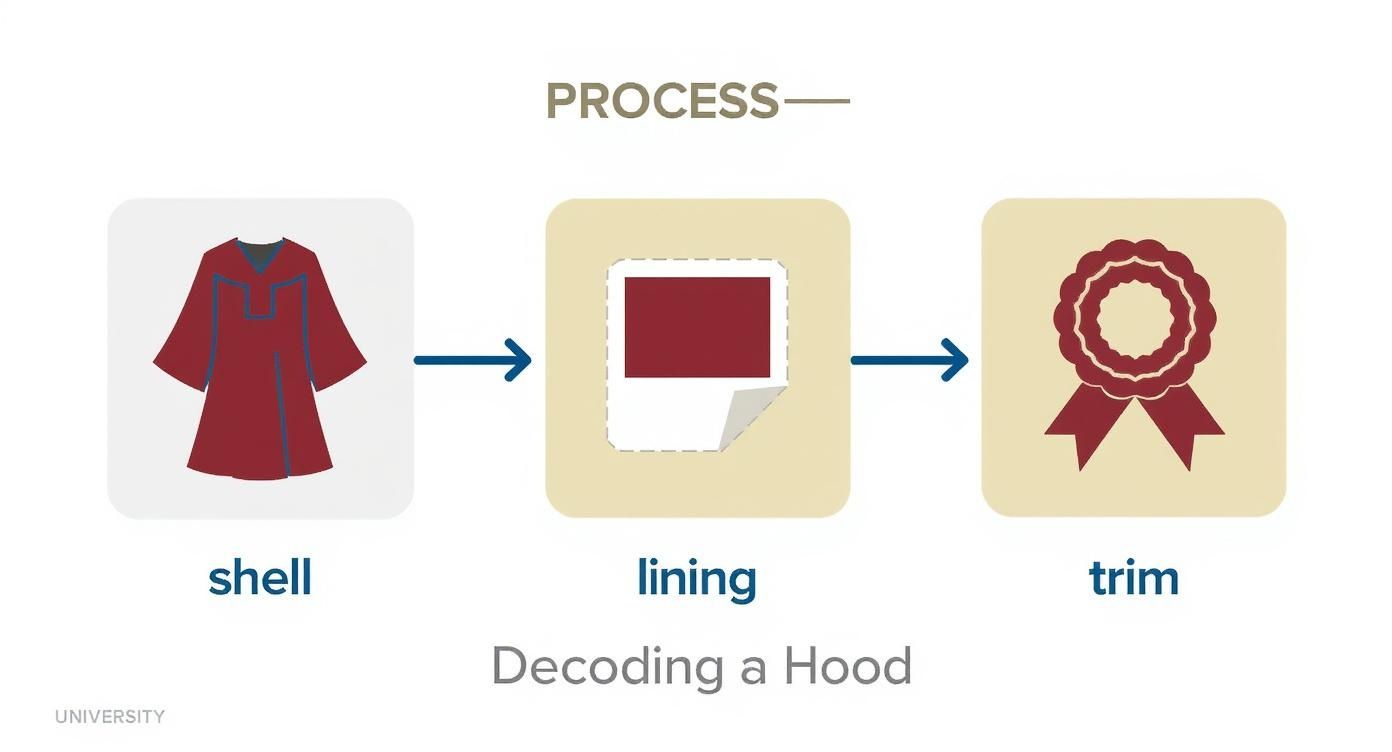
As you can see, turning out the lining is what truly completes the look and tells your full academic story.
The Final Tweak
Once you think you've got it, grab a friend, family member, or one of the faculty marshals for a quick once-over. A second pair of eyes can spot if something is off-center or bunched up.
Here's your final checklist:
- Is the velvet trim fully visible from the front, framing your shoulders?
- Is the hood secured at your neck and not sliding back?
- Are the school colors on the satin lining turned out neatly?
- Is the point of the hood hanging straight down the middle of your back?
Taking a few seconds for that final adjustment can make a world of difference for your photos and your confidence. You’ve worked hard for this moment—making sure your regalia looks just right is the finishing touch.
Putting It All Together: Your Hood and Other Regalia
Your academic hood is the star of the show, but it’s rarely a solo act. To really nail that distinguished, polished look on graduation day, you need to know how to coordinate your hood with the rest of your academic attire—the gown, cap, stoles, and any honor cords you've earned. Getting this right isn't about following a super-strict rulebook; it's about making sure every symbol of your hard work is visible and worn with respect.
The whole ensemble starts with the gown. Before you even touch your hood, get your gown on, zipped up, and sitting comfortably on your shoulders. Think of it as the perfect black canvas that makes the rich colors of your hood, stoles, and cords truly pop.
Once your gown is situated, you can start adding your other honors. This is where people sometimes get tangled up, but the order is actually pretty simple.
The Right Way to Layer Everything
The easiest way to remember the sequence is to build your look from the inside out. After the gown, your stoles and honor cords come next. They should lie as flat as possible against your chest and drape over your shoulders, right where your hood will eventually sit.
Your academic hood is always the last piece you put on. It's the grand finale. Draping it over everything else ensures it frames your other awards perfectly instead of hiding them. This layering technique prevents a cluttered, messy look and keeps each element of your regalia looking sharp and distinct.
- First: Your academic gown.
- Next: Any graduation stoles or sashes.
- Then: All of your honor cords.
- Finally: Your academic hood goes on top.
Following this order guarantees that the V-neck of your hood sits cleanly over your stoles and cords, almost like a "lock" that holds them in place. Around back, the hood will then cascade neatly over your gown for an impressive, formal finish.
Juggling Cords and Stoles
Let's be honest, managing a bunch of cords and a stole or two can feel like trying to untangle Christmas lights. The secret is to get them organized before the hood goes on. If you have several honor cords, group them together so they hang neatly in parallel on both sides of your gown. If you're also wearing a stole, make sure it’s perfectly centered before you add the cords on top of it.

One of the most common frustrations is having cords slip and disappear under the hood. To avoid this, just let them hang a bit wider on your shoulders so the front of the hood doesn't swallow them up. Here's a pro tip: a small, hidden safety pin can be a lifesaver. Just discreetly pin the cords to your gown at the shoulder seam. For even more advice, check out our complete guide on how to wear graduation honor cords.
A well-arranged set of regalia tells the full story of your academic journey. By layering each piece correctly, you give every honor—from your degree itself to your GPA and extracurriculars—the spotlight it deserves.
Achieving a Clean, Balanced Look
The goal is to look distinguished, not like you're just covered in decorations. You should absolutely wear every honor you've earned with pride, but a little attention to balance goes a long way.
Take a Moment for a Symmetry Check
Before you line up for the processional, grab a friend or find a mirror for a quick final check.
- Is the hood centered on your back?
- Are the ends of your stole hanging at the same length?
- Are your honor cords fanned out evenly on both sides?
Fight the Bunch-Up
The weight of a hood can sometimes make stoles and even the gown itself bunch up around the neck. After putting your hood on, smooth everything out. Gently pull your stole down from the front so it lies flat. It's a tiny adjustment that makes a huge difference in photos.
The Finishing Touch: Cap and Tassel
Don't forget the final piece! Your cap (or tam, for doctoral graduates) completes the look. The mortarboard should sit flat and level on your head, not tilted back like a halo. Your tassel starts on the right side before you officially graduate, and you'll ceremoniously move it to the left after your degree is conferred. When you put it all together, you get a confident, professional image that truly honors your achievement.
Getting Your Hood to Sit Just Right

There’s nothing worse than an ill-fitting academic hood on graduation day. Instead of soaking in the moment, you end up fidgeting with a hood that keeps slipping, bunching up, or feeling like it’s choking you. Nailing the fit from the get-go is the secret to wearing your regalia with the confidence you've earned.
The way we wear academic hoods has a long history, with traditions dictating their placement. In the UK, for instance, the hood is often worn over the left shoulder, with the lining turned out to show. The hood's length and shape are also a big deal—they signify the degree level. A bachelor’s hood is typically around 3 feet long, a master’s hood is closer to 3.5 feet, and a doctoral hood can stretch to 4 feet. You can dive deeper into the history of these traditions with resources like the academic dress code at the University of Glasgow.
Know Your Hood Dimensions
Those differences in length and width aren't just for show; they’re a visual cue of academic achievement. While you rarely see a Bachelor’s hood in the U.S., the distinction between Master’s and Doctoral hoods is very clear.
- Master's Hoods: Expect a length of 3.5 feet with a three-inch wide velvet trim.
- Doctoral Hoods: These are longer at 4 feet and have a much more prominent five-inch velvet trim, giving them a distinguished look.
That extra length and wider trim on the doctoral hood create a fuller, more impressive drape down the back, symbolizing the pinnacle of academic pursuit. When you're selecting your regalia, making sure you get the right size for your degree is the first and most important step. You’ll find a great selection of high-quality Master's and Doctoral regalia designed to meet these exact specifications.
The Pre-Ceremony Fit Check
Whether you’re renting or buying, don't wait until graduation morning to try on your hood for the first time. That's a recipe for last-minute stress.
A few days before the ceremony, do a quick dress rehearsal. Put on the actual clothes you'll wear under your gown, then layer the gown and hood on top. This is your chance to catch any issues while you still have time to fix them.
1. Check the Front Cord and Neckline
That little cord at the V-neck of your hood is your anchor. It needs to be long enough to loop around a shirt button without tugging or feeling too tight. If it's too short, the hood will ride up your neck. Too long, and it will constantly slip off.
2. See How it Sits on Your Shoulders
The hood should rest comfortably and evenly across both shoulders. The velvet trim should frame your neck and shoulders without bunching up on one side. If it keeps sliding off one shoulder, it might be off-balance, or you may just need to secure it a bit better.
3. Look at the Drape Down Your Back
The main part of the hood should hang smoothly right down the center of your back. Once you’ve turned out the satin lining to show off your university’s colors, the fabric should cascade naturally without any weird folds. The pointed "shell" at the bottom should align with your spine.
A well-fitting hood feels secure but almost weightless. If you're constantly aware of it, something's not right. The goal is to put it on, secure it, and forget it's even there so you can focus on your big day.
Quick Fixes for a Perfect Drape
Even with the right size, you might need a small tweak to get the look just right. A couple of safety pins in your pocket can be a real lifesaver.
If the front cord isn't cooperating, a safety pin hidden on the inside of your gown's shoulder can work wonders. This simple trick will keep the hood perfectly centered and stop it from slipping. For an even more polished look, consider adding accessories like custom graduation stoles, which can also help anchor your hood perfectly in place.
Troubleshooting Common Hood Mishaps

Even with the best preparation, things can go a little sideways on graduation day. It's a chaotic, exciting time, and wardrobe malfunctions happen. But don't panic—nearly every common hood mishap has a quick fix that will have you looking sharp again in seconds.
The most common complaint I hear is a hood that keeps slipping off one shoulder. It’s usually caused by the slick fabric of the gown, coupled with all the standing, sitting, and shifting you do before and during the ceremony. The result is a lopsided look that’s a constant annoyance.
Another frequent issue is when the colorful satin lining decides to hide, folding back in on itself. This is frustrating because the whole point of the lining is to proudly display your university's colors and your field of study.
Quick Fixes for a Slipping Hood
If your hood is determined to go rogue, your new best friends are a couple of small safety pins. Trust me, this is a simple trick that faculty and ceremony marshals have been using for decades.
- Pin it at the shoulders: Just open your gown and use a small pin on each side to secure the front of the hood to the gown's fabric, right at the top of your shoulders. This anchors it and stops it from sliding around.
- Secure the back: For some extra insurance, have a friend add one more pin at the back, just below your gown’s collar. This keeps the hood from creeping up your neck.
These little adjustments are completely invisible and will keep your hood perfectly centered through the processional, the ceremony, and all the photos that follow.
Keeping Your School Colors Visible
When the satin lining tucks itself away, it’s usually because the fabric just hasn't been set in place properly. The trick is to give it a more defined fold that encourages it to stay put.
Take the hood off for a moment and lay it down. Carefully fold the lining out so it drapes over the velvet trim, then press down firmly along the edge to give it a good, crisp crease. Often, just doing this once is enough to remind the fabric how it's supposed to hang.
A Pro Tip for the Perfect Drape: Before the ceremony starts, ask a friend for help. Once the hood is on and secured, have them stand behind you and give the base of the hood a gentle tug downward. Gravity will do the rest, settling the fabric so the colorful lining stays perfectly displayed.
The Last-Minute Adjustment
Sometimes, you’ll be in line and realize things have gone askew despite your best efforts. The easiest solution? Turn to the person behind you. A simple, "Hey, can you make sure my hood is centered?" works wonders. Everyone is in the same boat and happy to help.
The tradition of wearing an academic hood is a powerful symbol of achievement recognized worldwide. In the United States, hoods are a core part of academic regalia at over 90% of universities, with their design dictated by the Intercollegiate Code. The tradition is just as strong in the UK, where around 85% of institutions require hoods for graduates. You can learn more about the fascinating history and global variations in academic dress around the world.
Ultimately, these little issues are completely normal. Tucking a few safety pins into a pocket and knowing these quick fixes will turn any potential wardrobe drama into a non-event, letting you focus on the incredible milestone you're there to celebrate.
Your Academic Hood Questions, Answered
It's almost graduation day, and it's totally normal to have a few last-minute questions about your regalia. You've figured out the basic draping, but specific situations can still make you second-guess if you're getting it right. Let's clear up some of the most common questions so you can walk into your ceremony with complete confidence.
Think of academic dress as its own unique language. Once you get the hang of the tradition and the logic behind it, everything just clicks. Here are the things graduates are usually asking right before they line up for the big march.
Do I Have to Wear My Hood for the Whole Ceremony?
For the most part, yes. Plan on wearing your full academic regalia—hood included—for the entire commencement. That means from the processional march, through all the speeches, and right to the final recessional. Your hood is a central part of your academic attire; it’s meant to be seen.
But there's one major exception: doctoral candidates. Many universities have a special hooding ceremony built right into the main event. It's a really meaningful tradition where a faculty advisor or dean officially places the doctoral hood over your shoulders on stage.
If your school does this, you’ll carry your hood neatly draped over your arm during the procession and wait to be hooded. The best advice? Always double-check your university’s specific commencement instructions so you know exactly what the plan is.
What’s the Real Difference Between a Master’s and a Doctoral Hood?
At a quick glance, they might look alike, but the distinctions between a Master's and a Doctoral hood are very intentional and rooted in academic tradition. The differences are designed to create a clear visual hierarchy of achievement, and it all boils down to size, shape, and the velvet trim.
The most obvious difference is the length. A Master's hood is 3.5 feet long, while a Doctoral hood extends to a full 4 feet long. That extra half-foot gives the doctoral hood a noticeably more substantial presence.
The velvet trim, which shows your specific field of study, is also much wider on a doctoral hood.
- Master's Hood: Has a three-inch wide velvet trim.
- Doctoral Hood: Features a much broader five-inch velvet trim.
When you combine that wider band of color with the longer, fuller cut, the doctoral hood stands out immediately. It's an unmistakable symbol of the highest academic honor, and you can see these precise details in finely crafted doctoral and faculty regalia.
Can I Wear Multiple Honor Cords or Stoles with My Hood?
Of course! Wearing multiple honor cords and stoles is not only allowed, it's encouraged. Each one represents a piece of your academic journey—your GPA, a specific honor society, or a special program—and you should be proud to display them all.
The trick is layering them correctly. Your academic hood should always be the final, outermost piece that drapes down your back. Get your stoles and cords situated on your shoulders first, making sure they lie as flat and neatly as possible. Then, simply drape the hood right over them.
By layering this way, you make sure every single honor is visible without looking messy. The hood acts as a perfect frame for your stoles and cords, allowing each symbol of your hard work to shine as you walk across the stage.
This simple technique keeps everything from getting tangled or hidden and creates a polished, distinguished look that truly celebrates all you've accomplished.
To pull your entire look together for the big day, check out the full range of academic regalia at Gradshop. Whether you’re looking for high-quality caps and gowns, custom graduation stoles, or a perfectly made academic hood, we have everything you need to celebrate your achievement in style.