

The colors of honor cords you see at graduation aren't just for show—each one tells a story about a student's specific academic achievements, their field of study, or membership in a prestigious honor society. While some meanings are practically universal, like gold signifying high academic honors, many others can be unique to a specific school. This makes each cord a distinct symbol of a graduate's personal journey and accomplishments. Understanding the specific honors cord color meanings can help you appreciate the diverse achievements on display.
A Quick Reference to Graduation Cord Colors
Graduation ceremonies are filled with time-honored traditions, and the regalia graduates wear is packed with symbolism. Among the most noticeable accessories are the honor cords—the braided ropes draped over the graduate's shoulders. They're much more than decoration; they serve as a public acknowledgment of a student's hard work, dedication, and specific successes during their time in school.
It's important to remember that the meaning behind a color can change quite a bit between high school and university commencements. A royal blue cord, for example, might be for a leadership role in high school but represent an entirely different academic department at the college level. This guide is here to help you make sense of the common honor cord color meanings you're likely to see on the big day.
To give you a quick overview, here's a table outlining some of the most widely recognized honor cord colors and what they typically represent.
Common Honor Cord Colors and Their Meanings
| Cord Color | Common Meaning or Field of Study | Awarded For |
|---|---|---|
| Gold | General academic excellence, highest honors | Graduating Summa Cum Laude, Magna Cum Laude, or Cum Laude. |
| Silver | Distinguished academic achievement, science | Often represents excellence in a specific field or second-tier honors. |
| White | Humanities, Arts, English, History | Often signifies a major in the liberal arts or a pure field of study. |
| Royal Blue | Leadership, community service, political science | Membership in leadership societies or for service-based achievements. |
| Red | Journalism, public service, theology | Can also represent courage, passion, or specific honor societies. |
| Green | Medicine, environmental studies, agriculture | Associated with fields related to life sciences and the natural world. |
| Light Blue | Education | Represents the field of teaching and academic instruction. |
| Purple | Law, justice, royalty | Common for legal studies or societies associated with high scholarship. |
This table covers the basics, but the real story often lies in how the cords are combined and worn.
The Role of Single, Double, and Braided Cords
Just as important as the colors themselves is how the cords are structured. The format—whether single, double, or braided—adds another layer of meaning to a graduate's accomplishments.
- Single Cords: A single, solid-colored cord usually points to one specific honor. This could be for graduating with distinction in a particular subject or for membership in a national honor society.
- Double Cords: When you see two separate cords worn together, it typically means the student has earned multiple honors. For instance, a graduate might wear one cord for academic merit and a second one for their commitment to community service.
- Braided Cords: These cords weave two or more colors into one rope. They often signify a combination of achievements, interdisciplinary studies, or the official colors of a particular academic society.
Whether you're preparing for a high school or university graduation, getting the regalia right is a key part of the experience. You can find a complete collection of high-quality single and braided honor cords at Gradshop to perfectly match your achievements. To see how cords fit in with other regalia, check out our guide on stole and cord colors.
The Meaning of Gold Cords in Academic Achievement
When you see a graduate wearing a gold cord, you know you're looking at someone who has achieved something special. Of all the colors worn at commencement, gold is the one most universally tied to supreme academic performance. Its brilliant, metallic luster just screams excellence. This isn't a new trend, either; for centuries, gold has represented wisdom, success, and the best of the best, making it the perfect choice for academic tradition.
Most often, you'll see these prestigious cords draped around the necks of students graduating with Latin honors. These distinctions are all about the final Grade Point Average (GPA) and signify the absolute highest levels of scholarly success.
Tiers of Academic Excellence
While specific GPA cutoffs can differ from one school to another, the honors a gold cord represents generally fall into three well-known tiers:
- Summa Cum Laude: This is the pinnacle. It translates to "with the highest praise" and is reserved for graduates with the very top GPAs in their class.
- Magna Cum Laude: Meaning "with great praise," this honor is for students who have earned an incredibly high GPA, just shy of the top spot.
- Cum Laude: Translating to "with praise," this distinction recognizes students who have consistently maintained a high GPA all through their studies.
Wearing a gold cord is more than just adding a piece of regalia. It’s a powerful, visible symbol of years of hard work, late nights in the library, and a true commitment to learning. It tells everyone at the ceremony that this graduate has reached a level of academic skill that deserves special recognition.
Association with Prestigious Honor Societies
Gold cords aren't just for individual GPA achievements. They are also the signature color for many of the nation's most respected honor societies. Big names like the National Honor Society (NHS) and the Beta Club use gold to signify membership, celebrating students who shine not only in their studies but also in leadership, service, and character. For a high school student, a gold cord is a badge of honor that sets them apart and really makes a college application stand out.
Gold honor cords are, without a doubt, one of the most distinguished symbols at any graduation, signifying top-tier academic work from high school to university. In the U.S., where high school graduation rates hit 86% in 2022, only a select group—typically just 10-15% of students with a GPA over 3.5—earns the right to wear one. It’s a rare and sought-after honor. You can dive deeper into the world of graduation cord symbolism on Graduation Source.
To really make that achievement shine, you need a high-quality cord. At Gradshop, our brilliant gold honor cords are designed to pop against any color gown. They're a perfect match for our collections of high school caps and gowns, creating a truly polished look. For an even more personalized touch, you can layer the cord over one of our custom stoles to display all of your accomplishments with pride.
Decoding Cord Colors for Academic Fields of Study
Beyond general academic achievement, one of the most interesting traditions at the university level is tying honor cord colors to a specific field of study. This practice creates a vibrant visual tapestry during commencement, helping everyone identify graduates by their discipline. This isn't just a random assortment of colors; the system is largely standardized by the American Council on Education (ACE), which maintains a consistent framework for schools across the country.
This standardization means that the colors you see on a graduate's regalia—from their cords to the velvet trim on their academic hoods—carry a shared meaning. For instance, Light Blue is the universal shorthand for Education, while a bright Golden Yellow almost always signifies the Sciences. The system is especially prominent at postgraduate ceremonies, where it's a key way to distinguish between Master's and Doctoral candidates from dozens of different departments.
Common Colors for University Degrees
As you watch graduates file into their seats, you'll see a whole spectrum of colors. Each one tells a part of that graduate's story, representing the path they chose and the expertise they cultivated. For anyone earning an advanced degree, these colors are a core part of their academic identity, showing up on both their cords and the hoods that complete their regalia. This system provides clear honors cord color meanings for different fields.
- White for Arts and Humanities: This classic color is for majors like English, History, and Fine Arts. It's meant to symbolize the purity and broad intellectual foundation of the liberal arts.
- Golden Yellow for Science: You'll see this bright, optimistic color on graduates in Biology, Chemistry, Physics, and other hard sciences, signifying their rigorous work in scientific inquiry.
- Drab for Business: This unique, earthy tone represents Commerce, Accounting, and Business Administration. It signifies the practical, foundational nature of the business world.
- Light Blue for Education: This familiar, softer hue is the mark of a future teacher, school administrator, or education specialist, symbolizing a deep commitment to learning and instruction.
This visual guide provides a quick look at some of the key requirements often associated with earning prestigious honors, particularly those represented by gold cords.
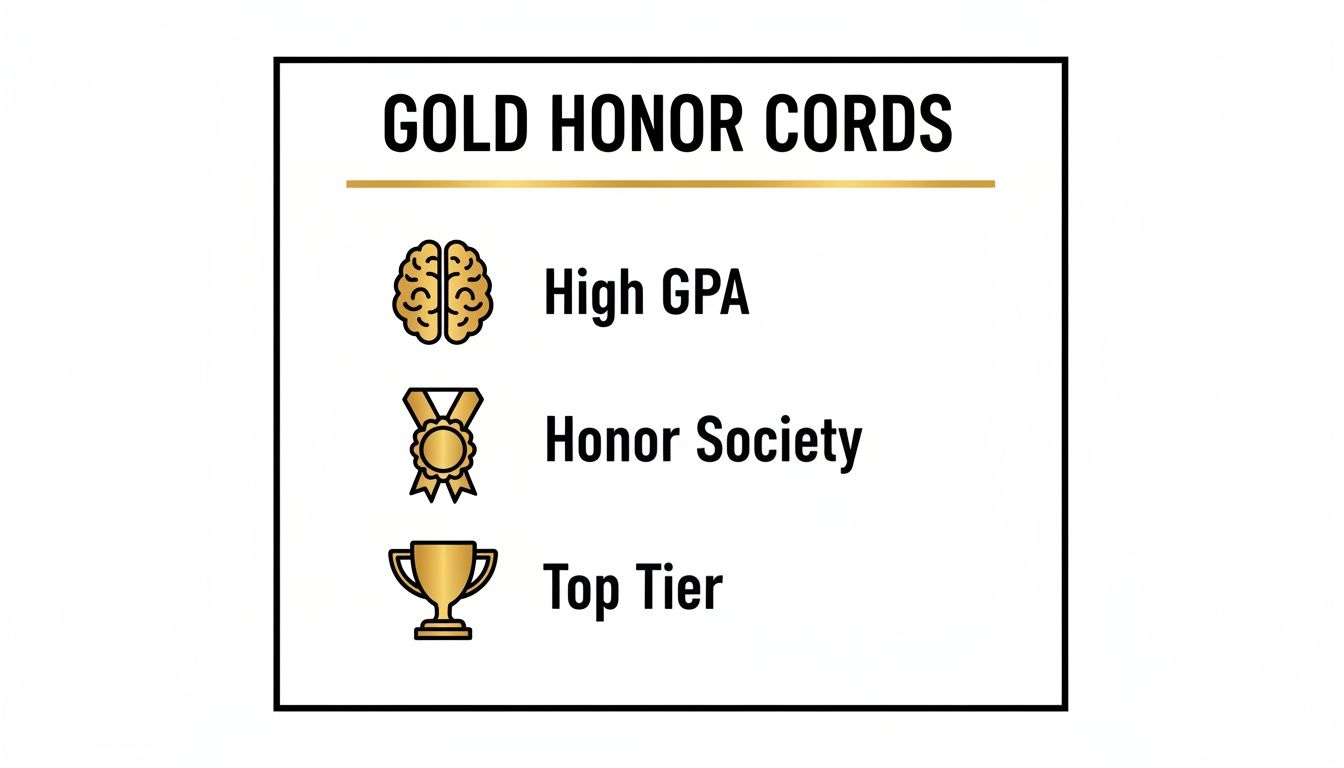
As the infographic shows, top-tier academic honors symbolized by a gold cord aren't handed out lightly. They're typically earned through a combination of a high GPA, active membership in an honor society, and an overall record of excellence.
The tradition of assigning colors to academic disciplines goes way back, with roots in the medieval universities of Europe. The system we see today was formalized in the United States in the late 19th century to create a uniform code that adds a layer of history and meaning to every ceremony.
The table below provides a more detailed breakdown of the official colors for various academic fields, based on the widely accepted ACE guidelines. This is the code that most universities use to assign colors for both honor cords and the velvet trim on academic hoods.
Academic Degree Color Meanings (ACE Guidelines)
| Academic Field | Associated Color | Relevant Degree Examples |
|---|---|---|
| Agriculture | Maize | Agronomy, Animal Science, Forestry |
| Arts, Letters, Humanities | White | English, History, Philosophy, Fine Arts |
| Commerce, Accountancy, Business | Drab | Business Administration, Marketing, Finance |
| Dentistry | Lilac | Doctor of Dental Surgery (DDS) |
| Economics | Copper | Economics, Political Economy |
| Education | Light Blue | Elementary Education, Educational Leadership |
| Engineering | Orange | Civil Engineering, Mechanical Engineering |
| Fine Arts | Brown | Architecture, Painting, Sculpture |
| Journalism | Crimson | Journalism, Communications, Media Studies |
| Law | Purple | Juris Doctor (JD), Master of Laws (LLM) |
| Library Science | Lemon | Library and Information Science |
| Medicine | Green | Doctor of Medicine (MD), Medical Science |
| Music | Pink | Music Performance, Music Education |
| Nursing | Apricot | Bachelor of Science in Nursing (BSN) |
| Pharmacy | Olive Green | Doctor of Pharmacy (PharmD) |
| Philosophy | Dark Blue | Doctor of Philosophy (PhD) |
| Physical Education | Sage Green | Kinesiology, Sports Management |
| Public Administration | Peacock Blue | Public Policy, Urban Planning |
| Science | Golden Yellow | Biology, Chemistry, Physics, Mathematics |
| Social Work | Citron | Master of Social Work (MSW) |
| Theology | Scarlet | Divinity, Religious Studies, Ministry |
| Veterinary Science | Gray | Doctor of Veterinary Medicine (DVM) |
This list covers most of the disciplines you'll encounter, but it's always a good idea to confirm your specific school's or department's traditions, as minor variations can sometimes occur.
To make sure your regalia perfectly reflects these academic standards, it’s critical to get it from a supplier who knows the ropes. Gradshop offers a complete range of academic attire that follows these established guidelines. Whether you're ordering for a whole department or just for yourself, you'll find the correct attire. Take a look at our collections for Master's regalia and Doctoral regalia to see how these important colors are built right into the hoods and gowns, ensuring you look the part on your big day.
Colors Representing National Honor Societies
While many honor cords signify a specific field of study, there's another powerful tradition at play during graduation: cords that represent membership in a national honor society. These groups, along with leadership organizations, fraternities, and sororities, often have rich histories, and their colors are chosen to reflect core values like scholarship, service, and leadership.
For a graduate, wearing one of these cords is a proud, public acknowledgment of belonging to a distinguished community. It's more than just a piece of regalia—it’s a visible symbol of commitment and achievement that goes beyond standard coursework, connecting them to a nationwide network of peers.
Prominent Societies and Their Cord Colors
Each organization has its own unique single, double, or braided cord that sets its members apart during the commencement ceremony. The meanings behind these honor cord colors are decided by the society's national council, ensuring they are consistent from one chapter to the next.
Here are a few of the most well-known honor societies and the specific cord colors that represent them:
- National Honor Society (NHS): Easily one of the most recognized high school societies, NHS members wear distinctive Royal Blue and Gold braided cords. These colors are chosen to symbolize the group's pillars of scholarship and excellence.
- Mortar Board: This is a prestigious national honor society for college seniors, recognizing outstanding scholarship, leadership, and service. Its members wear a braided cord of Maroon and Silver.
- Phi Beta Kappa: As the country's oldest and most respected academic honor society, Phi Beta Kappa members often wear a Pink and Sky Blue cord to signify their exceptional achievements in the liberal arts and sciences.
- Alpha Kappa Mu: This society, which honors high-achieving juniors and seniors, identifies its members with Royal Blue and White cords.
Wearing an honor society's cord connects a graduate’s individual success to a much larger, shared tradition of excellence. It signals that they’ve met demanding national standards and are now part of a community that champions intellectual curiosity and character.
Finding the Right Colors for Your Organization
Because every society has a specific, non-negotiable color combination, getting that exact match is crucial. A generic cord just doesn't carry the same meaning when you're representing an organization's official regalia. For a more comprehensive breakdown of different societies and their traditions, feel free to check out our detailed guide on colors of honor for honor societies.
Your honor cord is a key part of your graduation story, whether you belong to a national leadership fraternity or a subject-specific society. Gradshop offers a huge selection of single and braided honor cords in dozens of combinations, so you can find the perfect match your organization requires. Our cords are made to look sharp against any high school or university gown, letting you wear your affiliation with pride.
Understanding Braided and Multi-Color Honor Cords
While a single-color cord tells a straightforward story, a braided or multi-color one often points to a graduate with a more layered academic experience. These cords literally weave together different parts of a student's journey, representing everything from multiple honors and interdisciplinary studies to unique affiliations.
Think of a braided cord as more than just a style choice—its color combination is deliberate. Each strand adds to the story, giving you a richer picture of the graduate's specific path. The individual honors cord color meanings blend together to create a complete narrative.
Decoding Common Color Combinations
So, what do these multi-color cords actually mean? You'll see them used for all sorts of achievements. For instance, a graduate might wear a double cord for dual majors or a braided one to show they belong to an organization with several official colors.
Here are a few common examples you'll see at commencement:
- Dual Honors: A student who belongs to an honor society and graduates with a high GPA might wear a cord combining the society's color with gold. A great example is the classic Royal Blue & Gold Honor Cord, which signals both leadership and academic excellence.
- Interdisciplinary Studies: Graduates from programs that cross over different academic departments often wear braided cords that pull in the colors associated with each field of study.
- School Spirit: Many schools use braided cords in their own official colors to recognize students who have shown incredible school spirit or have served in student government.
- Special Recognition: The Red, White & Blue Honor Cord is a particularly meaningful one. It’s often worn by student veterans or graduates heading into military service, symbolizing their patriotism and commitment to the country.
The real beauty of a braided cord is how it communicates multiple achievements at a single glance. It's a powerful symbol showing that a graduate has excelled in more than one area, highlighting their versatility and dedication.
Finding Your Perfect Braided Cord
Because these color combinations are so specific, getting the exact braided cord is crucial. A graduate representing the National Honor Society needs that precise blue and gold, while someone in a unique dual-degree program will have their own distinct combination.
At Gradshop, we keep a huge inventory of braided and multi-color options on hand to meet these diverse needs. Whether you're after a traditional Red & White Honor Cord or a more complex mix, you'll find the right match to represent your hard work. Our quality cords ensure you can wear your achievements with pride, perfectly completing your high school or university regalia.
Wearing Your Honor Cords and Regalia the Right Way
Understanding what your honor cord colors mean is one thing, but wearing them correctly is what really pulls your whole look together for the big day. Getting the placement of your cords and academic hood just right gives you that polished, distinguished appearance that honors the tradition of the ceremony. Thankfully, it's pretty simple once you know how.

The secret is to make sure they hang evenly and are draped securely. It doesn't matter if you have one cord or a whole collection of them—the technique is the same and will keep them from sliding around as you make that memorable walk across the stage.
Draping Your Honor Cords
Just follow these quick steps to get your honor cords sitting perfectly on your graduation gown:
- Find the Center: Hold up the cord and find the midpoint—this is usually where the knot is, or you can just find the middle of its length.
- Drape from Behind: Place the cord’s center at the back of your neck. Let the tassels fall forward naturally over your shoulders.
- Check for Evenness: A quick look in a mirror is all you need. Make sure both sides are hanging at the same length down the front of your gown.
- Pin if Needed: If you're wearing several cords, a small safety pin hidden under the yoke of your gown or behind your neck can keep them neatly bundled and prevent them from tangling.
Using this method ensures your cords frame your gown symmetrically, showing off your accomplishments without getting in the way. For a deeper dive, check out our guide on how to wear graduation honor cords.
Correctly Wearing an Academic Hood
If you're a Master's or Doctoral candidate, the academic hood is a key part of your regalia, but it's also the piece that trips most people up. Wearing it the right way is crucial for showing off the colors that represent your university and field of study.
The hood goes over your gown, draping around your neck so it hangs down your back. Start by placing it over your head with the velvet side up, so the V-shaped part rests on your chest. The longer tail section should hang down your back.
Crucial Tip: The colorful satin lining inside the hood is meant to be seen! To show it off, you have to "turn out" the lining. Just reach behind you, find the tail of the hood, and flip the velvet edge outward. This will reveal the vibrant colors of your institution.
This last step is what really makes the hood pop. To make sure your regalia is flawless for your advanced degree ceremony, take a look at Gradshop’s official Master's Hoods and Doctoral Hoods, all designed to meet strict academic standards.
Answering Your Questions About Honor Cords
Figuring out graduation regalia can feel a little confusing, especially with all the traditions and rules around honor cords. We get a lot of questions about this, so we’ve put together some clear, straightforward answers to the most common ones. Think of this as your quick guide to wearing your achievements with confidence on the big day.
From telling the difference between a cord and a stole to figuring out if you can wear more than one, these answers should clear things up. We'll touch on the key details about honors cord color meanings and point you in the right direction.
What’s the Difference Between an Honor Cord and a Graduation Stole?
An honor cord is a simple, braided rope with tassels on each end that you drape over your shoulders. It’s usually meant to signify a very specific achievement, like a high GPA or membership in a prestigious honor society. The colors are key—they tell a story about what you’ve accomplished.
A graduation stole, on the other hand, is that much wider, sash-like piece of fabric also worn around the neck. Stoles tend to represent a broader affiliation or achievement. You might wear one for being in a fraternity or sorority, serving in student government, or to celebrate your cultural heritage. To see the difference for yourself, Gradshop has a great selection of both honor cords and custom stoles to cover every part of your academic journey.
Can I Wear More Than One Honor Cord at Graduation?
Absolutely! It's actually very common for students to wear multiple cords. If you've earned several different honors, wearing a cord for each one is the perfect way to display the full scope of your hard work. You might have one for academic excellence, another for a leadership role, and a third for an honor society.
The one thing to remember, though, is to always check your school's rules on graduation regalia. Some institutions might limit the number of cords or other accessories you can wear. As long as your school gives the green light, you can drape all your cords neatly around your neck. With Gradshop’s huge variety of colors, you’ll find a high-quality cord for every single one of your hard-earned honors.
If there’s one key takeaway, it’s this: confirm your school's regalia policy first. It’s a simple step that guarantees your commencement outfit is both a celebration of your success and fully compliant with the ceremony's guidelines.
How Do I Know Which Honor Cord Color to Buy?
This is a critical question. The most reliable way to know the correct honors cord color meanings for your situation is to go straight to the source. Check with your school's registrar, your academic department head, or the faculty advisor for your honor society. They will have the official guidelines.
As a general rule, gold is the universal standard for high academic honors like Cum Laude. For specific university degrees, the colors are often standardized based on your field of study, as laid out in the ACE guidelines we mentioned earlier. Once you've confirmed the right color, you can browse the complete honor cords collection at Gradshop to find your perfect match.
Do Honor Cord Meanings Change Between High School and College?
Yes, they often do, and it’s an important distinction. While some colors have a fairly consistent meaning—like gold for high honors—many others mean different things depending on the academic level.
- In High School: Cords often represent things like maintaining a certain GPA, being a member of the National Honor Society, completing community service hours, or excelling in a particular subject like art or science.
- In College: The color system becomes much more standardized and is usually tied to your academic discipline. For example, you’ll see light blue for Education, green for Medicine, and orange for Engineering. These colors directly correspond to the velvet trim you see on the academic hoods worn by Master's and Doctoral graduates.
Because the systems are so different, it’s always best to verify the specific color meanings with your own school to make sure you get it right.
Here at Gradshop, we’re dedicated to helping you celebrate your graduation with high-quality regalia that truly represents everything you’ve achieved. From high school caps and gowns to doctoral hoods and every honor cord in between, we have what you need for a memorable commencement.
Explore our complete collection of graduation essentials at Gradshop today.