

There's no single required graduation stole size: most adult stoles are about 60 to 72 inches end to end and about 4 to 5.5 inches wide. Choosing by height alone misses the details that determine fit, including the gown, academic hood, decoration placement, and your school's rules.
Standard Graduation Stole Size Chart
Common graduation stole lengths and widths
Every length below means total end-to-end length, not the length of a hanging panel.
| Format or source | Total length | Width | Shape or status |
|---|---|---|---|
| Common supplier unisex | 60 in | 4.7 in | Straight listing |
| Tapered adult stole | 62 in | 4 in neck to 5 in bottom | Tapered |
| Longer front coverage | 70 in | 4.5–4.8 in | Straight listing |
| Wide custom format | 71 in | 6 in | Straight listing |
| Flag stole listing, 2024 | 72 in | 5 in | Straight listing |
| Youth or short-gown stole | Seller confirmation required | Seller confirmation required | Confirm with seller |
The representative supplier formats summarized in the unisex graduation stole specifications include 60 inches by 4.7 inches, a 62-inch tapered stole with a 4-inch neck and 5-inch bottom, and a 70-inch format approximately 4.5–4.8 inches wide. The flag-stole product listing published in 2024 specifies 72 inches long by 5 inches wide.
Treat these as finished supplier formats, not approved ceremony sizes. A catalog can tell you what the manufacturer makes, but it can't tell you what your registrar permits.
Choose the endpoint before the artwork
Start with where you want the lower panels to finish on the closed gown. Use a flexible tape draped around the back of the neck to estimate the required total length, then compare that measurement with the chart.
The conventional adult formats suit a familiar front drape. Longer formats provide more coverage for a taller wearer, a fuller body, or a bulky gown, but extra length isn't automatically better. The lower panels still need to stay clear of the graduate's hands during the diploma presentation.
Next, compare neck width and bottom width. A tapered stole can offer room for lettering lower down without carrying that same width around the collar. A straight stole keeps a more consistent panel shape, which may simplify a vertically arranged design.
- For a plain stole: Prioritize the endpoint and an even drape.
- For a personalized stole: Check whether the name, emblem, and title fit inside the actual decoration area.
- For a hooded outfit: Check the neck opening before choosing a wider lower panel.
- For a youth gown: Leave the size undecided until the seller confirms a suitable finished garment.
Copy the specifications, not the size label
Save the total length, neck width, bottom width, material, and shape with your order notes. Labels such as adult, standard, and unisex aren't substitutes for finished inches.
Identical graduation stole measurements can look different on different graduates. Shoulder shape, gown fullness, and the position of the neckline change how much fabric remains visible down the front.
For a school or organization order, approve a physical sample on the intended gown before authorizing production. Examine it from the front and side, not just laid flat on a table. A flat sample shows construction; an on-gown sample shows whether you've chosen the right row.
Why One Stole Size Does Not Exist
A stole's finished length and width matter more than its size label. No single measurement fits every wearer and design because manufacturers use different patterns, while stoles may represent a club, college, honor society, athletic group, heritage, or service organization.
Academic tradition doesn't establish a universal stole pattern
The University of South Carolina Aiken's history of academic regalia traces gowns and hoods to European universities of the 12th and 13th centuries and identifies 1895 as the adoption of the American Intercollegiate Code. That history describes shared traditions in degree-related academic dress, not one standard pattern for modern stoles.
For comparing garments, record total length, neck width, and bottom width. These finished measurements describe the stole more clearly than a suggested wearer height. The difference between a stole and an academic hood is covered in the section on wearing the two together.
Length and width solve different problems
Length sets the front endpoint. Width determines how much space each panel occupies beside the collar, cords, medals, and other regalia. A narrow panel can suit a crowded neckline; a wider one gives lettering more room.
Check how the seller defines length. Some describe the entire garment from end to end; others give the hanging length of one side when the stole is folded around the neck. A product photo alone may not make that distinction clear. A garment's fit and design also need to meet the school's ceremony rules, so check the commencement policy before ordering personalized work.
How to Measure a Stole on Adults and Youth
Use a flexible measuring tape, a flat surface, and the gown the graduate will wear. Record the garment's dimensions first, then assess the wearer's fit. Height helps with gown selection, but it doesn't establish where a stole will finish.
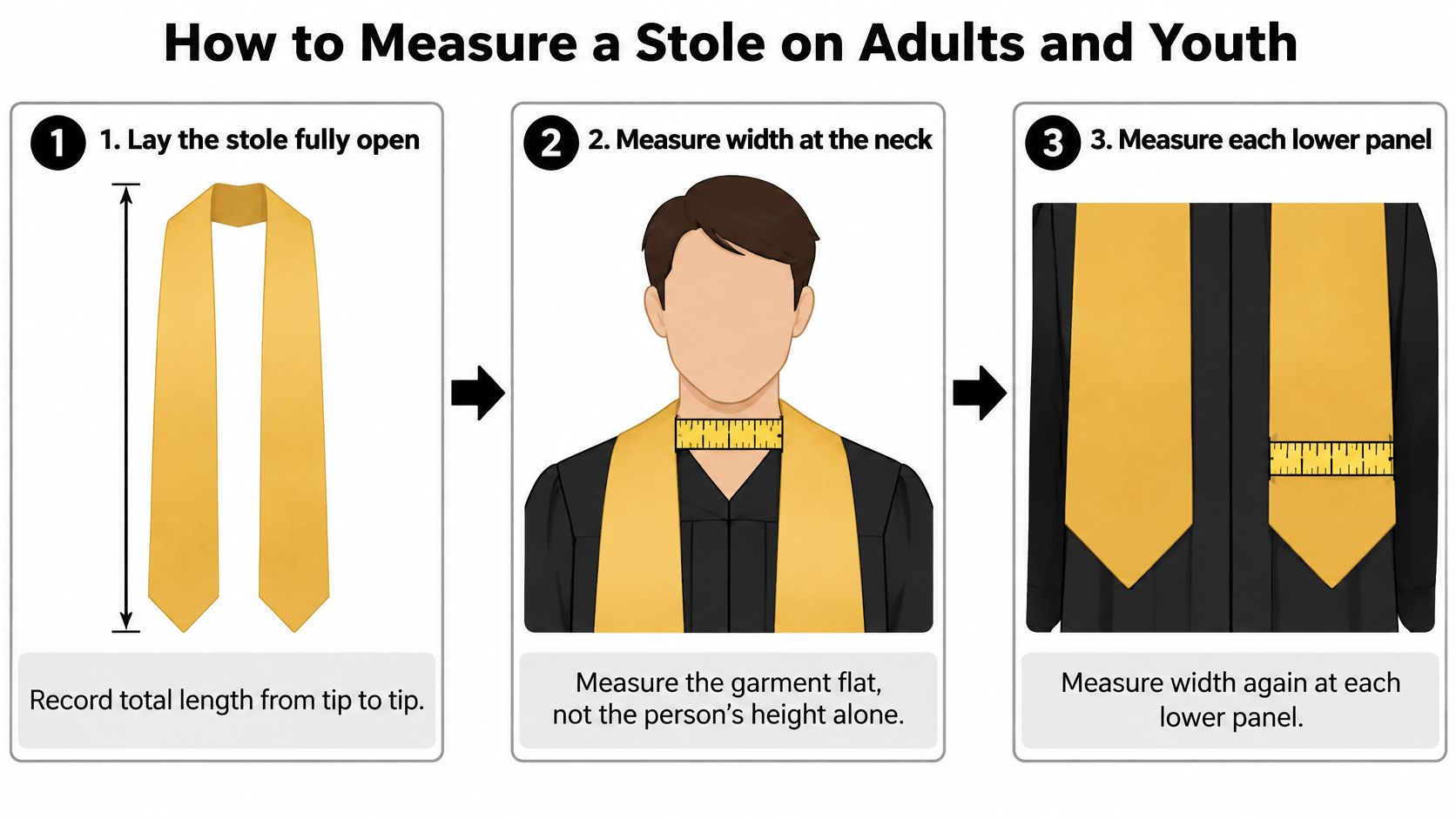
Follow the measurement routine
- Lay the stole fully open. Smooth it without stretching the fabric and measure from tip to tip along its length. Fit check: Confirm that the seller's stated length describes the same measurement, including the finished ends.
- Measure the neck and lower panels. Record the width across the section that rests behind the neck, then across each lower end. Fit check: Note taper, trim, or a shaped bottom rather than treating every stole as a rectangle.
- Drape it over the closed gown. Use the actual high-school, bachelor's, master's, or doctoral gown whenever possible. Fit check: Make sure the stole lies flat instead of catching on the collar, shoulder seams, or zipper.
- Center the panels and assess the endpoint. Position the stole at the back of the neck and let both sides settle naturally. Fit check: Rehearse receiving a diploma so the hands don't hide the decoration or catch the lower ends.
- Add the remaining regalia. Put on the academic hood, cords, and any permitted medals in the arrangement specified by the school. Fit check: Turn the head and move the shoulders to identify collar pressure or shifting.
- Compare a youth stole with the gown hem. Measure on the child's own gown rather than borrowing an adult recommendation. Fit check: Reject a length that reaches or passes the hem, interferes with movement, or overwhelms the shorter garment.
The published academic-regalia sizing guidance distinguishes full head-to-toe height from gown length and advises choosing the larger gown size when between sizes; the accompanying measurement guidance also identifies a wide custom stole format of 71 inches by 6 inches. Don't transfer the larger-size rule blindly to stoles, where surplus length can create an awkward endpoint.
Separate gown sizing from stole sizing
Use our cap and gown measuring guide to establish the underlying outfit. Then test the stole independently.
For example, the Matte White High School Gown has front center pleats and a matching white zipper. Close the zipper and let the pleats settle before judging how the stole panels hang.
If a product photo measures only a hanging side, doubling that measurement provides an estimate, not a confirmed total. The neck curve and the photograph's starting point may change the result. Obtain the finished end-to-end measurement before ordering.
For preschool, elementary, and junior-high gowns, record the hem position and leave the youth stole length unconfirmed until the seller supplies it. There's no published youth dimension in the lookup chart.
The final pass test is practical: even panels, readable decoration, free movement, and no interference with the zipper or hood.
Stole Categories by Wearer and Design
Choose a stole by what it needs to communicate, then evaluate its shape. The category tells you what belongs on the panels; it doesn't guarantee a particular length or width.
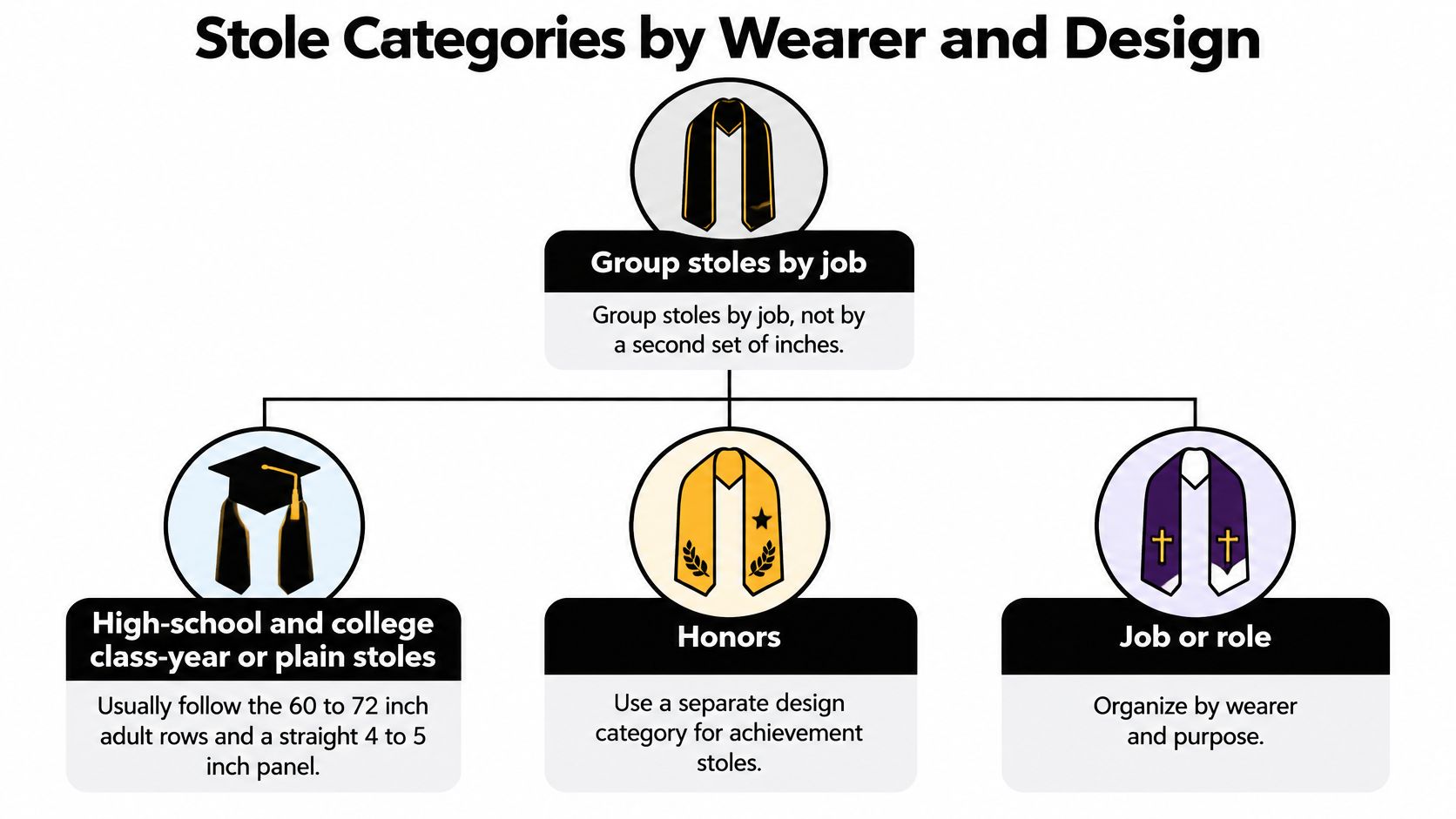
Plain, class-year, and achievement stoles
Plain and class-year stoles place the most emphasis on overall proportion. Without a large emblem or a long title, the drape and symmetry become especially noticeable. For example, a simple class-year design can look unbalanced if the lower panels finish at different heights.
Honors and role-based stoles need a readable decoration zone. Class officers, first-generation graduates, nursing students, and student athletes may want a short title alongside an emblem. The useful question is whether that title remains visible when the wearer moves, not whether the product is labeled an honors size.
A fitted high-school gown may suit a shorter conventional adult format, but that's a starting point for a fitting, not a separate rule for academic achievement. Adding an honor designation doesn't require adding fabric.
Heritage, service, and organizational designs
| Category | Dimension or construction to examine | Practical example |
|---|---|---|
| Kente, serape, and other heritage styles | Panel width and neckline bulk | Check that a patterned border doesn't crowd the usable name area |
| Country-flag stoles | Total length and flag placement | Keep the flag visible below the shoulder curve |
| Military and veteran stoles | Emblem position | Place branch identification away from the neck fold |
| Fraternity and sorority stoles | Finished bottom shape | Measure a pennant's widest section before approving a name layout |
| Trimmed stoles | Finished edge and collar thickness | Test the trimmed garment rather than an untrimmed sample |
| Kids' stoles | Relationship to the youth gown hem | Fit the child's garment without borrowing adult proportions |
Heritage designs often carry meaning through patterns as well as added text. Avoid placing a large seal where it obscures the feature the graduate wants to display.
Military and veteran designs benefit from deliberate emblem placement. A mark positioned too high can disappear as the fabric curves over the shoulder, even when it looks centered in a flat proof.
Shape changes the artwork
A V-neck or pennant stole is not just a straight stole with a different label. Its lower outline changes where text can sit and how much room remains beside the point. Measure the finished shape rather than drawing a rectangular print box over it.
Trim also changes the wearing experience. A bordered panel can feel more substantial around the neck than a plain panel of the same finished width.
Match the design to the graduate's purpose, but approve the finished shape on the gown.
Before combining organization stoles, count all the accessories the ceremony permits. Before adding names, confirm the decoration area separately from the garment outline.
School Limits on Stole Length and Width
A 5-inch width cap can exclude a wider custom design even when the length looks right: King University's commencement dress code limits stoles and sashes to that width, permits up to three academic accoutrements, and restricts medallions to 3 inches in diameter. Its rule doesn't state a stole length.
These are ceremony requirements, not national standards or legal clothing sizes. The institution, not the catalog, decides which accessories are acceptable for its event.
Compare the published requirements
Published school limits for stoles and sashes
| School | Length rule | Width rule | Other limit |
|---|---|---|---|
| Wayland Baptist University | 72 in maximum | 5.5 in maximum | Outside stole needs registrar approval at least 8 days prior |
| King University | Not stated | 5 in maximum | Up to 3 accoutrements; medallions 3 in maximum |
| Lamar State College Port Arthur, 2026 | 68–74 in required | 3–5 in required | Commencement regalia guide |
Wayland Baptist University's graduation instructions permit the specified heritage, ethnicity, native-culture, military-service, and first-generation stoles or sashes at no more than 72 inches long and 5.5 inches wide, with outside-source approval from the Registrar or Associate Registrar at least eight days before the ceremony.
For 2026, Lamar State College Port Arthur's commencement regalia guide specifies stoles 68–74 inches long and 3–5 inches wide. That required range illustrates why a generally conventional stole can still fall outside a particular school's instructions.
Count accessories before paying
A buyer planning organization stoles plus honor cords needs to check the total accessory count, not just the width of each stole. A medal may count too. Don't assume that separate approval for individual organizations means every accessory can be worn together.
Color, message, and placement restrictions deserve the same attention. A culturally meaningful design may be suitable for portraits or a separate celebration without being permitted in the official procession.
Our flag graduation stole guide offers additional context for choosing a heritage design. The commencement office remains the authority on whether it can be displayed during the ceremony.
Turn approval into an ordering checkpoint
Send the registrar a written specification with the proposed dimensions, colors, wording, and an image of the design. Ask whether the stated width includes trim and whether the approval covers the intended wearing arrangement.
- Save the response: Keep written approval with the order confirmation.
- Check the deadline: Allow time for school review before production and shipping.
- Resolve silence: Ask directly when the published policy doesn't address stoles.
- Approve the final version: A substantially changed design may need another review.
A cautious catalog choice isn't permission. Confirm the school's requirements before committing to personalized work.
Stole Size Next to Academic Hoods
Start with the hood measurements, then check how much room the stole leaves at the neckline. Valdosta State University's academic costume guidance lists hood lengths of 3 feet for bachelor's, 3.5 feet for master's, and 4 feet for doctoral degrees. The corresponding velvet edging is 2, 3, and 5 inches wide.
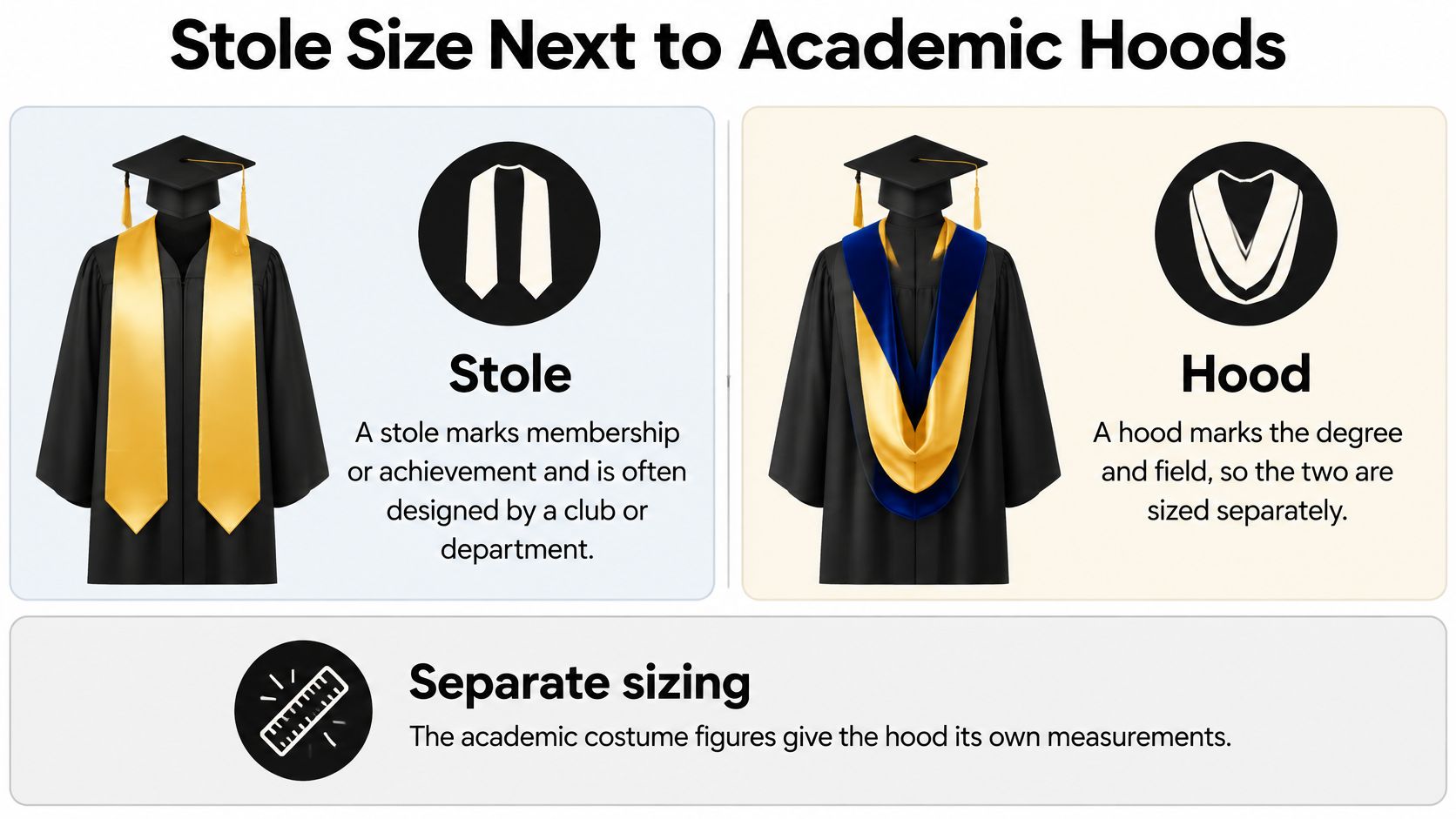
Compare the garment measurements correctly
The hood's length and velvet edging describe different parts of its construction. Use the edging measurement as a reference for the degree trim, not as the width of the entire hood. A 36-inch bachelor's hood and a 4-inch stole panel, for example, measure different features; the numbers do not indicate how much fabric will overlap at the neckline.
| Academic hood | Length | Velvet edging width | Degree level |
|---|---|---|---|
| Bachelor's | 3 ft | 2 in | Bachelor's |
| Master's | 3.5 ft | 3 in | Master's |
| Doctoral | 4 ft | 5 in | Doctoral |
Fit by degree outfit
For a high-school gown without a hood, check how the stole falls from the collar and across the front. For a master's outfit, arrange the hood as the institution directs, then see whether the stole lies flat beside it. Doctoral regalia may have more velvet at the front, so inspect whether an optional stole covers the facing or crowds the neckline.
A full-length check is more useful than judging the garments laid flat. Look at the front and back, then sit and stand to see whether either piece shifts or bunches. The difference between graduation hoods and stoles can help clarify how each garment is worn.
Fitting checkpoint: Keep required degree regalia in its intended position. Adjust the optional stole around it.
Width Embroidery Space and Comfort
Width is both a layout choice and a comfort choice. A broader panel gives the designer more room, but it also places more fabric near the collar and shoulders. A narrower panel reduces that bulk, although the artwork may need simpler wording or a different arrangement.
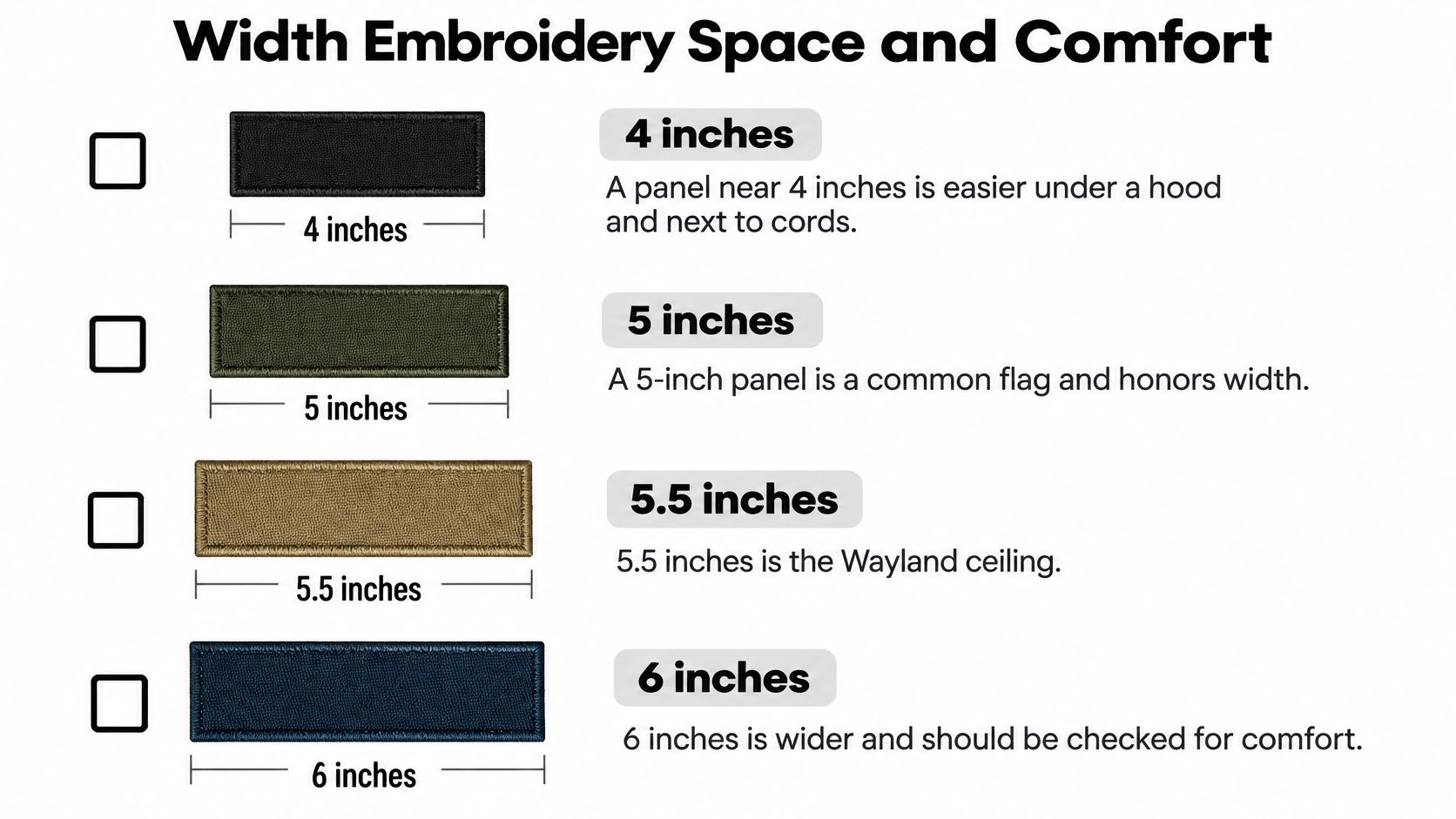
Mark the usable decoration zone
The usable decoration area is smaller than the finished garment outline. Seams, trim, the neck fold, and a pointed bottom all reduce the space where lettering can remain legible.
Place paper templates of the proposed name and emblem on the stole while it's being worn. Check them from the distance at which someone would normally view the graduate, rather than leaning over a flat design proof.
A name positioned too high can disappear behind the collar or curve around the shoulder. A title placed too low may be covered by the graduate's hands. Neither problem is fixed by making the lettering larger.
Use the following layout checks before approving embroidery:
- Neck fold clearance: Keep important words below the section that turns around the shoulder.
- Edge clearance: Leave room between the artwork and seams or decorative borders.
- Bottom clearance: Keep text above the narrowing point rather than forcing letters into it.
- Reading order: Arrange the name, organization, and achievement so each is understandable when the panels hang separately.
- Proof accuracy: Check spelling and placement on the correct left and right panels.
A second line or a seal may justify a wider lower panel, but shortening the wording is often a better solution than enlarging the whole garment.
Check comfort and accessibility
Our blank graduation stole guide connects the choice of a base stole with decoration and fit. A marketplace length label alone doesn't establish how the manufacturer measured the garment or how it will sit on a particular wearer.
Before ordering, confirm the school's color, message, and accessory-count rules. Measure over the closed gown, add the required hood, and identify the actual print area while the stole is draped.
Then test the accessories as a complete outfit. Cords shouldn't slide beneath an emblem, a medal shouldn't pull the stole sideways, and fabric shouldn't block access to the zipper.
For a graduate using a walker or another mobility aid, rehearse the actual reach and arm movement involved. Check for catching fabric and pressure near the shoulder without assuming that a visually tidy arrangement is comfortable.
Give bulk buyers a repeatable specification
Publish finished dimensions and an endpoint photograph, rather than promising universal fit. Include the stole's shape and show the sample on the gown intended for the ceremony.
For a group design, approve the artwork and garment together. A digital proof can verify the wording, but only a physical fitting can confirm whether the decoration remains readable and the neckline stays comfortable.
Confirm the Size and Order the Match
Choose the stole that passes the complete outfit test, not the one with the most reassuring size label. A useful order specification connects the finished garment, school permission, and the graduate's movement in a single decision.
Start by separating required regalia from optional recognition. The degree determines the appropriate academic hood. Honors, heritage, service, and organizational affiliation determine whether a stole belongs in the outfit and what it should display.
Decide what must change
If the endpoint is wrong, reconsider length. If the collar feels crowded, reconsider neck width or construction. If the wording won't fit, simplify the design before assuming that every part of the stole needs to become larger.
A tapered style can address a different problem from a longer style. Likewise, a pennant shape may require a different artwork arrangement without requiring more overall length.
Use a practical acceptance checklist:
- School compliance: The finished dimensions and design meet the ceremony's written requirements.
- Gown compatibility: The garment sits properly on the actual closed gown.
- Accessory clearance: The hood, cords, and medals retain their intended positions.
- Movement: The graduate can sit, walk, reach, and receive a diploma without catching the fabric.
- Decoration visibility: Names and emblems remain readable when the panels hang naturally.
Don't treat the chart as an exhaustive list of all acceptable products. A school-approved custom or youth cut may use another dimension. What matters is a confirmed measurement, an appropriate fit, and permission for the intended ceremony.
Approve a sample before a group order
For a bulk school or organization purchase, use a physical sample to settle the pattern before production. Record the approved shape, material, finished dimensions, and decoration placement so the order doesn't rely on a photograph alone.
Youth orders need particular care. Compare the sample with the actual child's gown and movement, rather than assuming an adult pattern can be shortened without affecting the artwork.
For master's and doctoral outfits, complete the fitting with the required hood in place. Faculty and department buyers should also distinguish personal affiliation accessories from the degree regalia specified for their role.
Set the ordering deadline from the school's approval date, allowing room for the design review and sample decision. A shipping estimate alone doesn't account for those steps.
Keep the final size sheet
Write these lines on the order record and fill them with confirmed specifications:
- Total length: Finished tip-to-tip measurement in inches.
- Neck width: Finished width where the stole rests behind the neck.
- Bottom width: Finished width across each lower panel.
- Shape: Straight or tapered, with any pennant point or trim identified.
Approve the order only when that sheet matches the intended garment and the on-gown fitting passes. Keep the approved artwork beside it so the size and personalization can't be mistaken for separate decisions.
Gradshop offers high-school caps, gowns, and stoles, along with master's regalia and doctoral tam, gown, and hood packages. Our Custom Graduation Stoles can be designed online, cost $29.00, and have a 4.8 rating from 293 reviews. Visit Gradshop with your completed size sheet to choose regalia and a stole design that match your ceremony requirements.