

When it comes to your graduation day, getting the robe length right is the first—and most important—step to looking sharp and feeling ready to celebrate. The standard is a mid-calf length, meaning the hem should fall somewhere between your knee and your ankle.
This isn't just about looking good; it's a practical choice that ensures a formal, unified look for the graduating class while preventing any stumbles as you make that memorable walk across the stage.
Why Your Graduation Robe Length Matters

Nailing the perfect robe length is about more than following a dress code. It's about respecting a centuries-old academic tradition. When your gown fits correctly, it adds to the dignified and cohesive atmosphere of the ceremony. A robe that's too short can look a bit too casual, while one that drags on the floor is not only a tripping hazard but can also look sloppy.
This tradition of academic regalia has deep roots. Back in medieval times, long robes were practical everyday wear for scholars and students, providing much-needed warmth in drafty university halls. By the 14th century, universities like Oxford and Cambridge began requiring gowns to create a sense of uniformity, erasing visual social class distinctions based on students' clothing.
The Foundation of a Perfect Fit
Think of your graduation robe as the canvas for your entire commencement outfit. When the length is right, everything else—your honor cords, stole, and academic hood—will drape perfectly. This one detail pulls your whole look together.
- It keeps you safe and comfortable. A proper fit means you can navigate stairs and take your seat without worrying about tripping over a long hem.
- It creates a sharp silhouette. You’ll look fantastic in all your photos, from the official handshake to the candid shots with family and friends.
- It shows respect for the occasion. A well-fitting gown honors the gravity of the ceremony and the academic standards of your institution.
A well-fitted gown is a non-negotiable part of commencement. It’s the final piece of the puzzle that brings your entire academic journey to a polished and memorable conclusion.
Ultimately, the goal is a comfortable, confident, and picture-perfect experience. You can dive deeper into the meaning behind each piece of your outfit by exploring our guide on why you wear graduation regalia. Getting this foundational element right sets you up for a fantastic day.
How to Measure for the Perfect Gown
Don't worry, getting the right graduation gown length is way simpler than your final exams. You don't need to be a professional tailor or bust out a complicated set of measurements. In fact, chest and waist sizes don't matter here at all.
The one and only measurement that counts is your height. Think of the gown's size code as a direct translation of how tall you are, from head to toe. This is how schools ensure every graduate has that consistent, formal, and distinguished look.
Your Step-by-Step Measurement Guide
Ready to find your perfect fit? This process takes about a minute and removes all the guesswork.
- Shoes Off! This is the most common mistake. Your true height is what we need, and heels or even thick-soled sneakers can throw off the measurement and leave you with a gown that’s too long.
- Stand Tall: Find a flat, empty wall and stand with your back straight against it. Your feet should be together, and your posture should be natural and upright—no slouching!
- Mark the Spot: Have a friend or family member help with this part. They can place a hardcover book or a ruler flat on top of your head, making sure it’s level with the floor. Then, they’ll make a tiny, light pencil mark on the wall right at the bottom edge of the book.
- Measure Up: Now, just step away from the wall. Use any standard tape measure to record the distance from the floor all the way up to that pencil mark. That single number is your key.
For an even more comprehensive look at getting every part of your regalia just right, be sure to read our complete guide on how to measure for your cap and gown.
Matching Your Height to a Size Code
Once you have your height, the hard part is over. Graduation gown makers use standardized size codes that directly correspond to specific height ranges, which makes choosing your robe a breeze. If you want a general reference point, you can also look at general unisex size charts to see how this works for other garments.
To make it even easier, we've put together a standard chart below. Just find your height in the left column to find the exact size code you'll need to order.
Standard Graduation Gown Size Chart by Height
Use this table to find your recommended gown size. Simply find your height in the left column to determine the correct size code you'll need to order.
| Your Height (ft & in) | Recommended Gown Size Code |
|---|---|
| 4'6" – 4'8" | 39 |
| 4'9" – 4'11" | 42 |
| 5'0" – 5'2" | 45 |
| 5'3" – 5'5" | 48 |
| 5'6" – 5'8" | 51 |
| 5'9" – 5'11" | 54 |
| 6'0" – 6'2" | 57 |
| 6'3" – 6'5" | 60 |
| 6'6" – 6'8" | 63 |
Pro Tip: What if you land right between two sizes? We always recommend sizing up. A gown that's a touch too long looks far more elegant and formal than one that comes up short. Plus, your choice of footwear for the big day can help fine-tune the final length.
That one simple head-to-toe measurement is all it takes to guarantee you look polished and feel great when you walk across that stage.
Decoding Gown Styles by Academic Level
Ever looked out at a university commencement and noticed the graduates are wearing slightly different robes? That’s not an accident. Every academic level, from high school all the way up to a doctorate, has its own distinct gown that tells a visual story of achievement. The style, the cut, and even the sleeves change to signify just how far a graduate has come on their academic journey.
Think of it like a uniform. A rookie wears the standard jersey, but a team captain might get a special patch. Academic regalia works the same way, with each new degree earning its own unique design features.
High School and Bachelor’s Gowns
For most people, the first time they don a cap and gown is for their high school graduation. These robes, along with the ones worn for a bachelor's degree, share a similar, straightforward design. The whole point is to create a powerful sense of unity and shared accomplishment among the graduating class.
Here’s what defines them:
- Sleeve Style: Both feature long, pointed sleeves. This is the simplest and most common design out there, representing that foundational level of academic achievement.
- Material and Trim: They're typically made from a matte or shiny polyester fabric and are kept clean and unadorned, without the velvet trim you see on higher-level gowns.
- Overall Look: The focus is on sharp, clean lines and uniformity, which is why getting the graduation robe length just right is so crucial for a polished group photo.
You can see this timeless style for yourself in our complete collection of high school caps & gowns.
Master’s Gowns: A Step Up in Distinction
This is where you start to see a real, noticeable change. The master's gown introduces a significant new element, especially in the sleeves, that immediately sets these graduates apart.
The dead giveaway is the oblong sleeve. Unlike the simple pointed sleeve of a bachelor's gown, this is an elongated, closed sleeve with a slit for the arm to pass through. It’s a very unique cut and a clear signal that the wearer has put in the work to earn a master's degree. It's a subtle but powerful symbol of advanced scholarship.
While the gown styles differ, the process for finding the right size is always the same—it all starts with the graduate's height.
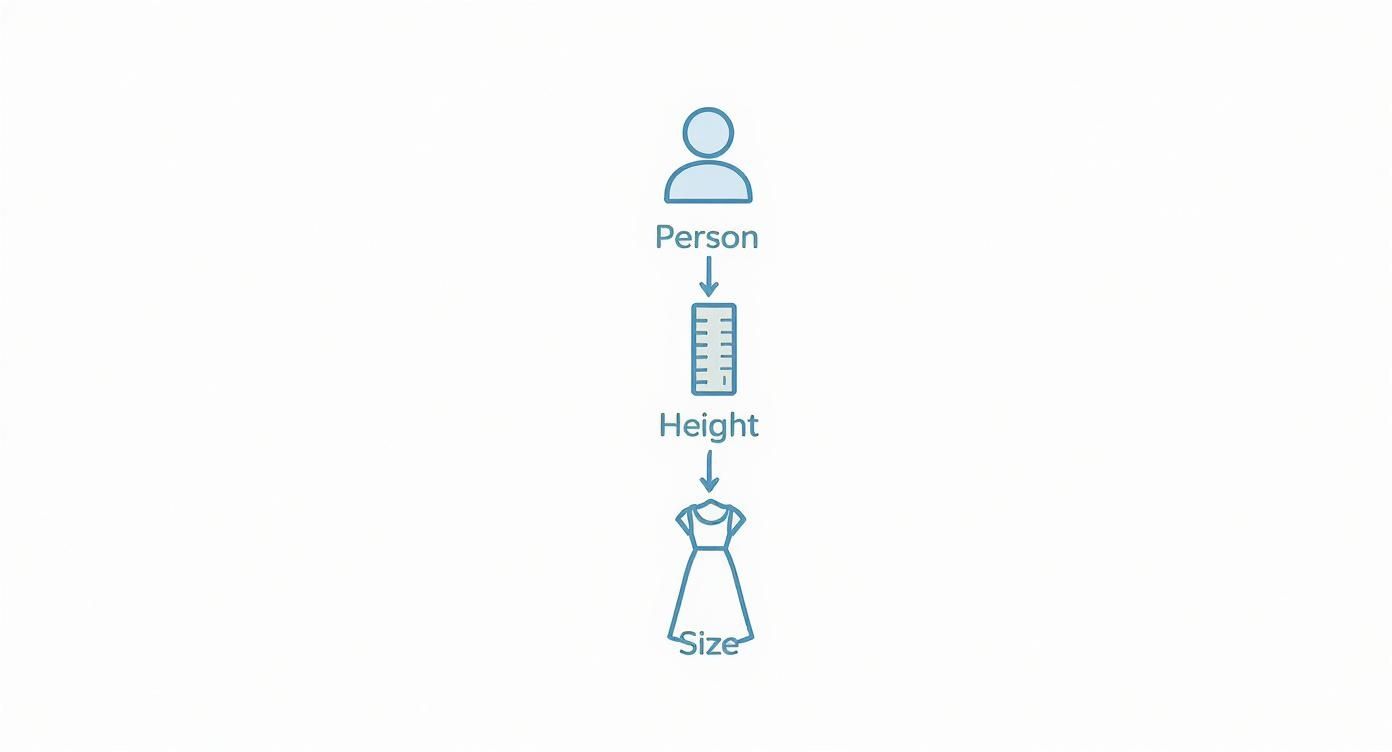
This visual hierarchy reinforces that even as the regalia gets more complex, the fundamentals of getting a great fit never change.
Doctoral Gowns: The Pinnacle of Academia
The doctoral gown is, without a doubt, the most elaborate of them all. It’s designed to reflect the highest level of academic achievement, and its features are steeped in tradition. Most of these standards date back to the 1895 Intercollegiate Code of Academic Costume, which also set the specific lengths for academic hoods—3 feet for bachelor's, 3.5 feet for master's, and 4 feet for doctoral degrees. You can read more about the long history of academic dress in the United States.
The doctoral robe is distinguished by its luxurious velvet trim and full, bell-shaped sleeves, making it instantly recognizable and prestigious.
Key features make the doctoral gown unmistakable:
- Velvet Panels: You'll see two three-inch wide velvet panels, called "facings," running down the front of the gown.
- Velvet Chevrons: Each full, bell-shaped sleeve is adorned with three velvet bars, known as chevrons.
- Color Significance: While the velvet is often black, it can also be a specific color to represent the graduate’s field of study—dark blue for a Doctor of Philosophy (Ph.D.), for example.
To give you a clearer picture, here’s a quick breakdown of how the gowns compare.
Gown Features by Degree Level
This table highlights the key design differences you'll see as a graduate progresses through their academic career.
| Feature | High School | Bachelor's | Master's | Doctoral |
|---|---|---|---|---|
| Sleeve Style | Pointed | Pointed | Oblong, with wrist slit | Full, bell-shaped |
| Sleeve Adornment | None | None | None | Three velvet bars (chevrons) |
| Front Trim | None | None | None | Two wide velvet panels (facings) |
| Material | Typically polyester | Typically polyester | Polyester or finer fabric | High-quality fabric, often with velvet |
These rich details are what make master’s and doctoral regalia so special, celebrating years of dedication, research, and contribution to a field.
Styling Your Gown with Stoles and Cords
Think of your graduation gown as the classic black dress or sharp suit of academia. It’s the essential foundation, but the accessories—the stoles, cords, and hoods—are what tell your personal story. These pieces showcase everything from your field of study to your hard-earned honors. Getting the placement right is what pulls the whole look together.
The real goal here is to look polished and intentional, not cluttered. Each accessory should lie flat and hang symmetrically, transforming your regalia from a simple uniform into a proud display of your academic journey.
Draping Academic Hoods and Stoles
Your academic hood and stole are the most significant accessories, so it’s worth taking a moment to get them just right. A hood that’s bunched up or a stole that’s gone crooked can distract from an otherwise perfect look in photos.
When you put on your academic hood, the velvet trim should face outward, framing your shoulders and draping cleanly down your back. The colorful satin lining inside—representing your university and degree—needs to be turned out so those colors are on full display. Don't worry too much about this part; a faculty member or marshal often helps with the "hooding" during the ceremony itself.
Stoles are much more straightforward. Just drape one over your neck so it hangs evenly down both sides of your gown.
- Secure Your Stole: A couple of small safety pins hidden under the fabric at the shoulders will keep your stole from slipping around while you walk.
- Keep it Flat: Before you head out, double-check that your stole is lying smoothly against your gown without any awkward twists or folds.
- Check the Length: Make sure both ends hang at the same length. A balanced look is a sharp look.
Arranging Multiple Honor Cords
It’s common for high-achieving graduates to have more than one honor cord. The trick is to make them look like an organized, cascading display of your accomplishments, not a tangled mess. There’s a bit of an art to it.
You’ll want to drape the cords around the back of your neck so they hang down the front of your gown. If you have several, group them together and use a single pin behind your neck to keep the bundle neat and centered.
Try layering them so each distinct color can be seen. Arranging them by color or thickness often creates a really nice, visually organized effect. For a deeper dive, you can learn all about the meanings and proper ways to wear stoles and cords in our in-depth guide.
At the end of the day, a perfectly fitted gown provides the ideal canvas for all these important accessories. When your robe hits at the right mid-calf length, it allows your stoles and cords to hang beautifully, completing your distinguished look for the big day.
Solving Common Gown Fit Problems
Your graduation gown has finally arrived, but when you slip it on, something feels… off. Don't panic. A less-than-perfect fit is a super common problem, and thankfully, most issues have simple, quick fixes that will get you looking sharp for the big day.
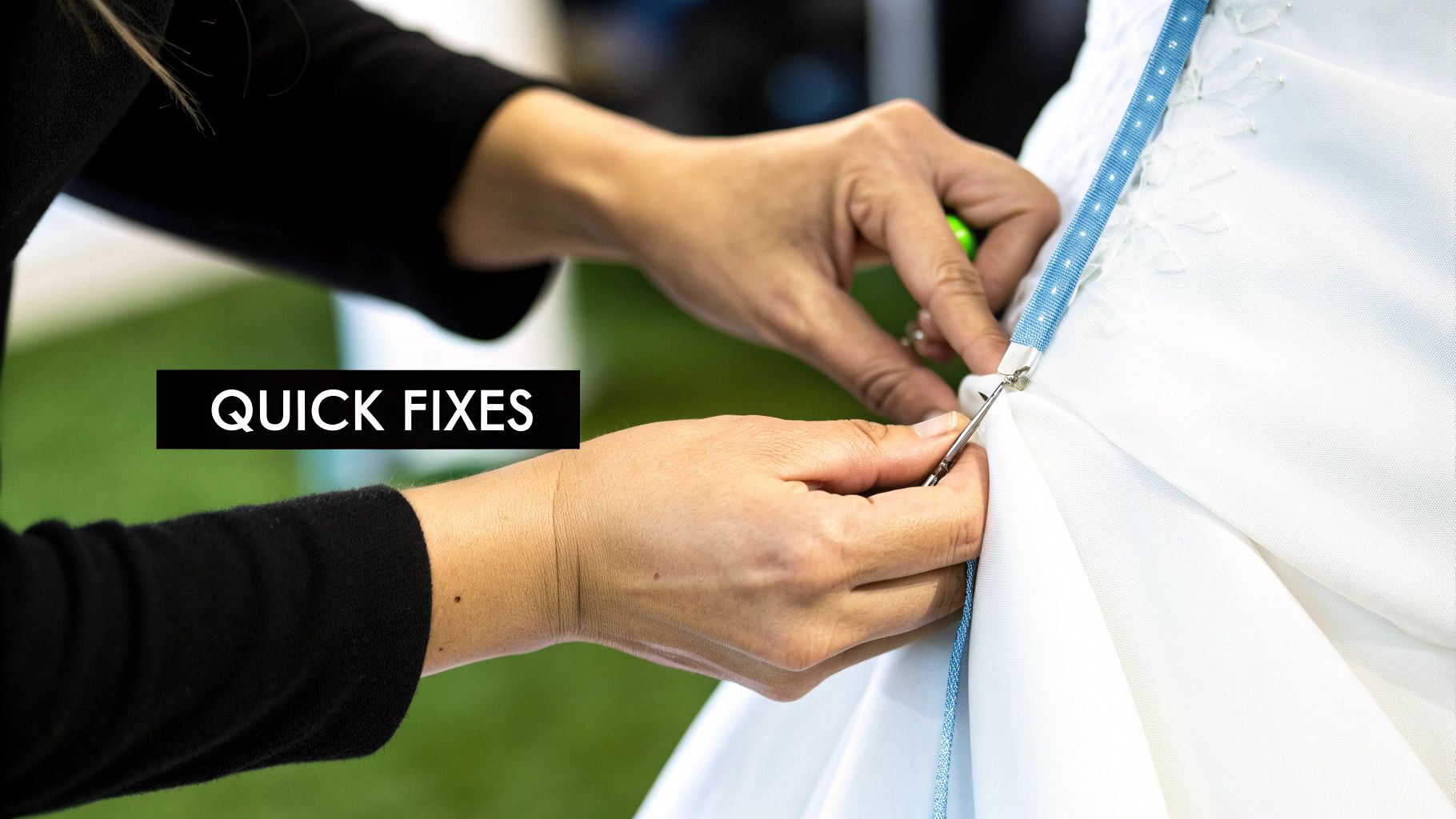
Whether it’s the graduation robe length or the sleeve fit, a few small adjustments can make all the difference. These temporary tweaks are a lifesaver, especially for rented regalia, since they let you dial in the fit without making any permanent changes.
Temporary Fixes for Gown Length
Is your gown dragging on the floor or hitting you a bit too high? Here’s how to handle it.
- If your gown is too long: The easiest no-sew solution is to grab some safety pins or double-sided fabric tape. Just fold the hem inward to the length you want and secure it from the inside. This is a completely reversible fix that literally takes minutes.
- If your gown is too short: You can’t magically add more fabric, but you can adjust your footwear. Choosing flats or shoes with a much lower heel can really help make the length look more intentional and appropriate.
Managing Sleeves and Bulk
Sometimes the hem is fine, but the gown itself just feels too roomy or the sleeves are all wrong.
Ideally, a gown’s sleeves should end right around your wrist, maybe letting a tiny bit of your shirt cuff peek out. If yours are too long, a single safety pin tucked inside each cuff can create a quick, temporary fold. If the robe feels too bulky or wide, try a stylish belt worn over your clothes but under the gown. It’ll cinch in your waist for a more defined shape without anyone ever seeing it.
Remember, the goal is to feel comfortable and confident. A few small tweaks can transform a clumsy fit into a polished look, letting you focus on your achievement, not on your outfit.
These fit issues are pretty universal, but the regalia itself can be wildly different depending on where you are. The global variations in graduation robe lengths show just how much academic dress can be adapted by different cultures. For instance, while the United States standardized hood lengths way back with the 1895 Intercollegiate Code, Scotland developed its own conventions, often using gowns without any hoods at all. You can dive deeper into these fascinating traditions and the history of academic gowns to see how regional values have shaped what graduates wear.
Making Bulk Orders a Breeze for Your School
Getting graduation gowns for an entire class can feel like herding cats. If you're an administrator or teacher, you know the drill: making sure every single student has the right size gown is a huge deal, but juggling hundreds of individual orders is a logistical nightmare. This is where bulk ordering comes in to save the day.
When you place one large order for the whole class, you're doing more than just simplifying the process. You often get better pricing, which is a big win for students and their families. Plus, a single order guarantees that every gown is the same color and style, giving your commencement ceremony that polished, unified look you're after. It turns a potential headache into a smooth, manageable task.
Putting Together a Simple Game Plan
The key to a successful bulk order is straightforward communication and clear deadlines. First things first, create a simple guide showing students and parents how to measure for height. Make it super clear: measure from the top of their head to the floor, without shoes. Get this guide out everywhere—email it, post it on the school website, and even mention it in announcements.
Next, set a firm deadline for students to submit their sizes. You’ll want to give them plenty of time, but don't leave it open-ended. We've found that setting a deadline at least 8-10 weeks before the ceremony is the sweet spot. This window gives you a comfortable buffer for production and shipping, so every gown arrives with plenty of time for you to hand them out.
Pro Tip: A smooth bulk order is all about great communication. Walk everyone through the measurement steps clearly and be firm about your deadlines. This simple approach avoids that last-minute panic and makes sure every student looks and feels their best on graduation day.
Once you have all the measurements, organize them into a single spreadsheet. This list is your new best friend—it's what you'll use to place the order and track everything when the gowns arrive. Keeping it all in one place is the easiest way to prevent mix-ups and keep the process running smoothly from start to finish.
Frequently Asked Questions
Got a few last-minute questions about getting your gown length just right? You're not alone. Let's clear up some of the most common things we get asked.
How Long Should a Graduation Robe Be?
Traditionally, your graduation robe should hit you somewhere around mid-calf. Think of the sweet spot between your knee and your ankle—that's the target. This length looks sharp and uniform in group photos and, more practically, keeps you from tripping on stage.
While mid-calf is the go-to standard for most high schools and universities, it's always a good idea to quickly check if your institution has its own specific rules. But if they don't, aiming for mid-calf is a safe bet for a classic, comfortable fit.
Can I Hem My Graduation Gown?
That depends! If you bought your gown outright, then absolutely. Taking it to a tailor for a professional hem is a great way to get a perfect, custom length.
However, if you're renting your regalia, any permanent changes like hemming are a definite no-go. For a temporary fix on a rental that's a bit too long, you can carefully fold the hem under and use safety pins or double-sided fabric tape on the inside. It’s a simple trick that ensures you look great without breaking the rental agreement.
Should I Measure My Height with Shoes On?
Nope, always measure your height without shoes. Gown sizing is based on your true height, from the top of your head to the floor. Getting this one measurement right is the key to finding your correct size on the chart.
Once your gown arrives, that's the time to try it on with the shoes you'll be wearing for the ceremony. This "dress rehearsal" will show you exactly how the hem falls and confirm you've got the ideal graduation robe length for your big day.
What Is the Sleeve Difference Between Gowns?
The sleeves are one of the coolest and most telling details in academic regalia. A bachelor's gown has simple, pointed sleeves. A master's gown, on the other hand, features unique oblong sleeves—they’re closed at the end, but your arm comes through a slit, creating an elegant, draped effect that signifies a higher degree.
At Gradshop, we're here to help you celebrate your achievement in style. Find the perfect regalia for your milestone by exploring our full collection and order with confidence today at https://www.gradshop.com.