

When you see a graduate with blue and gold honor cords draped over their shoulders, you're looking at a story of serious dedication. These aren't just decorative ropes; they're prestigious symbols, badges of honor awarded by societies to celebrate academic excellence, leadership, and true distinction. It’s a way of showing the world, at a single glance, the commitment and hard work that defined their time in school.
What Blue and Gold Honor Cords Really Mean

At its heart, an honor cord is a visual testament to an earned achievement—think of it as a medal for academic life. When a graduate wears blue and gold, it’s a public acknowledgment of their incredible effort. Each color in that braided cord has its own rich history and significance, and together, they tell a powerful story of success.
The color blue often stands for wisdom, loyalty, and truth—all qualities you’d hope to find in a dedicated scholar. Gold is universally recognized for prosperity and high value, signifying just how precious the accomplishment is. Put them together, and you get a combination that’s not only visually striking but deeply meaningful, representing the absolute pinnacle of academic achievement.
You can learn about the symbolism behind other combinations in our complete guide on the meaning of graduation honor cord colors.
To give you a clearer picture, here’s a quick breakdown of what these cords typically represent at different levels.
Blue and Gold Honor Cord Quick Facts
| Academic Level | Primary Associations | What They Signify |
|---|---|---|
| High School | National Honor Society (NHS), California Scholarship Federation (CSF), specialized societies (e.g., National English Honor Society) | Academic excellence, leadership, character, and service. Often represents a GPA in the top 10-15% of the graduating class. |
| Undergraduate | University-wide honors programs, Cum Laude/Magna Cum Laude/Summa Cum Laude, Phi Kappa Phi, departmental honors | Sustained high academic performance (typically a 3.5 GPA or higher), research distinction, or completion of a rigorous honors curriculum. |
| Graduate | Specialized honor societies (e.g., in business, engineering, law), specific program accolades | Exceptional achievement in a focused field of study, significant contributions to research, or top-tier academic standing within a graduate program. |
As you can see, while the core meaning of excellence remains, the specific context can vary depending on the institution and the level of study.
A Tradition Steeped in History
The practice of using specific colors to denote academic honors goes back centuries, but the blue and gold pairing has become a modern staple. These cords act as a quiet but powerful announcement that a graduate belongs to an elite group of peers who have truly excelled.
This is especially common in high schools across the country. Blue and gold honor cords are frequently associated with prestigious groups like the National Honor Society, which recognizes students who have shown outstanding scholarship, service, leadership, and character.
An honor cord is so much more than an accessory; it's a wearable testament to the countless hours of study, the perseverance, and the intellectual curiosity that define a distinguished academic career.
A Recognized Mark of Distinction
The sheer number of students wearing these cords at commencement shows just how widespread this tradition has become. In fact, it's estimated that approximately 8% of graduates in honors programs proudly wear this specific color combination, marking them as top performers in their class. It’s a standardized, elegant way for institutions to celebrate their highest-achieving students on a day filled with pride and accomplishment.
Which Honor Societies Use Blue and Gold Cords?
While the blend of blue and gold universally signals high achievement, several prestigious honor societies have specifically claimed these colors to represent their members and mission. The story behind each society reveals the diverse fields these cords celebrate, spanning from high school auditoriums to university lecture halls.
For high school students, earning these cords is a huge milestone. It’s often about more than just good grades; it signifies a real commitment to community, character, and leadership.
High School Honor Societies
Two of the most well-known high school organizations that use this color scheme are the National English Honor Society (NEHS) and the International Thespian Society (ITS).
-
National English Honor Society (NEHS): If you see a student wearing this cord, you know they've excelled in the language arts. Induction into NEHS requires a top-tier GPA in English courses and a genuine passion for literature and writing.
-
International Thespian Society (ITS): This society is all about honoring excellence in the theatre arts. The blue and gold honor cord combination is iconic for ITS, which has inducted over 2.5 million students since it began in 1929 and now has chapters in over 7,000 schools worldwide. These cords recognize both leadership and performance achievements, often awarded to students who've put in at least 25 hours of verified theatre service. You can read more about the long-standing traditions of honor cords on Wikipedia.
These societies perfectly illustrate how blue and gold cords recognize a wide spectrum of talent, from academic skill in the classroom to creative expression on the stage.
The specific society behind the cord gives it its unique story. A blue and gold cord from an English society tells a tale of literary analysis and eloquent essays, while one from a theatre society speaks of countless hours rehearsing lines and building sets.
University and Collegiate Honors
Once you get to the university level, blue and gold cords often point to excellence in a specialized field of study. They recognize dedicated scholars at the undergraduate, master's, and even doctoral levels.
Two fantastic examples are Omicron Delta Epsilon for economics and Delta Mu Delta for business.
-
Omicron Delta Epsilon (ODE): As the international honor society for economics, ODE uses blue and gold to distinguish outstanding students in the discipline. For anyone planning a career in finance, research, or public policy, membership is a significant honor.
-
Delta Mu Delta (DMD): This international honor society recognizes business students who have demonstrated truly exceptional academic achievement. The blue and gold cords are a clear signal that the graduate is in the top 20% of their class and poised to become a leader in the business world.
From high school literary stars to doctoral candidates in economics, the blue and gold honor cords you see at graduation are rich with meaning. They represent belonging to a community of scholars and achievers, with each cord acting as a thread in a larger story of dedication and success.
How to Properly Wear Your Honor Cords for Commencement
Wearing your blue and gold honor cords the right way is the finishing touch on your graduation look. Think of it like displaying a medal—how you wear it matters. Getting it right shows you respect the tradition and the honor you’ve earned, letting you walk across that stage with complete confidence.
It’s a pretty simple process, really. Just find the midpoint of the cord, which is usually marked by a small knot. This knot goes right at the back of your neck, tucked neatly under the collar of your gown so it stays hidden.
With the cord centered, let the two tasseled ends drape over the front of your shoulders. You'll want them hanging evenly down the front of your gown. A quick glance in the mirror is all you need to make sure both tassels are at the same length for a clean, symmetrical look.
The Basic Steps for Wearing Your Cords
Putting on your honor cords correctly is easy once you know the drill. Following these steps will give you that polished, professional look that truly honors the occasion.
- Find the Center: First, grab your cord and locate the middle, usually where you'll find a center knot.
- Drape from the Back: Place that knot at the nape of your neck and let the cord rest on your shoulders.
- Adjust the Tassels: Let the tasseled ends fall naturally down the front of your gown, making sure they’re the same length.
- Secure if Necessary: If you’re wearing multiple cords or a stole, a small safety pin hidden under your gown’s collar can be a lifesaver, keeping everything from shifting around during the ceremony.
For a deeper dive, check out our complete guide on how to wear graduation honor cords, which walks through all kinds of different scenarios.
Layering Cords with Other Regalia
Many graduates, especially those earning Master's or Doctoral degrees, will be wearing more than just a cap and gown. When you’re adding blue and gold honor cords to the mix with stoles or hoods, there's a simple rule of thumb: start with the bulkiest item first.
This infographic shows how regalia builds from high school honors to university achievements, often becoming more layered over time.

The journey pictured here mirrors how a graduate's regalia grows, with each new piece representing another milestone.
For instance, a Master’s candidate would put on their academic hood first, since it's the largest piece. The honor stole would go on next, draped over the shoulders. Finally, the honor cords are placed on top of it all, resting neatly over both the stole and hood.
Layering this way ensures that every single one of your achievements is visible. The goal is a distinguished, organized look that celebrates all your hard work without looking cluttered.
Coordinating Cords with Your Graduation Regalia
Your graduation day look is more than just the gown and cap. It’s a complete ensemble, and figuring out how to style your blue and gold honor cords is key to making sure every one of your achievements shines. The goal is to create a look that’s celebratory and distinguished, not cluttered.
A classic black gown is the perfect backdrop. It really makes the vibrant blue and rich gold of the cords stand out. But don't feel limited to black! These cords look fantastic with specific school colors, too. A navy blue gown, for example, can create a sleek, sophisticated monochromatic effect, while a white or gold gown provides a bright contrast that makes your honor cords pop.
Balancing Cords with Other Honors
Many students graduate with more than one honor, which means you might have a stole, a sash, and maybe even a medal to wear along with your cords. The trick is to layer these pieces so that each one is visible and gets the attention it deserves. Think of it like arranging trophies on a shelf—you want each one to have its own space.
Here’s a simple layering strategy that works every time:
- Academic Hoods: If you're a Master's or Doctoral candidate, your hood is a big deal. It always goes on first, right after the gown.
- Stoles or Sashes: Next, drape your stole or sash over your shoulders. It should lie smoothly over the hood. We have a great selection of honor stoles for high school if you're looking for one that coordinates.
- Honor Cords: Your blue and gold honor cords are the final touch. Drape them over everything else so they can hang freely and be seen clearly.
- Medals and Medallions: These are typically worn on a ribbon around your neck. They should go on before the cords, allowing them to rest flat against your chest, just beneath where the cords hang.
Following this order gives you a clean, organized look that properly respects every single honor you've earned.
A well-coordinated set of regalia tells a story of your academic journey. Every piece, from the gown to the cords, works together to create a visual narrative of your hard work and success.
For graduates moving on from college, this coordination becomes even more significant. Did you know that 12% of U.S. college graduates wear cords specific to their field of study? Blue and gold are top choices for many professional disciplines. They often represent honors in economics through Omicron Delta Epsilon or in business via Delta Mu Delta, which are huge accomplishments for Master's and Doctoral degree recipients. In fact, the use of blue and gold cords in these fields has jumped by 15% since 2010, mirroring the rise in business program enrollments. You can learn more about these kinds of commencement customs and traditions to see how deep these practices run.
Whether you're celebrating with a single, meaningful cord or a full display of academic honors, putting a little thought into how you wear them will ensure you look and feel your best on this unforgettable day.
Finding the Right Blue and Gold Cords for Your Ceremony
When it comes time to get your blue and gold honor cords, you want to make sure you're getting something that truly reflects the achievement. This isn't just another accessory for your graduation gown; it's a keepsake that symbolizes years of dedication and hard work. Choosing the right one ensures it not only looks sharp on the big day but also stands as a proud reminder for years to come.
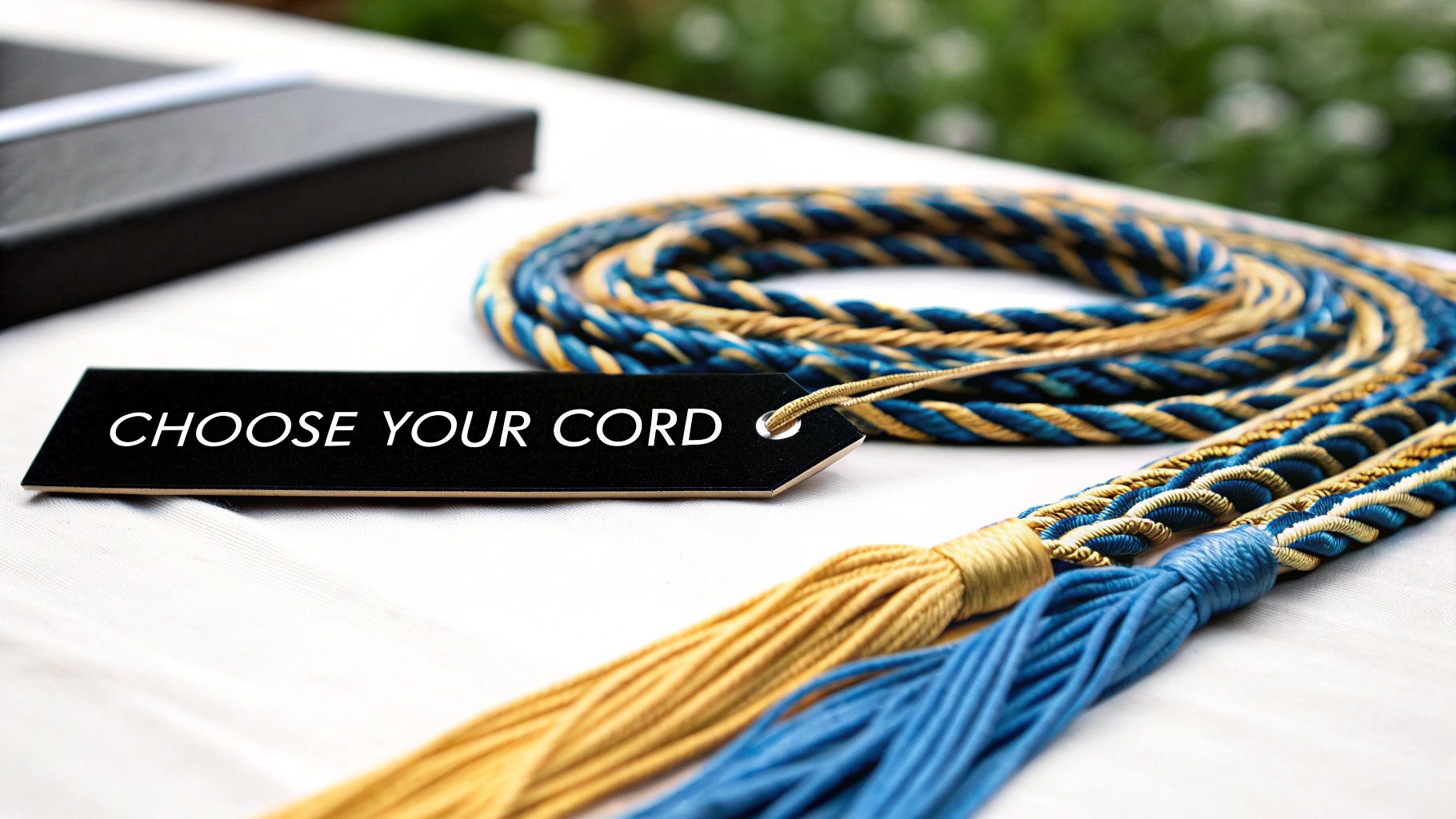
The first thing I always tell people to look at is how the cord is made. A high-quality cord is usually crafted from a durable material like rayon, which gives it that nice, vibrant sheen and a smooth feel. You'll want to check for a tight, consistent braid—the kind that won’t start to fray or unravel after being handled. That’s the mark of a cord built to last.
Understanding Cord Styles
It might surprise you, but not all honor cords are the same. The style you pick can communicate different types or levels of achievement, so knowing the difference helps you make the right choice.
You’ll generally come across three main styles:
- Single Cords: Just like it sounds, this is a single-colored cord. It’s less common to see blue and gold represented this way unless they are worn as two separate cords alongside each other.
- Double Cords: This is the classic and most popular choice for blue and gold honor cords. It features one blue cord and one gold cord, tied together in the middle. It’s a clean, traditional look.
- Braided Cords: These cords have the blue and gold strands twisted together into one thicker rope. This interwoven style often signifies a higher distinction or a more prestigious honor society.
Ultimately, the right style usually comes down to your school’s specific guidelines or the traditions of the honor society you’re a part of.
The construction of your honor cord is a direct reflection of the honor it represents. A well-made cord with rich, lasting color not only looks better but also serves as a durable symbol of your accomplishment.
Key Factors for Your Purchase
Beyond just the style, a few other details make a big difference. Color vibrancy is huge—the royal blue should be deep and rich, and the gold should be bright and brilliant to create that eye-catching contrast. It's also worth noting that different institutions can have very specific shades in mind. While cords aren't printed, resources like a guide to PMS color for gold printing can give you a deeper appreciation for color standards.
Pay attention to the length and thickness, too. A standard length of 60 inches (not including the tassels) is pretty typical and hangs perfectly on most graduates. And don't forget the tassels! They should be full and securely fastened to complete that polished, distinguished look. You can see some great examples of what to look for by checking out these double color graduation cords, which hit all these quality marks.
Options for Individuals and Institutions
Whether you’re a student buying your own cord or an administrator outfitting a whole graduating class, the process should be simple. If you're buying for yourself, look for a supplier that doesn't require a minimum order and can get it to you quickly.
For schools, clubs, and honor societies, ordering in bulk is definitely the way to go. It’s almost always more cost-effective, as most suppliers offer pretty good discounts for larger orders. My advice is to find a provider that offers free samples. This way, you can see and feel the quality for yourself and verify the colors before placing a big order. It’s the best way to ensure every single honoree receives a beautiful, high-quality cord that represents your institution with pride.
Common Questions About Graduation Honor Cords
As graduation day gets closer, it’s natural for questions to pop up about all the traditions that come with it. The rules around academic regalia, especially honor cords, can feel a little confusing, but we've got you covered. Knowing the basics will help you wear your achievements with pride.
We’ve pulled together some of the most common questions to give you clear, simple answers. Let's sort out any confusion you might have about those blue and gold honor cords so you can focus on celebrating.
Can I Wear More Than One Honor Cord at Graduation?
Yes, absolutely! It’s actually very common for graduates with multiple achievements to wear several cords. This is a fantastic way to showcase the full range of your hard work and dedication throughout your academic career.
The trick is to arrange them neatly so they look sharp. Just place the center knot of each cord at the back of your neck, and let the cords drape evenly down the front of your gown. While most schools are happy for you to display all your honors, it's always smart to double-check your school's specific rules for commencement day.
What Is the Difference Between an Honor Cord and a Stole?
Think of it this way: a cord is for a specific achievement, while a stole often represents a broader one. An honor cord is a thin, braided rope with tassels at the end, usually signifying membership in a particular honor society or a specific academic award.
A stole, on the other hand, is that wider, scarf-like sash worn over your shoulders. Stoles typically represent more general honors, like graduating cum laude, or holding a major leadership role in a student organization. You can definitely wear both your blue and gold honor cords and a stole at the same time to celebrate your different accomplishments.
Your honor cord is a cherished memento of your success. Preserving it well allows it to serve as a lasting symbol of your dedication and achievement for years to come.
How Should I Preserve My Honor Cord After Graduation?
You’ll want to keep your cord looking as vibrant as it did on graduation day. The best way to do that is to store it out of direct sunlight, which can fade those brilliant blue and gold colors over time.
A shadow box frame is a really popular and beautiful option, letting you display the cord right alongside your diploma and tassel. If it ever gets a little dusty, just spot-clean it gently with a damp cloth—avoid tossing it in the wash.
If you're looking for inspiration on how to display your academic awards, checking out how others display their mementos can be a big help. You might find some great creative ideas for displaying personal achievements that you can adapt for your honor cords.
How Do Schools or Clubs Order Honor Cords in Bulk?
Ordering for a group is usually a straightforward process. A school administrator or club advisor can simply reach out to a regalia supplier to get a quote. This is also the time to ask about volume discounts and request samples to check the quality and color of the blue and gold honor cords.
Placing a bulk order is the best way to make sure everyone's cords are consistent, and it almost always saves the organization money.
At Gradshop, we make finding the perfect regalia easy, whether you're an individual graduate or an entire institution. Explore our complete collection of high-quality graduation essentials and celebrate your achievements in style. Learn more at https://www.gradshop.com.