

You've found an Army graduation stole that would look right over the gown, and you're ready to order it before graduation gets any closer. Then someone asks whether the school allows military stoles. That's the question to settle first, before choosing colors, adding a unit name, or paying for personalization.
An Army graduation stole is a ceremonial accessory, not automatic permission to wear military recognition at commencement. Start with the graduate's status and the school's written regalia policy. Once those match, choosing the right design becomes much simpler.
Army Graduation Stole Options at a Glance
Choose the accessory that fits the graduate's approved recognition category, not just the design they like. An Army ROTC graduate may need a branch sash, while a veteran at the same ceremony may receive a military honor cord. Those accessories aren't interchangeable just because both recognize a military connection.
For broad Army-themed designs, black and gold are the usual starting point. Red, white, and blue commonly appear in campus military-service recognition, but the school must assign that meaning. High school JROTC students should be especially careful: participating in a program doesn't automatically authorize a stole over the graduation gown.
Army Stole Type by Graduate Type
| Graduate | Usual Accessory | Colors Typically Used | Qualifying Basis |
|---|---|---|---|
| Army ROTC graduate | Branch sash or Army-themed stole | Army Black and Army Gold, or branch colors | Completed ROTC and commissioning path |
| Active-duty or Reserve member | Red, white and blue honor cord or stole | Red, white and blue | Current or honorable military service |
| Veteran | Red, white and blue honor cord | Red, white and blue | Honorable service in the U.S. military |
| High school JROTC student | Army-themed stole | Army Black and Army Gold | School policy decides |
| Honors or class officer | Solid gold, red or blue stole | Gold, red or blue | Academic honors standing, not military service |
Treat these as selection categories, not universal entitlements. A school may issue its own accessory, approve only a particular cord, or prohibit an independently purchased stole.
Eligibility Follows Status
Penn State Abington's regalia policy awards red, white, and blue military cords to eligible undergraduates who have honorably served, currently serve, or are commissioned to serve in the U.S. military. Its eligible groups include active-duty, Reserve, and National Guard members, veterans, and graduates receiving commissions through ROTC or official recruiting programs.
That distinction matters for families buying an Army graduation stole as a gift. Interest in the Army isn't the same as qualifying military service, and JROTC participation shouldn't be presented as veteran status.
For an honors recipient who also serves, ask which recognition category the school assigns to each accessory. Don't replace an academic honors stole with an Army-themed version and assume the substitution will be accepted.
Find the graduate's row, identify the accessory the school recognizes, and confirm its eligibility requirements. Then choose the design, rather than buying first and asking for an exception afterward.
What an Army Stole Signals and Which Ceremony Applies

A veteran crosses the commencement stage wearing a stole printed with Veteran and service dates. A few rows back, an ROTC graduate wears one naming the program and the commissioning year. Both read correctly, because each states a status the wearer holds. That is the whole job of an Army stole at an academic ceremony: it identifies an affiliation. It carries no rank, grants no authority, and gives no permission to appear in uniform.
Accuracy matters more than decoration. A veteran's stole can name veteran status. An ROTC stole can identify the program. Neither should suggest a qualification or service history the graduate has not earned.
Ceremonial Recognition Is Not Army Uniform
Army Regulation 670-1 governs authorized insignia identifying grade, branch, organization, duty assignment, qualification, and prior service, including approved specifications and color designations. It also governs uniform wear for specified occasions, including circumstances requiring service or dress uniforms rather than combat or physical-fitness uniforms.
A decorative graduation sash doesn't become an authorized uniform item because it carries Army wording. Keep its design clearly ceremonial. Army-inspired colors, branch text, unit names, veteran status, and service dates can communicate the intended recognition without copying a regulated uniform component.
For a school or group order, use these design choices:
- Broad sash shape: Make the accessory visibly part of academic regalia rather than a replica uniform attachment.
- Readable personalization: State the graduate's approved category in plain text instead of relying on an emblem to explain it.
- Non-regulation graphics: Use decorative elements that stay clear of official insignia, and obtain permission before reproducing protected or controlled marks.
Practical rule: If the design could pass as an official uniform component, change it before ordering.
A stole and a cord also serve different visual roles. Our guide to graduation stoles and cords explains the accessory distinction, and the ceremony organizer still decides which one belongs in the graduate's outfit.
Basic Training and Academic Commencement Need Different Answers
Basic Combat Training graduation is a military event run under military control. The soldier's unit sets the ceremony and prescribes the attire. Families shouldn't add an academic stole to a military uniform based on photographs from an unrelated ceremony.
The Fort Benning Basic Combat Training FAQ directs families to the commander letter for the soldier's specific schedule because ceremony details differ by unit. Use that unit-specific guidance for graduation and family-day planning rather than a general graduation-shopping checklist.
At high school or university commencement, the school controls the academic gown and permitted adornments. A decorative Army stole goes through that approval process and never substitutes for prescribed Army attire.
Ask exactly what the graduate will wear at each event: military uniform, academic gown, or separate outfits for separate ceremonies. If a commissioning event is followed by commencement, treat them as distinct dress decisions. Order only the accessory approved for the event where it will be worn.
Army Colors and What Each One Signals
| Color or Combination | Meaning | Best Use on a Stole |
|---|---|---|
| Army Black and Army Gold | Primary institutional Army colors | Broad Army-themed design |
| Armor branch yellow | Armor branch affiliation | Branch-specific sash |
| Air Defense Artillery scarlet | Air Defense Artillery affiliation | Branch-specific sash |
| Adjutant General's Corps dark blue and scarlet | Adjutant General's Corps affiliation | Branch-specific sash |
| Red, white and blue mixed | Military service or veteran status when the school assigns it | Veteran or service cord, if approved |
| Solid gold, red or blue | Academic honors at schools such as the University of Southern Indiana | Honors stole, not a military design |
The institutional and branch distinctions in Army uniform and insignia guidance provide a useful starting point for color selection. They don't establish a universal graduation color code, and a branch color alone doesn't establish the wearer's eligibility.
Army Black and Army Gold suit broad Army recognition. Branch-specific colors narrow the message, so use them deliberately. Don't select scarlet merely because it photographs well if the design is supposed to identify a different branch.
Pair Color With Plain Text
Color needs a label. Print Army, Veteran, ROTC, or the approved branch name so a guest can understand the recognition without decoding a shade or emblem.
For example, a black-and-gold stole labeled Army ROTC communicates something more precise than an unmarked gold sash. Likewise, a veteran accessory should say Veteran when personalization is permitted, rather than expecting viewers to distinguish military recognition from academic honors.
Our explanation of graduation stole color meanings can help you separate general regalia conventions from the meaning your own school assigns. When the two differ, follow the school's designation.
Color should support the wording, not replace it.
Check contrast against the actual gown. Lay the design proof beside a photograph of the gown, then view it at a reduced size to see whether the lettering remains readable. Avoid dark lettering on a dark panel and decorative backgrounds that compete with the graduate's category.
Give Bulk Orders a Color Key
For group purchases, write the color rules into the design brief before collecting names. Separate JROTC, ROTC, active-duty, and veteran designs by both approved wording and assigned colors, rather than asking the seller to infer eligibility from a roster.
Include the base fabric color, lettering color, trim, and exact category label. If the school approves a specific shade or sample, attach it to the brief. That gives the purchaser, designer, and commencement coordinator the same reference and reduces preventable substitutions.
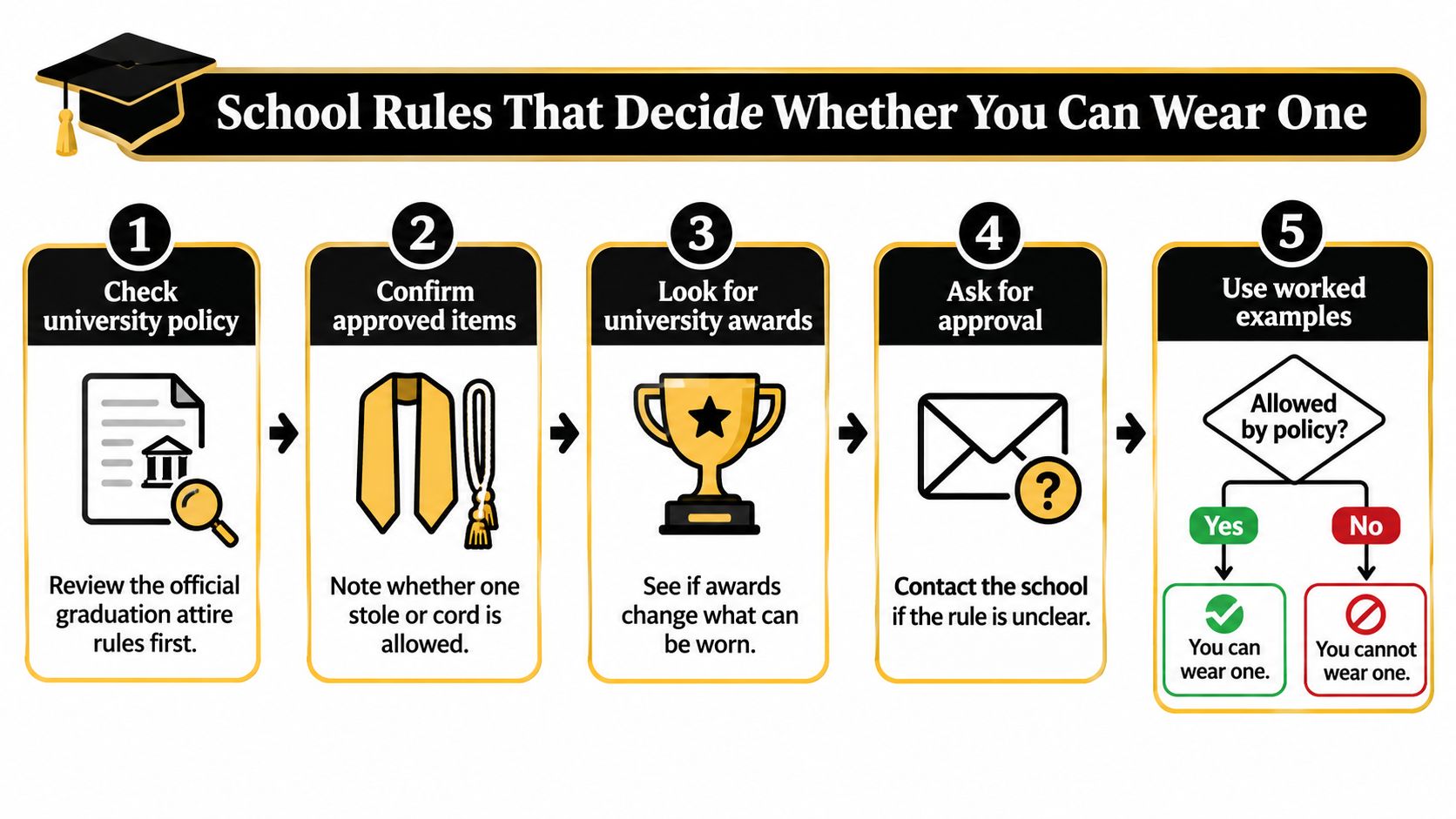
School Rules That Decide Whether You Can Wear One
The University of Southern Indiana's policy permits one approved stole or cord in addition to university-provided awards, reserves mixed red, white, and blue cords for students who serve or served, and requires new stole or cord categories to receive approval at least 60 days before commencement. That's an institutional rule, not an Army-wide standard.
Charleston Southern University's published graduation rules distinguish veteran honor cords from ROTC branch sashes, permit one stole outside the gown for approved campus-organization members, and prohibit decorating caps or regalia. Check the policy for your ceremony before treating another institution's permission as your own.
Examples of School Military Regalia Rules
| School | Military Accessory | Wearing Limit | Approval Rule |
|---|---|---|---|
| University of Southern Indiana | Red, white and blue mixed cords for students who serve or served | One approved stole or cord plus university awards | New categories require advance approval |
| Penn State Abington | Red, white and blue cord for eligible serving, honorably served, or commissioning undergraduates | Confirm any combined-accessory limit with commencement staff | Academic dress or armed-forces uniform required; cord distributed at the Graduation Fair |
| Charleston Southern University | Veteran honor cords; branch sash for Army ROTC | Approved organization stole worn outside the gown | Decorating caps or regalia prohibited |
| High school in the reported California case | Army stole for photos, baccalaureate, or awards events | No Army stole over the commencement gown | Only approved scholarship cords and sashes allowed on the gown |
High school rules can be stricter than families expect. In the California case reported by FOX 4, the school prohibited gown adornments except approved scholarship cords and sashes, leaving photographs, baccalaureate, or awards events as alternatives for the Army stole.
Treat such restrictions as a consistency measure, not automatically as a judgment on military service. Approval for portraits isn't approval to walk across the commencement stage wearing the same accessory.
Get These Answers in Writing
Send the principal or commencement coordinator a picture of the proposed stole and ask:
- Is a military stole approved? Identify whether it recognizes enlistment, JROTC, ROTC, current service, or veteran status.
- Are only school-issued items allowed? An approved category may still require an institution-issued accessory.
- Are colors or placement prescribed? Ask about trim, wording, and position relative to other regalia.
- Can it be worn over the gown? Separate ceremony permission from permission for photographs.
- How many stoles are allowed? Include every cord, award, sash, and hood the graduate expects to wear.
- Is a unit logo permitted? School approval and permission to reproduce an emblem are separate questions.
For combined outfits, our guide to how many cords you can wear at graduation helps organize the questions. Don't assume an unlimited cord allowance means an unlimited stole allowance.
Students familiar with formal dress expectations at MUN, explained by Model Diplomat, will recognize the underlying principle: event-specific rules govern what's appropriate. Save the coordinator's written answer with the final design proof.
How to Brief an Army Stole Order Correctly
A useful order brief gives the designer decisions, not a vague request for something military-themed. Keep the school's approval, personalization text, garment reference, and artwork permissions together so nobody has to guess.
Build a Production-Ready Brief
- Record the approved category and wearing limit. Copy the school's wording into the brief and attach its written approval. This prevents a service cord approval from being mistaken for permission to make a stole.
- Choose the design family. Black and gold reads as broad Army identity, an approved branch palette signals branch recognition, and school-assigned service colors follow the institution's own scheme. A decorative preference should never change the category being recognized.
- Finalize the exact personalization. Type the approved wording, including capitalization, rather than sending handwritten notes. Add service dates or unit text only where permitted, and verify every name before approving production.
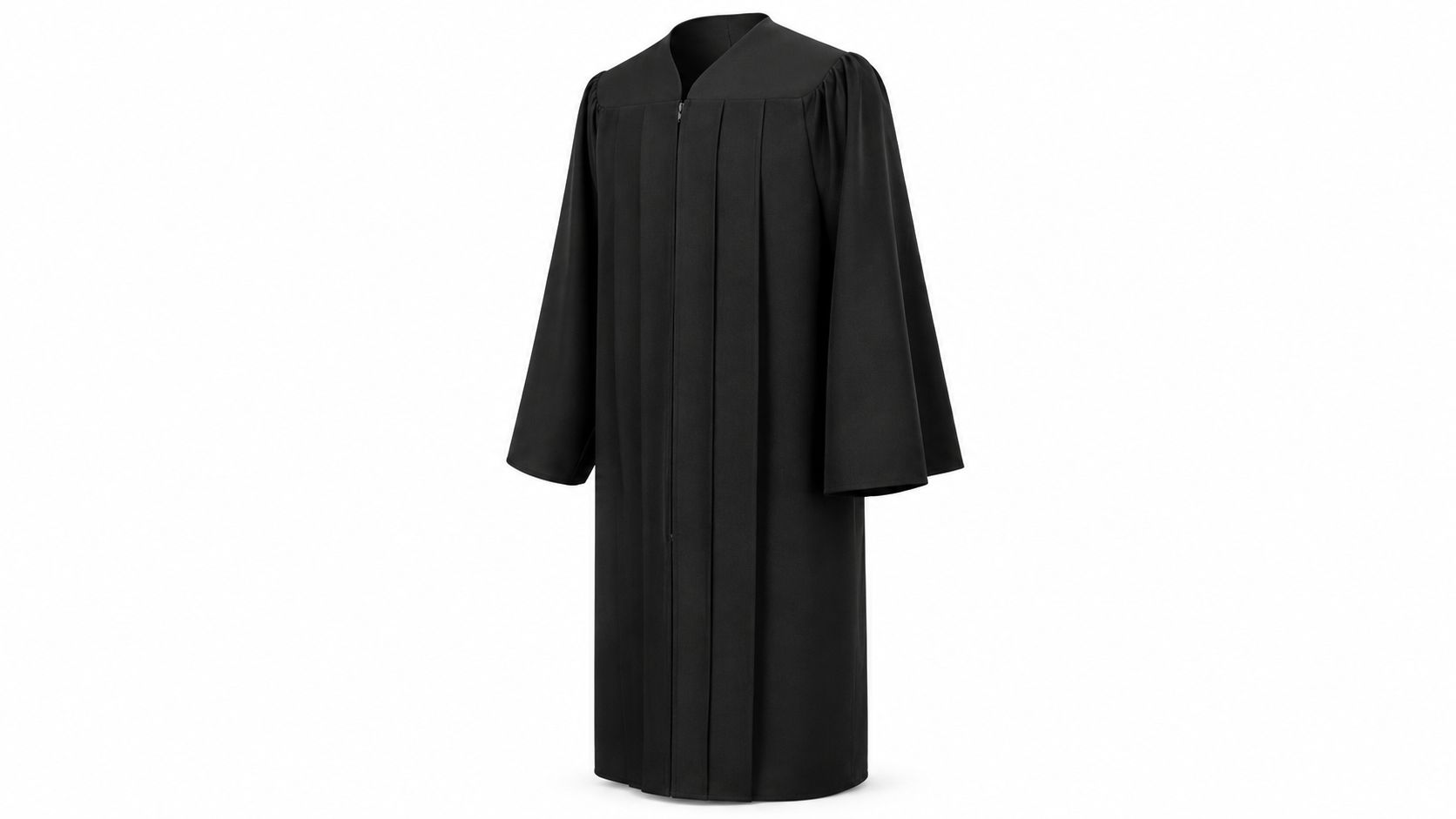
- Test lettering against the gown. Request a proof showing the front panels over the intended garment color. For a dark-gown reference, compare the proof against a product photo such as the Matte Black High School Gown, since gold thread reads differently on black fabric than on a white proof background.
- Specify fit and placement. Record the chosen length and width, where the ends should fall, and any school placement requirement. If the graduate will wear a master's or doctoral hood, check the full outfit rather than approving the stole in isolation.
- Resolve artwork permissions. Leave out unit crests, logos, and regulated insignia unless written permission exists. Plain branch wording is safer than an impressive-looking emblem nobody has cleared.
- Work backward from commencement. Put school approval, proof review, production, delivery, and an outfit check on the calendar. Get written turnaround dates before committing, because institutional approval has to land well before the event.
The walkthrough on designing custom graduation stoles online covers the personalization fields to prepare before opening the order form. Keep the approved proof and the school's written response accessible on ceremony day.
Order safeguard: A brief that matches written permission is easier to defend at check-in than a verbal assurance that military stoles are usually allowed.
What an Army Graduation Stole Costs
| Order item | Listed price | What to check before paying |
|---|---|---|
| Gradshop custom graduation stole | $29.00 | Online-designed text and colors; school approval still required |
Price is only useful after permission. A ready-made Army-themed stole, a class-year stole, and a custom stole can look similar in a photo while carrying different text, colors, and approval problems. Compare the finished order, not the product label.
Compare the Finished Order
Check what the quoted price covers before choosing. A product photograph doesn't establish whether the seller can add the exact category text your school requires.
- Materials and dimensions: Compare fabric, finish, length, and width instead of treating every satin-looking sash as equivalent.
- Personalization: Confirm whether names, branch wording, dates, and approved graphics are included or separately charged.
- Proof approval: Establish how you'll review spelling, colors, and placement before production.
- Delivery terms: Request written turnaround dates and distinguish the production deadline from the date the package must arrive.
Don't assume shipping, customization, or taxes are included unless the listing or written quote says so. For a group order, compare the complete specification rather than multiplying a headline price across the roster.
A cheaper stole isn't a useful saving if the school rejects it and you must replace it. Policy approval comes before price comparison. Budget for an additional stole only after the school confirms the wearing limit, or clearly reserve it for portraits and keepsake use.
If the approved accessory is a school-issued military cord, buying a separate Army stole may be unnecessary. Spend on the item the graduate can wear.
Confirm the School Policy Before You Order
Order only when permission, eligibility, and design agree. A real military connection still needs ceremony approval, and a well-made stole can be the wrong accessory for that event.
Run one closing test before payment. Ask until the answer is clear.
The Final Approval Test
- Permission is explicit. The school allows the proposed military accessory and states the wearing limit, including how it interacts with university awards.
- Eligibility is accurate. The graduate's service, veteran, JROTC, or ROTC status matches the category the institution approved.
- The proof matches the permission. Colors, printed wording, placement, and graphics follow the approved design rather than an earlier draft.
If any answer is missing, send the coordinator the proof and ask for a direct decision. A product description saying military graduation stole identifies a product category. Treat the school's written answer as the permission.
Once the checks pass, an online-designed custom stole is a practical next step for approved text and colors. Keep customization and approval as separate steps: submit the production proof only after the coordinator confirms the final wording.
For a school-approved white-gown outfit, use the Matte White High School Graduation Gown when white is the required gown color. Match the base garment to the school's rule before choosing stole colors.
Send a Complete Approval Packet
Give the commencement coordinator the policy answers, final design brief, and a clear proof showing the entire accessory. State which event it is for, especially if the graduate also has a commissioning ceremony, awards event, or portrait session. The same approval logic holds for a high school cap and gown, a college stole order, or masters and doctoral regalia.
Ask for written confirmation of the deadline and keep the response with the order records. For department and group purchases, name one person to approve the final roster and artwork so conflicting edits never reach production.
Choose the Army graduation stole that matches the graduate's status and the ceremony's written permission. Order it after approval, size the design to the wearing limit, and keep any extra commemorative version for portraits if the school allows only one accessory.
Gradshop offers military graduation stoles and custom stoles you can design online, alongside African Kente, country flag, class officer leadership, and student athlete styles. Visit Gradshop once you have written school approval, then use your approved colors, wording, and design brief to prepare the right accessory for your graduate.