

A royal blue cap and gown isn't just something you wear for a day; it's a powerful symbol. It represents years of hard work, academic achievement, and the pride of your institution. This specific shade often signifies fields like philosophy, education, and political science, carrying a rich history tied to scholarship and wisdom. When you put on that gown, you're connecting to a long tradition of academic excellence.
Uncovering the Story Behind Your Gown
That gown you'll wear on graduation day? It’s the modern version of a tradition that’s been around for centuries. What started as practical clothing for scholars in the Middle Ages has transformed into a profound symbol of academic success. Knowing the history behind your royal blue cap and gown adds a whole new layer of meaning to the ceremony. It’s no longer just a uniform; it’s a connection to a huge legacy of knowledge.
The roots of academic regalia trace all the way back to medieval European universities. In the 12th and 13th centuries, scholars and clerics wore long robes mostly just to stay warm. It wasn’t until the 1950s that colleges in the US really started embracing uniquely colored gowns—like royal blue—as a break from the traditional, all-black standard.
This change was a big deal. It gave schools and specific degree programs a way to create their own visual identity, turning commencement into the vibrant and colorful celebration of academic diversity we see today.
The Symbolism of Royal Blue
Color is a big language in academia, and every shade has its own story. While black is the classic, choosing royal blue is a deliberate and symbolic act. Most famously, this deep blue is tied to the Doctor of Philosophy (Ph.D.) degree, representing the pursuit of wisdom and truth across every discipline imaginable.
But it’s not just for Ph.D. candidates. Many colleges and universities have adopted royal blue as an official school color, using it for all their graduates to build a sense of unity. In that case, the royal blue cap and gown stands for a shared identity and the collective success of the entire graduating class. It’s a way to visually link every student to the school's heritage.
When you wear a royal blue gown, you're doing more than celebrating your own success. You're honoring the academic field or the institution that shaped your journey. Think of it as a visual link to generations of scholars who came before you.
This color system helps everyone in the audience instantly recognize different fields of study and academic honors. It’s a silent language that speaks volumes about achievement. To really get into what the different shades mean, check out our guide on the colors of graduation regalia and what each one signifies.
From Medieval Necessity to Modern Tradition
It's pretty fascinating how academic attire went from purely functional robes to the ceremonial dress we know now. In the drafty, unheated halls of Europe's first universities, long gowns with hoods weren't for show—they were essential for staying warm. Since many early scholars were also members of the clergy, the designs were heavily influenced by clerical robes.
As universities grew and became more established, these practical garments were standardized into official dress. Specific details were added to show a person's rank and area of study:
- Sleeve Shape: The cut of the sleeves started to signify whether someone held a bachelor's, master's, or doctoral degree.
- Hood Linings: The colors on the inside of the hood were used to represent the graduate's specific university.
- Velvet Chevrons: Those distinct bars on the sleeves were added to indicate a doctorate holder.
The royal blue cap and gown you see today is a direct descendant of this long evolution. It honors tradition while still leaving room for schools and individuals to express themselves, making sure your walk across that stage is packed with historical meaning.
Matching Your Gown to Your Academic Level
Not all royal blue gowns are created equal. While the color itself is a powerful symbol, the specific cut of your gown tells the story of your academic journey. From a high school auditorium to a university stage, the design of a royal blue cap and gown—from the sleeves to the fabric—communicates your level of achievement.
Knowing these differences isn't just about tradition; it ensures you get the right regalia to honor your hard-earned milestone. It's a visual language that has evolved over centuries.
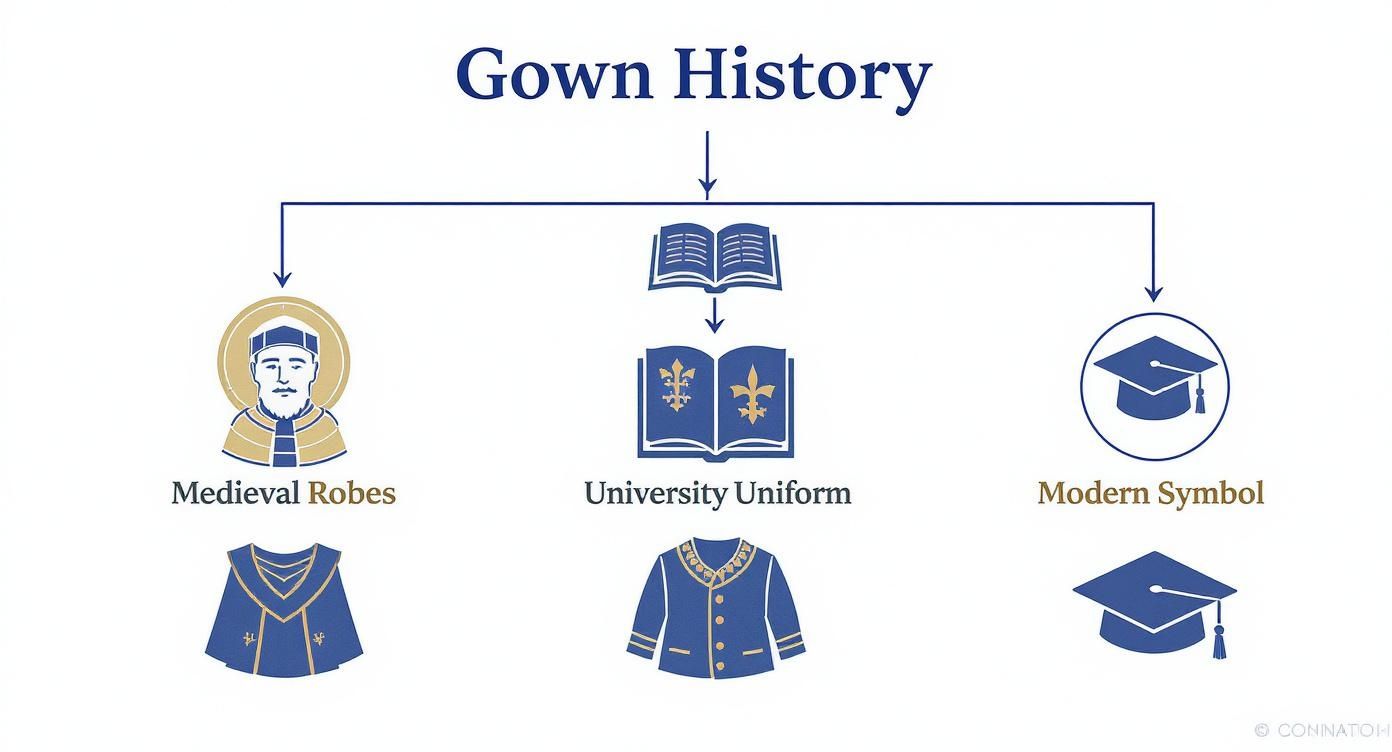
What started as practical robes for scholars in unheated medieval halls has become a cherished emblem of success, rich with meaning.
High School and Bachelor’s Gowns: The Foundation
For most of us, our first cap and gown experience is in high school. These gowns are designed for simplicity and uniformity, creating that classic, cohesive look across the graduating class. The bachelor's gown is very similar, marking the first major milestone in higher education.
- Sleeve Style: Both feature long, pointed sleeves. It's a clean, straightforward design that signifies a foundational level of academic accomplishment.
- Material: You’ll typically find these gowns in polyester with either a shiny or a more modern matte finish. The goal is a sharp, uniform appearance for the ceremony.
- Simplicity: You won't find any velvet panels or elaborate hoods here. The look is intentionally unadorned, which lets the cap, tassel, and any stoles or honor cords really pop.
The beauty of the high school and bachelor's gown is in its simplicity. It’s the perfect canvas for showcasing school colors and celebrating individual honors, while emphasizing the collective achievement of the graduating class.
Whether you're outfitting an entire class or just need a single set, you can explore a wide variety of high school caps and gowns to find the perfect style.
The Master’s Gown: A Clear Step Up
Earning a master's degree means your regalia gets an upgrade, too. The master's gown introduces new design elements that instantly set it apart from a bachelor's gown, signaling a higher level of specialized knowledge. Put two graduates side-by-side, and the difference is obvious—it's all in the sleeves.
The standout feature is the unique oblong sleeve, which is open at the wrist. The back of the sleeve hangs down in a long, squared-off panel, while the front has a distinct arc cut into it. This style is an unmistakable marker of postgraduate achievement. Master's gowns are also worn with an academic hood, which uses color to represent both the university and the specific field of study.
The Doctoral Gown: The Pinnacle of Regalia
As you’d expect, the doctoral gown is the most ornate of all academic regalia. It’s designed to reflect the highest level of scholarly attainment with a fuller cut and more elaborate details, making for a powerful presence on stage.
Key features make it impossible to miss:
- Full, Bell-Shaped Sleeves: These create a much more formal and stately silhouette.
- Luxe Velvet Panels: The gown features three prominent velvet bars, known as chevrons, on each sleeve. A wide velvet panel also runs all the way down the front.
- Color with Meaning: While the velvet trim is often black, it can also be a specific color representing the academic discipline. For the Doctor of Philosophy (Ph.D.), this velvet is traditionally a deep, dark blue, which happens to pair beautifully with a royal blue gown.
This color-coding system is part of a formal tradition. The American Council on Education has long maintained an academic dress code, standardizing dark blue for the Ph.D. to visually distinguish these graduates. You can learn more about the history of academic dress in the United States.
To help you see the differences at a glance, here’s a quick breakdown of the gown features by academic level.
Royal Blue Gown Features by Academic Level
This table quickly compares the key design differences you'll see in academic gowns.
| Academic Level | Sleeve Style | Material & Finish | Hood Included? | Typical Velvet Accents |
|---|---|---|---|---|
| High School | Simple, pointed sleeves | Polyester (Shiny or Matte) | No | None |
| Bachelor's | Long, pointed sleeves | Polyester (Shiny or Matte) | No | None |
| Master's | Oblong sleeves, open at the wrist | Higher-quality polyester/faille | Yes | None on the gown itself |
| Doctoral | Full, bell-shaped sleeves with chevrons | High-quality fabric (faille, velvet) | Yes | 3 bars on each sleeve; front panels |
Each level has its own distinct look, making it easy to recognize a graduate's achievements just by their regalia. It’s a tradition that adds so much to the pageantry of commencement day.
Gradshop offers a full range of distinguished master's and doctoral regalia designed to honor these incredible academic milestones with the quality and detail they deserve.
How to Find the Perfect Gown Fit and Fabric
Your graduation day is one of those milestone moments. The last thing you want to be thinking about is an ill-fitting gown that’s too tight, too short, or so big you’re swimming in it. When it comes to your royal blue cap and gown, getting the fit right is everything, and it all starts with two simple numbers: your height and weight.
Forget about using your t-shirt size as a guide. Academic regalia is sized completely differently to create that classic, formal silhouette we all recognize. The hem should hit somewhere between your knee and your ankle—long enough to look dignified, but not so long you’re tripping on your way to get that diploma.

Taking Your Measurements Correctly
Getting the right measurements is easy, but you have to do it right. Stand straight with your back against a wall and—this is important—wear the shoes you’ll have on for the ceremony. People often measure in bare feet, but that inch or two from your shoes can make a real difference in how the gown hangs.
- Measure Your Height: Grab a friend and have them measure you from the very top of your head straight down to the floor. Keep the measuring tape perfectly vertical.
- Provide Your Weight: This number isn't about the fit around your chest, but about the overall fullness of the gown. It ensures the fabric drapes properly without looking baggy or pulling tight.
What if you're between sizes? My advice is always to size up. A gown that’s a touch too long is far better than one that’s awkwardly short. For a complete guide on how your measurements translate into sizes, check out this super helpful graduation cap and gown size chart.
Choosing the Right Fabric for Your Ceremony
Fit is just one part of the equation; fabric is the other. Your royal blue gown will likely come in two main options: a traditional shiny finish or a more modern matte finish. There's no "better" choice here—it really comes down to personal taste and your ceremony's setting.
A shiny finish looks fantastic indoors. Under stage lighting, the fabric catches the light and makes that royal blue color really pop with vibrancy. It's the classic, celebratory look many people picture.
On the other hand, a matte finish has a subdued, almost velvety elegance. It’s my go-to recommendation for outdoor ceremonies because it eliminates glare in photos. If you're worried about looking washed out by bright sun or harsh stage lights, a matte royal blue cap and gown is a safe and sophisticated bet.
Pro Tip: Pay attention to the fabric's weight. Heavier materials hang much better, resist wrinkles, and are less likely to be see-through under bright lights. A little extra heft can save you from last-minute steaming on graduation morning.
What to Look For in Quality Construction
A well-made gown isn't just about the fabric—it's about the little details that ensure it looks sharp and holds up. When your gown arrives, give it a quick once-over for these signs of quality.
- Reinforced Yoke: The pleated area around your shoulders and collar should feel sturdy. This reinforcement helps the gown drape evenly instead of bunching up.
- Sturdy Zipper: A good zipper glides smoothly and is stitched securely. A color-matched zipper that disappears into the royal blue fabric is always a mark of quality.
- Clean Hemlines: Look at the stitching on the sleeves and the bottom hem. It should be straight and clean, with no frayed edges or loose threads.
These details make all the difference. Investing in a gown with solid construction means you'll not only look polished on the big day, but you'll have a meaningful keepsake to remember your achievement for years to come.
Personalizing Your Look With Cords and Stoles
Your royal blue cap and gown is the perfect foundation for graduation day, but the real story of your academic journey is told through the accessories. Honor cords, stoles, and even your tassel transform your regalia from a simple uniform into a personal statement of achievement. This is how you proudly display the clubs, societies, and honors that defined your time in school.

Think of it this way: your gown shows you've reached the finish line, but the cords and stoles tell everyone about the race you ran to get there. They highlight everything from your GPA to your leadership roles, making your accomplishments visible to everyone in the audience.
The Significance of the Tassel
That little tassel might seem like a small detail, but it’s loaded with symbolism. It's a required part of your attire, and its placement is a key part of the ceremony itself. Before your degree is conferred, the tassel hangs from the right side of your mortarboard cap.
This placement signifies you are still a candidate for graduation. Then comes the iconic moment: the 'turning of the tassel'. After you've officially graduated, you'll move it to the left side, marking your transition from student to graduate. It’s a small gesture, but it’s one of the most memorable parts of any commencement.
While the color often just matches your school or gown, some institutions use specific tassel colors to represent different fields of study:
- Gold: Often signifies sciences or summa cum laude honors.
- Light Blue: Commonly represents the field of education.
- White: Typically associated with humanities and social sciences.
Decoding the Colors of Honor Cords
Honor cords are those braided ropes you see draped over a graduate's neck, and they’re one of the most common ways to display specific achievements. Schools or honor societies usually award them for academic excellence, club membership, or student government participation. The colors are far from random; each one carries a specific meaning.
For example, a student wearing a gold cord with their royal blue cap and gown is likely being recognized for high academic honors, like magna cum laude or summa cum laude. A red cord might signify membership in a leadership society, while a silver cord could denote service achievements.
Seeing a graduate with multiple cords is like reading a visual resume of their college career. Each color combination tells a story of late-night study sessions, leadership roles, and a commitment to their community and field of study.
Making a Statement With Graduation Stoles
Stoles, also known as sashes, offer a much larger canvas for personalization. These wide strips of cloth are worn around the neck over the gown and can be customized with text, logos, and symbols. They are often used to represent deep involvement in specific organizations.
You might see graduates with stoles representing:
- Greek Life: Displaying the letters of a fraternity or sorority.
- Cultural Identity: Kente stoles, for instance, are worn to celebrate African heritage.
- Student Organizations: From the debate team to the student newspaper.
- Military Service: A way to honor their commitment to their country.
These stoles are a powerful way to celebrate your identity and the groups that supported you. For a deeper dive into what each color represents, you can explore this detailed guide on the meaning of graduation stole colors. It's a fantastic resource for understanding the rich symbolism behind each sash.
Common Honor Cord and Stole Color Meanings
To help you decipher the regalia you'll see on graduation day, here’s a quick reference guide to some of the most common colors and what they typically represent.
| Color | Commonly Associated Field or Honor | Example |
|---|---|---|
| Gold | Sciences, High Academic Honors (e.g., Summa Cum Laude) | A physics major graduating with a 4.0 GPA. |
| Silver | Oratory, Public Speaking, General High Honors | A member of the university debate team. |
| Light Blue | Education | A graduate with a Master of Education degree. |
| White | Humanities, Arts, Social Sciences | An English literature or sociology major. |
| Red | Journalism, Communications, Leadership | The editor of the student newspaper or student body president. |
| Orange | Engineering, Computational Sciences | A graduate from the College of Engineering. |
Remember, while these are common associations, the exact meanings can vary by institution. It’s always best to check with your school's registrar or commencement office to confirm their specific traditions and requirements for wearing these distinguished accessories with your royal blue cap and gown.
Wearing Your Regalia the Right Way
You’ve put in the work to earn that degree, so let's make sure you look the part on the big day. Properly wearing your royal blue cap and gown isn't just about looking sharp for photos; it’s about honoring the tradition you're now a part of.
It might seem simple, but each piece has its place. From the angle of your cap to the way your hood drapes, getting these details right will help you feel confident and ready to walk across that stage.
Positioning Your Cap and Tassel
First things first, the mortarboard cap. It’s designed to sit flat on your head, perfectly parallel to the ground. You don't want it tilted back or sliding down your forehead. A quick tip to find the front: the pointed part of the inner skullcap goes to the back, leaving the flat edge to rest on your forehead.
Now for the tassel—its placement is a key part of the ceremony itself.
- Before the diploma: Your tassel should hang on the right side of your cap. This signifies you're still a candidate for graduation.
- After the diploma: Once your degree is officially conferred, everyone will move their tassel to the left side. This is the classic "turning of the tassel," a symbolic moment that marks your new status as a graduate.
Don’t miss out on this iconic part of the ceremony! Starting with the tassel on the correct side makes the moment that much sweeter.
Pro tip: Getting the cap to stay level can be a real struggle, especially with certain hairstyles. A couple of bobby pins are your best friend here. Use them to discreetly secure the cap to your hair, and it won't budge all day.
Mastering the Academic Hood
If you're a master's or doctoral candidate, the academic hood is your most distinguished—and sometimes trickiest—piece of regalia. When you get it right, it’s a beautiful display of both your university's colors and the specific color of your academic field.
Start by placing the hood over your head so the velvet portion drapes down your back. The V-shaped part in the front should rest comfortably at your throat. Look for a small loop on the inside; this is meant to be fastened to a shirt button or an internal gown cord to keep the hood from slipping off your shoulders.
The final touch is to reveal the colors. You’ll need to reach back and flip the satin lining outward, starting from the middle of your back. This creates that iconic, colorful bell shape. It's totally normal to need a hand with this, so don't hesitate to ask a fellow graduate or a faculty marshal for help—it’s a common pre-ceremony ritual. With these details sorted, your royal blue regalia will look absolutely perfect.
Keeping Your Gown Looking Its Best
Your graduation day is a huge milestone, and that royal blue cap and gown isn't just an outfit—it's a symbol of all your hard work. Taking good care of it means you'll not only look sharp for the ceremony but also preserve a piece of your personal history for years to come.
When you first take your gown out of the package, you'll probably notice some creases from being folded. Whatever you do, don't reach for an iron! The direct heat can easily melt or ruin the polyester fabric.
The best and safest way to get those wrinkles out is with steam. Just hang your gown up in the bathroom while you run a hot shower; the steam will work its magic and release most of the creases. If you have a few stubborn ones left, a handheld garment steamer on a low setting is perfect. A few light passes, and your gown will be smooth and photo-ready.
On Graduation Day
Once the wrinkles are handled, it's time to think about the day itself. You’ll be shaking a lot of hands, posing for pictures, and, most importantly, accepting that diploma. The last thing you want is to be juggling a big bag or a bouquet of flowers. It's best to leave those with your family or friends in the audience.
My best advice? Carry only the absolute essentials—your phone, keys, and maybe some lip balm. Most graduation gowns have handy pockets sewn right into the side seams, which makes this super easy. Keeping your hands free means you're ready for every handshake and photo without a second thought.
Also, don't forget to check the venue's rules ahead of time. Many stadiums and arenas have "clear bag" policies, and knowing this beforehand will save your guests a lot of hassle at the door. A little planning goes a long way in keeping the day stress-free.
Storing Your Gown After the Celebration
When the party's over, don't just shove your gown into the back of your closet. To keep it from fading, yellowing, or getting dusty, you need to store it properly. If you can, getting it professionally dry-cleaned is a great first step to remove any dirt or oils from the big day.
For long-term storage, here’s what you need to do:
- Choose the Right Hanger: A wide, padded hanger is your best bet. It supports the gown's shoulders and prevents the fabric from stretching out of shape. Thin wire hangers are a definite no-go.
- Use a Garment Bag: Keep your gown in a breathable garment bag. This protects it from dust and light but still lets air circulate, preventing any musty smells or mildew.
- Find a Cool, Dark Spot: A closet that's not in direct sunlight and doesn't experience extreme temperature swings is the ideal home for your gown. Attics and basements often get too hot or humid, which can damage the fabric over time.
This isn't just about simple upkeep; it's about preserving a piece of history. Gown colors and academic traditions change over time, and what seems standard today might become a unique artifact of your university's past.
The shift from traditional black to a royal blue cap and gown, for example, has caused quite a stir at some universities. A recent change at UC Riverside sparked a debate among students, with many arguing that the classic black gown held more academic weight. It’s a fascinating look at how deeply regalia is tied to a school's identity. You can read more about the student reactions to the gown color change.
By taking care of your regalia, you're protecting your own piece of that legacy. It becomes more than just a memory—it’s a tangible link to your academic journey.
At Gradshop, we design high-quality regalia meant to be cherished for a lifetime. Explore our full collection and find the perfect pieces to celebrate your achievement. https://www.gradshop.com