

A PhD cap and gown set, formally known as doctoral regalia, is the special attire worn by those who have earned a doctorate. The full set has three main parts: a unique doctoral gown with velvet chevrons, an academic hood showing your university's colors, and special headwear—usually a soft velvet tam.
What's in Your Doctoral Regalia Set?

Your doctoral regalia is so much more than a graduation outfit. It’s a powerful symbol of your highest academic achievement. Think of it as the uniform for an exclusive club you’ve just worked incredibly hard to join—a visual testament to years of intense research, late nights, and intellectual drive. Every piece tells a part of your unique academic story.
This tradition isn't new; it traces back to the 12th and 13th centuries at the first universities in Europe. Back then, scholars wore long robes and hoods for a very practical reason: to stay warm in drafty, unheated medieval buildings. Over hundreds of years, that functional clothing evolved into the symbolic regalia we see today, with standards largely set in the U.S. by the American Council on Education. You can find more on the history of academic dress on Wikipedia.
The Three Core Pieces of PhD Regalia
A complete PhD cap and gown set is a sophisticated collection of symbols. To really appreciate what it all means, you have to understand its three main components:
- The Doctoral Gown: This is the base of your outfit, easily identified by its full, bell-shaped sleeves and rich velvet trim.
- The Academic Hood: This is the most colorful and personal part of the regalia. It tells everyone your university, your degree, and your specific field of study.
- The Doctoral Tam: The special headwear, typically a soft-sided velvet cap, that marks you as a doctor.
Your regalia is a story told in fabric and color. The gown signals your degree level, the hood shares your academic history, and the tam is the finishing touch of scholarly distinction.
What Sets Doctoral Attire Apart?
The details of a PhD cap and gown are reserved only for those who have reached the very top of the academic ladder. Unlike the plainer gowns worn for bachelor's and master's degrees, doctoral regalia has specific features that broadcast this high honor.
The most obvious differences are the three velvet chevrons on each sleeve and the wide velvet panels, called facings, that run down the front of the gown. These are like the academic world’s version of military stripes, instantly letting everyone know the wearer is a doctor. This guide will walk you through every piece, helping you choose and wear your regalia with the pride you’ve earned.
Decoding Your PhD Gown
Your doctoral gown is the showstopper of the whole phd cap and gown ensemble, a piece of academic tradition that’s loaded with meaning. It's a world away from the simpler robes you might remember from bachelor’s or master’s ceremonies. The doctoral gown has very specific features that broadcast your achievement—the highest one a university can award.
Putting on your doctoral gown is like stepping into a piece of living history. The design follows a long-established academic code, creating a shared visual language for scholars everywhere. You can think of these features like the insignia on a decorated general's uniform; every stripe and color is there for a reason, telling a story of dedication, expertise, and rank.
Signature Bell Sleeves
The first thing you’ll likely notice about a doctoral gown? The sleeves. They aren't the pointed, simple sleeves of a bachelor's gown or the longer, oblong sleeves seen on master's robes. Instead, doctoral gowns have full, flowing bell-shaped sleeves.
It's a design choice that immediately adds a sense of gravitas and prestige. The generous cut creates a really distinguished silhouette, allowing for a graceful, flowing movement as you walk across the stage. More than anything, it’s a clear visual cue that sets your regalia apart from everyone else's.
The Meaning of Velvet Chevrons and Panels
The most striking and important elements of a doctoral gown are its rich velvet accents. These aren't just for show—they are the core symbols of your new status as a doctor.
- Front Velvet Panels: Two wide velvet panels, called "facings," run down the entire front of the gown. They create a strong vertical line that gives the robe its formal, commanding structure.
- Three Sleeve Chevrons: Each bell sleeve is marked with three velvet bars, known as chevrons. This three-bar design is reserved exclusively for doctorate holders, making it the most recognizable sign of your academic rank.
The three velvet chevrons on your sleeves are more than just decoration—they are a clear and proud declaration of your doctoral achievement. Each bar represents a step up in the academic hierarchy, culminating in the highest degree awarded by a university.
This specific design is what truly distinguishes your phd cap and gown from all other academic wear. A master's gown is plain, and a bachelor's gown is simple. Your gown’s velvet trim, however, is designed to proudly display your hard-earned accomplishment for all to see.
Choosing Your Gown Fabric and Finish
Beyond the symbolism, the actual material of your gown makes a huge difference in how it looks and how comfortable you feel on the big day. Doctoral gowns come in a few different fabrics, so you can pick one that works for your budget and style.
The two most common options are:
- Matte Finish: A classic choice for good reason. Matte fabric has a clean, non-reflective look that photographs beautifully. It's usually made from a durable, lightweight polyester that keeps you comfortable, even during a long ceremony.
- Deluxe or Souperline Fabric: If you want to invest in something a bit more premium, deluxe fabrics have a richer feel and drape more elegantly. These materials tend to be a little heavier, resist wrinkles better, and have a subtle sheen that looks incredibly distinguished.
When you're choosing your doctoral regalia, think about the logistics of your ceremony. A breathable matte finish is probably your best bet for a hot, sunny outdoor event. For a formal indoor commencement, a deluxe fabric will give you that extra bit of weight and presence. Whichever you choose, the goal is to feel just as good as you look.
Understanding Your PhD Hood Colors
If your doctoral gown is the stately foundation of your academic attire, the hood is where the story really comes alive. It's much more than just a decorative piece; the academic hood is the most personal and visually striking part of your entire PhD cap and gown set. Think of it as a tapestry that communicates your unique academic journey to everyone in the room.
In a way, your hood is a wearable diploma. Its specific colors and fabrics tell a detailed story at a glance, answering three key questions: where you earned your degree, what type of degree it is, and your specific field of expertise. Learning to "read" a hood is like learning a language—it unlocks the rich history woven into every graduate's regalia.
This concept map breaks down the key features of the doctoral gown, which provides the foundation for the colorful hood.
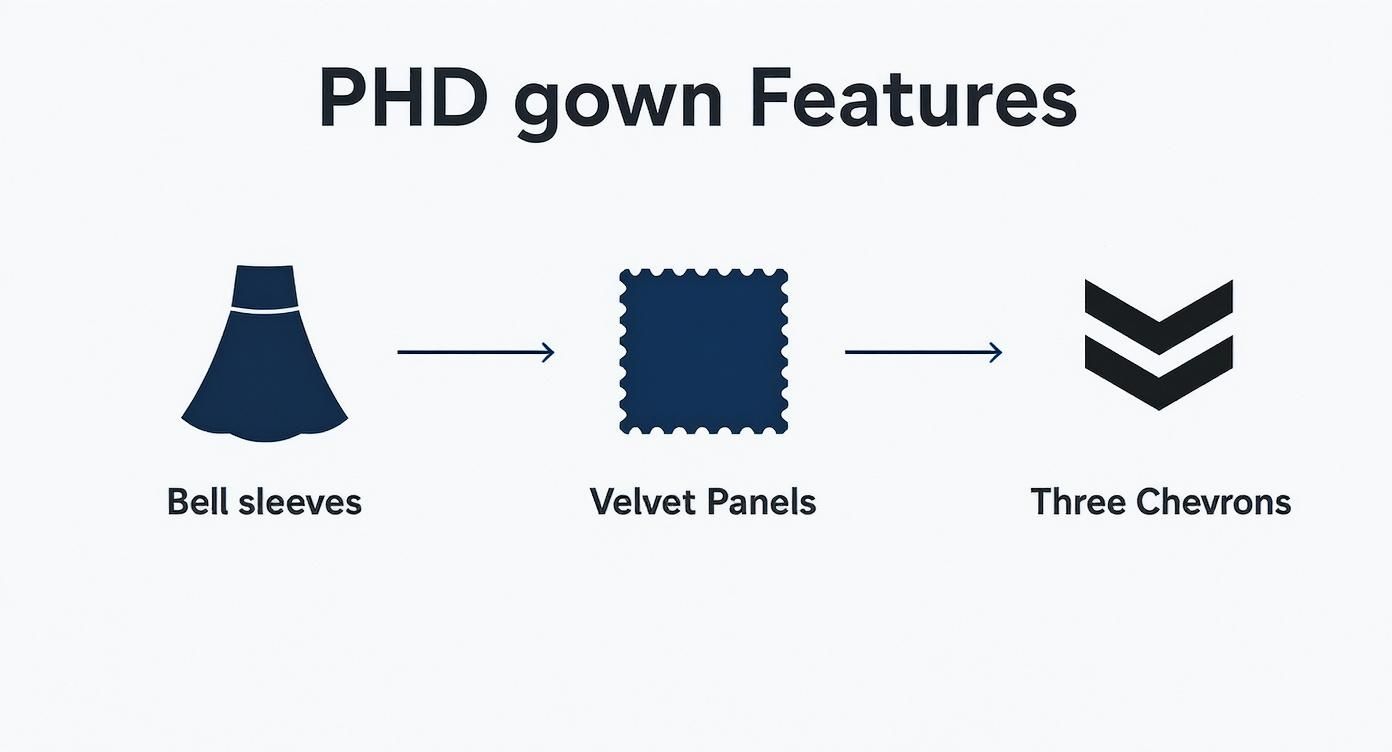
As the infographic shows, the bell sleeves, velvet panels, and three chevrons are what make the doctoral gown so distinct. They set the stage perfectly for the hood, which serves as the final, most symbolic element of your look.
The Anatomy of an Academic Hood
A doctoral hood might look a little complicated at first, but its design is actually quite logical. Each part has a specific job to do in telling your story. It’s made up of three main parts that work together beautifully.
- The Shell: This is the outer fabric of the hood. It’s almost always made from the same black material as your doctoral gown, giving it a classic, uniform structure.
- The Lining: When the hood is worn properly, it's turned out to reveal a colorful satin lining. These are your university's official colors, proudly displaying the institution that granted your hard-earned degree.
- The Velvet Trim: The band of plush velvet along the outer edge is arguably the most important color on your hood. This color signifies your specific degree and field of study.
The Velvet Trim: Your Field of Study
That velvet trim is what truly sets your PhD apart from others. Its color isn't random; it follows a standardized code that assigns a specific hue to each academic discipline. This system allows anyone familiar with academic regalia to instantly recognize your area of expertise.
For instance, the familiar dark blue velvet trim represents the Doctor of Philosophy (PhD), which is the most common doctoral degree. But other doctorates have their own designated colors. This color-coding adds a fascinating layer of meaning to the commencement ceremony, turning the procession of graduates into a vibrant display of the university's diverse scholarly community.
Common PhD Hood Velvet Colors and Their Meanings
Getting familiar with these colors is key to understanding the full story behind your PhD cap and gown. While the official list is long, a few common colors show up most frequently at doctoral ceremonies. Knowing them can help you spot the disciplines of your fellow graduates.
Here is a quick reference table for some of the most common doctoral hood colors you'll see.
| Velvet Color | Field of Study (Doctorate) | Example Degrees |
|---|---|---|
| Dark Blue | Philosophy | PhD (Doctor of Philosophy) |
| Golden Yellow | Science | Doctor of Science (ScD) |
| Light Blue | Education | Doctor of Education (EdD) |
| Brown | Fine Arts / Architecture | Doctor of Fine Arts (DFA) |
| Purple | Law | Juris Doctor (JD) |
| Green | Medicine | Doctor of Medicine (MD) |
| Lilac | Dentistry | Doctor of Dental Surgery (DDS) |
| Pink | Music | Doctor of Music (DM) |
| Orange | Engineering | Doctor of Engineering (EngD) |
The velvet color on your hood is a badge of honor for your specific discipline. It connects you to a long lineage of scholars in your field and visually represents your intellectual home within the vast world of academia.
Ultimately, your academic hood is the final, essential piece that completes your regalia. It ties your personal achievement—your specific doctorate from your specific university—to the centuries-old traditions of higher education. For a deeper dive into the symbolism behind each color, check out our complete guide on the meaning of doctoral hood colors. Wearing it correctly and with pride is the final step in presenting yourself as a newly minted doctor.
Choosing Your PhD Headwear

When it comes to your phd cap and gown, the headwear is where you get a choice that truly sets you apart from every other graduate. While everyone from high schoolers to master's candidates wears the familiar square mortarboard, doctoral graduates earn the right to wear something far more distinctive: the doctoral tam.
This isn't just a style choice; it’s a mark of your new academic standing. Think of the tam as a privilege reserved for those who have reached the pinnacle of their field. It’s an immediate visual cue that tells everyone you've earned your doctorate.
The Classic Mortarboard Cap
We all know the mortarboard—it’s the graduation cap. That stiff, flat square top and fitted skullcap are recognized around the world. It’s perfectly acceptable for a doctoral candidate to wear one, but it’s also the same hat worn by graduates at every level below you.
Many graduates feel the mortarboard just doesn't quite capture the significance of earning a doctorate. It gets the job done, but it lacks the unique character and comfort of the tam.
The Distinguished Doctoral Tam
The tam is a different story altogether. It’s a soft, brimless cap, almost always made from a plush black velvet that perfectly matches the velvet trim on your doctoral gown. Unlike the rigid, often wobbly mortarboard, the tam's pillbox shape is incredibly comfortable and stays put, which is a huge plus during a long ceremony.
The shape itself is part of its appeal. Most tams are designed with multiple sides, giving them a unique silhouette that you won’t see on anyone else.
- Four-Sided Tams: A classic, more subtle option that gives a hint of a squared-off look.
- Six-Sided Tams: This is one of the most popular styles, striking a great balance between tradition and elegance.
- Eight-Sided Tams: The fullest, most rounded profile. Many graduates choose this for its commanding and distinguished presence.
The doctoral tam isn't just an alternative to the mortarboard; it's an upgrade. Its velvet feel and unique shape are reserved for doctorate holders, making it a clear and comfortable symbol of your academic rank.
The Significance of the Gold Tassel
Another detail that matters is the tassel. For other degrees, the tassel color might represent the university or field of study. But for a doctorate, the tradition is much more specific.
A gold bullion tassel is the standard for all doctoral degrees, regardless of your field. This thick, metallic tassel adds a final touch of prestige to your phd cap and gown. It hangs from the center of your tam and, unlike the tradition for bachelor's degrees, is usually worn on the left side from the very start of the ceremony. This signifies that you've already earned your degree—the ceremony is a formality.
For a deeper dive into this tradition, check out our guide on what type of hat doctoral graduates wear.
Ultimately, whether you choose a tam or a mortarboard is up to you. But the tam offers a level of comfort, distinction, and symbolic weight that really honors the incredible achievement of earning a PhD.
How to Order Your Doctoral Regalia
Getting your doctoral regalia sorted out doesn't have to be another final exam. With a bit of foresight, ordering your PhD cap and gown can be one of the smoothest parts of your graduation prep. Let’s walk through the essential steps, from taking the right measurements to understanding your university's specific rules, so you can be confident you’ll have everything you need for the big day.
Think of it as a simple checklist. The first item? Deciding whether you'll rent or buy. Most universities partner with a specific vendor, but this choice is usually yours, and it’s the first step toward getting that iconic doctoral look just right.
Renting Versus Buying Your Regalia
One of the first forks in the road is deciding whether to rent or buy your regalia. There's no wrong answer here; it really boils down to your budget and what you see yourself doing after graduation.
Renting is the go-to for many graduates. It's cost-effective for a single event and completely hassle-free. You get your set for the ceremony, wear it with pride, and return it afterward. No need to worry about cleaning or finding a place to store it for years to come.
On the other hand, buying your regalia is a true investment in your academic future. If you’re planning a career in academia, you’ll likely attend future ceremonies as a faculty member. Owning your own PhD cap and gown means you're always ready. Plus, it serves as a powerful, tangible memento of all your hard work. When you're looking at your options online, new tools like virtual try-on technology can even help you see how it will look before you commit.
Key Takeaway: Renting is a smart, budget-friendly choice for a one-and-done ceremony. Buying is a long-term investment for future academics and a deeply meaningful keepsake.
This choice is part of a massive global market. The cost to purchase a doctoral set is significantly higher than for other degrees—wholesale sets can run from $48 to $70, while a bachelor's gown might be under $10 in bulk. That price difference reflects the superior materials, intricate details, and specific design elements that make doctoral regalia so distinct.
Your Essential Ordering Checklist
A little organization goes a long way in making this process a breeze. Just follow these steps, and you'll have everything covered well before your ceremony.
-
Start with Your University's Rules: This is non-negotiable. Before you even think about browsing, check your university's official commencement guide. They will have strict specifications for colors, styles, and often, a designated vendor you must use. Get this information first to avoid any costly mistakes.
-
Take Accurate Measurements: A poor fit looks sloppy and feels uncomfortable. For a perfect fit on your PhD cap and gown, you'll need three simple measurements:
- Height: Measure from head to toe, but be sure to wear the shoes you plan to have on for graduation.
- Chest: Wrap a tape measure around the fullest part of your chest to get an accurate number.
- Head Circumference: For your tam, measure the circumference of your head about an inch above your eyebrows.
-
Know Your Academic Details: Your academic hood is the most personalized part of your regalia, so you need to get the details exactly right. Have this information handy when you order:
- Your University: This dictates the colors of the satin lining.
- Your Exact Degree: Are you a Doctor of Philosophy (PhD), a Doctor of Education (EdD), or something else?
- Your Field of Study: This determines the velvet trim color. Philosophy is dark blue, Education is light blue, and so on.
-
Order Early, Relax Later: Procrastination is not your friend here. Custom-made regalia takes time to produce and ship. To avoid steep rush fees and the gut-wrenching anxiety of a late delivery, place your order several months ahead of time. For more great advice, check out our tips for graduation regalia ordering.
Following this checklist will help you navigate the process with ease, ensuring your regalia arrives looking perfect and ready for you to celebrate this incredible milestone.
PhD Regalia Ordering Timeline and Checklist
To make sure your regalia is ordered, delivered, and ready long before your ceremony, we recommend following this timeline. Planning ahead is the single best way to avoid stress and last-minute panic.
| Time Before Graduation | Action Item | Key Considerations |
|---|---|---|
| 3-4 Months | Research & Decide: Rent or Buy? | Evaluate your budget and future academic plans. Research university-approved vendors and custom suppliers like Gradshop. |
| 3 Months | Confirm University Specs & Measure | Download your university’s commencement guide. Take accurate height, chest, and head measurements. |
| 10-12 Weeks | Place Your Order | Submit your order with all correct details: degree, field of study, university, and sizing. This is the sweet spot for custom orders. |
| 4-6 Weeks | Confirm Shipping & Delivery Date | Follow up on your order. You should receive a tracking number and an estimated delivery date. |
| 2-3 Weeks | Receive & Inspect Your Regalia | As soon as it arrives, open the box. Try everything on. Check for correct colors, sizing, and quality. |
| 1 Week | Prepare Your Regalia | Remove your gown from the packaging and hang it up to let wrinkles fall out naturally. Lightly steam if necessary. |
| Graduation Day | Wear with Pride! | You’ve earned it. Follow our guide on how to properly wear your tam, gown, and hood. |
By breaking the process down into these manageable steps, you can focus on what really matters: celebrating the culmination of years of hard work.
Common Questions About Your PhD Regalia
Getting ready for commencement can bring up a surprising number of last-minute questions. When it comes to your PhD cap and gown, you want to feel completely confident that every detail is right for your big day. This is your practical guide to answering those common questions so you can focus on your achievement, not on wardrobe worries.
We'll walk through everything from how to wrangle that academic hood into place to the best way to preserve your gown after the ceremony. Let’s make sure you feel as sharp as you look.
How Do I Properly Wear My PhD Hood?
The academic hood can look a little intimidating at first, but it's simple to put on once you know the trick. Its whole purpose is to show off your university's colors and your field of study, so wearing it correctly is a key part of the tradition.
-
Get it Over Your Head: Start by placing the hood over your head. The V-shaped part should sit comfortably at the front of your neck, with the velvet trim facing up. The long tail of the hood will naturally drape down your back.
-
Flip the Colors: This is the magic step, and you might want to ask a friend or a ceremony marshal for a hand. The back of the hood is designed to be turned out, revealing the colorful satin lining that represents your university. Just flip the lining so the colors are visible—it creates that classic, vibrant look.
-
Secure the Front: You'll find a small cord or loop on the front V-neck part. This is crucial for keeping the hood from sliding around or uncomfortably pulling at your neck. Fasten it to a shirt button or use a pin to attach it to your gown. This will lock it securely and comfortably in place.
What Is the Difference Between a Master’s Gown and a PhD Gown?
The visual cues separating a master's gown from a doctoral one are very deliberate, each signaling a different level of academic achievement. While both are a clear step up from the bachelor’s robe, the PhD gown has some exclusive and very noticeable features.
- The Sleeves: A master's gown has distinctive oblong sleeves that are open at the wrist. In contrast, a PhD gown features full, bell-shaped sleeves, giving it a more formal and commanding presence.
- The Velvet: This is the biggest giveaway. The doctoral gown is trimmed with three velvet chevrons (bars) on each sleeve and matching velvet panels running down the front. A master’s gown has no such markings.
These aren't just decorative touches; they're part of an academic tradition that goes back centuries. The velvet chevrons and panels are reserved only for those who have earned a doctorate, making your gown instantly recognizable.
How Should I Care for My PhD Cap and Gown After Graduation?
Your regalia is more than just an outfit; it's a keepsake of a monumental achievement. Whether you'll wear it again as a faculty member or store it as a memento, a little care goes a long way.
The moment you get home, hang your gown up. This will let most of the wrinkles from being packaged fall out on their own. For any stubborn creases, gentle steaming is the way to go—never use a hot iron, as it can easily damage the fabric and flatten the velvet's pile.
When it comes to cleaning, always check the care tag first. Most high-quality doctoral regalia needs to be professionally dry-cleaned to protect the delicate materials. Understanding how to care for special fabrics is key to keeping your investment looking pristine for years.
For long-term storage, place your PhD cap and gown in a breathable garment bag and keep it in a cool, dry place away from sunlight, which can cause fading.
Can I Customize My PhD Cap and Gown?
Absolutely! Customization is a great choice, especially for graduates who are purchasing their regalia instead of renting. Adding a personal touch can make your academic attire feel even more special.
Some of the most popular ways to customize include:
- Upgraded Fabrics: You can often choose from different fabric weights and finishes for a more comfortable, luxurious feel and a better drape.
- Colored Piping: A thin line of colored piping along the velvet panels and chevrons can add a subtle but sharp touch of distinction.
- Embroidery: Many scholars choose to have their initials or graduation year embroidered on the inside lining of the gown as a personal mark.
One important note: always check your university’s commencement guidelines before ordering. Some institutions have strict rules to ensure a uniform look during the ceremony. Custom orders also take longer to produce, so be sure to get your order in well ahead of time.
At Gradshop, we make it easy to find doctoral regalia that truly honors your hard work. From complete PhD cap and gown sets to individual hoods and tams, our high-quality options will have you looking and feeling your best. Explore our collections and order with confidence today at https://www.gradshop.com.