

You've got the ceremony date. The cap and gown are either ordered or sitting in a cart. A family member just asked, “Did you send the announcements yet?” and suddenly this simple task doesn't feel simple at all.
That's the moment most families hit. They know graduation matters, but they don't always know how to make a graduation announcement that feels polished, clear, and worth keeping. Some cards accidentally read like party invites. Others get crowded with too much text, too many photos, or details that belong somewhere else. The result is confusion for guests and extra stress for the graduate.
A strong graduation announcement does three jobs at once. It shares the achievement, respects the reader's time, and gives the graduate a keepsake that still feels meaningful years later. That matters more than people think. Graduation announcements sit inside a ceremony tradition that reaches back to 12th-century medieval universities in Paris and Bologna, with later formalization at Oxford and Cambridge. Modern U.S. graduation attire also comes from those European academic traditions and was standardized in 1895 by the American Intercollegiate Commission at Columbia University, which helps explain why announcement wording still tends to sound formal and milestone-driven rather than casual or chatty (history of graduation traditions).
That formal instinct isn't outdated. It's part of why these pieces still work. Graduation is also a major U.S. greeting card category, with about 59 million graduation cards sold each year according to the Greeting Card Association, which shows how widely families still use this format to share the news across extended networks (Congressional Research Service report citing the Greeting Card Association).
Introduction to Graduation Announcements That Get Noticed
A graduation announcement isn't the same thing as an invitation. That distinction shapes everything else.
If the card only announces the milestone, recipients understand they're being informed and included in the celebration, not asked to attend. If it also includes ceremony tickets, RSVP instructions, or party details, then it needs to function like an invitation and be timed differently. Many of the mistakes I see come from mixing those two purposes into one crowded card.
What a good announcement actually does
The best announcements are easy to read in a few seconds. They tell people exactly who graduated, from where, and at what level. They also leave enough visual space that the graduate's photo, school colors, or honors can stand out.
Practical rule: If someone has to reread the card to figure out whether they're invited, the wording needs work.
Good announcements also match the ceremony experience. A high school senior in a classic cap and gown needs a different visual tone than a doctoral graduate wearing a hood and tam. Families notice when the announcement reflects what the graduate will wear on stage. That's why photo choice, regalia details, and degree level matter just as much as wording.
Why details still matter in a digital-first moment
Text messages and social posts spread news fast, but they don't replace the role of an announcement. Relatives save printed cards. Mentors pin them up. Grandparents display them next to ceremony photos. Even digital versions work better when they borrow the structure of a traditional announcement instead of reading like a casual caption.
A thoughtful announcement doesn't need to be fancy. It needs to be intentional. That means getting the timeline right, choosing the right format, keeping the wording tight, and designing around what the graduate has earned and will wear.
Planning Your Timeline and Checklist Without the Stress
Most announcement problems start too late, not at the printer.
If you wait until the final stretch of graduation season, every small task gets compressed. Photos become rushed. Guest lists stay messy. Envelopes sit unaddressed. The easiest fix is to work backward from ceremony day and treat the announcement like one more graduation essential, not a side project.
The timeline that keeps things calm
Independent etiquette guidance lines up around a narrow mailing window. Pure announcements are typically sent 2 to 4 weeks before the ceremony, with some guidance allowing 2 to 3 weeks before or up to 6 weeks after. When the piece also acts as an invitation, it should go out earlier so guests have time to plan and RSVP (graduation announcement timing guide).
Another etiquette guide recommends ordering announcements at least two months before mailing them, sending party-detail pieces 4 to 6 weeks before the event, and using a later window for announcement-only cards if needed (when to send graduation announcements).
That ordering buffer matters. It gives you time to proof, reorder if needed, gather addresses, and schedule photos in cap and gown without panic.

A reverse checklist that works
Use this sequence if you want a practical answer to how to make graduation announcement planning manageable:
- Start with the ceremony date. Count backward and decide whether your card is announcement-only or also includes an invitation.
- Build the recipient list early. Don't pull every name from your full contacts list. Graduation announcements usually go to family, friends, and people closely connected to the achievement. Some etiquette guidance also includes extended family, godparents, coaches, extracurricular teachers, and mentors who had a meaningful impact (who to send announcements to).
- Schedule the photo while regalia is available. If you want cap-and-gown images, don't leave photography until after everything else is done.
- Proof before you address envelopes. Catch name spelling, school wording, honors, and event details before anything gets stuffed.
- Mail in one batch. Mixed timing creates confusion, especially when some recipients are invited and others are only being informed.
The checklist families forget
The obvious tasks get done. The small ones cause delays.
- Address collection: Don't assume you already have current mailing addresses for professors, mentors, or out-of-town relatives.
- Photo consistency: Use the same cap, gown, stole, cords, or hood in the announcement photo that the graduate will wear on stage.
- Secondary event details: If there's a party, decide whether that belongs on the main card or a separate insert.
- Link testing: Any QR code or URL needs to be tested before printing.
- Graduation-day coordination: Families juggling regalia, photography, and ceremony logistics often benefit from a broader graduation day checklist.
If your announcement includes a celebration, a practical planning companion is these graduation party planning tips from The Merrill Hotel. They're useful when you're trying to coordinate mailing timing with food, venue setup, and RSVPs.
Send too early without a clear event purpose, and the card loses urgency. Send too late with party details, and guests can't plan around it.
Choosing the Right Format for Your Announcement
The right format depends on who's receiving it, how fast you need it, and whether the card is meant to become a keepsake.
Some graduates still want the classic printed card because it feels substantial and ceremonial. Others need something fast they can share with mentors, classmates, and long-distance relatives right away. Most families land somewhere in the middle.
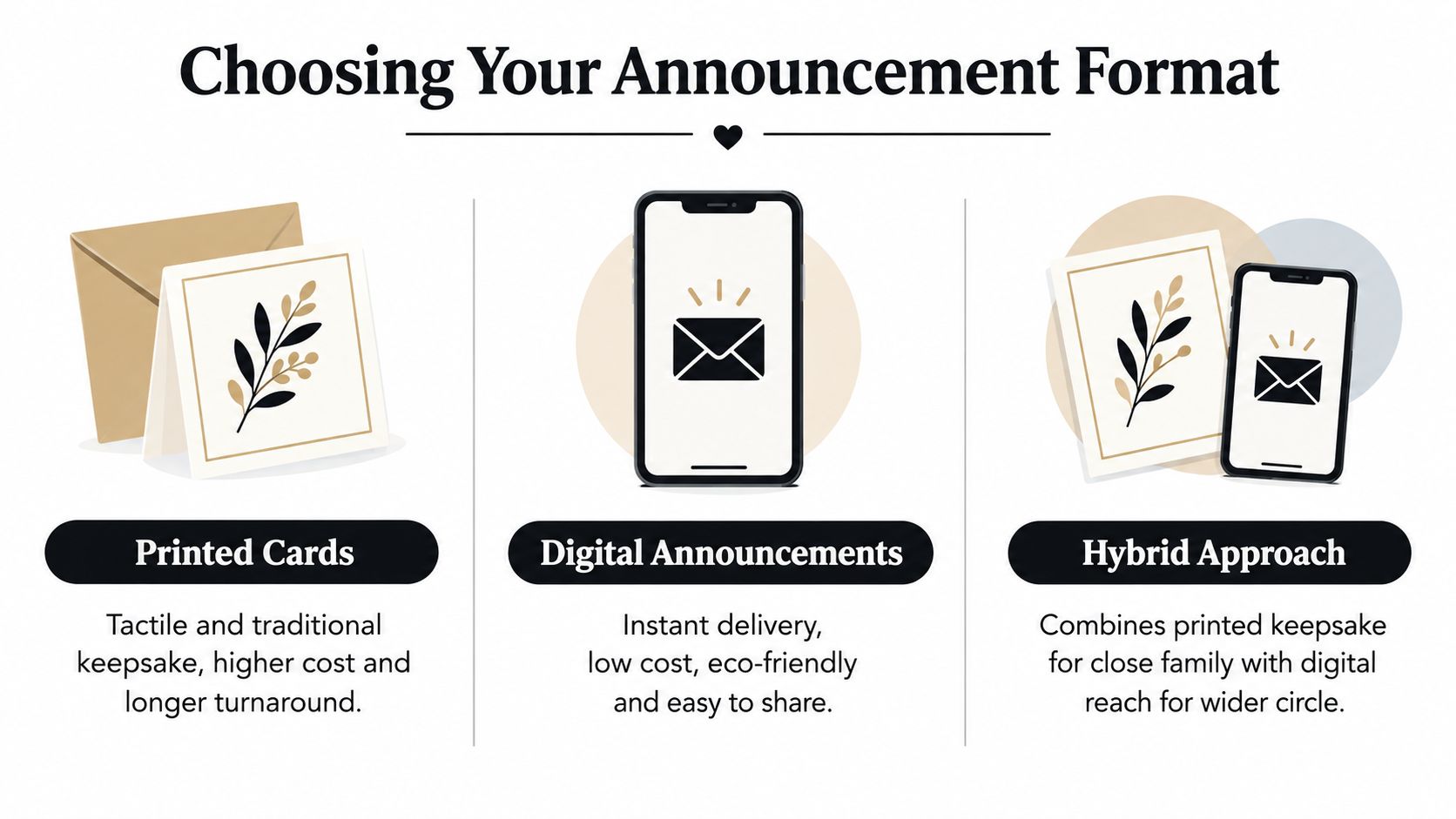
Print, digital, or both
Here's the trade-off in plain terms:
| Format | Works well for | Watch for |
|---|---|---|
| Printed cards | Close family, grandparents, formal mailing lists, keepsakes | Longer production timeline, envelope work, higher overall cost |
| Digital announcements | Fast sharing, distant networks, classmates, mentors | Easier to overlook, less tactile, can feel informal if poorly designed |
| Hybrid approach | Graduates with both formal family recipients and broad digital circles | Requires keeping wording and visuals consistent across formats |
Printed cards make the most sense when the audience values tradition. That's common for high school announcements sent to extended relatives or for advanced-degree milestones where the formality matches the achievement.
Digital announcements work well when speed matters or when the recipient is unlikely to need a mailed keepsake. Professors, internship supervisors, former coaches, and distant family friends often respond well to a clean digital version.
When each style makes sense
A simple flat card is often the safest choice. It gives the graduate photo room to breathe and keeps the wording easy to scan.
Foil or heavily embellished designs can work, but only if the rest of the design stays restrained. If the graduate is already wearing visible honors, school colors, or a doctoral hood in the photo, the announcement doesn't need extra visual noise.
A hybrid approach usually works best in real life:
- Mail printed cards to close family, godparents, and people likely to save the piece.
- Send digital versions to wider networks, especially when geography makes mailing slower or less practical.
- Use the same image and wording structure so everything feels connected.
A quick decision filter
Choose printed if the announcement needs to feel ceremonial.
Choose digital if the priority is reach and speed.
Choose hybrid if you want tradition for the inner circle and convenience for everyone else.
That's the practical answer to how to make graduation announcement decisions without overthinking every design option.
Wording and Layout Templates for Every Degree Level
Most wording problems come from trying to say too much.
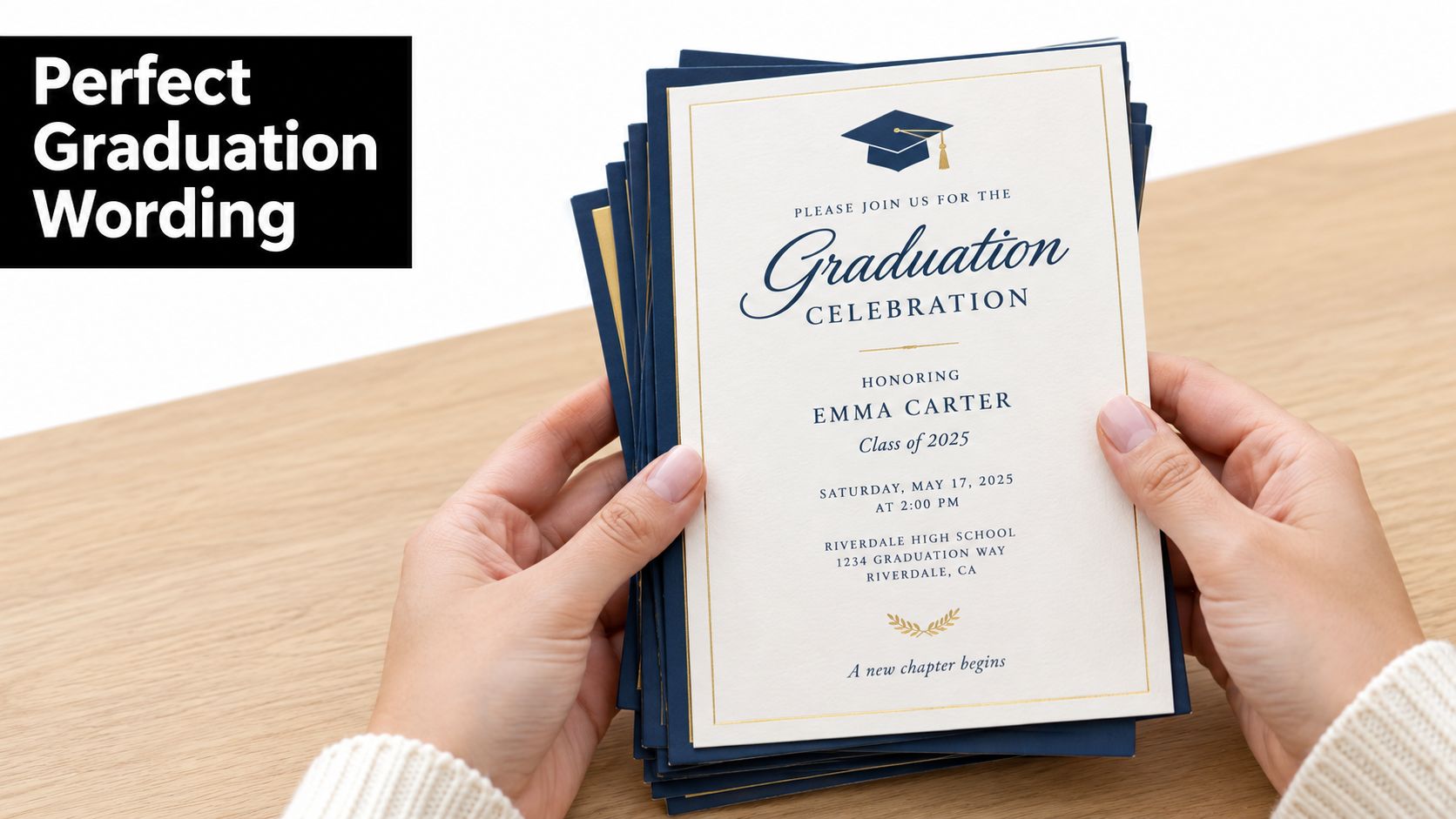
A practical workflow is to build the card around four mandatory data fields: graduate full name, school name, degree or level, and graduation year. Then add only one secondary action, such as RSVP or party details, if needed. Keeping the copy to about 4 to 6 lines improves readability and reduces clutter. Proofing photo resolution, spelling, addresses, and QR or link functionality catches the most common production mistakes before print (what to put on graduation announcements).
The clean layout that reads well
The strongest announcement layout usually looks like this:
- Line 1: Graduate's full name
- Line 2: School name
- Line 3: Degree, diploma level, or program
- Line 4: Graduation year
- Line 5 and 6: Optional honors or one event detail
That's enough. Once people start adding multiple quotes, long thank-you notes, future plans, and full party instructions on one card, readability drops fast.
Copy-and-use templates
If you need wording fast, these templates keep the structure clear.
High school graduation
[Graduate Full Name]
has graduated from
[High School Name]
Class of [Year]
Optional add-on line:
Honors: [Honor or distinction]
College graduation
[Graduate Full Name]
graduated from
[College or University Name]
with a [Degree Name]
Class of [Year]
Optional add-on line:
[Latin honors or academic distinction]
Master's degree graduation
[Graduate Full Name]
announces the award of a
[Master's Degree Name]
from [University Name]
[Year]
Optional add-on line:
Celebration to follow at [time/place]
Doctoral graduation
[Graduate Full Name]
has earned the degree of
Doctor of [Field]
from [University Name]
Class of [Year]
Optional add-on line:
Hooding ceremony and reception details enclosed
Short copy looks more formal than crowded copy. That's one of the easiest wins in graduation stationery.
Formal, casual, and audience-aware wording
Tone should match both the graduate and the recipient list. High school families often lean warm and celebratory. Graduate programs usually read better with a more restrained style.
Independent etiquette guidance also points to a wider range of recipients than many templates account for, including mentors, professors, and extended networks. It notes that announcements may include honors, school colors, photos, or “no gifts” language, but many examples still fall short on personalization for multicultural families, varied geographies, and digital-first sharing habits. That gap matters because graduation-platform coverage has reported that accurate pronunciation and pre-recorded name announcements can raise participation from 20% to 51%, showing that inclusive, personalized graduation communication can materially affect engagement (college graduation announcement etiquette and personalization).
That's a useful reminder. If you're sending to grandparents in one country, professors in another, and family friends who know the graduate by a nickname, you may need slightly different versions.
For more sample phrasing, degree-specific examples, and formal wording ideas, this collection of graduation announcement wording examples is a helpful reference point.
Design Tips That Make Your Announcement Shine
The announcement looks strongest when it matches the ceremony, not when it competes with it.
That means the graduate's real regalia should guide the design. If the graduate is wearing a matte black high school gown with a gold tassel, the announcement should echo that palette. If the graduate will cross the stage in a master's hood or doctoral tam, the photo and layout should leave room for those details instead of cropping them out.

Start with the regalia, not the template
Families often pick a card design first and then try to force the graduation photo into it. That usually leads to awkward cropping, lost tassels, hidden stoles, or colors that clash.
A better approach is to decide what needs to show in the photo:
- Cap and gown for a classic graduation look
- Honor cords or medals if academic distinctions matter visually
- Custom stole or sash if heritage, service, Greek life, military background, or first-generation identity should be visible
- Academic hood for master's and doctoral graduates, where degree color is part of the story
Once that's clear, the layout becomes easier. You know whether you need a full portrait, a waist-up image, or a tighter crop.
Match the card to what the graduate wears on stage
Announcement design becomes more memorable. The strongest cards borrow from actual commencement details.
| Ceremony detail | Design use |
|---|---|
| School colors | Use as accent text, border lines, or envelope liner color |
| Honors | Mention briefly in text or show visually through cords or medals |
| Degree level | Let the formality of the layout rise with the degree |
| Regalia silhouette | Choose photo crops that show the stole, hood, or gown shape clearly |
If you're coordinating the announcement with what the graduate will wear, it helps to review the actual regalia options first. For high school seniors, high school graduation caps and gowns set the core look. For identity-based or achievement-based personalization, custom graduation stoles and sashes often become the visual centerpiece. Graduate students usually need to think in terms of master's graduation regalia or doctoral graduation regalia, where hood color and tam style affect the overall photo. Finishing details like graduation honor cords, tassels, and diploma covers and frames can also influence what you choose to feature.
Keep the visual hierarchy simple
Typography should support the graduate's name, not overpower it. One readable display font for the name and one clean font for details is enough.
Use contrast carefully. Dark text on a light background almost always reads better in print. If the photo already has strong school colors, keep the rest of the design neutral so the card doesn't turn noisy. And always check photo resolution before finalizing. Soft images, muddy shadows, and overfiltered portraits age badly on printed keepsakes.
One practical option for coordinating regalia and ceremony items is Gradshop, which carries products across high school, college, master's, and doctoral levels, including stoles, hoods, cords, tassels, diploma covers, and related ceremony essentials. That makes it easier to match announcement styling to the actual graduation look when you're planning everything at once.
Printing Budgeting and Mailing Your Announcements With Confidence
Printing is where nice ideas either turn into a polished announcement or a rushed compromise.
You don't need the most elaborate stock or finish. You need enough paper quality for the card to feel intentional, enough time for proofing, and enough quantity to cover your actual list plus a few keepsake copies. Budget trouble usually comes from reprints, rush shipping, or oversized designs that complicate postage.
Where to spend and where to keep it simple
Spend on the parts people notice first: the photo, paper feel, and print clarity.
Save on extras that don't improve communication. That includes overdecorated layouts, too many inserts, or visual treatments that make the announcement harder to read. If the card includes a link to photos, a celebration page, or a video message, test it before printing. For families using scannable links, this guide to using a QR code at Wedding Studio is a practical reference for making sure the code works for recipients.
Mailing etiquette that keeps things orderly
A major stationery source recommends using a standard three-line address format for recipient names and addresses: family name first, street address second, and city-state-ZIP third. It also notes that announcements can be sent 2 to 4 weeks before graduation or 6 to 8 weeks after when paired with a graduate photo in cap and gown (graduation announcement wording and envelope format).
If your piece includes an invitation, another etiquette source says it should be mailed at least 2 to 3 weeks before the ceremony so guests have time to receive it and RSVP. If it does not include a party invite, sending it two weeks before through four weeks after is acceptable (graduation announcement etiquette timing).
Use that structure to avoid two common mistakes:
- Inviting too late: guests can't plan, and attendance drops
- Announcing too vaguely: readers don't know whether they're being informed or asked to respond
A final send-off checklist
Before the envelopes go out, check these:
- Names and spelling: Verify every graduate and recipient name.
- Addresses: Use the standard three-line format consistently.
- Photo quality: Make sure printed images are sharp.
- RSVP details: Include only if the piece functions as an invitation.
- Program consistency: If your family or school is coordinating ceremony materials too, a reference like these programs for graduation ceremony can help keep wording and presentation aligned.
Late send? It happens. If the event has passed, keep the wording centered on the achievement and consider using a cap-and-gown photo from the actual day. That reads as keepsake communication, not a missed invitation.
If you want your announcement to match the graduation moment, Gradshop offers caps and gowns, stoles, cords, hoods, tassels, diploma covers, and ceremony essentials across high school, college, master's, and doctoral levels. It's a practical place to coordinate the look on stage with the photo and details you put on the card, especially when timing and consistency both matter.