

A graduation stole is more than just a colorful piece of fabric draped over your shoulders; it's a wearable banner that tells the story of your unique academic journey. It's where you get to showcase everything from high honors and leadership roles to your cultural heritage and personal passions.
What a Graduation Stole Actually Represents

Think of your graduation regalia as an outfit, where each piece plays a distinct role. The cap and gown are the uniform, signifying your new status as a graduate. But the stole? That’s where your individual story truly shines through. It's easily the most versatile and expressive part of your academic attire.
While academic hoods and honor cords have fairly rigid symbolism, the stole acts as a canvas. It’s a powerful way to visually communicate the accomplishments that defined your time in school. This is why getting to the heart of a graduation stole's meaning is so important—it adds a rich layer of personal significance to the ceremony.
A Tradition with Deep Roots
The stole isn't a new trend. Its history traces all the way back to medieval Europe in the 12th and 13th centuries, evolving from the clerical 'stolas'—the Latin term for ceremonial scarves worn by clergy to signify their authority and service. As the first universities began to form, scholars adopted similar garments to represent their own scholarly commitment and achievements. You can learn more about the journey of graduation stoles from their historical roots to modern ceremonies.
That long history has evolved, allowing today's graduates to celebrate in ways that are both traditional and deeply personal.
A stole transforms a standard graduation gown into a personalized statement of achievement. It separates you from the crowd by highlighting what made your academic path unique—whether that’s academic excellence, cultural pride, or service to your community.
More Than Just Decoration
Every detail on a stole is there for a reason. The colors, symbols, and text embroidered onto the fabric are all chosen to represent specific affiliations or honors. This is what makes it so different from other regalia:
- Academic Honors: Signifies top-tier achievements like summa cum laude or membership in an honor society.
- Organizational Affiliation: Represents involvement in Greek life, student government, or other campus clubs.
- Cultural Identity: Celebrates heritage with powerful designs like Kente or Serape patterns.
- Field of Study: Uses specific, designated colors to denote a major, like light blue for education.
Whether you're looking for the perfect honor stole for your high school graduation or distinguished regalia for a master's degree, each stole tells a vital part of your success story.
Decoding the Language of Colors on Your Stole
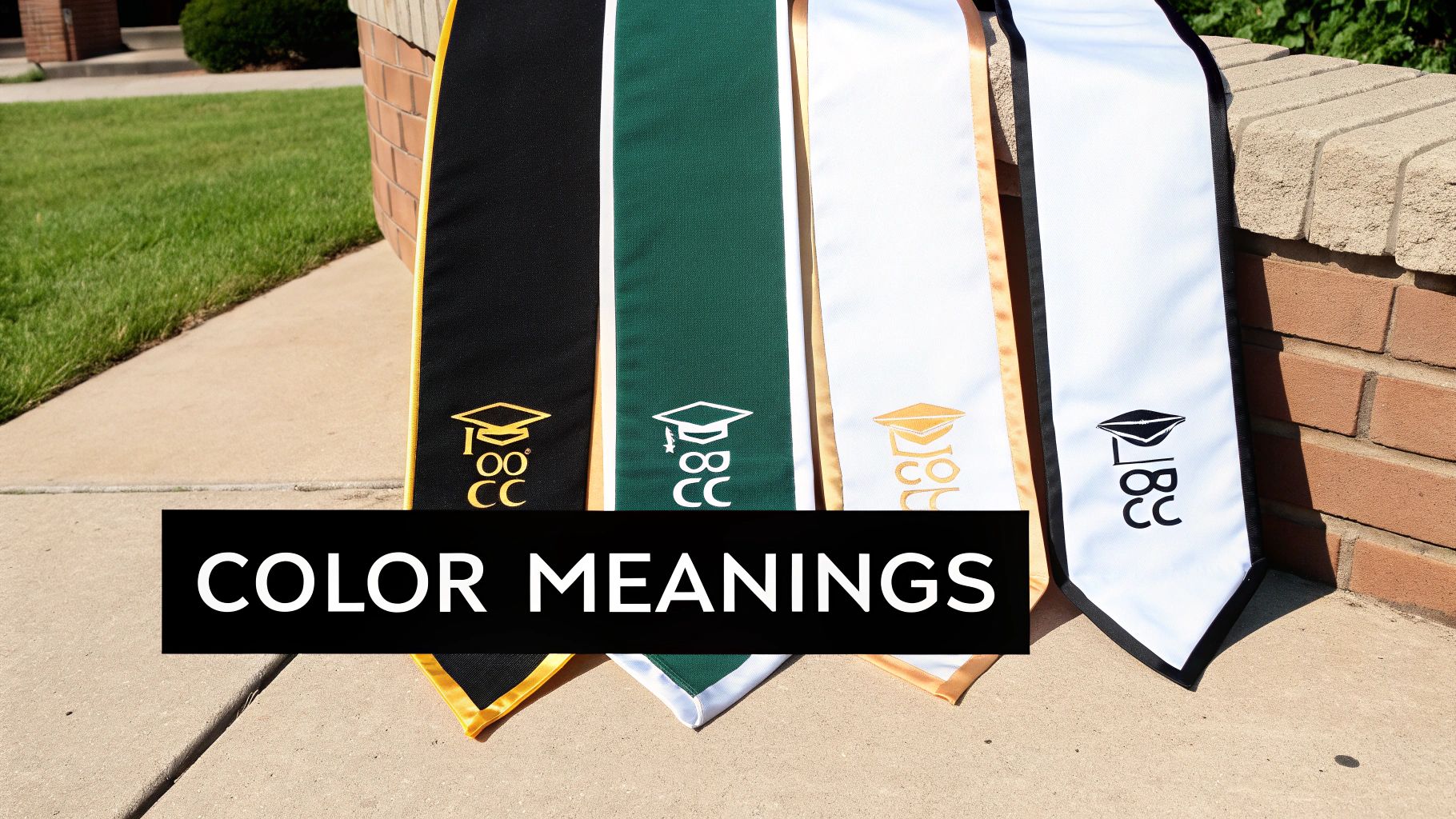
The colors on a graduation stole are so much more than a design choice. They’re a visual language, a kind of code that tells you about a graduate's unique academic journey at a single glance. Understanding this color tradition adds a whole new layer of meaning to the ceremony.
Of course, some schools stick to their own institutional colors to create a sense of unity across the graduating class. But many others follow a standardized academic color code that assigns specific hues to different fields of study, turning the commencement into a vibrant, meaningful tapestry of achievement.
Common Colors for Academic Excellence
No matter what you studied, some colors are universally understood to signal top-tier academic achievement. You'll typically see these on students who have earned Latin honors (like summa cum laude) or have been inducted into prestigious honor societies.
- Gold: This is the classic. Gold almost always signifies the highest honors. A gold stole is an undeniable mark of distinction.
- Silver: You'll often see silver used for general academic honors or significant scholastic achievements that are a step below the very highest awards.
- Red: While red can represent a specific major, it's also frequently used to highlight students with leadership roles, like those in student government or other major campus organizations.
Think of these colors as a quick visual cue, instantly recognizing someone for their outstanding performance and dedication.
Colors Representing Fields of Study
Beyond general honors, there's a widely used color system that ties a stole directly to a graduate’s major or degree. While you might find slight variations from one school to the next, many colors have long-held traditional associations. We actually have a much more detailed breakdown in our guide to graduation stole colors and their meanings.
Understanding this color code lets you truly appreciate the incredible academic diversity at any graduation. It’s a celebration not just of finishing, but of the specific knowledge and skills each and every graduate worked so hard to master.
Here are just a few of the most common examples you’ll see:
- Light Blue for Education
- Golden Yellow for Science and Mathematics
- Drab (Beige) for Business and Accounting
- White for Arts, English, and Humanities
- Orange for Engineering
- Green for Medicine and Pharmacy
- Purple for Law and Jurisprudence
When you spot a graduate wearing one of these colors, you’re seeing a proud declaration of their chosen field. It's a fantastic tradition that honors the specific path they took to get to that stage.
Celebrating Heritage with Cultural and Organizational Stoles
While the color of your stole can represent your field of study, many stoles tell a far more personal story—one of heritage, identity, and the communities that shaped you. These stoles go beyond pure academics to celebrate the unique journey that brought you to this moment.
When you wear a stole that represents your background or a group you belong to, you're sharing a vital piece of who you are. It’s a powerful way to add a rich, meaningful layer to the traditional cap and gown.
Stoles of Cultural and Heritage Pride
For so many graduates, commencement is the perfect time to honor their roots. Cultural stoles are beautiful expressions of identity, designed with specific patterns, colors, and symbols that pay tribute to a student's heritage.
Here are a few of the most popular cultural stoles you'll see on graduation day:
- Kente Stoles: You can't miss the intricate, brightly colored patterns of Kente cloth, which originates with the Ashanti people of Ghana. Every single color and pattern has a specific meaning, representing concepts like royalty, strength, and spiritual purity. This makes it a profound symbol of African and African-American heritage.
- Serape-Inspired Stoles: These stoles, with their vibrant striped patterns, are reminiscent of traditional Mexican serapes. They're a beautiful way for graduates to celebrate their Latino or Hispanic pride and connect with their cultural identity on a special day.
- International Flag Stoles: It's common to see students who studied abroad or international students wear a stole featuring the flag of their home country or the country they studied in. It’s a great visual representation of their global perspective and the cross-cultural experiences that shaped their education.
If you want to take a deeper dive into one of the most significant cultural garments, check out our guide on the symbolism and history behind Kente stoles. These stunning designs allow graduates to carry their history with them as they step toward their future.
Celebrating Unique Journeys and Affiliations
Beyond cultural heritage, stoles are also a fantastic way to signify other important parts of a graduate's story. These stoles often highlight perseverance, service, and the specific communities that were instrumental to their success.
This kind of personal expression has become incredibly important. In fact, a 2023 Gradshop customer survey of over 10,000 buyers found that 92% of U.S. colleges now permit custom stole designs. Cultural stoles are especially popular—Kente stoles are worn by approximately 30% of Black graduates at HBCUs, and serape-inspired stoles are used in 15% of ceremonies in the Southwest U.S. These traditions are thriving.
Wearing a stole of identity is a way of saying, "This is who I am, this is where I come from, and this is what I accomplished." It acknowledges that the path to graduation is shaped by more than just academics.
Other meaningful stoles you might see include:
- First-Generation Stoles: Worn by students who are the first in their family to graduate from college, these stoles represent a truly monumental achievement not just for the graduate, but for their entire family.
- Military Service Stoles: Graduates who are veterans, on active duty, or are commissioning officers will often wear a stole representing their branch of the U.S. military—a proud display of their service.
- Greek Life Stoles: Members of fraternities and sororities proudly display their organization's Greek letters, colors, and crests, celebrating the brotherhood or sisterhood that was a key part of their college experience.
Stoles vs. Hoods vs. Cords: Navigating Your Academic Regalia
As graduation day approaches, you’ll start hearing a lot about regalia—and it can feel like learning a new language. You have your cap and gown, but what about all the other accessories? Stoles, hoods, cords… what’s the difference?
Think of your gown as the foundation of your graduation look. The accessories are what tell your unique story. While they all signify achievement, each piece—the stole, the hood, and the honor cord—has a very specific job to do.
The Stole: Your Personal Storyboard
Of all the regalia, the graduation stole is easily the most versatile and personal. It’s that long, sash-like piece of fabric you wear draped over your shoulders, and it’s a powerful way to showcase who you are.
- What it represents: Stoles are a canvas for your accomplishments and identity. They can represent academic honors, membership in a club, your cultural heritage, service in the military, or your affiliation with a fraternity or sorority.
- Who wears it: Anyone can wear a stole! They’re common for graduates at every level, from high school ceremonies to doctoral commencements.
- Appearance: Typically made of satin, stoles are designed to be customized. You’ll see them with intricate embroidery, logos, flags, and specific color schemes that make each graduate’s regalia unique.
The Academic Hood: A Mark of Higher Learning
The academic hood is the most formal and regulated piece of graduation attire. Unlike the versatile stole, its meaning is very precise: it signifies the completion of a postgraduate degree, like a master’s or a doctorate.
The colors on a hood aren't random; they're a code. The velvet trim color points to your specific field of study (like light blue for Education or gold for Science), while the satin lining proudly displays the official colors of the university that granted your degree. We dive deeper into this in our guide to graduation hoods vs. stoles.
While a stole is a statement of your personal journey, an academic hood is a formal declaration of advanced academic achievement. It’s a tradition-rich item reserved for those who have completed graduate-level studies.
The Honor Cord: A Symbol of Distinction
Finally, we have honor cords. These are the simplest of the three—thin, twisted ropes with tassels on the ends, worn around the neck.
- What it represents: Cords almost always point to a specific academic achievement, most often related to a high GPA. They're the visual marker for Latin honors like summa cum laude (highest honors), magna cum laude (high honors), and cum laude (honors).
- Who wears it: You'll typically see honor cords worn by undergraduates and high school students who have met their institution's criteria for academic excellence.
- Appearance: The colors of the cords are key, representing the level of honor or membership in a particular honor society. A student might wear a single cord for one achievement or have multiple cords braided together.
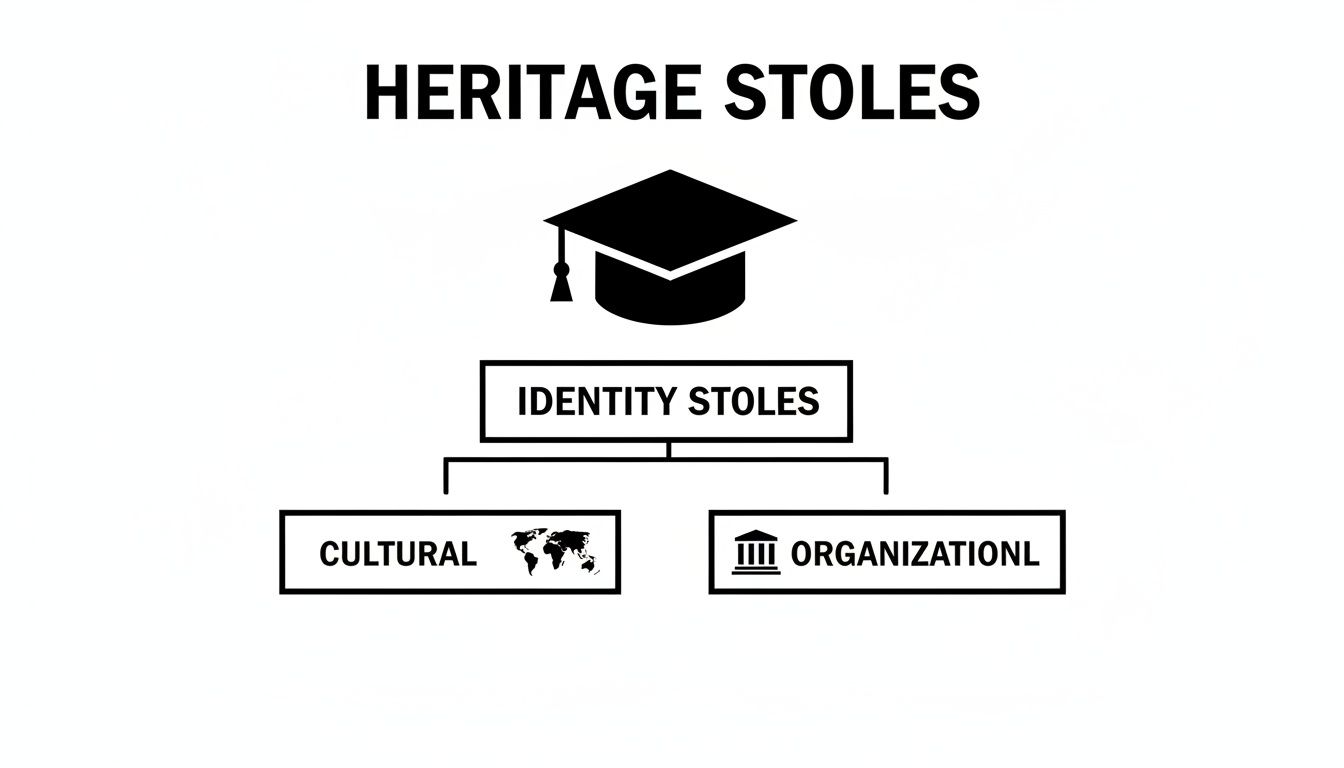
This diagram helps show the two main paths for stoles: one representing personal identity and cultural heritage, and the other for belonging to a specific organization or group. It really highlights the stole's unique role in letting graduates celebrate their individual journeys.
To make it even clearer, here’s a quick side-by-side comparison.
Stole vs. Hood vs. Cord: A Quick Comparison
| Regalia Item | Primary Meaning | Academic Level | Typical Appearance |
|---|---|---|---|
| Stole | Personal identity, honors, clubs, cultural heritage | All levels (High School, Bachelor's, Master's, Doctoral) | Wide, sash-like fabric, often customized with embroidery |
| Hood | Specific postgraduate degree and field of study | Master's & Doctoral only | Draped fabric with velvet (discipline) & satin (school colors) |
| Cord | Specific academic honors (e.g., GPA-based) | High School & Undergraduate | Thin, twisted ropes, color-coded by honor society or level |
Ultimately, each piece of regalia works together to tell the full story of your time as a student. The hood and cords speak to your academic rigor, while the stole shares a piece of your personal identity with the world.
How to Properly Choose and Wear Your Graduation Stole

You've spent years working toward this moment, and you've picked a stole that tells your story. Now for the final touch: wearing it correctly. How you wear your stole is what pulls your entire graduation look together, making you look sharp and confident while respecting the traditions of the day.
It's actually quite simple. The main goal is to get the stole to drape evenly over your shoulders, laying flat against your gown without any annoying twists or bunches. A few small adjustments make all the difference.
Step-by-Step Guide to Wearing Your Stole
Getting that perfect, polished look is easy. Once you’ve got your gown on and zipped up, you're ready to go.
- Find the Center: Hold the stole up and look for the midpoint. On most stoles, there's a V-shaped seam at the back that makes this obvious.
- Drape from the Back: Place that center seam right on the back of your neck, like you're putting on a scarf.
- Even it Out: Let the two long ends of the stole hang down your front. Take a second to adjust them so both sides are the same length. They should lie smoothly against the front panels of your gown.
- Secure if Necessary: Most stoles will stay put on their own, but if you're worried about it shifting during the ceremony, a small safety pin hidden under the back of your gown can keep it perfectly in place.
The right fit does more than just look good—it honors the graduation stole meaning. When your stole is draped properly, any custom embroidery or symbols representing your achievements are clearly and respectfully displayed for everyone to see.
Choosing the Right Stole for You
So you know how to wear it, but how do you pick the right one in the first place? It really comes down to the physical details. The material and, just as importantly, the length contribute to the overall look, whether it's for a high school graduation or part of more complex master's and doctoral regalia.
Keep these details in mind when making your selection:
- Length and Your Height: While most stoles have a standard length, how it looks on you is what matters. The ends should ideally fall somewhere between your waist and the top of your knees. This sweet spot keeps it from looking comically short or overwhelmingly long.
- Material and Finish: The classic choice is satin, which has a beautiful sheen that catches the stage lights perfectly. You'll often have a choice between a high-shine satin or a more subtle matte finish, so go with what feels right for you (and what your school allows).
Ultimately, the perfect stole doesn't just carry a ton of personal meaning; it also fits seamlessly with the rest of your academic attire. It should complement everything from a traditional high school cap and gown to advanced university regalia. When you find one you love, it stops being just a required accessory and becomes a true keepsake of your accomplishment.
Your Graduation Stole Questions Answered
As your big day gets closer, you're probably starting to think about the finer details of your graduation regalia. Let's tackle some of the most common questions about graduation stoles so you can walk across that stage with complete confidence.
Can I Wear More Than One Graduation Stole?
Absolutely! It's very common for graduates to wear multiple stoles, and it's a great way to show off everything you've accomplished. You might layer one for academic honors on top of another celebrating your cultural heritage, or maybe one for your fraternity and another for a specific program.
Just be sure to check with your school first. Some institutions have specific guidelines about how many stoles you can wear at once.
When you're layering them, you want to make sure each one gets its moment in the spotlight. Here's a simple way to do it:
- Step 1: Start with the widest stole, or the one that feels most important to you, and put it on first.
- Step 2: Gently drape the second one right on top, adjusting it so the design and colors of both are clearly visible.
- Step 3: Make sure they both lie flat against your gown and aren't bunched up around your neck. The goal is a neat, respectful display of your achievements.
What’s the Difference Between a High School and College Stole?
While they might look similar at a glance, the real difference is in the story they tell.
High school stoles are typically all about school spirit. They often feature the school's colors, the graduating class year, or recognize top honors like valedictorian or salutatorian. You can see some great examples in our high school stoles collection.
College stoles, however, are usually much more specific. They represent a deeper connection to academic tradition. A stole at the university level might signify your exact field of study (like engineering or nursing), membership in a prestigious national honor society, or your involvement in a unique academic program. The graduation stole meaning becomes a formal nod to your specific academic journey.
How Far in Advance Should I Order My Graduation Stole?
Good timing is everything if you want to avoid that last-minute scramble.
For a fully custom stole with special embroidery or logos, you’ll want to order at least 4-6 weeks before your graduation. That gives plenty of time for the design, production, and shipping to happen without any stress.
If you're grabbing a standard, in-stock stole—like a classic gold honor stole or a Kente stole—ordering 2-3 weeks ahead of time is a safe bet.
For schools and organizations placing bulk orders, it's best to start the process 2-3 months before the ceremony. This ensures there's ample time to coordinate the design, get everything produced, and distribute them to the graduates smoothly.
A "Stole of Gratitude" is a special stole a graduate wears during the ceremony and then gives to someone who was a huge part of their success—like a parent, mentor, or favorite teacher. It’s a wonderful tradition that turns a piece of regalia into a meaningful gift and a cherished keepsake.
With your stole and gown all sorted, you can focus on the fun stuff, like planning a graduation party to celebrate with friends and family.
What Is a Stole of Gratitude?
The Stole of Gratitude is one of the most heartfelt traditions in commencement ceremonies. It’s a way to shift the spotlight from your own accomplishment and shine it on the people who helped you get there.
A graduate wears this special stole throughout the ceremony, and it serves as a visible thank you to their support system.
After the diplomas are handed out, the graduate finds that one person who made a real difference—a parent, a mentor, a professor, or even a close friend—and presents the stole to them. It’s a powerful, tangible way to share the honor of the moment and say, "I couldn't have done this without you." These stoles often have simple, beautiful messages embroidered on them, like "Thank You" or "You Made a Difference," making the gesture incredibly touching.
At Gradshop, we know that every piece of your regalia tells a part of your unique story. From high school celebrations to earning your doctorate, we have everything you need to honor your journey. Take a look at our full collection of graduation stoles to find the perfect one to represent your hard-earned achievements.