

You've chosen your graduation outfit, but the stole still isn't settled. You want it to recognize your family, achievements, or student organization, and the ceremony date is getting closer. Before you approve a design, you need to know whether it's allowed, how it will look over your gown, and what the maker needs to produce it correctly.
Designing a Stole That Means Something
Consider a graduate who wants a white stole with a family name, an organization emblem, and a message of thanks. Each element matters, but placing everything on the same garment can make the design crowded. Choosing an attractive layout also doesn't establish permission to wear it.
A graduation stole maker needs more than a description of the decoration. The maker needs to understand the intended wearer, ceremony, wording, visual priorities, and delivery requirements. Your job is to explain what the stole should communicate. The maker's job is to translate that meaning into a garment with suitable proportions, materials, and readable decoration.
A plain stole is a useful starting point because you can consider placement before committing to embellishment.

Begin with the school's accessory policy, then choose the main message. A family tribute might prioritize a name; an organization stole might prioritize its approved emblem. Use this guide to graduation stole colors and their meaning to frame your questions, not as a substitute for institutional guidance.
Practical rule: Decide what the stole must communicate before deciding how much decoration it should carry.
Keep your complete outfit in view. A meaningful accessory still needs to work with the gown, neckline, and any required academic hood.
How Academic Stoles Fit Into Regalia
Think of academic regalia as a visual language rather than a collection of interchangeable accessories. A gown, cap, tassel, hood, cord, and stole can communicate different information. The institution decides which combinations belong at its ceremony.
That language has deep roots. Academic clothing developed through medieval European university traditions, with gowns and hoods serving practical purposes before becoming ceremonial symbols. In the United States, an intercollegiate commission formed in 1893, and representatives adopted an academic-dress code at Columbia University in 1895, according to the University of Pennsylvania's history of academic regalia.
The diagram separates the main garments so you can recognize what a product listing describes.
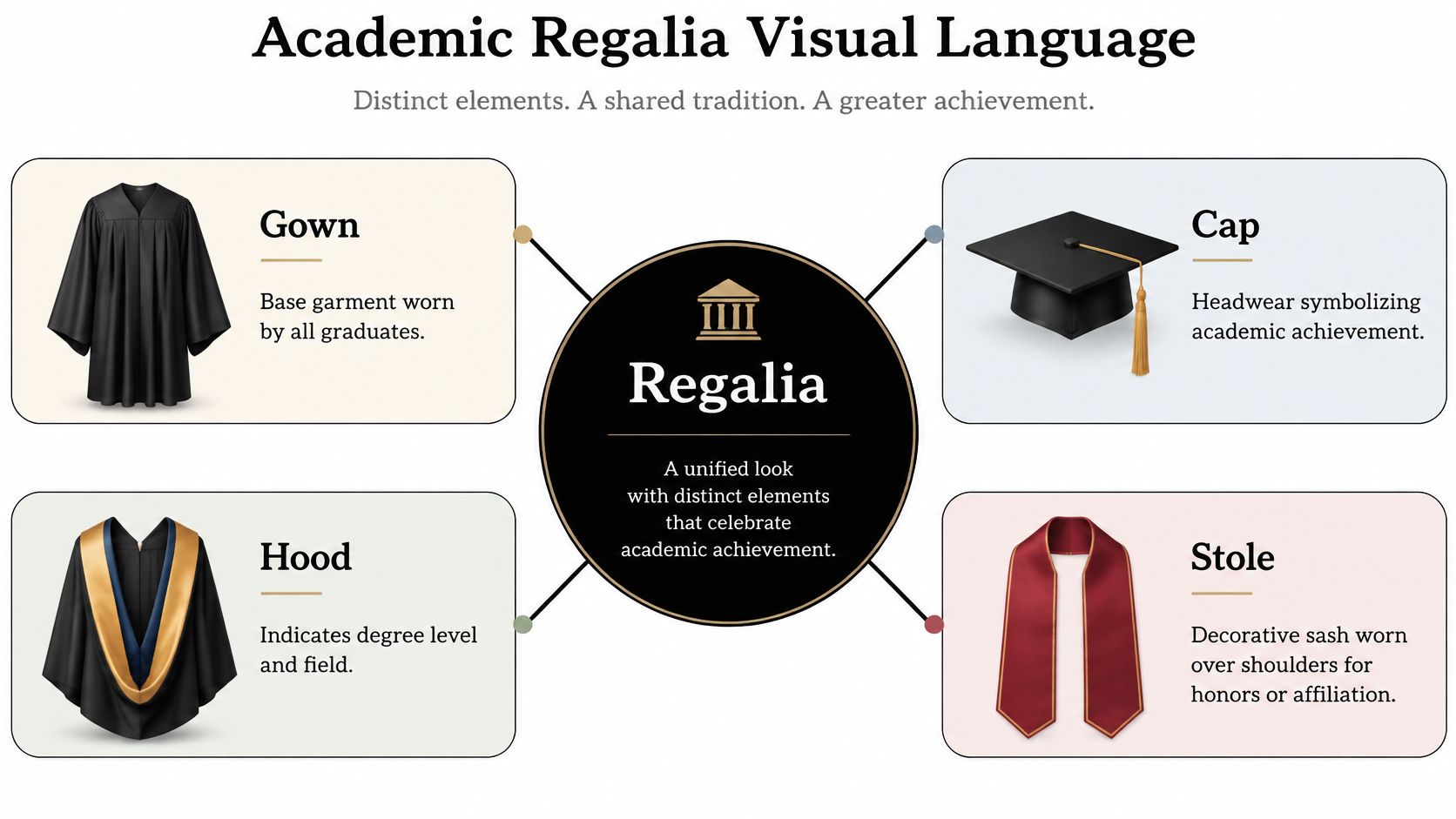
A stole is the shoulder-worn accessory you might personalize for achievement, identity, service, or affiliation. An academic hood belongs to a more formal degree-related system. Confusing the names can lead you to order an attractive accessory when you need a required garment.
Identity and academic qualification
Honor, cultural, military, international, Greek-life, and class-year stoles can carry personal or organizational meaning. Their purpose isn't automatically equivalent to the meaning of a hood.
When comparing listings, ask whether you're buying an optional identity piece or official degree regalia. That distinction matters more than whether a seller describes both garments as ceremonial.
Compare Stole Styles and Personalization Choices
Compare the garment shape before comparing decorative details. Ask for the available pattern or a clear product photograph rather than assuming that descriptions such as straight, sash-like, or V-stole identify identical construction across sellers.
Next, separate fabric, base color, lettering, logos, and trim into individual decisions. A contrasting border can frame a simple design, while embroidery can give lettering a textured appearance. Neither choice fixes an overcrowded layout.
Personalization Options by Stole Purpose
| Stole Purpose | Typical Visual Direction | Primary Ordering Check |
|---|---|---|
| High school class-year stole | Clear year lettering and a restrained school-color palette | Does the design coordinate with the required gown? |
| Honors stole | Approved honor name, emblem, or color | Is the wearer entitled to that distinction? |
| Cultural or heritage stole | Meaningful pattern, wording, or symbols | Is the representation appropriate and permitted? |
| Military stole | Service-related wording and approved imagery | Are names, symbols, and affiliations accurate? |
| Organization stole | Recognized name, letters, or emblem | Has the organization authorized the artwork? |
For fabric and drape, ask how the finished stole hangs over the actual gown. Don't judge it only from an artwork preview on a flat background. A design that looks balanced on screen may place important text too close to the neckline or below the intended photograph crop.
For lettering, prioritize contrast and hierarchy. If the year is the main message, give it more visual space than a secondary dedication. Ask the maker whether small lettering or intricate emblem details need simplification.
For embellishment, choose deliberately. Trim, embroidery, printed artwork, and decorative accents should support the message rather than compete with it. Request confirmation of the available techniques for the specific item, since a customization option on one listing may not apply to another.
Build a Production-Ready Stole Design
A useful design brief replaces subjective requests with instructions the maker can reproduce. Instead of asking for a distinguished-looking stole, identify the approved colors, finished shape, exact wording, and placement you want.
University specifications illustrate this precision. The University of New England specifies a gold cloth stole 10 cm wide and 2.5 m long, with 13 mm satin ribbons, in its academic-dress requirements. Those aren't universal buying dimensions. They demonstrate why a maker needs explicit specifications rather than assumptions.
Use this sequence to organize the handoff.
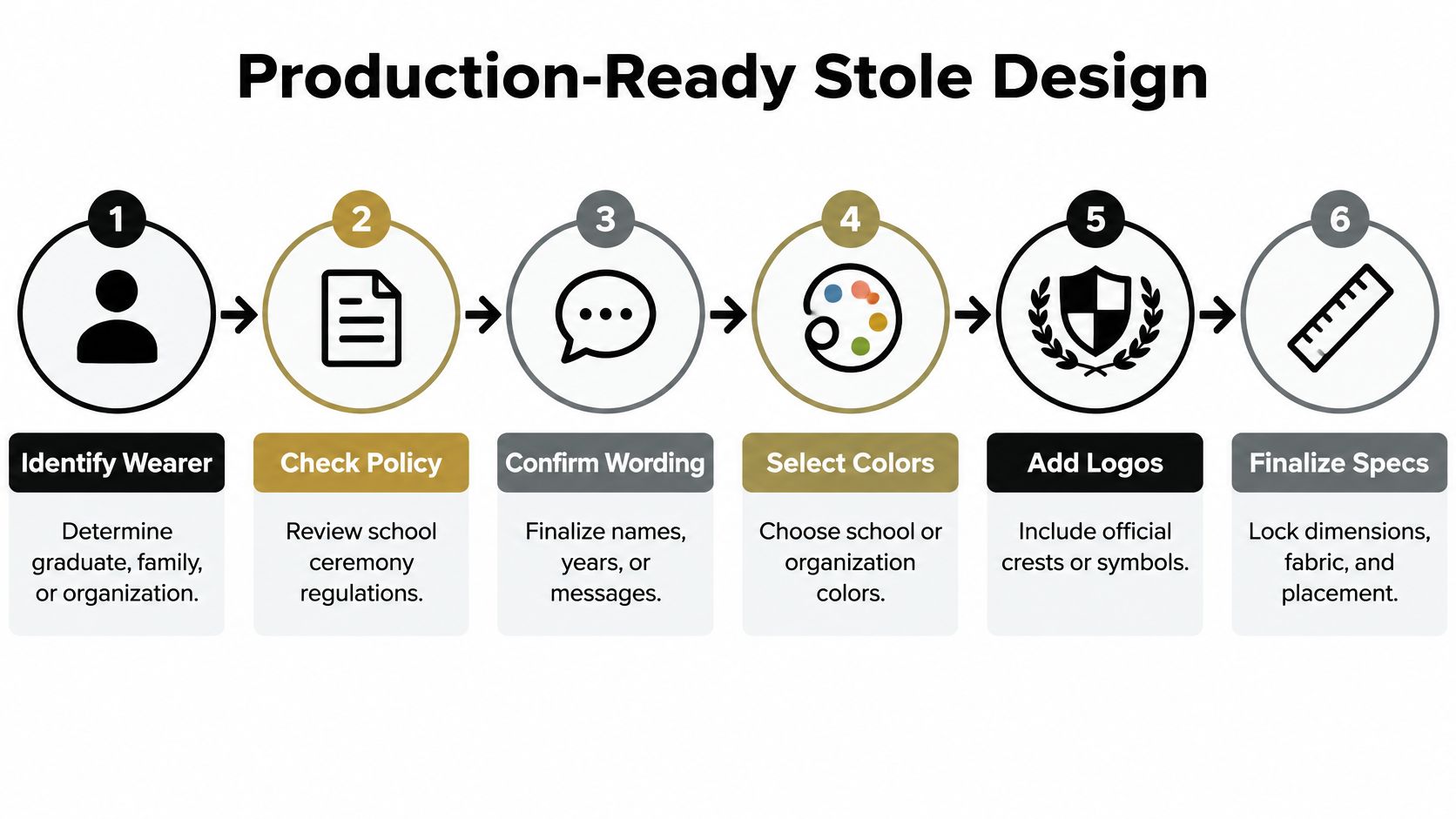
Prepare the artwork and construction brief
- Identify the wearer and ceremony: Include the intended event and the date the finished garment must arrive.
- Lock the wording: Check names, capitalization, graduation year, and the order of phrases such as “Class of.”
- Define the colors: Provide approved references where available. Don't rely solely on a screen preview.
- Supply clear artwork: Use an authorized logo file rather than a screenshot. Cobra DTF's production-ready vector design guide offers useful context for preparing artwork, while your stole maker should confirm its own file requirements.
- Specify construction: Record finished dimensions, fabric, edging, lettering method, and placement.
- Approve the proof: Confirm the final version in writing before production begins.
For embroidery, ask about polyester thread, stabilizer, and lettering size. A technical comparison of embroidery threads reports stronger lightfastness for polyester than rayon and lower rub resistance for metallic thread. The practical question is how the chosen thread and stitch density will perform on the selected fabric without puckering.
Before submitting payment, match the approved proof to the current product details. Confirm whether the delivery estimate includes artwork approval, production, and shipping, rather than shipping alone.
Check Ceremony Rules Before Customizing
More decoration isn't always a better choice. An attractive stole can still be unsuitable if the school restricts its organization, wording, or visual resemblance to an academic honor.
The University of Southern Indiana permits university-approved stoles and cords for specified affiliations, including recognized organizations, international affiliations, military and veteran students, fraternities, sororities, and athletic teams. Its regalia, stoles, and cords policy also requires approval for adornments. Permission therefore depends on more than the accessory's general category.
Purdue takes an institution-controlled approach to the complete outfit. Its commencement attire guidance requires official university-approved academic attire and excludes keepsake or unofficial gowns. An accessory purchase shouldn't distract you from checking whether the base outfit is acceptable.
Ask the person who can authorize it
Contact the commencement office, school administrator, or designated regalia coordinator with the proposed design attached. Ask whether the rule applies to the main commencement ceremony, a separate recognition event, or both.
- For honors: Verify eligibility and whether the school supplies the required cord or stole.
- For cultural designs: Ask who approves personal or community symbols.
- For organizations: Confirm both institutional permission and authorization to use the name or emblem.
- For academic colors: Check whether a proposed color could imply a distinction you haven't received.
A school's silence about a particular design isn't the same as written approval.
If you're considering international imagery, the flag graduation stole guide can help you consider the design's purpose before submitting it for review. Once permission is settled, return to the intended stole and cap-and-gown listing rather than substituting a visually similar item.
Explore Personalized Stole Examples
A high school class-year stole can begin with a straightforward message: the graduate's milestone. Consider prominent year lettering, a contrasting background, and enough open space that the wording remains easy to distinguish.
This example shows how a light-colored stole can provide a clear background for the year.

An honors stole should communicate the school's recognized achievement, not merely look prestigious. A Kente or heritage stole begins with cultural meaning rather than a matching-color exercise. An international-flag stole may recognize a graduate's background or connections, so ask which flag representation and orientation the maker will reproduce.
Match the example to its purpose
- Military recognition: Consider concise service-related wording. Ask the institution whether the proposed recognition is eligible for ceremony wear.
- Greek-life or student organizations: Use approved names, letters, and logo files. Ask whether the ceremony permits that organization's stole specifically.
- Master's or doctoral graduates: Treat a personalized stole as a separate accessory proposal. Ask where it may sit alongside the required hood without obscuring it.
Families can coordinate their own celebration clothing without adding more detail to the graduate's garment. For ideas outside formal regalia, explore DTF shirt ideas from Raccoon Transfers, then keep those plans separate from the graduate's ceremony requirements.
Use the accompanying video as another planning resource while reviewing your intended look.
The useful question isn't which example looks most elaborate. It's which design communicates your intended message accurately and suits the event where you'll wear it.
Choose Regalia for Each Degree Level
A search for a graduation stole maker may reveal that your missing item isn't a stole at all. Before choosing accessories, compare your school's required outfit with what you already own.
Syracuse University distinguishes undergraduate regalia with a mortarboard, master's regalia with a hood and mortarboard, and doctoral regalia with a hood and tam in its regalia and etiquette guidance. These are useful examples, not universal specifications for every institution.
Regalia Components by Graduation Level
| Graduation Level | Common Regalia Components | Stole Buying Consideration |
|---|---|---|
| High school | School-specified cap, gown, and tassel | Coordinate the accessory with the required set |
| Bachelor's | Gown, mortarboard, and tassel | Check which optional recognition pieces apply |
| Master's | Master's gown, hood, mortarboard, and tassel | Purchase the required hood separately from decorative accessories |
| Doctoral | Doctoral gown, hood, tam, and tassel | Confirm the institution's complete doctoral specification |
For graduate buyers, the hood requires particular care. The University of Miami identifies master's hoods as three and a half feet long and doctoral hoods as four feet long, with velvet indicating discipline and lining generally reflecting institutional colors in its academic hood and regalia guidance.
Order by the exact degree, not just the university name. For example, the University of North Dakota assigns drab tan to its Master of Business Administration and light blue to its Master of Education in its degree-specific regalia guidance. A personalized stole can't substitute for the required hood.
Order Your Gradshop Stole With Confidence
Turn your decisions into a final purchase check rather than reopening the entire design. Keep the approved proof, institutional permission, and intended arrival date together so you can compare them against the item you're ordering.
- Choose the correct category: Separate personalized stoles from high school cap-and-gown sets, master's regalia, and doctoral regalia.
- Read current details: Verify the selected item's dimensions, available colors, personalization methods, pricing, and availability.
- Check every personalized element: Compare names, year, artwork, and placement against the approved proof.
- Confirm timing: Ask whether the stated fulfillment option fits your deadline after any required approval.
Use the guide to where to buy graduation stoles to organize your purchasing questions. Don't assume that a general shipping statement applies to a custom order.
The right stole balances symbolism, legibility, construction, permission, and delivery needs. An appealing preview is only part of that decision.
Gradshop offers graduation stoles and academic regalia, including high school caps and gowns, master's attire, and doctoral products. Visit Gradshop to find the relevant category, review current item details, and bring your approved design and ceremony deadline to the ordering process.