

A graduation diploma frame should provide 99% UV-blocking glazing paired with acid-free, lignin-free matboard and backing. That combination is the practical minimum for preserving a diploma intended to last for decades.
You've just received the document you worked years to earn. It may still be in a mailing tube, tucked inside a diploma cover, or resting on a table while you scroll through graduation diploma frames online. The choices can look deceptively similar: different wood finishes, mat colors, school seals, tassel holders, and price points. Yet the most important differences often sit behind the frame, where you can't see them.
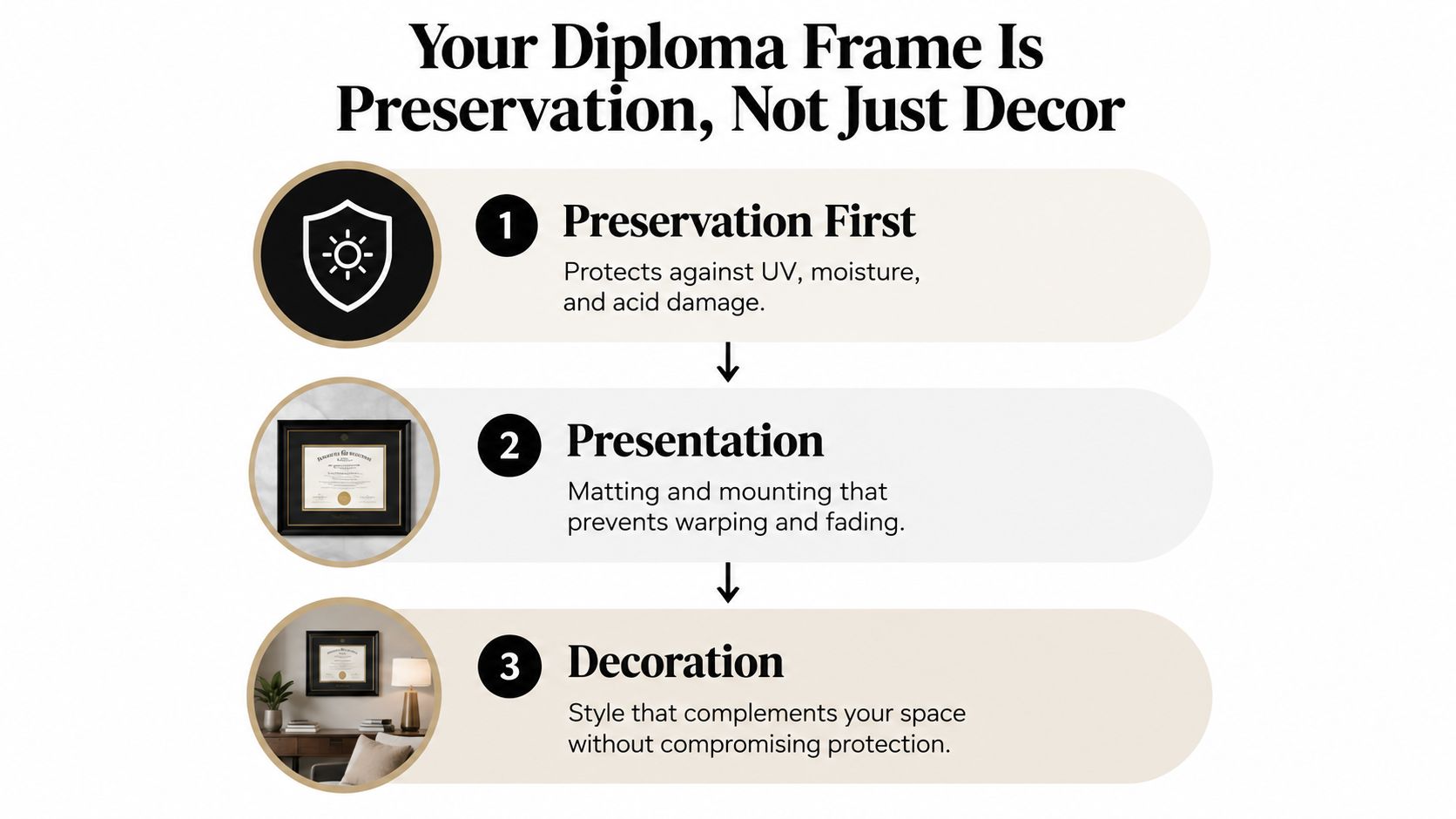
A decorative frame can make a diploma look finished. A preservation-grade frame also helps protect its paper, ink, signatures, and seals from light and acidic materials. The right purchase starts with conservation specifications, then moves to size, layout, installation, and style.
Why Your Diploma Frame Is a Preservation Decision, Not Just Decoration
Standing in a frame shop with a diploma in hand can make a simple purchase feel surprisingly complicated. One frame has a glossy black moulding, another has a school medallion, and a third includes a place for a tassel or photograph. Online, product pages add even more variables. The natural temptation is to choose the frame that looks best in a room.
That choice matters, but it shouldn't come first. A diploma is an official academic credential, a record of personal achievement, and often a family keepsake. It may eventually hang in a first office, a home study, or a family room. If the frame exposes it to damaging light or places it against unstable materials, the document can age even when the outside still looks attractive.
Conservation-quality framing typically combines acid-free and lignin-free mats, UV-filtering glazing, and reversible mounting to slow yellowing, brittleness, and light damage. UV-protective glazing can block up to 97% to 99% of harmful rays, while museum acrylic paired with archival materials can support 80-plus years of display. By contrast, standard craft mats may last under 10 years, according to the preservation guidance from DiplomaFrame.com.
Start with the layers that touch the diploma
The glazing protects the front from light. The mat creates separation around the document and helps prevent direct contact with the glass. The backing supports the reverse. Each layer has a preservation role, so a frame shouldn't be judged only by its moulding or school branding.
My practical order of priority is straightforward:
- Specify UV protection first. This is especially important if the diploma will be displayed in a bright room.
- Confirm acid-free, lignin-free materials. Commodity paper products can create acidic byproducts as they age.
- Choose reversible mounting. The diploma should be held securely without permanent adhesive or unnecessary alteration.
- Select the style afterward. Color, wood finish, seal, engraving, and tassel presentation should complement the preservation package.
A frame can be visually understated and still protect the document exceptionally well. Conversely, an ornate frame can be a poor choice if it uses ordinary glass and acidic matboard.
Practical rule: Spend first on the components that protect the diploma, not on decorative details that only change its appearance.
Once the archival specification is right, you can coordinate the finished piece with other artwork in the room. For example, browsing Slone Brothers Furniture art pieces can help you compare framing scale, wood tones, and wall composition without treating the diploma as an isolated object.
Diploma Frame Types, Materials, and What Actually Protects Your Document
A diploma frame is a small preservation system. The moulding holds the package together, but the glazing, mat, backing, and mounting method determine how the document experiences its environment.
Standard glass is familiar and often economical, but it doesn't automatically provide meaningful protection from ultraviolet exposure. UV-filtering glass reduces the damaging radiation reaching the diploma. Museum acrylic can be useful when shipping risk, weight, or larger dimensions make glass less practical. The correct choice depends on the display location and the supplier's documented specification, not just on whether the product description says “premium.”
The matboard deserves equal scrutiny. A decorative mat made from ordinary wood-pulp material can age poorly because lignin and related compounds may contribute to acidic deterioration. Cotton rag and chemically purified lignin-free matboard are more suitable for long-term document display. The backing also matters because it sits behind the diploma and can transfer damaging compounds over time.
Independent conservation guidance cited by Jerry's Artarama's diploma frame reference recommends UV-opaque acrylic glazing, 100% cotton rag or chemically purified lignin-free matboard, pH-neutral or slightly alkaline board at pH 8.5, and a minimum 4-ply mat. These materials help reduce contact damage and slow discoloration. They also protect the visual features people most want to retain, including ink, signatures, seals, and the paper's original tone.
Compare the package, not the frame alone
| Component | Budget Option | Preservation-Grade Option | Impact on Diploma Longevity |
|---|---|---|---|
| Glazing | Standard glass | UV-filtering glass or museum acrylic | Reduces light exposure that contributes to fading and yellowing |
| Matboard | Commodity paper or wood-pulp mat | Acid-free, lignin-free, or cotton rag matboard | Limits acidic transfer and contact-related deterioration |
| Backing | Ordinary board | Acid-free, inert, or archival backing | Protects the reverse of the diploma from unstable materials |
| Mounting | Permanent adhesive | Reversible mounting | Makes future inspection or removal less damaging |
| Mat thickness | Thin decorative mat | Minimum 4-ply archival mat | Creates better separation and reduces contact pressure |
A frame with UV glazing but ordinary backing is incomplete. The same is true of a cotton rag mat behind standard glass when the diploma hangs in bright daylight. Buyers should evaluate the entire material package.
Choose the layout around the document
A single-opening frame keeps attention on one diploma and usually creates the cleanest presentation. A double-opening frame can suit couples, two degrees, or a diploma paired with another credential, but the combined layout requires careful measurement and enough wall space. Tassel-and-seal frames add ceremony memorabilia, though they're less visually restrained than a simple document frame.
For product research, the Gradshop guide to choosing the perfect wood diploma frame is useful for comparing wood style and display considerations. Just remember that a good-looking moulding doesn't prove that the internal materials are archival. Look for explicit language about UV protection, acid-free matboard, lignin-free construction, backing, and mounting.
The best preservation-grade diploma frames make the material specifications easy to verify. If a product page emphasizes finish and school branding but says little about glazing or paper-contact materials, ask questions before ordering.
How to Measure Your Diploma and Choose the Right Frame Size
The most expensive framing mistake is often not choosing the wrong color. It's ordering the wrong size.
There is no single national standard for diploma dimensions in the United States, so you should measure the school-issued document rather than assume a universal format. Common reference sizes include 8.5 by 11 inches for high school and many bachelor's degrees, 11 by 14 inches for doctoral degrees, and 15.75 by 22 inches for MD diplomas, as documented in this diploma frame sizing guide.
Measure the paper before browsing
Place the diploma on a clean, flat surface. Measure the document from edge to edge, recording the width and height separately. Don't measure the diploma cover, decorative border, or mailing tube. If the document has an unusual shape, oversized seal, or extended ceremonial design, record the full paper dimensions and ask whether a custom opening is needed.
Check orientation at the same time. A document that is wider than it is tall needs a horizontal arrangement. A document that is taller than it is wide needs a portrait arrangement. Some school-specific frames are designed for one orientation, while generic certificate frames may allow more flexibility.
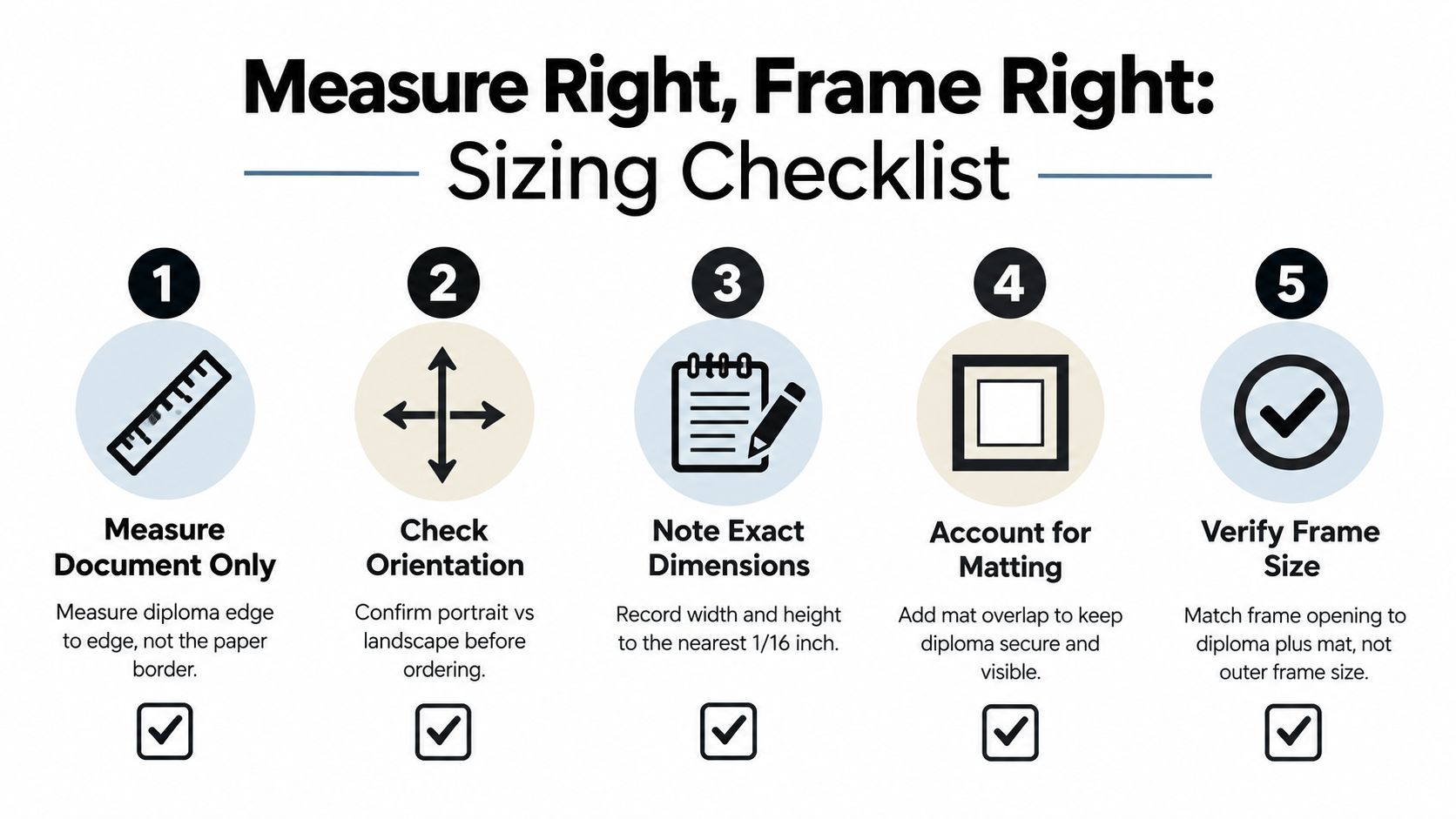
Matting changes the footprint dramatically. An 8.5 by 11 inch diploma with a 3-inch mat border measures about 14.5 by 17 inches overall, while an 11 by 14 inch diploma with the same mat becomes about 17 by 20 inches overall, according to Custom Picture Frames' diploma frame measurements. Those outer dimensions matter when you're planning a wall arrangement or checking whether a frame will fit above a desk.
Check the opening, not just the advertised size
Product listings may describe the document size, the mat opening, or the outside frame dimensions. Those measurements aren't interchangeable. A frame marketed for an 8.5 by 11 inch diploma might have an opening designed to overlap the document edges, while a separate listing may use the same phrase to describe the visible opening.
Before ordering, verify:
- Document dimensions: Measure the actual diploma, not its cover.
- Orientation: Confirm portrait or vertical format.
- Opening dimensions: Check what part of the paper the mat will cover.
- Outer dimensions: Reserve enough wall space for the completed frame.
- Layout: Confirm whether a tassel holder, seal, photograph, or second document changes the size.
- Mounting area: Make sure the available wall can support the finished frame.
A useful related reference is Gradshop's 10 by 13 picture frame guide, particularly when comparing nearby certificate and photo-frame formats. It shouldn't replace measuring the diploma itself, but it can help clarify how listed frame dimensions relate to common document presentations.
For a visual walkthrough of the measuring process, use the guide below before placing an order.
If the diploma has already been mounted, don't force it into a smaller opening. Remove it only when the mounting method is understood, and contact the framer if the document appears attached with permanent adhesive. A correct frame should secure the diploma without trimming, folding, or pressing it into place.
Customization, Display Options, and Matching Your Frame to Your Space
A preservation-grade frame doesn't have to look clinical. The most successful graduation diploma frames balance archival materials with a design that feels appropriate for the graduate's next environment.
A high-school graduate may prefer school colors, a tassel compartment, and room for a graduation photograph. A college graduate may want an understated wood frame for a first apartment or office. A faculty member may need a restrained presentation for several credentials, professional certificates, or academic hoods. The right layout depends on what the frame needs to preserve and how the recipient will use the space.
Build the display around the diploma
School branding can be meaningful when it's licensed and accurately reproduced. Medallions, embossed seals, engraved nameplates, and graduation years create a formal presentation, but they can also make the frame visually dominant. If the diploma itself has elaborate typography or a large seal, a quieter mat and moulding may provide better balance.
Mixed-media options create a different trade-off. A tassel holder, honor cord compartment, photograph opening, or seal display preserves more of the commencement experience, but every added element increases the visual complexity and may increase the outer dimensions. Keep the diploma as the focal point rather than allowing accessories to crowd the document.

Honor cords deserve careful identification before they become part of a display. Their meanings aren't universal, although common associations include gold for high academic honors, blue for education or related fields, green for science or environmental studies, red for service or specific disciplines, and purple for law or theology, according to this guide to graduation cord colors. Don't assign a meaning based only on color if the school provides an official explanation.
Some universities use cords for specific organizations or achievements. Examples include burgundy and gold for Alpha Sigma Lambda Honor recipients, double gold for the Arnold Fletcher Award, purple and gold for Delta Mu Delta, violet-jade-gold for Kappa Delta Pi, red-white-blue for military service, and blue-gold for the Order of the Sword and Shield, as listed by Thomas Edison State University.
Let the room guide the finish
A dark wood or black frame can suit a formal office. A lighter finish may work better in a dorm room or first apartment with pale furniture. Metallic trim can echo hardware already present in the room, but too many competing finishes can make a display feel busy.
Wall placement should also influence the design. A single diploma above a desk creates a clear focal point. Several degrees may look more intentional when their outer edges align, even if their document sizes differ. Leave enough space for the frame's actual outside dimensions, not just the diploma opening.
Mounting hardware is part of the design decision. Use hardware suited to the wall type and the frame's weight, and keep the frame level so pressure doesn't shift toward one corner. A well-designed display protects the document while making the accomplishment feel at home in the space.
Installation, Display Placement, and Long-Term Care for Framed Diplomas
A diploma can be protected by excellent materials and still deteriorate after poor installation. Direct sunlight, changing humidity, and unstable mounting expose the document to risks that premium glazing and matboard can only reduce.
Choose an interior wall away from windows when possible. UV-filtering glazing helps, but it does not make years of strong sun exposure safe. Keep the frame away from bathrooms, kitchens, heating vents, fireplaces, and spots where temperature or moisture changes quickly. A stable room environment protects the paper more effectively than relying on glazing alone.
Install for stability
Select wall anchors rated for the frame's weight and the wall construction. Attach the hanging wire or hardware according to the frame design, then check that the frame sits flush instead of leaning forward. A level frame is easier to inspect, and it reduces the chance of shifting toward one corner.
For several framed credentials, plan the arrangement before drilling. Mark each piece's outside dimensions with removable tape, then check the sightlines from the desk, doorway, and seating area. Measure the actual frame footprint, not only the diploma opening. Follow this step-by-step picture hanging guide for a more detailed installation reference.
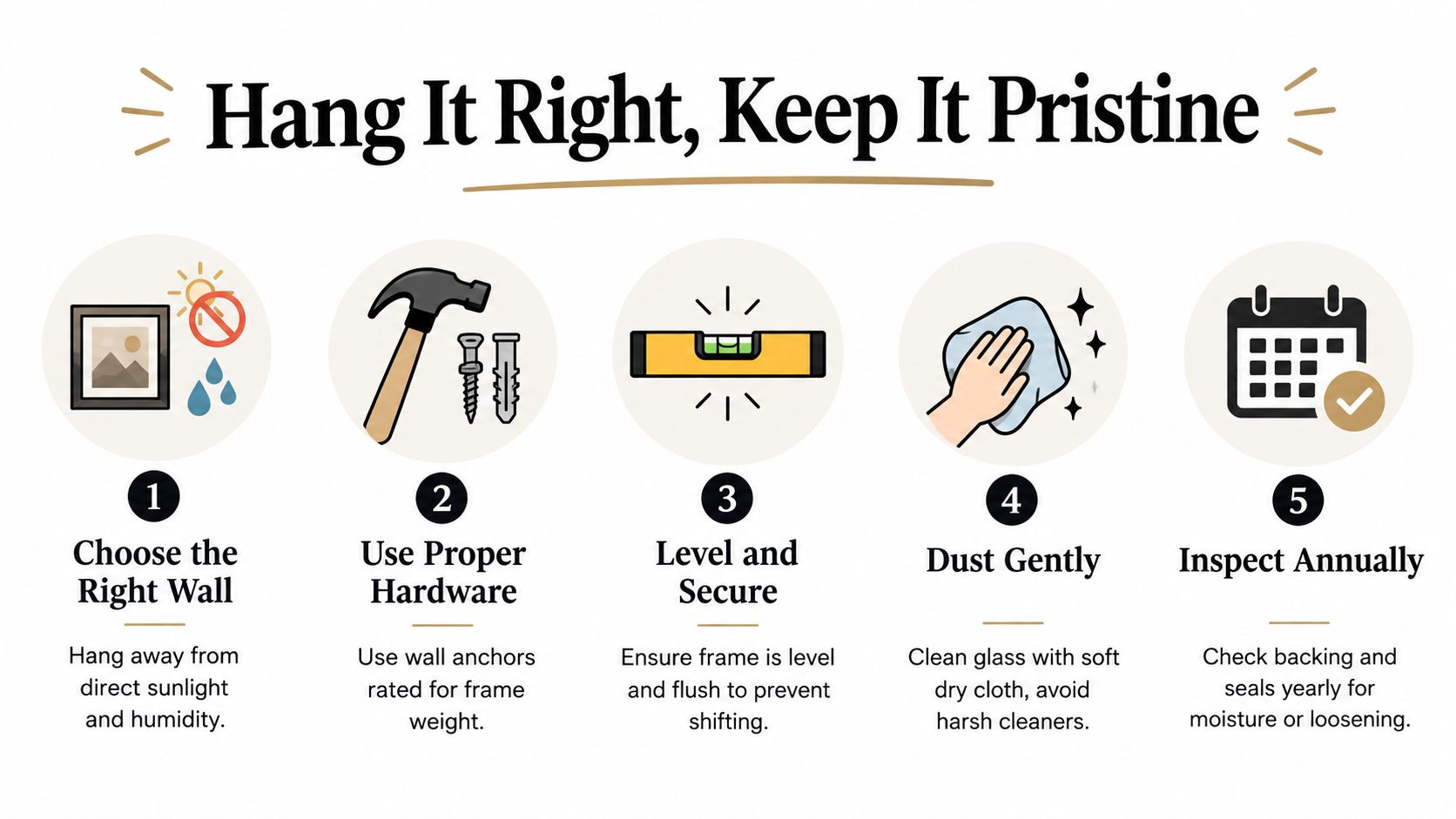
Clean the exterior with a soft, dry cloth. Follow the glazing manufacturer's instructions before using any cleaner, and never spray liquid directly onto the frame. Moisture can reach the mat, backing, or frame joints. Abrasive products may scratch the glazing or mark the finish.
Inspect the frame without disturbing the diploma
Check periodically for condensation, staining, mat discoloration, loose backing, or gaps in the frame. These signs can indicate moisture intrusion or material deterioration. If you notice a problem, move the frame away from the wall and have a qualified framer assess it. Avoid opening the package casually. Handling the diploma unnecessarily increases exposure to dirt, bending, and accidental creasing.
Inspect the frame from the outside first. The document should remain supported and undisturbed during routine checks.
For broader guidance, Gradshop explains methods for preserving certificates and master's diploma frames. During a move, wrap the frame to prevent scratches, support it so the glazing carries no pressure, and keep it upright when practical. Do not place heavy boxes on top of it.
Buying Framed Diplomas as Gifts and Ordering in Bulk for Schools
Gift buyers usually know the graduate, but they may not know the diploma dimensions. That makes a frame a thoughtful purchase with one important logistical risk: the recipient may receive a beautiful product that doesn't fit the document.
The safest approach is to confirm the school, degree type, and diploma size discreetly. Ask a family member to check the document once it arrives, or give a framed-diploma gift certificate or presentation note when the dimensions are uncertain. Don't guess based on the school's reputation or the graduate's degree level, because institutions use different formats.
Choose a gift that will age well
Timeless finishes generally make safer gifts than highly fashionable colors. A traditional wood tone, neutral mat, or school-color accent can work in several future spaces. Add a nameplate, graduation year, school seal, tassel holder, or photograph opening only when you know those features match the recipient's taste and the available wall space.
The ceremony itself can guide complementary gifts. A diploma frame pairs naturally with academic stoles, honor cords, tassels, diploma covers, and other regalia accessories. If the graduate has a specialized honor cord or organization stole, preserving those pieces beside the diploma can create a more personal display than choosing decoration unrelated to the ceremony.
The history of diploma framing helps explain why this category has lasting appeal. Graduation Source's diploma history notes that Harvard College did not standardize take-home diplomas until 1813, and that diplomas varied in shape and size before the 1800s. Established frame specialists also report more than 30 years of continuous handcrafting in the category, evidence that diploma frames have developed into a long-running market for academic memorabilia and document preservation.
Bulk ordering requires consistency
Schools and departments should evaluate more than the per-unit price. Ask suppliers about:
- Document compatibility: Confirm the opening and orientation for the diploma issued by the institution.
- Material consistency: Require the same glazing, matboard, backing, and mounting specifications across the order.
- Brand presentation: Decide whether the school seal, colors, nameplate, or institutional mark should appear on every frame.
- Delivery coordination: Align ordering and delivery with diploma distribution and commencement schedules.
- Sample approval: Review a physical or detailed sample before committing to a larger production run.
- Replacement support: Establish how damaged or incorrectly sized units will be handled.
A single gift purchase rewards personalization and careful sizing. An institutional order rewards repeatability, clear specifications, and predictable fulfillment. In both cases, the frame should protect the credential first and represent the institution or graduate second.
Your Graduate Diploma Frame Decision Checklist
A diploma can look perfectly framed and still age badly if the order is wrong. Confirm the document and preservation package first, then make presentation choices around those requirements.
Use this checklist before ordering
- Photograph the diploma for verification: Take a straight-on image beside a ruler, including the full edges and any seals or raised elements. Keep the file with your order details so sizing questions can be resolved before production.
- Record the document size and format: Measure edge to edge, and note whether the certificate is portrait or horizontal.
- Confirm the opening and layout: Check that the listed opening provides secure mat overlap, then calculate the finished dimensions for any tassel, seal, photograph, or second-document compartment.
- Set the preservation specification: Request 99% UV protection as the practical benchmark for the glazing. Confirm acid-free, lignin-free, cotton rag, or otherwise inert matboard and backing, along with a reversible mounting method that avoids permanent adhesive.
- Match glazing to the setting: Choose UV-filtering glass or museum acrylic when the room, handling, or shipping conditions justify the added cost. Weigh optical clarity, weight, breakage risk, and budget rather than selecting glazing by label alone.
- Plan the complete installation: Select a wall location away from direct sunlight, damp areas, vents, and unstable temperatures. Use suitable hardware, keep the frame level, and account for its weight before hanging.
- Review the order and future handling: Match moulding, mat color, school branding, engraving, and accessories to the recipient's space. Check the return or replacement terms, retain the measurements and product specifications, and wrap the frame to prevent pressure on the glazing during a move.
A simple frame can preserve a diploma well. The costly mistakes are usually hidden in acidic paper-contact materials, inadequate ultraviolet filtering, or mounting that cannot be reversed without altering the document.
The same standard applies to a high-school diploma, bachelor's degree, master's credential, doctoral document, or faculty certificate. Ceremony items, including caps and gowns, graduation stoles, honor cords, tassel holders, and master's or doctoral regalia, can be coordinated with the display without allowing accessories to dictate the frame's protective construction.
Use this list to compare specifications rather than product photographs. Once the dimensions, materials, mounting, and installation plan are confirmed, select the finish and display arrangement that fit the graduate's home or professional space.
Gradshop offers diploma frames and graduation essentials for individual graduates, families, schools, and departments, including diploma covers, tassel holders, stoles, honor cords, and master's and doctoral regalia. Visit Gradshop to compare frame and ceremony options, verify sizing details, and order the pieces needed to preserve and celebrate the achievement.