

Don't start your order with a color chart. That's the most popular advice for custom tassels graduation shopping, and it's the advice that causes the most expensive mistakes. A chart can tell you a common color for a degree or major, but it can't tell you what your school will let you wear across the stage.
A custom tassel is a policy-compliance product first and a keepsake second. The costly failure isn't a shade that's slightly off in photos. It's a tassel that looks right, arrives on time, and then gets refused because the color, charm, side, or extra decoration breaks ceremony rules. I would check the full set, tassel, cap, hood, cord, and stole, against written school policy before anyone talks about thread or production dates.
Tassel Colors and Placement by Degree Level
Start with the lookup below, then treat every row as a starting point rather than a final answer. The conventions are real, but institutions override them often enough that you can't order from a generic table alone.
| Degree level | Typical tassel color | Placement during ceremony |
|---|---|---|
| High school | Set by the school (for example black-and-gold) | Right side until the graduation declaration, then per school instructions |
| Bachelor's | University colors or field-of-study color | Right side before conferral, moved left when degrees are announced |
| Master's | Black (commonly), institution may override | Left side for the entire ceremony |
| Doctoral | Gold bullion (commonly) | Left side for the entire ceremony |
High school and bachelor's rows
High school colors are set by the school, not by a national discipline system. One school's black-and-gold combination means nothing at the next school, and the side change follows that school's own announcement point.
For bachelor's candidates, the tassel commonly shows university colors or the field of study. The familiar movement is right side before conferral, then left when degrees are announced, which is why a bachelor's custom order has to hang cleanly and move easily over the board.
Master's and doctoral rows
The graduate rows work differently. According to the University of Oklahoma academic traditions guide, bachelor's tassel colors represent the field of knowledge, master's candidates generally wear black tassels, and doctoral candidates commonly wear gold bullion tassels. That same tradition places discipline identity on the hood, where the velvet border identifies the academic discipline and the lining identifies the institution.
That distinction matters for ordering. If you put an undergraduate field color on a master's cap, you've duplicated a signal that usually belongs on the hood velvet. If you add gold to a master's set because it looks formal, you've borrowed a doctoral convention your institution may not allow.
Placement is the other graduate-level trap. Master's and doctoral tassels stay on the left for the whole ceremony. They don't start on the right and move at conferral the way a bachelor's tassel does. Custom orders get this wrong when families copy high school instructions onto a graduate set, so confirm the side in writing before the loop length and hang are finalized.
There's useful background in our guide to colors of graduation regalia and shades of knowledge, especially if you're sorting discipline colors from institution colors. Use it to ask better questions, not to skip the approval step.
The table gets you to the right question. Your school's own commencement page settles the answer, and its rules override any chart, including this one.
High School Rules for Caps, Decorations and Stoles
High school is where the policy-first approach matters most, because there's no discipline system to fall back on. Your school or district writes the rules, and they can be very specific about color, decoration, and what counts as approved regalia.
Take one worked example. Chapel Hill High School's published ceremony requirements specify a black cap and gown, a black-and-gold tassel, and a gold stole. Students keep the tassel on the right side until the declaration of graduation is announced, so even the timing of the side change is prescribed.
That same school requires caps to remain free of decoration except for the graduation tassel, unless the district approves an exception based on a religious or cultural right or benefit. Read that carefully if you're planning a decorated cap. The tassel is allowed because it's required regalia. Everything else needs permission in advance.
The one-tassel limit
Quantity limits catch people out too. Under Auburn University's commencement policies, only one tassel may be worn, and unapproved regalia or accessories may be confiscated and returned after the ceremony. That's a different institution and a different level, but the mechanism is the same one high schools use. An extra decorative tassel or charm bought separately doesn't become allowed just because you own it.
What to ask your school
Send these questions before you order, and get answers in writing:
- Written dress code: Can you send the current graduation attire rules, not last year's version?
- Cap decoration: Are decorated caps, extra tassels, charms, or year drops permitted at all?
- Stoles and cords: Which stoles and cords need approval, and who grants it?
- Approved colors: Which exact cap, gown, tassel, and stole color combinations are on the approved list?
- Tassel side: At what point in the ceremony does the tassel move, and who announces it?
The trade-off for families is simple. A themed charm can look great in photos, but it can also be refused at the ceremony entrance, when there's no time to fix it. A separate keepsake version for portraits solves that problem without risking the walk.
If the school's replies are vague, ask who has final authority on ceremony day and whether exceptions are granted in advance or at check-in. Those two answers tell you how much customization is safe.
Master's and Doctoral Tassels That Match the Hood
For graduate orders, design the hood first and the tassel second. The hood usually carries the discipline signal, and a tassel that repeats it creates a set that looks coordinated but misstates the degree.

Master's candidates commonly wear black tassels, while field color sits in the hood's velvet trim and institution colors sit in the lining. Doctoral regalia can differ in construction as well as color, so confirm the details with your institution rather than treating a gold tassel as proof of doctoral status. The UTSA commencement regalia guidance reflects the graduate split: discipline identity is carried through the hood, not through a customized cap tassel.
A matching set and a conflicting set
A master's graduate in education orders a black tassel, a hood with the correct discipline velvet, and a lining in the institution's colors. The set matches because each piece does its own job. The cap stays neutral, and the hood carries the academic information.
Change one piece. The same graduate orders a field-color tassel copied from a bachelor's chart, plus a gold charm because it looks like honors. The set now conflicts. The tassel repeats the hood's signal, and the gold reads as doctoral or as an honor distinction she may not have been awarded. It looks plausible in a product photo and wrong in the processional.
Six-step compatibility check
- Verify the degree: Confirm the exact degree abbreviation and the institution's written policy.
- Locate the field color: Identify whether the hood velvet or edging already carries your discipline color.
- Reserve gold: Use gold for doctoral orders only when the institution confirms that convention.
- Confirm fit dimensions: Check cap button size and loop length before production.
- Inspect the batch: Check symmetry, thread coverage, knot security, and color consistency across every unit.
- Pack separately: Keep tassels protected from compression so the hanging strands don't kink.
A gold tassel and a gold honor cord are not interchangeable. They signal different things, they sit in different places, and swapping one for the other changes what the regalia claims about the graduate.
If you want the pieces matched from the start, the Classic Masters Academic Cap, Gown & Hood Package gives you a package to build from. Check the hood's velvet and lining against your institution's colors before you finalize anything. Our breakdown of master's degree hood colors helps you separate discipline trim from institutional lining.
Ordering rule: If the hood already states your discipline, keep the tassel plain unless your institution tells you otherwise.
Check the Full Custom Set Against School Policy
A custom tassel can look right and still fail the school's ceremony rules. The usual cause is a generic color chart that treats one color as one job, while the school assigns it a different one. Two institutions can both be following tradition and still require completely different sets from their graduates.
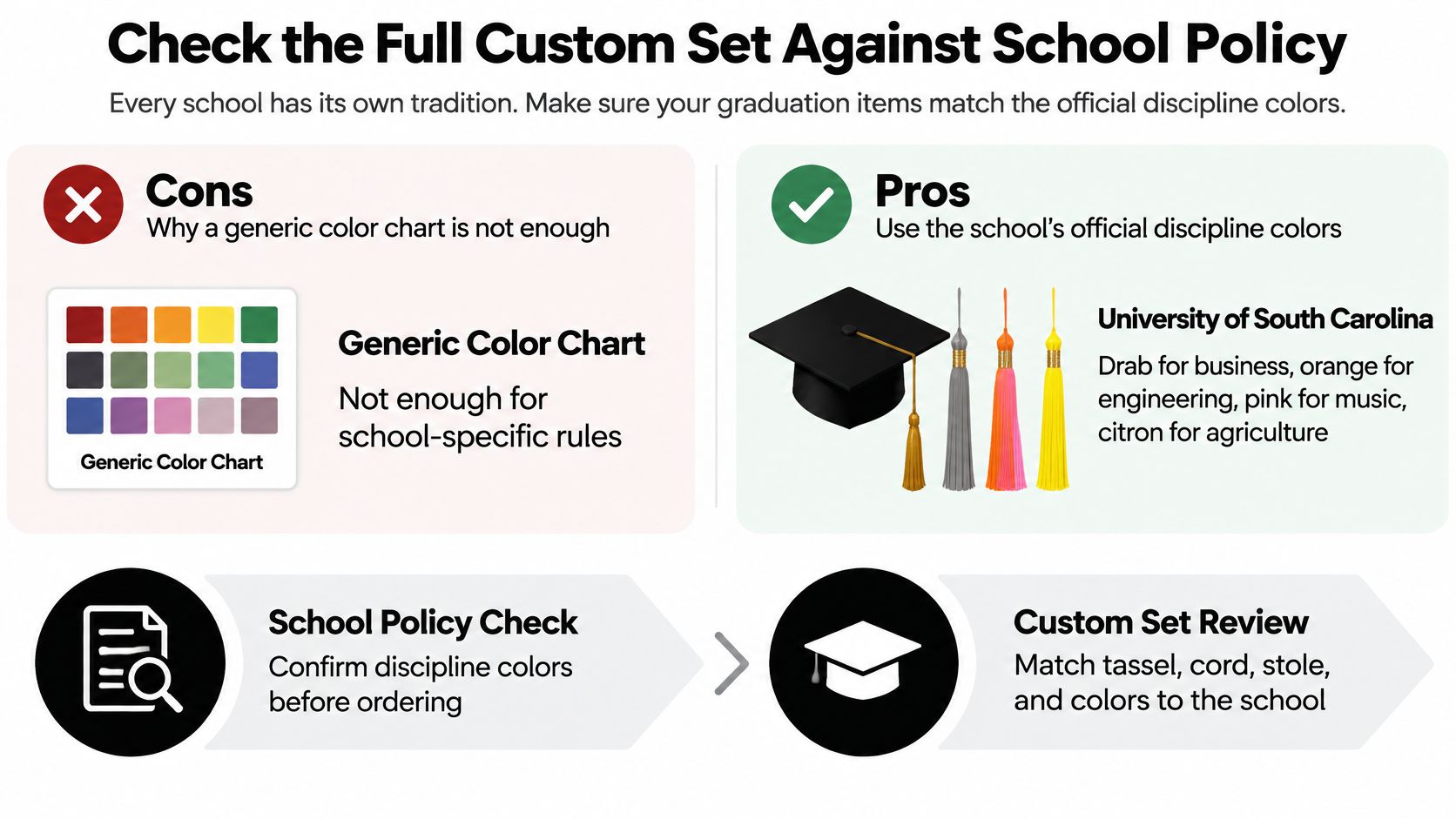
The University of South Carolina academic regalia guidance assigns tassel colors by discipline, including drab for business, orange for engineering, pink for music, and citron for social work, and it uses gold braided cords for Latin honors with institution-specific GPA thresholds. The tassel states the field, the cord states the honor, and neither one substitutes for the other.
Elsewhere, the logic flips. Some universities use institutional colors for bachelor's tassels and save discipline colors for graduate degrees. Others issue a distinct cord for a specific group, such as military-affiliated graduates, while the tassel stays standard. Copying a color from another school's photos is unreliable. You're copying the answer to a question your school may not be asking.
Run the six-point policy check in order
Do these in sequence, because each answer narrows the next one:
- Ceremony level: High school, bachelor's, master's, or doctoral. This sets placement and whether a hood is involved.
- School policy: The written commencement rules for your ceremony, this year.
- Degree or major: The field that determines discipline color, where your school uses one.
- Honor society membership: Which cords or stoles you've been awarded and may wear.
- Military status: Whether your school issues or approves a specific cord or stole for it.
- Item type: Whether you're ordering a tassel, cord, stole, or hood, since each carries a different signal.
After that list, decide between school colors and a standard option, then confirm whether charms, year drops, or other decoration are allowed. Get the school's answers in writing before the order moves to production. The handoff and proofing workflow later in this guide shows where that approval file gets locked to the job.
Sixteen tassel colors and online stole design only help after the approved list is in hand. Gradshop offers high school graduation tassels in 16 colors, plus custom graduation stoles that can be designed online, and can personalize graduation products for a school's graduation ceremony. The same catalog lists high school caps and gowns in 16 colors, but availability is not approval. Picking from sixteen colors without the school's list gives you fifteen ways to be wrong.
For a master's order, the same check applies to a bundled set such as the Classic Masters Gown & Hood Package. Confirm the hood and tassel details against your school's specification before treating the set as ceremony-ready.
A compliant tassel next to an unapproved stole is still an unapproved set at the door. Check every piece in the order against the same policy answers, not just the tassel.
Materials, Charms and Logo Embroidery Options
Lock color approval first, then work through construction. Each choice below carries a permission check, because a well-made add-on can still be an unapproved one.
Strand type, loop, and hanging length
Choose the strand type first. Bullion or metallic thread belongs where the school specifies gold, most often on doctoral orders, and it needs a sample check for even coverage. Metallic thread that looks uniform on a spool can show gaps around the knot once it hangs, so judge it on a finished sample rather than a thread card. A high school tassel in standard rayon can pass visual inspection and still fail the school's color standard if the dye lot shifts.
Next, set the loop and hanging length against the actual cap button and mortarboard you will use. A loop that is slightly tight pulls the strands off center. A hang that runs too long puts the tassel in the graduate's face during photos. Measure on the cap, not flat on a table.
Charms, year drops, and embroidery
Add a charm or year drop only if the school allows extra decoration. Some schools treat the tassel as the sole permitted cap decoration, and others limit graduates to a single tassel, so an unapproved charm can cost you the whole accessory at check-in. Our guide to charms for graduation tassels covers the styles available. Which one a graduate may wear is still a policy question, and for a doctoral order the answer can differ from the high school rule.
Logo work needs the same discipline. Place embroidery only when the school supplies approved artwork, and request a stitched proof with a thread color reference rather than approving a screen image. If you are comparing print, embroidery, and other branding approaches for group apparel, this overview of decoration options for branded uniforms is a useful way to weigh durability against detail before you commit.
A bundled master's set shows how these choices combine. The Master's Degree Academic Cap, Gown, Tassel and Hood Packs put the gown, cap, tassel, and hood in one order and save money versus ordering the pieces separately. The tassel is included, and any charm or logo work is added only when the school's policy and your written specification allow it.
For themed or commemorative designs, keep the charm off the cap unless it is approved and offer it as a separate keepsake instead. Tie every option back to the approved component list so each SKU in the order carries the same approved parts. No improvised substitutions at packing.
Order, Proof and Schedule a Custom Tassel Set
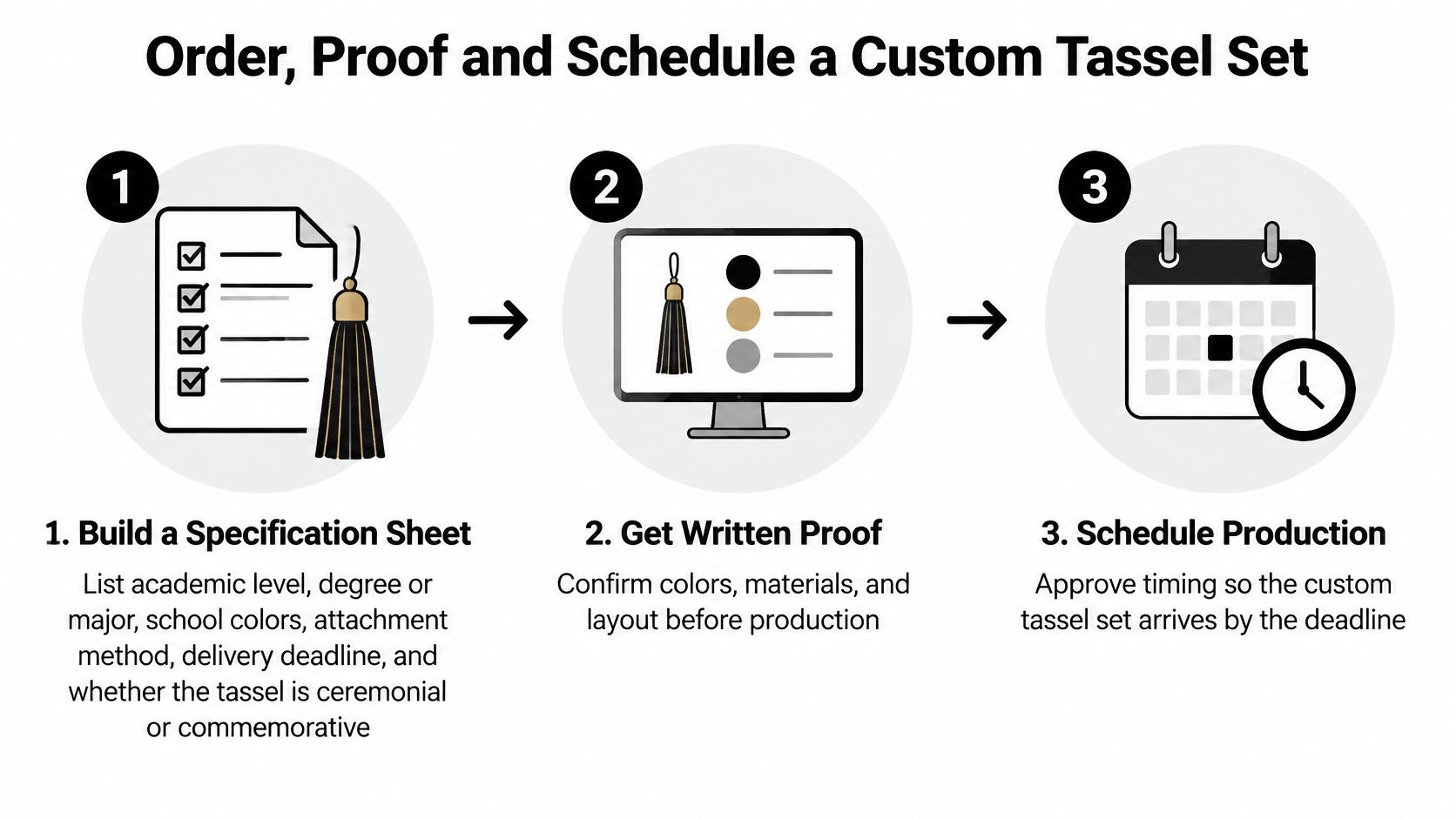
A custom tassel set fails expensively when the build is perfect and the specification is wrong. The strands match, the proof looks clean, and the school refuses the set at check-in because one line missed a ceremony rule. The gates below are built to catch that while the fix is still a paperwork change, not a remade cohort.
The gate sequence
Specification sheet. List academic level, degree or major, school colors, attachment method, delivery deadline, and whether each tassel is ceremonial or commemorative. That last field matters. A commemorative tassel can carry decoration a ceremonial one cannot, and mixing the two in one order is how unapproved pieces reach the check-in table. Split high school, bachelor's, master's and doctoral quantities into distinct lines so a bachelor's field color never lands in a master's set.
Color approval. Use color references, with Pantone numbers where the school has them, and get a named person to approve them. The University of Washington Bothell tassel colors guidance shows why schools may override common conventions with school-specific colors or tricolor designs. Your approval document is what protects you when two departments remember the school color differently.
Sample proof. Check loop length, top button fit, hanging length, and metallic or bullion thread on a finished unit. A passing sample has a loop that seats on the button without pulling, strands that hang to the same length, and a color that matches the approved swatch in daylight rather than under warehouse lighting. Test it on the intended mortarboard, not a similar board and not flat on a table. Button diameter and board size change how the tassel hangs and whether it stays on the correct side when a graduate turns her head.
Production run. Confirm final quantity by level and degree before the run starts, and ask for production and dispatch dates in writing. A color change after proofing, without a new proof, can send the wrong tassel to an entire cohort because every downstream document still describes the old specification. Any change to color, charm, loop, or quantity restarts the proof for that line. I would rather re-proof one SKU than explain a mismatched processional.
Packing reconciliation. Match the approved proof against the packing list line by line. If counts by level and degree do not match the purchase order, stop the shipment. Finding a short cohort at distribution is worse than finding it at packing.
Scheduling backward from the ceremony
Work backward from the ceremony date and fix a slot for each gate: color approval, sample proof, production run, and packing reconciliation. Plan for approval to be the step that slips. The person who signs off on colors is often tied up with the ceremony itself, and a production slot can usually absorb a late approval better than a skipped proof. Build your buffer around approval, not around shipping. If color sign-off takes an extra week, production can often still hold. If you skip the proof to recover that week, you have traded a schedule problem for a compliance problem.
The guide to tips for graduation regalia ordering covers the wider ordering calendar for caps, gowns, and hoods, worth aligning with your tassel schedule so the whole set arrives together.
Comparing bulk quotes fairly
Compare quotes only on identical inputs. Match academic level, approved color and backup color, thread or bullion, quantity by degree, charm, loop length, and delivery date. The lower number usually reflects a changed input: standard thread instead of bullion, a dropped backup color, or fewer pieces in the count. Match those inputs before you compare totals.
| Stage | What to lock | Who signs off |
|---|---|---|
| Specification sheet | Levels, degree fields, school colors, quantities | Administrator or purchasing officer |
| Color approval | Color references and backup color | School commencement office |
| Sample proof | Loop, top button fit and hanging length on the mortarboard | Department contact |
| Production run | Final quantity by level and degree | Order contact |
| Packing reconciliation | Packing list matched to the approved proof | Purchasing officer |
Keep the sign-off chain attached to the order from start to finish. When a question comes up on distribution day, the approved proof and the purchase order answer it in seconds, and nobody has to reconstruct a decision from memory.
Gradshop can personalize graduation products for a school's ceremony and offers high school caps and gowns, tassels, stoles, honor cords, hoods, diploma covers, and master's and doctoral regalia. Order single sets or school quantities, and start with your written policy, degree level, and approved colors at Gradshop.