

Does a velvet graduation hat belong to the person earning a doctorate, the dean leading the ceremony, or both? When shopping for a beefeater tam, the name alone won't answer that question. Your ceremony role, the headpiece's construction, and your institution's written requirements matter more than how a retailer labels the hat.
What a Beefeater Tam Is and Why It Confuses Buyers
Beefeater, Tudor bonnet, and doctoral tam overlap in academic vocabulary, but they aren't reliable promises of identical construction. A buyer searching those names may encounter similar-looking hats intended for different wearers. That's why choosing from a photograph without reading the specifications can lead to an unsuitable purchase.
The terminology varies. Yale's guide to graduation fashion describes beefeaters as six- to eight-sided velvet tams, also called Tudor bonnets, primarily worn by Ph.D. holders instead of mortarboards. That broader usage helps explain why an institutional guide and a product listing may describe comparable headwear differently.
This comparison illustrates where the names overlap.
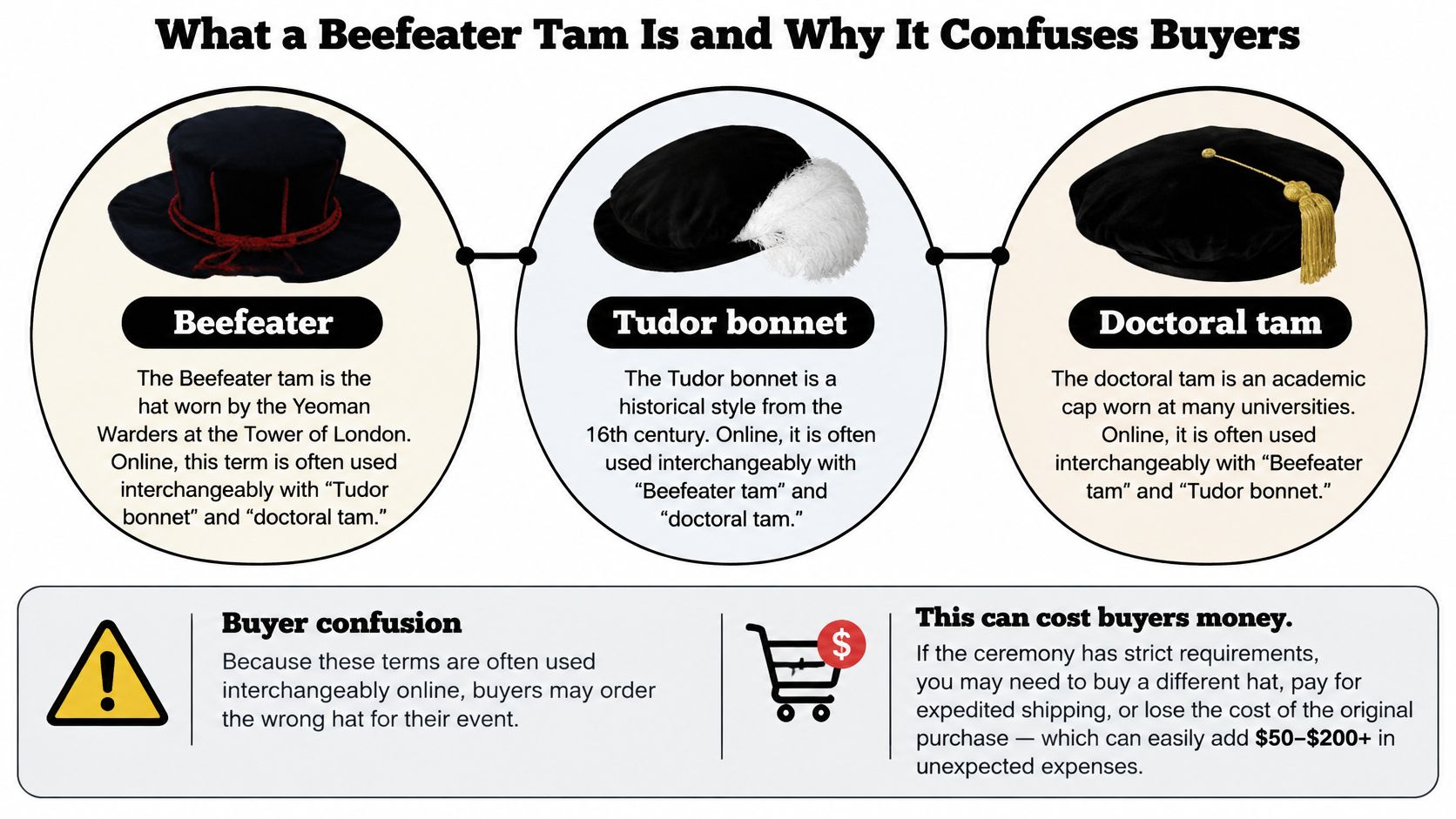
Read the construction, not just the name
For a practical buying distinction, think of a structured beefeater as a formal hat designed to preserve its outline. A soft doctoral tam has a fuller crown that drapes more like a beret. Those descriptions are more useful than assuming every item called a Tudor bonnet has the same shape or intended use.
Don't interpret the beret comparison as permission to style the hat however you like. It describes the softness of the crown, not the correct wearing position.
Buying rule: Match the institution's specification to the actual headpiece, not merely to the words in its title.
Before comparing styles, complete this sentence: I'm attending as a candidate, faculty member, or presiding official, and my ceremony guide requires this headwear. If you can't fill in the final part, pause the purchase. A degree title provides useful context, but it doesn't replace an explicit regalia requirement.
How Academic Headwear Evolved into the Modern Tam
Academic dress began with practical clothing rather than a shopping category. Its origins reach back to European universities founded in the 12th and 13th centuries, where scholars' gowns provided warmth in unheated buildings while reflecting clerical and scholarly status, as outlined in the University of Texas doctoral-regalia guidance.
The historical sequence helps explain why modern regalia combines clothing, ceremony, and academic identity.
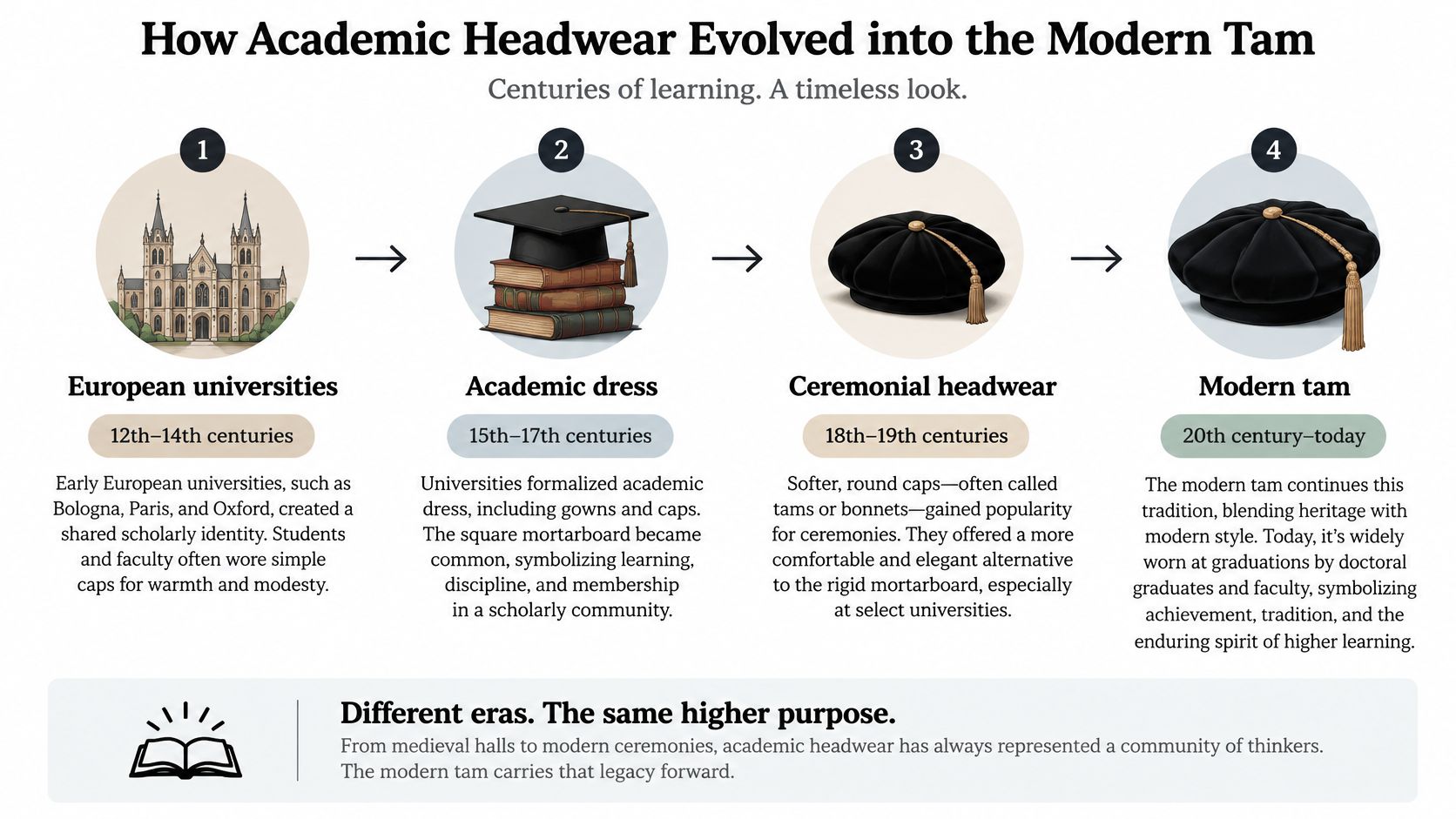
From practical dress to recognizable distinctions
In the United States, the Intercollegiate Code of Academic Costume, adopted in 1895, formalized recognizable differences among bachelor's, master's, and doctoral regalia. Those distinctions included gown construction, sleeve shapes, hoods, and headwear, within the academic-dress history described by the university guidance linked above.
For a longer chronological account, consult our history of academic regalia. The useful lesson for a first-time buyer is that academic garments operate together. A cap isn't an isolated accessory chosen because it looks more elaborate.
The doctoral tam developed as a softer alternative to the rigid mortarboard, commonly using velvet or velvet-like fabric. Its association with advanced academic dress explains why it shouldn't be treated as an optional upgrade to an ordinary student cap.
This video provides another way to approach academic-dress traditions.
- Headwear identifies a category of dress. A soft doctoral cap and a square mortarboard aren't interchangeable merely because both carry tassels.
- Other pieces add distinctions. Stoles, honor cords, and colored hoods can communicate additional institutional or disciplinary information.
- History isn't an ordering specification. Knowing the tradition helps you understand a requirement, but the ceremony's current instructions determine what you should buy.
Beefeater Versus Doctoral Tam and Who Wears Each
Start with who will wear the hat and what they'll do during the ceremony. A graduating candidate and the official presiding over commencement may stand on the same platform, yet need different headwear. Shopping by role makes that distinction easier to manage.
A structured beefeater is generally associated with senior ceremonial officials, including deans, presidents, and commencement leaders. Its reinforced construction and defined velvet headband help preserve the bonnet's shape, whereas a doctoral tam is typically softer and fuller.
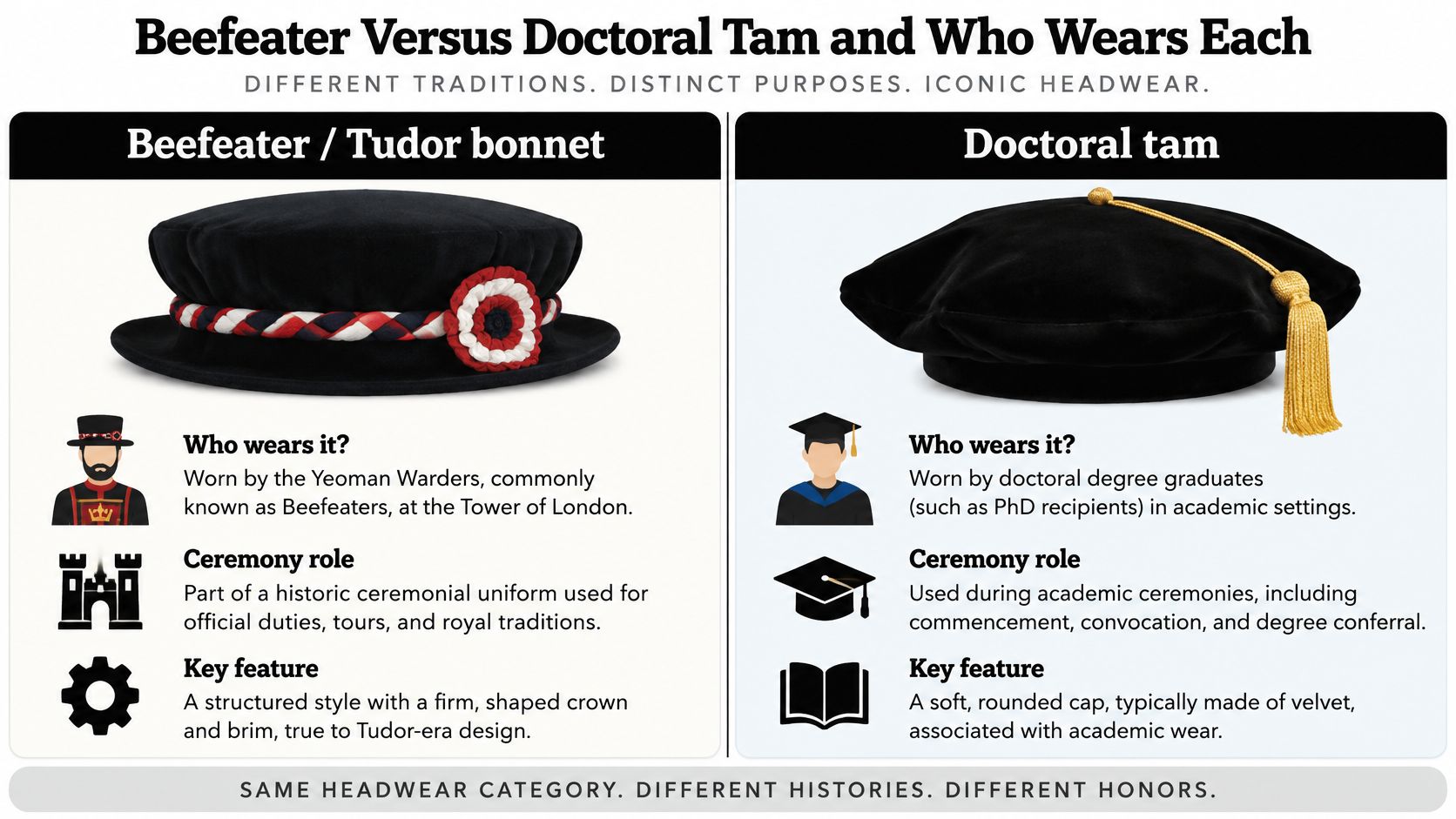
Match the wearer to the requirement
| Wearer or ceremony role | Sensible starting point |
|---|---|
| High-school graduate | A mortarboard, following the school's cap-and-gown instructions |
| Undergraduate candidate | Usually a mortarboard |
| Master's candidate | A mortarboard or institution-specific tam |
| Doctoral candidate | Commonly a six- or eight-sided velvet tam, subject to institutional requirements |
| Faculty member or presiding official | Degree-appropriate faculty regalia or an authorized beefeater |
The doctoral gown-and-tam guidance from Academic Hoods provides context for advanced-degree headwear and the importance of matching institutional specifications. Treat these categories as starting points, not permissions that override your school's policy.
A master's candidate shouldn't assume that completing postgraduate study automatically authorizes a tam. Likewise, a doctoral candidate shouldn't choose a structured official's bonnet solely because it appears more formal.
For readers comparing religious-studies programs, the degree guide from The Bible Seminary is a separate resource for understanding degree pathways. Use a program resource to clarify the credential you're pursuing, then use the awarding institution's ceremony guide to establish its regalia requirements.
Your ceremony role and your academic qualification are related, but they aren't the same ordering instruction.
For departmental purchases, record the wearer's role alongside the requested headpiece. That simple distinction keeps a faculty or platform order separate from candidate regalia and gives the commencement office a clear question to approve before purchasing.
Decoding Color Signals on Tams and Hoods
An education researcher earning a Ph.D. and a candidate earning an Ed.D. may study related subjects without requiring identical hood colors. Degree title, academic discipline, and university identity are separate signals. Choosing everything in the school's colors can therefore produce the wrong combination.
The University of New England's academic-regalia guide distinguishes Ph.D. blue from the light blue associated with an Ed.D. It also supplies the degree-color examples below, which illustrate why the exact credential matters.
Degree Title Color Signals Versus Discipline Color Signals
| Degree or Field | Color Signal |
|---|---|
| Ph.D. | Dark blue |
| Doctor of Education | Light blue |
| Doctor of Science | Gold |
| Doctor of Medicine | Green |
| Doctor of Humanities | White |
| Doctor of Law | Purple |
A Ph.D. in Education may use Ph.D. blue, rather than the light blue associated with an Ed.D. The subject alone doesn't settle the choice.
Separate the parts of the hood
Hood satin and chevron colors can represent the institution, while velvet trim represents the field or degree. Our explanation of doctoral hood colors and their meaning can help you identify which part of the hood you're checking.
- Ph.D. versus Ed.D. Confirm whether the rule follows the degree title rather than the shared education subject.
- DPT versus Ph.D. Don't assume that studying related health topics means both candidates need the same trim. Request the requirement for the exact credential.
- Master's versus doctorate. Don't copy another graduate's complete outfit because they studied in your department.
Velvet doctoral headwear also shouldn't be selected as a color-coordinated substitute for standard high-school attire. Color matching doesn't establish eligibility to wear a particular cap.
Before ordering, write down the degree title, required velvet trim, institutional lining colors, and headwear specification separately. Compare each entry with the granting institution's ceremony guide, rather than trying to infer the whole outfit from a single color chart.
Choosing the Right Sides and Fit for Your Tam
More corners don't automatically mean a higher academic rank. Doctoral tams can have four, six, or eight sides, and the Intercollegiate Registry's history of academic caps records those variations. Northwestern University's four-corner doctoral style is a useful reminder that an eight-sided tam isn't universally required.
Use the required shape as an ordering specification, not a personal preference.
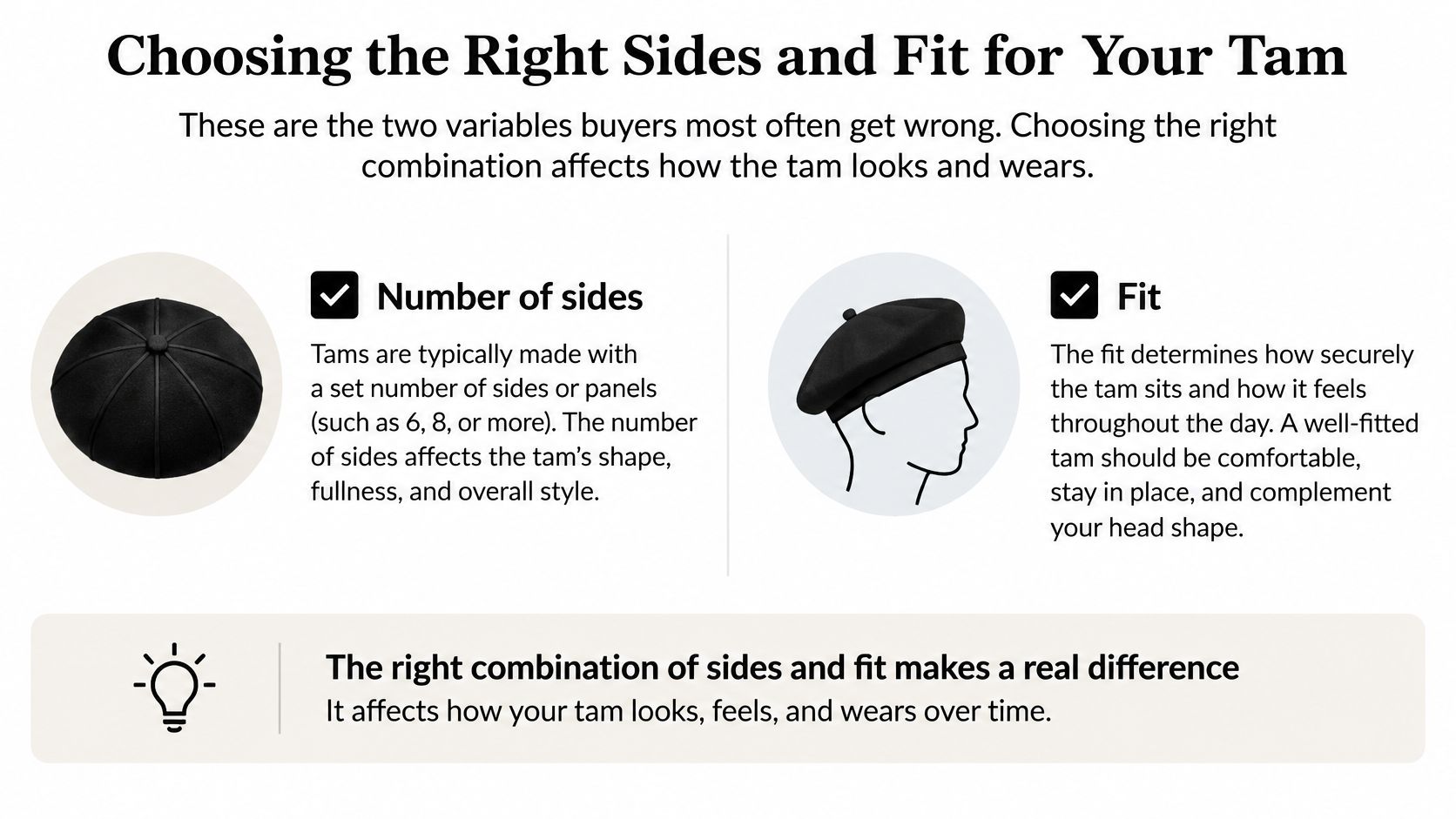
Measure before selecting a size
Wrap a flexible measuring tape around the widest circumference of the head, above the ears. Record the measurement and compare it with the particular headpiece's stated range. Don't assume that a size label or adjustable band makes every hat a universal fit.
Use our graduation cap and gown size chart guide to organize measurements for the complete outfit. Keep the head measurement separate from gown measurements so neither gets substituted for the other.
- Confirm the shape. Copy the required side count directly from the written policy.
- Check the stated range. Compare your measurement with the actual item's specifications.
- Test the position. The cap should feel secure without needing constant adjustment.
- Review the whole set. Confirm that the selected cap belongs with the approved gown and hood.
Check how it sits
The University of Missouri's academic-regalia instructions place the doctoral tam on top of the head or slightly toward the back. A practical fit check is to keep it secure and level, without excessive forehead coverage or backward slipping.
Before ceremony day: Try on the headwear with the rest of your regalia, then walk and turn your head to check stability.
A soft crown doesn't need to be pulled forward like a fashion beret. If it won't stay comfortably in position, revisit the size and the institution's wearing instructions rather than forcing the shape.
Building a Complete Doctoral Look and Your Next Step
A correct doctoral outfit isn't just a collection of attractive graduation accessories. The gown, hood, and headwear need to match the same institutional specification. Stoles and honor cords belong in that check too, especially when a department or student organization supplies them separately.
Start with the approved gown and hood combination, then verify the headwear against it. Don't assume a matching fabric color means that a cap belongs in the set. For high-school and undergraduate buyers, keep the mortarboard-based requirements separate from advanced-degree and faculty orders.
Build an approval record
Create a short written record before placing an order. This is particularly useful when a family member, departmental assistant, or purchasing officer is buying on someone else's behalf.
- Wearer and role. Record the graduate's exact degree title or the official's ceremony position.
- Garment requirements. Note the gown style and the hood's required trim and lining.
- Headwear details. Include the approved style, side count where applicable, measurement, and tassel instructions.
- Additional pieces. Confirm whether stoles or honor cords are authorized, rather than adding them only for appearance.
For doctoral candidates also organizing their final academic work, Thesis Book Project's guide to prepare for your dissertation defense offers a separate planning resource. Keep defense preparation and commencement purchasing on distinct checklists so you can confirm the relevant requirements for each.
Compare the approved specification with the available items
At Gradshop, we offer doctorate products including gowns, tam, gown and hood packages, PhD hoods, tams, and beefeaters. Our 6 Sided Tam has a list price of $39.95, with prices as low as $19.95; our 8 Sided Tam also has a list price of $39.95, with prices as low as $19.95.
For an authorized structured style, review the doctoral academic beefeater specifications. This velvet headpiece has internal reinforcement, a velvet headband for approximately 21–24 inches of head circumference, a gold strand, and a handcrafted gold bullion tassel, according to that product listing. Those details make the construction and fit more informative than the beefeater name alone.
If you're coordinating high-school caps and gowns, stoles, and master's or doctoral purchases together, maintain separate approval lists for each group. Shared ceremony dates don't imply shared headwear rules.
Before checkout, compare your written record with every selected item. Resolve any difference with the commencement office, measure the wearer, and review the ordering timeline against the ceremony date. That gives you a concrete basis for choosing the right beefeater tam or doctoral cap without relying on appearance.
Gradshop offers caps and gowns, stoles, and advanced-degree regalia, including doctoral tams and beefeaters. Visit Gradshop with your school's written requirements and head measurement to select the correct headwear and coordinate it with your ceremony outfit.